
Puck, 1879-11-26 · page 12 of 18
Puck — November 26, 1879 — page 12: what you’re looking at
What you’re looking at
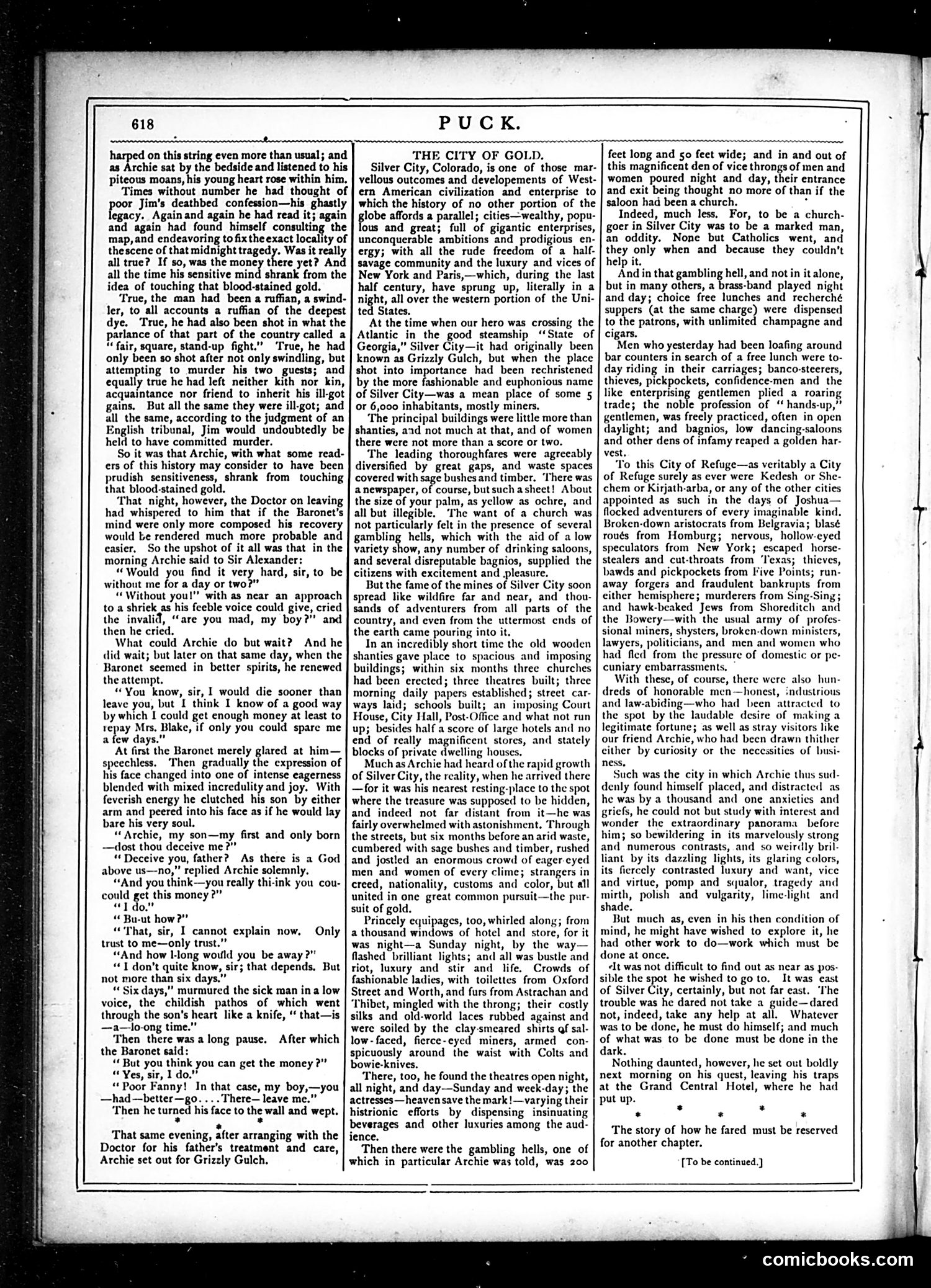
This page from Puck contains no political cartoon, but rather the continuation of a serialized fiction story titled "The City of Gold." The narrative follows a character named Archie who travels to Silver City, Colorado—described as a booming mining town full of saloons, gambling halls, theaters, and other vices. The story satirizes the rapid, chaotic development of Western boomtowns during the gold rush era, contrasting the town's newfound luxury and enterprise with its moral emptiness. References to gambling dens, disreputable establishments, and the crude society reflect period concerns about Western lawlessness and commercialism. The page ends with a "[To be continued]" note, indicating this is mid-narrative. No specific political figures or detailed satire are evident on this particular page.
📄 Transcribed text from this page (OCR, searchable)
Machine-transcribed from the original scan — historical spelling and the odd misread are preserved.
618 PUCK. c ta ed on this string even more than usual; and as Archie sat by the bedside and listened to his piteous moans, his young heart rose within him. Times without number he had thought of pov Jim's deathbed confession—his ghastly legacy. Againand again he had read it; again and again had found himself consulting the map, and endeavoring to fix the exact locality of thescene of that midnight tragedy. Was it really all true? If so, was the mone; there yet? And all the time his sensitive mind shrank from the idea of touching that blood-stained gold. ‘True, the man had been a roffian, a swind- ler, to all accounts a ruffian of the deepest dye, True, he had also been shot in what the parlance of that part of the country called a “ fair, square, stand-up fight.” True, he had only been so shot after not only swindling, but attempting: to murder his two guests; and equally true he had left neither kith nor kin, acquaintance nor friend to inherit his ill-got gains, But all the same they were ill-got; and all the same, according to the judgment of an English tribunal, Jim would undoubtedly be held to have committed murder. So it was that Archie, with what some read- ers of this history may consider to have been prudish sensitiveness, shrank from touching that blood-stained gold. ‘That night, however, the Doctor on leaving had whispered to him that if the Baronet’s mind were only more composed his recovery would be rendered much more probable and easier, So the upshot of it all was that in the morning Archie said to Sir Alexander: “Would you find it very hard, sir, to be without me for a day or twos” “Without you!" with as near an approach to a shriek_as his feeble voice could give, cried the invalid, “are you mad, my boy?” and then he cried, What could Archie do but wait? And he did wait; but later on that same day, when the Baronet seemed in better spirits, he renewed the attempt. “You know, sir, I would die sooner than leave you, but I think I know of a good way by which I could get enough money at least to repay Mrs. Blake, if only you could sparc me afew days,” At first the Baronet merely glared at him— speechless. ‘Then gradually the expression of his face changed into one of intense eagerness blended with mixed incredulity and joy. With feverish energy he clutched his son by either arm and peered into his face as if he would lay bare his very soul. “Archie, my son—my first and only born —dost thou deceive me?” “Deceive you, father? As there is a God above us—no,” replied Archie solemnly. “And you think—you really thi-ink you cou- could ge this money?” “T do.” “ Bu-ut how?” ‘That, sir, I cannot explain now. trust to me—only trust.”” “And how long would you be away?" “I don't quite know, sir; that depends, But not more than six days.” “ Six days,” murmured the sick man ina low voice, the childish pathos of which went through the son's heart like a knife, ‘ that—is —a—lo-ong time.” Then there was along pause. After which the Baronet said: “But you think you can get the money ?” “Yes, sir, I do.” ‘Poor Fanny! In that case, my boy,—you —had—better—go. ... There— leave me.” ‘Then he turned his face to the wall and wept. * * Only That same evening, after arranging with the Doctor for his father's treatment and care, Archie set out for Grizzly Gulch. THE CITY OF GOLD. Silver City, Colorado, is one of those mar- vellous outcomes and developements of West- ern American civilization and enterprise to which the history of no other portion of the globe affords a parallel; cities—wealthy, popu- lous and great; full of gigantic enterprises, unconquerable ambitions and prodigious en- ergy; with all the rude freedom of a half- savage community and the luxury and vices of New York and Paris,—which, during the last half century, have sprung up, literally in a nights all over the western portion of the Uni- ted States. At the time when our hero was crossing the Atlantic in the good steamship ‘State of Georgia,” Silver City—it had originally been known as Grizzly Gulch, but when the place shot into importance had been rechristened by the more fashionable and euphonious name of Silver City—was a mean place of some 5 or 6,000 inhabitants, mostly miners. ‘The principal buildings were little more than shanties, and not much at that, and of women there were not more than a score or two. The leading thoroughfares were agreeably diversified by great gaps, and waste spaces covered with sage bushes and timber. ‘There was a newspaper, of course, but such asheet! About the size of your palm, as ycllow as ochre, and all but illegible. ‘The want of a church was not particularly felt in the presence of several gambling hells, which with the aid of a low variety show, any number of drinking saloons, and several disreputable bagnios, supplied the citizens with excitement and pleasure. But the fame of the mines of Silver City soon spread like wildfire far and near, and thou- sands of adventurers from all parts of the country, and even from the uttermost cnds of the earth came pouring into it. In an incredibly short time the old wooden shanties gave place to spacious and imposing buildings; within six months three churches had been erected; three theatres built; three morning daily papers established; street car- ways laid; schools built; an imposing Court House, City Hall, Post-Office and what not run up; besides half a score of large hotels and no end of really magnificent stores, and stately blocks of private dwelling houses. Muchas Archie had heard of the rapid growth of Silver City, the reality, when he arrived there —for it was his nearest resting-place to the spot where the treasure was supposed to be hidden, and indeed not far distant from it—he was fairly overwhelmed with astonishment. Through the streets, but six months before an arid waste, cumbered with sage bushes and timber, rushed and jostled an enormous crowd of eager eyed men and women of every clime; strangers in creed, nationality, customs and color, but all united in one great common pursuit—the pur- suit of gold. Princely equipages, too, whirled along; from a thousand windows of hotel and store, for it was night—a Sunday night, by the way— flashed brilliant lights; and all was bustle and riot, luxury and stir and life. Crowds of fashionable ladies, with toilettes from Oxford Street and Worth, and furs from Astrachan and ‘Thibet, mingled with the throng; their costly silks and old-world laces rubbed against and were soiled by the clay-smeared shirts af sal- low-faced, fierce-cyed miners, armed con- spicuously around the waist with Colts and bowie-knives. There, too, he found the theatres open night, all night, and day—Sunday and week-day; the actresses—heaven save the mark !—varying their histrionic efforts by dispensing insinuating beverages and other luxuries among the aud- ience, Then there were the gambling hells, one of which in particular Archie was told, was 200 feet long and 50 feet wide; and in and out of this magnificent den of vice throngs of men and women poured night and day, their entrance and exit being thought no more of than if the saloon had been a church. ii Indeed, much less, For, to be a church- goer in Silver City was to be a marked man, an oddity. None but Catholics went, and they only when and because they couldn't help it. And in that gambling hell, and not in it alone, but in many others, a brass-band played night and day; choice free lunches and recherché suppers (at the same charge) were dispensed to the patrons, with unlimited champagne and cigars. Men who yesterday had been loafing around bar counters in search of a free lunch were to- day riding in their carriages; banco-steerers, thieves, pickpockets, confidence-men and the like enterprising gentlemen plied a roaring trade; the noble profession of “hands-up,” gentlemen, was freely practiced, often in open daylight; and bagnios, low dancing-saloons and other dens of infamy reaped a golden har- vest. ‘To this City of Refuge—as veritably a City of Refuge surely as ever were Kedesh or She- chem or Kirjath-arba, or any of the other cities appointed as such in the days of Joshua— flocked adventurers of every imaginable kind, Broken-down aristocrats from Belgravia; blasé roués from Homburg; nervous, hollow-eyed speculators from New York; escaped horse- stealers and cut-throats from ‘l'exas; thieves, bawds and pickpockets from Five Points; run- away forgers and fraudulent bankrupts from cither hemisphere; murderers from Sing-Sing; and hawk-beaked Jews from Shoreditch and the Bowery—with the usual army of profes- sional miners, shysters, broken-down ministers, lawyers, politicians, and men and women who had fled from the pressure of domestic or pe- cuniary embarrassments, With these, of course, there were also hun- dreds of honorable men—honest, industrious and law-abiding—who had been attracted to the spot by the laudable desire of making a legitimate fortune; as well as stray visitors like our friend Archie, who had becn drawn thither cither by curiosity or the necessities of busi- ness, Such was the city in which Archie thus sud- denly found himself placed, and distracted as he was by a ihoimind and one ansiclics aad griefs, he could not but study with interest and wonder the extraordinary panorama before him; so bewildering in its marvelously strong and numerous contrasts, and so weirdly bril- liant by its dazzling lights, its glaring colors, its fiercely contrasted luxury and want, vice and virtue, pomp and squalor, tragedy and mirth, polish and vulgarity, lime-light and shade. But much as, even in his then condition of mind, he might have wished to explore it, he had other work to do—work which must be done at once. elt was not difficult to find out as near as pos- sible the spot he wished to go to. It was cast of Silver City, certainly, but not far east. ‘The trouble was he dared not take a guide—dared not, indeed, take any help at all. Whatever was to be done, he must do himself; and much of what was to be done must be done in the dark. Nothing daunted, however, he set out boldly next morning on his quest, leaving his traps at the Grand Central Hotel, where he had put up. * * * * The story of how he fared must be reserved for another chapter. [To be continued.) - comicbooks.com