
Puck, 1879-11-26 · page 6 of 18
Puck — November 26, 1879 — page 6: what you’re looking at
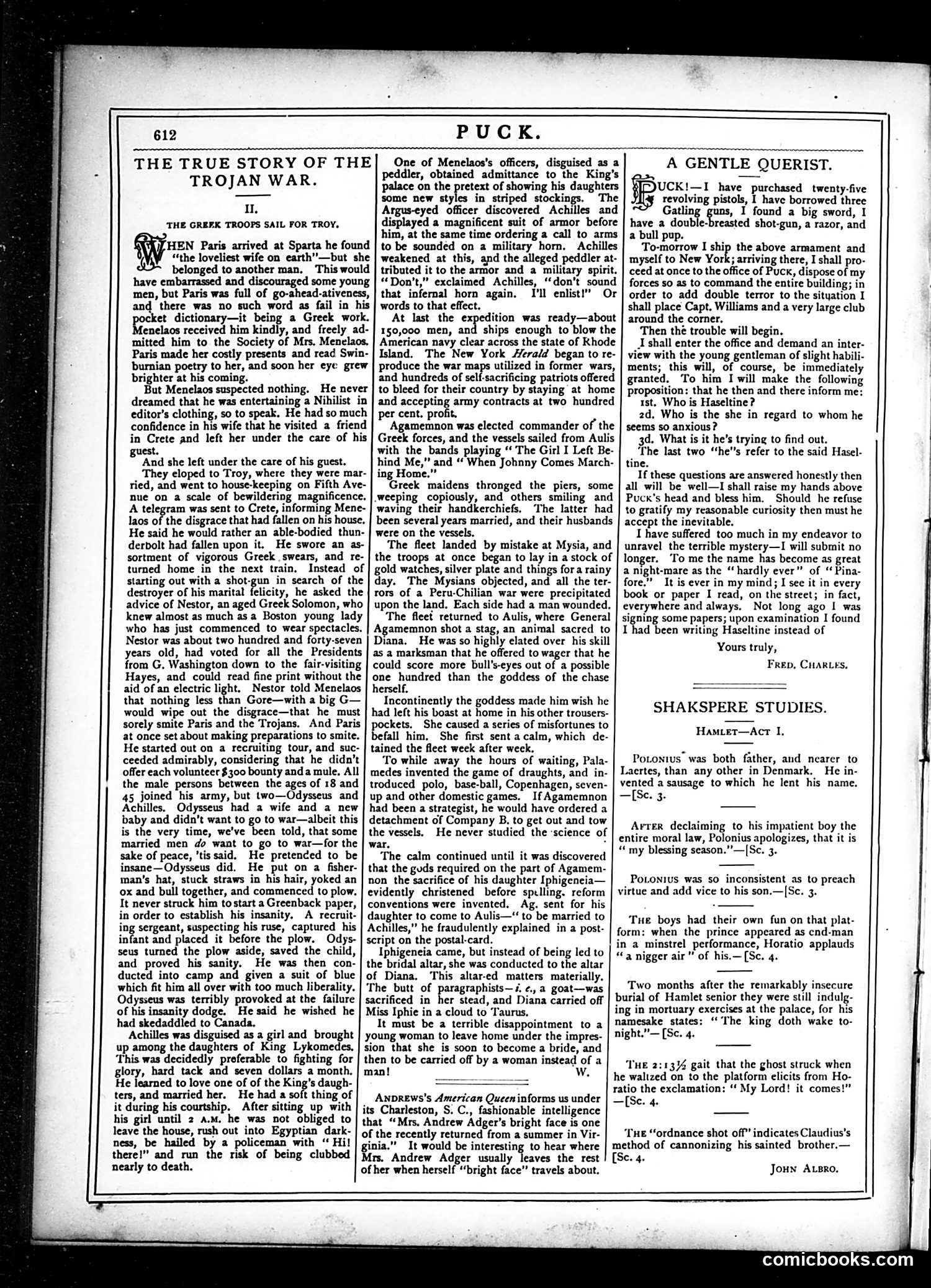
What you’re looking at
This page contains three distinct sections: two literary articles and one satirical piece titled "A Gentle Ouerfist." The main satire, "A Gentle Ouerfist," appears to mock an unnamed character planning violence in New York. The author humorously catalogs weapons (25 revolvers, borrowed Gatling guns, a short-gun, a razor, a bull-gun) while claiming peaceful intentions. This reads as satire of either anarchist threats or bombastic political rhetoric popular in the 1880s-90s era. The other sections—"The True Story of the Trojan War" and "Shakspere Studies"—are humorous retellings of classical literature, offering parody rather than political commentary. Without identifying specific individuals or dated events in the visible illustrations, the page primarily offers literary satire rather than direct political cartooning.
📄 Transcribed text from this page (OCR, searchable)
Machine-transcribed from the original scan — historical spelling and the odd misread are preserved.
612 PUCK. THE TRUE STORY OF THE TROJAN WAR. I. ‘THE GREFK TROOPS SAIL FOR TROY, HEN Paris arrived at Sparta he found “the loveliest wife on earth"—but she belonged to another man. This would have embarrassed and discouraged some young men, but Paris was full of go-ahead-ativeness, and there was no such word as fail in his pocket dictionary—it being a Greek work. lenelaos received him kindly, and freely ad- mitted him to the Society of Mrs. Menelaos, Paris made her costly presents and read Swin- burnian poetry to her, and soon her eye grew brighter at his coming. But Menelaos suspected nothing. He never dreamed that he was entertaining a Nihilist in editor’s clothing, so to speak. He had so much confidence in his wife that he visited a friend in Crete and left her under the care of his lest. And she left under the care of his guest. They eloped to Troy, where they were mar- ried, and went to house-keeping on Fifth Ave- nue on a scale of bewildering magnificence, A telegram was sent to Crete, informing Mene- laos of the disgrace that had fallen on his house. He said he would rather an able-bodied thun- derbolt had fallen upon it. He swore an as- sortment of vigorous Greek swears, and re- turned home in the next train, Instead of starting out with a shot-gun in search of the destroyer of his marital felicity, he asked the advice of Nestor, an aged Greek Solomon, who knew almost as much as a Boston young lady who has just commenced to wear spectacles. Nestor was about two hundred and forty-seven years old, had voted for all the Presidents from G. Washington down to the fair-visiting Hayes, and could read fine print without the aid of an electric light. Nestor told Menelaos that nothing less than Gore—with a big G— would wipe out the disgrace—that he must sorely smite Paris and the Trojans. And Paris at once set about making preparations to smite. He started out on a recruiting tour, and suc- ceeded admirably, considering that he didn’t offer each volunteer $300 bounty anda mule. All the male persons between the ages of 18 and 45 joined his army, but two—Odysseus and Achilles. Odysseus had a wife and a new baby and didn’t want to go to war—albeit this is the very time, we've been told, that some married men do want to go to war—for the sake of peace, 'tis said. He pretenced to be insane—Odysseus did. He put on a fisher- man’s hat, stuck straws in his hair, yoked an ox and bull together, and commenced to plow. It never struck him to start a Greenback paper, in order to establish his insanity, A recruit- ing sergeant, suspecting his ruse, captured his infant and placed it before the plow. Odys- seus turned the plow aside, saved the child, and proved his sanity. He was then con- ducted into camp and given a suit of blue which fit him all over with too much liberality. Odysseus was terribly provoked at the failure of his insanity dodge. He said he wished he had skedaddled to Canada, Achilles was disguised as a girl and brought up among the daughters of King Lykomedes. This was decidedly proferable to fighting for glory, hard tack and seven dollars a month. He learned to love one of of the King’s daugh- ters, and married her. He had a soft thing of it during his courtship. After sitting up with his girl until 2 a.m. he was not obliged to leave the house, rush out into Egyptian dark- ness, be hailed by a policeman with “ Hi! there!” and run the risk of being clubbed One of Menelaos’s officers, disguised as a peddler, obtained admittance to the King’s palace on the pretext of showing his daughters some new styles in striped stockings. The Argus-eyed officer discovered Achilles and displayed a magnificent suit of armor before him, at the same time ordering a call to arms to be sounded on a military horn. Achilles weakened at this, and the alleged peddler at- tributed it to the armor and a military spirit. “Don’t,” exclaimed Achilles, “don't sound that infernal horn again. I'll enlist!” Or words to that effect. At last the expedition was ready—about 150,000 men, and ships enough to blow the American navy clear across the state of Khode Island. The New York Herald began to re- produce the war maps utilized in former wars, and hundreds of self-sacrificing patriots offered to bleed for their country by staying at home and accepting army contracts at two hundred per cent. profit, Agamemnon was elected commander of the Greek forces, and the vessels sailed from Aulis with the bands playing “The Girl I Left Be- hind Me,” and ‘‘ When Johnny Comes March- ing Home.” Greek maidens thronged the piers, some weeping copiously, and others smiling and waving their handkerchiefs. The latter had been several years married, and their husbands were on the vessels. The fleet landed by mistake at Mysia, and the troops at once began to lay in a stock of gold watches, silver plate and things fora rainy day. The Mysians objected, and all the ter- rors of a Peru-Chilian war were precipitated upon the land, Each side had a man wounded, The fleet returned to Aulis, where General Agamemnon shot a stag, an animal sacred to Diana. He was so highly elated over his skill as a marksman that he offered to wager that he could score more bull’s-eyes out of a possible one hundred than the goddess of the chase herself, Incontinently the goddess made him wish he had left his boast at home in his other trousers- ockets. She caused a series of misfortunes to fall him. She first sent a calm, which de- tained the fleet week after week, To while away the hours of waiting, Pala- medes invented the game of draughts, and in- troduced polo, base-ball, Copenhagen, seven- up and other domestic games. IfAgamemnon had been a strategist, he would have ordered a detachment of Company B, to get out and tow the vessels, He never studied the ‘science of war. a The calm continued until it was discovered that the guds required on the part of Agamem- non the sacrifice of his daughter Iphigeneia— evidently christened before spelling. reform conventions were invented. Ag. sent for his daughter to come to Aulis—‘‘ to be married to Achilles,” he fraudulently explained in a post- script on the postal-card. Iphigeneia came, but instead of being led to the bridal altar, she was conducted to the altar of Diana. is altar-ed matters materially. The butt of paragraphists— i ¢., 4 goat—was sacrificed in her stead, and Diana carried off Miss Iphie in a cloud to Taurus, It must be a terrible disappointment to a young woman to leave home under the impres- sion that she is soon to become a bride, and then to be carried off by a woman instead of a man! WwW. Anprews's American Queen informs us under its Charleston, S. C., fashionable intelligence that “Mrs, Andrew Adger’s bright face is one of the recently returned from a summer in Vir- A GENTLE QU ERIST. iP UCK!—I have purchased twenty-five revolving pistols, I have borrowed three Gatling guns, I found a big sword, I have a double-breasted shot-gun, a razor, and a bull pup. To-morrow I ship the above armament and myself to New York; arriving there, I shall pro- ceed at once to the office of Puck, dispose of my forces so as to command the entire building; in order to add double terror to the sityation I shall place Capt, Williams and a very large club around the corner. ‘Then thé trouble will begin. I shall enter the office and demand an inter- view with the young gentleman of slight habili- ments; this will, of course, be immediately granted. To him I will make the following proposition: that he then and there inform me: 1st. Who is Haseltine? 2d, Who is the she in regard to whom he seems so anxious? 3d. What is it he’s trying to find out. The last two ‘“‘he'’s refer to the said Hasel- tine. If these questions are answered honestly then all will be well—I shall raise my hands above Puck's head and bless him. Should he refuse to gratify my reasonable curiosity then must he accept the inevitable. I have suffered too much in my endeavor to unravel the terrible mystery—I will submit no longer. To me the name has become as great a night-mare as the “hardly ever” of “Pina- fore.” It is ever in my mind; I see it in every book or paper I read, on the street; in fact, everywhere and always. Not long ago I was signing some papers; upon examination I found Thad been writing Haseltine instead of Yours truly, Frep, Cuartes, SHAKSPERE STUDIES. Hamcet—Act I. Potontus’ was both father, and nearer to Laertes, than any other in Denmark, He in- vented a sausage to which he lent his name. —[Se. 3. Arter declaiming to his impatient boy the entire moral law, Polonius apologizes, that it is “ my blessing season.” —[Sc. 3. Po.onius was so inconsistent as to preach virtue and add vice to his son.—[Sc. 3. Tue boys had their own fun on that plat- form: when the prince appeared as cnd-man in a minstrel performance, Horatio applauds “a nigger air” of his.—[Sc. 4. Two months after the remarkably insecure burial of Hamlet senior they were still indulg- ing in mortuary exercises at the palace, for his namesake states: “The king doth wake to- night.”—[Sc. 4. ‘THe 2:1334 gait that the ghost struck when he waltzed on to the platform elicits from Ho- ratio the exclamation: ‘‘ My Lord! it comes!” —[Se. 4. ‘Tue “ordnance shot off” indicates Claudius’s method of cannonizing his sainted brother.— ginia.” It would be Joker to hear where Mrs. Andrew Adger usually leaves the rest nearly to death. of her when herself “bright face” travels about. [Sc. 4. Joun AvsRo. comicbooks.com