
Puck, 1879-11-26 · page 10 of 18
Puck — November 26, 1879 — page 10: what you’re looking at
What you’re looking at
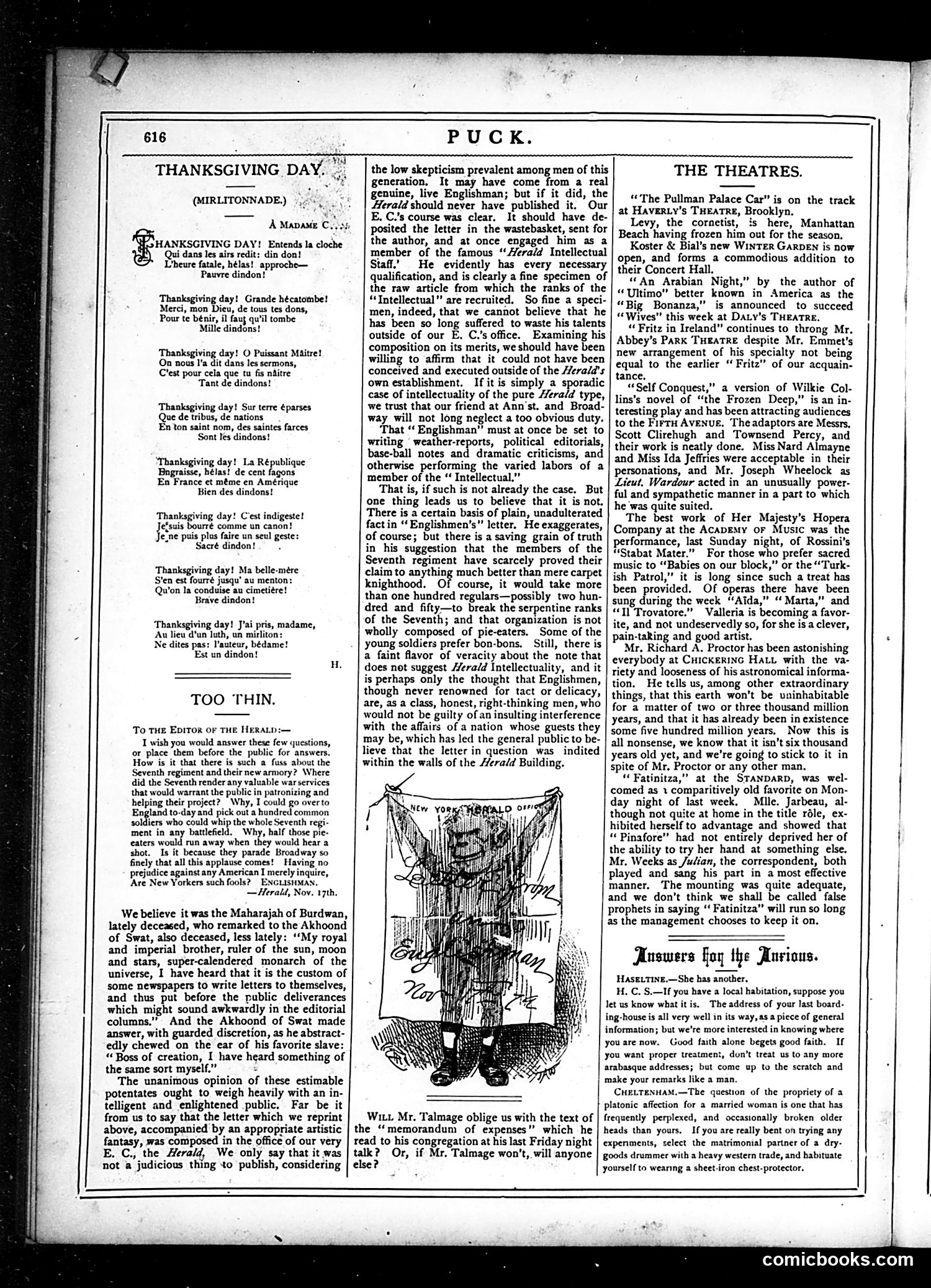
This page contains several sections rather than a unified cartoon. The main illustrated content shows **"Too Thin"** — a satirical drawing of an emaciated figure representing the **Herald newspaper's "Intellectual Staff."** The accompanying letter-to-editor debate concerns whether the Herald published a letter criticizing its own intellectual department. The satire suggests the Herald's intellectual writers are so self-important yet ineffective that they deserve ridicule. The skeletal cartoon emphasizes this critique through exaggeration. The right column, **"The Theatres,"** reviews current Broadway productions including works at the Pullman Palace Car, Hawaiian Theatre, and Abbey's Park Theatre. Below that, **"Answers for the Curious"** provides brief Q&A responses on various social matters. This appears to be a typical Puck page mixing political satire with entertainment coverage and reader correspondence.
📄 Transcribed text from this page (OCR, searchable)
Machine-transcribed from the original scan — historical spelling and the odd misread are preserved.
PUCK. Yi THANKSGIVING DA (MIRLITONNADE.) A Mapai Cy ess: HANKSGIVING DAY! Entends la cloche Qui dans les airs redit: din don! Liheure fatale, hélas! approche— Pauvre dindon! Thanksgiving day! Grande hécatombe! Merci, mon Dieu, de tous tes dons, Pour te bénir, il faug qu’il tombe Mille dindons! Thanksgiving day! O Puissant Maitre! On nous I’a dit dans les sermons, Crest pour cela que tu fis niitre Tant de dindons! Thanksgiving day! Sur terre éparses Que de tribus, de nations En ton saint nom, des saintes farces Sont les dindons! ‘Thanksgiving day! La République Bngraisse, hélas! de cent fagons En France et méme en Amérique Bien des dindons! Thanksgiving day! Cest indigeste! Jefsuis Bourré comme un canon! Jeine puis plus faire un seul geste: Sacré dindon!. ‘Thanksgiving day! Ma belle-mére S’en est fourré jusqu’ au menton: Qu’on Ia conduise au cimetiére! Brave dindon! ‘Thanksgiving day! J'ai pris, madame, Au lieu d’un luth, uh mirliton: Ne dites pas: auteur, bédame! Est un dindon! TOO THIN. To THE Epitor or THE HERALD:— I wish you would answer these few questions, or place them before the public for answers. How is it that there is such a fuss about the Seventh regiment and their new armory? Where did the Seventh render any valuable war services that would warrant the public in patronizing and helping their project? Why, I could go overto England to-day and pick out hundred common soldiers who could whip the whole Seventh regi- ment in any battlefield. Why, half those pie- eaters would run away when they would hear a shot. Is it because they parade Broadway so finely that all this applause comes! Having no prejudice against any American I merely inquire, Are New Yorkers such fools? ENGLISHMA: —Herald, Nov. 17th. We believe it was the Maharajah of Burdwan, lately deceased, who remarked to the Akhoond of Swat, also deceased, less lately: ‘‘My royal and imperial brother, ruler of the sun, moon and stars, super-calendered monarch of the universe, I have heard that it is the custom of some newspapers to write letters to themselves, and thus put before the public deliverances which might sound awkwardly in the editorial columns.” And the Akhoond of Swat made answer, with guarded discretion, as he abstract- edly chewed on the ear of his favorite slave: “Boss of creation, I have heard something of the same sort myself.” ® The unanimous opinion of these estimable potentates ought to weigh heavily with an in- telligent and enlightened public. Far be it from us to say that the letter which we reprint above, accompanied by an appropriate artistic fantasy, was composed in the office of our very E. C,, ‘the Herald, We only say that it was not a judicious thing to publish, considering the low skepticism prevalent among men of this generation. It may have come from a real genuine, live Englishman; but if it did, the Herald should never have published it. Our E. C.'s course was clear. It should have de- posited the letter in the wastebasket, sent for the author, and at once engaged him as a member of the famous ‘‘Hera/d Intellectual Staff.’ He evidently has every necessary qualification, and is clearly a fine specimen of the raw article from which the ranks of the “Intellectual” are recruited, So fine a speci- men, indeed, that we cannot believe that he has been so long suffered to waste his talents outside of our E. C.’s office. Examining his composition on its merits, we should have been willing to affirm that it could not have been conceived and executed outside of the Herald's own establishment. If it is simply a sporadic case of intellectuality of the pure /Yera/d type, we trust that our friend at Ann’st. and Broad- way will not long neglect a too obvious duty, That “Englishman” must at once be set to writing ‘weather-reports, political editorials, base-ball notes and dramatic criticisms, and otherwise performing the varied labors of a member of the “ Intellectual.” That is, if such is not already the case. But one thing leads us to believe that it is not. There is a certain basis of plain, unadulterated fact in ‘‘Englishmen’s” letter. He exaggerates, of course; but there is a saving grain of truth in his suggestion that the members of the Seventh regiment have scarcely proved their claim to anything much better than mere carpet knighthood. Of course, it would take more than one hundred regulars—possibly two hun- dred and fifty—to break the serpentine ranks of the Seventh; and that organization is not wholly composed of pie-eaters. Some of the young soldiers prefer bon-bons. Still, there is a faint flavor of veracity about the note that does not suggest Hera/d Intellectuality, and it is perhaps only the thought that Englishmen, though never renowned for tact or delicacy, are, as a class, honest, right-thinking men, who would not be guilty of an insulting interference with the affairs of a nation whose guests they may be, which has led the general public to be- lieve that the letter in question was indited within the walls of the Hera/d Building. WEA Witt Mr. Talmage oblige us with the text of the ‘‘memorandum of expenses” which he read to his congregation at his last Friday night Or, if Mr. Talmage won't, will anyone else? THE THEATRES. “The Pullman Palace Car” is on the track at Haverty's THEATRE, Brooklyn. Levy, the cornetist, is here, Manhattan Beach having frozen him out for the season, Koster & Bial’s new WinTER GARDEN is now open, and forms a commodious addition to their Concert Hall. “An Arabian Night,” by the author of “Ultimo” better known in America as the “Big Bonanza,” is announced to succeed “Wives” this week at Daty’s THEATRE. “Fritz in Ireland” continues to throng Mr. Abbey’s PARK THEATRE despite Mr. Emmet's new arrangement of his specialty not being equal to the earlier “Fritz” of our acquain- tance, “Self Conquest,” a version of Wilkie Col- lins’s novel of “the Frozen Deep,” is an in- teresting play and has been attracting audiences to the FirrH Avenue. The adaptors are Messrs, Scott Clirehugh and Townsend Percy, and their work is neatly done. Miss Nard Almayne and Miss Ida Jeffries were acceptable in their personations, and Mr. Joseph Wheelock as Lieut, Wardour acted in’ an unusually power- ful and sympathetic manner in a part to which he was quite suited. ‘The best work of Her Majesty's Hopera Company at the ACApEMy oF Music was the performance, last Sunday night, of Rossini’s “Stabat Mater.” For those who prefer sacred music to ‘Babies on our block,” or the “Turk- ish Patrol,” it is long since such a treat has been provided. Of operas there have been sung during the week “Aida,” ‘“ Marta,” and “Il Trovatore.” Valleria is becoming a favor- ite, and not undeservedly so, for she is a clever, pain-taking and guod artist. Mr. Richard A. Proctor has been astonishing everybody at CuickerInG Hatt with the va- riety and looseness of his astronomical informa- tion, He tells us, among other extraordinary things, that this earth won't be uninhabitable for a matter of two or three thousand million years, and that it has already been in existence some five hundred million years. Now this is all nonsense, we know that it isn’t six thousand years old yet, and we're going to stick to it in spite of Mr, Proctor or any other man. “ Fatinitza,” at the STANDARD, was wel- comed as 1 comparitively old favorite on Mon- day night of last week. Mlle. Jarbeau, al- though not quite at home in the title réle, ex- hibited herself to advantage and showed that “Pinafore” had not entirely deprived her of the ability to try her hand at something else, Mr. Weeks as Juéian, the correspondent, both played and sang his part in a most effective manner. The mounting was quite adequate, and we don’t think we shall be called false prophets in saying ‘ Fatinitza” will run so long as the management chooses to keep it on. Answers foy the Anrious. HAsELTINE.—She has another. H. C, S.—If you have a local habitation, suppose you let us know what itis. The address of your last board- ing-house is all very well in its way, as a piece of general information; but we're more interested in knowing where you are now. Good faith alone begets good faith. If you want proper treatment, don’t treat us to any more arabasque addresses; but come up to the scratch and make your remarks like a man. CHELTENHAM.—The question of the propriety of a platonic affection for a married woman is one that has frequently perplexed, and occasionally broken older heads than yours. If you are really bent on trying any expenments, select the matrimonial partner of a dry- goods drummer with a heavy western trade, and habituate yourself to wearing a sheet-iron chest-protector. comicbooks.com