
Puck, 1879-11-26 · page 11 of 18
Puck — November 26, 1879 — page 11: what you’re looking at
What you’re looking at
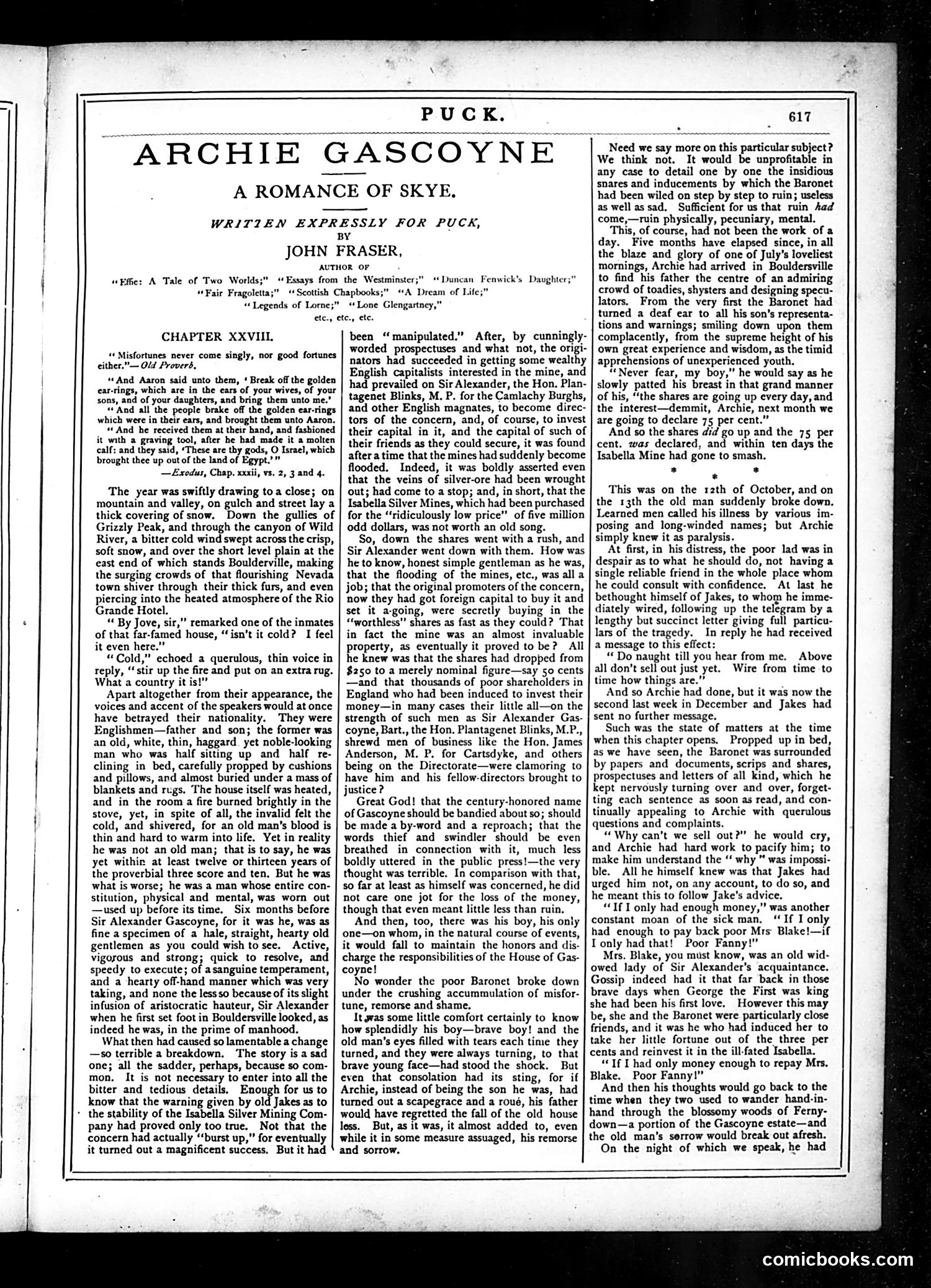
This page from *Puck* magazine presents **"Archie Gascoyne: A Romance of Skye,"** a serialized story by John Fraser written expressly for the publication. The page is primarily **text-based fiction rather than a political cartoon**. The narrative concerns a Scottish mining venture that collapsed financially, ruining shareholders. The story satirizes **Victorian-era financial fraud and speculation**, particularly how wealthy industrialists and MPs manipulated poor investors into purchasing worthless mining stocks. References include Sir Alexander Gascoyne and other English capitalists who profited while ordinary citizens lost their savings. The satire critiques **late-19th-century corporate malfeasance and the vulnerability of working-class investors** to schemes promoted by unscrupulous businessmen.
📄 Transcribed text from this page (OCR, searchable)
Machine-transcribed from the original scan — historical spelling and the odd misread are preserved.
ARCHIE GAS A ROMANCE OF SKYE, WRITTEN EXPRESSLY FOR PUCK, BY JOHN FRASER, AUTHOR OF uEfie: A Tale of Two Worlds;” “Essays from the Westminster;” Duncan Fenwick’s Daughter;” “Fair Fragoletta;” “Scottish Chapbooks;” “A Dream of Life;” “Legends of Lorne;” ‘Lone Glengartney,” ete., ete, etc. CHAPTER XXVIII. “« Misfortunes never come singly, nor good fortunes either."—Old Proverb, “And Aaron said unto them, ‘ Break off the golden car-rings, which are in the ears of your wives, of your sons, and of your daughters, and bring them unto me.’ “And all the people brake off the golden ear-rings which were in their ears, and brought them unto Aaron. “And he received them at their hand, and fashioned it with a graving tool, after he had made it a molten calf: and they said, ‘These are thy gods, O Israel, which brought thee up out of the land of Egypt.” —Exodus, Chap. xxxii, vs. 2, 3 and 4. The year was swiftly drawing toa close; on mountain and valley, on gulch and street lay a thick covering of snow. Down the gullies of Grizzly Peak, and through the canyon of Wild River, a bitter cold wind swept across the crisp, soft snow, and over the short level plain at the east end of which stands Boulderville, making the surging crowds of that flourishing Nevada town shiver through their thick furs, and even piercing into the heated atmosphere of the Rio Grande Hotel. “ By Jove, sir,” remarked one of the inmates of that far-famed house, “isn’t it cold? I feel it even here.” “Cold,” echoed a querulous, thin voice in reply, ‘stir up the fire and put on an extra rug. What a country it is!” Apart altogether from their appearance, the voices and accent of the speakers would at once have betrayed their nationality. They were Englishmen—father and son; the former was an old, white, thin, haggard. yet noble-looking man who was half sitting up and half re- clining in bed, carefully propped by cushions and pillows, and almost buried under a mass of blankets and rugs. The house itself was heated, and in the room a fire burned brightly in the stove, yet, in spite of all, the invalid felt the cold, and shivered, for an old man’s blood is thin and hard to warm into life. Yet in reality he was not an old man; that is to say, he was yet withir at least twelve or thirteen years of the proverbial three score and ten, But he was what is worse; he was a man whose entire con- stitution, physical and mental, was worn out —used up before its time. Six months before Sir Alexander Gascoyne, for it was he, was as fine a specimen of a hale, straight, hearty old gentlemen as you could wish to see. Active, vigorous and strong; quick to resolve, and speedy to execute; of asanguine temperament, and a hearty off-hand manner which was very taking, and none the lessso because of its slight infusion of aristocratic hauteur, Sir Alexander when he first set foot in Bouldersville looked, as indeed he was, in the prime of manhood. What then had caused so lamentable a change —so terrible a breakdown. The story is a sad one; all the sadder, perhaps, because so com- mon. It is not necessary to enter into all the bitter and tedious details. Baongh for us to know that the warning given by old Jakes as to * the stability of the Isabella Silver Mining Com- pany had proved only too true. Not that the concern had actually “burst up,” for eventually it turned out a magnificent success. But it had been “manipulated.” After, by cunningly- worded prospectuses and what not, the origi- nators had succeeded in getting some wealthy English capitalists interested in the mine, and had prevailed on Sir Alexander, the Hon. Plan- tagenet Blinks, M. P. for the Camlachy Burghs, and other English magnates, to become direc- tors of the concern, and, of course, to invest their capital in it, and the capital of such of their friends as they could secure, it was found after a time that the mines had suddenly become flooded. Indeed, it was boldly asserted even that the veins of silver-ore had been wrought out; had come to a stop; and, in short, that the Isabella Silver Mines, which had been purchased for the “ridiculously low price” of five million odd dollars, was not worth an old song. So, down the shares went with a rush, and Sir Alexander went down with them. How was he to know, honest simple gentleman as he was, that the flooding of the mines, etc., was all a job; that the original promoters of the concern, now they had got foreign capital to buy it and set it a-going, were secretly buying in the “worthless” shares as fast as they could? That in fact the mine was an almost invaluable property, as eventually it proved to be? All he knew was that the shares had dropped from $250 to a merely nominal figure—say 50 cents —and that thousands of poor shareholders in England who had been induced to invest their money—in many cases their little all—on the strength of such men as Sir Alexander Gas- coyne, Bart., the Hon, Plantagenet Blinks, M.P., shrewd men of business like the Hon, James Anderson, M. P. for Cartsdyke, and others being on the Directorate—were clamoring to have him and his fellow-directors brought to justice? Great God! that the century-honored name of Gascoyne should be bandied about so; should be made a by-word and a reproach; that the words thief and swindler should be even breathed in connection with it, much less boldly uttered in the public press!—the very thought was terrible. In comparison with that, so far at least as himself was concerned, he did not care one jot for the loss of the money, though that even meant little less than ruin. And then, too, there was his boy, his only one—on whom, in the natural course of events, it would fall to maintain the honors and dis- charge the responsibilities of the House of Gas- coyne! No wonder the poor Baronet broke down under the crushing accummulation of misfor- tune, remorse and shame, It was some little comfort certainly to know how splendidly his boy—brave boy! and the old man’s eyes filled with tears each time they turned, and they were always turning, to that brave young face—had stood the shock. But even that consolation had its sting, for if Archie, instead of being the son he was, had turned out a scapegrace and a roué, his father would have regretted the fall of the old house less. But, as it was, it almost added to, even while it in some measure assuaged, his remorse and sorrow. Need we say more on this particular subject? We think not. It would be unprofitable in any case to detail one by one the insidious snares and inducements by which the Baronet had been wiled on step by step to ruin; useless as well as sad. Sufficient for us that ruin had come,—ruin physically, pecuniary, mental. This, of course, had not been the work of a day. Five months have elapsed since, in all the blaze and glory of one of July’s loveliest mornings, Archie had arrived in Bouldersville to find his father the centre of an admiring crowd of toadies, shysters and designing specu- lators. From the very first the Baronet had turned a deaf ear to all his son’s representa- tions and warnings; smiling down upon them complacently, from the supreme height of his own great experience and wisdom, as the timid apprehensions of unexperienced youth. “Never fear, my boy,” he would say as he slowly patted his breast in that grand manner of his, “the shares are going up every day, and the interest—demmit, Archie, next month we are going to declare 75 per cent.” And so the shares did go up and the 75 per cent. was declared, and within ten days the Isabella Mine had gone to smash, * . * This was on the 12th of October, and on the 13th the old man suddenly broke down. Learned men called his illness by various im- posing and long-winded names; but Archie simply knew it as paralysis. At first, in his distress, the poor lad was in despair as to what he should do, not having a single reliable friend in the whole place whom he could consult with confidence, At last he bethought himself of Jakes, to whom he imme- diately wired, following up the telegram by a lengthy but succinct letter giving full particu- lars of the tragedy. In reply he had received a message to this effect: “Do naught till you hear from me. Above all don’t sell out just yet. Wire from time to time how things are.”” And so Archie had done, but it was now the second last week in December and Jakes had sent no further message. Such was the state of matters at the time when this chapter opens. Propped up in bed, as we have seen, the Baronet was surrounded by papers and documents, scrips and shares, prospectuses and letters of all kind, which he kept nervously turning over and over, forget- ting each sentence as soon as read, and con- tinually appealing to Archie with querulous questions and complaints. “Why can't we sell out?” he would cry, and Archie had hard work to pacify him; to make him understand the “ why " was impossi- ble. All he himself knew was that Jakes had urged him not, on any account, to do so, and he meant this to follow Jake’s advice. “If T only had enough money,” was another constant moan of the sick man. “If I only had enough to pay back poor Mrs Blake!—if Tonly had that! Poor Fanny!” Mrs. Blake, you must know, was an old wid- owed lady of Sir Alexander’s acquaintance, Gossip indeed had it that far back in those brave days when George the First was king she had been his first love. However this may be, she and the Baronet were particularly close friends, and it was he who had induced her to take her little fortune out of the three per cents and reinvest it in the ill-fated Isabella. “If [had only money enough to repay Mrs. Blake. Poor Fanny!” And then his thoughts would go back to the time when they two used to wander hand-in- hand through the blossomy woods of Ferny- down—a portion of the Gascoyne estate—and the old man’s sorrow would break out afresh. On the night of which we speak, he had comicbooks.com