
A complete issue · 18 pages · 1879
Puck — October 8, 1879
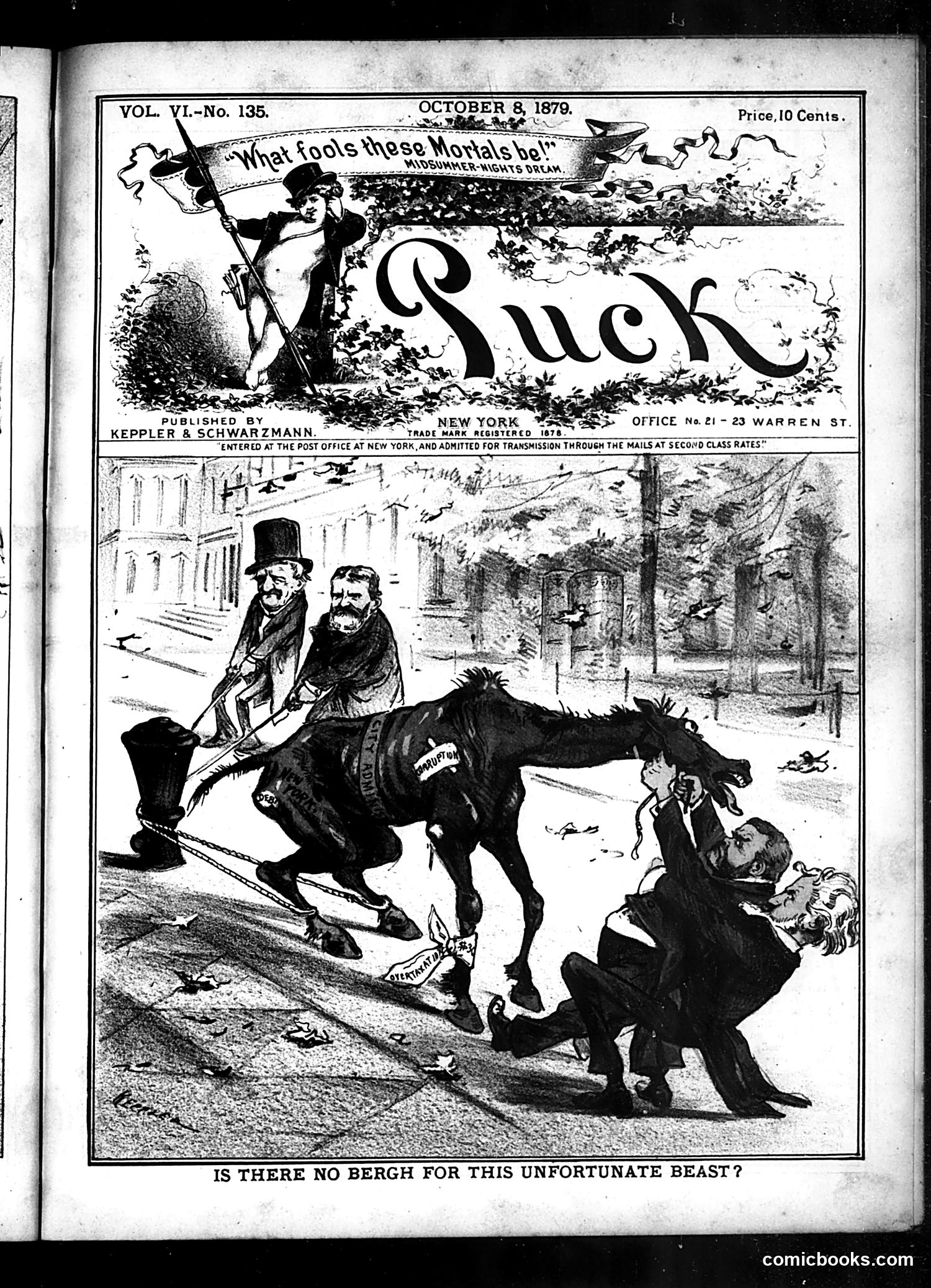
This satirical cartoon depicts a vicious dog labeled "CORRUPTION" attacking two well-dressed men on a city street while two other gentlemen stand helplessly behind them. The caption asks: "IS THERE NO BERGH FOR THIS UNFORTUNATE BEAST?" The reference is to Henry Bergh, founder of the American Society for the Prevention of Cruelty to Animals (ASPCA), famous for animal welfare advocacy. The cartoon uses this ironic comparison to suggest that corruption is being treated like a dangerous animal ravaging the city—and that society has no "Bergh" figure to restrain it. The satire criticizes widespread political corruption of the Gilded Age era, implying that corruption runs unchecked while animal welfare receives organized protection.
This page contains three distinct sections rather than a single cartoon: 1. **"The Prince of Snobs"** — A satirical article criticizing Cyrus Field, a wealthy gentleman who acquired a reputation for snobbery. The piece mocks his pretensions, including dining with nobility and his attempted superiority over others. The satire culminates in describing how Field "caps the climax of his snobbery by lodging to Mr. Dean Stanley and erecting a monument to a British spy." 2. **"Free Schools and Foul Air"** — Editorial commentary on overcrowded American public schools, particularly downtown institutions suffering from poor ventilation and sanitation. 3. **"Fame"** — A reader's letter discussing admiration for Puck magazine. The page is primarily text-based social commentary rather than visual satire, typical of Puck's editorial content.
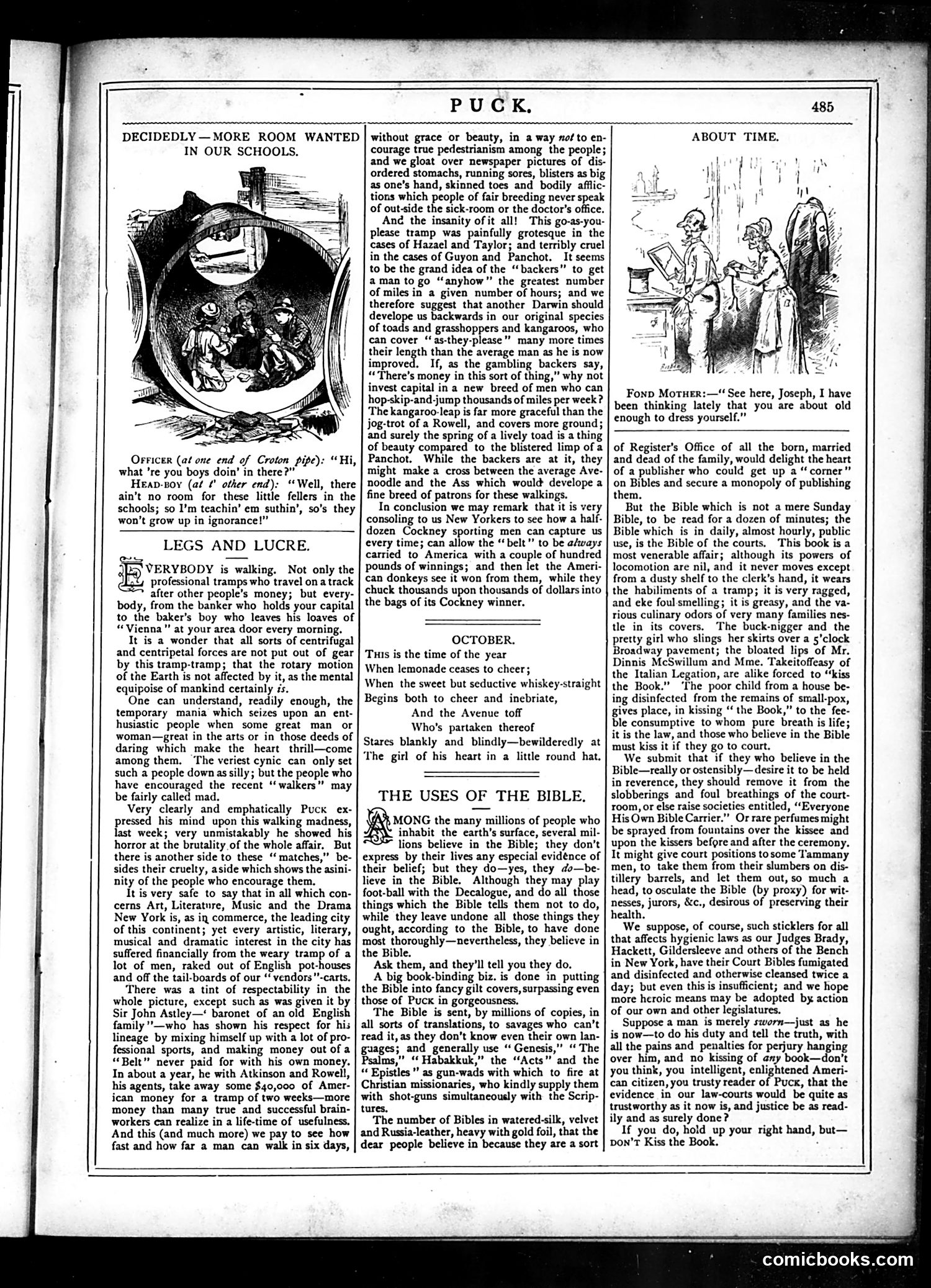
The left cartoon, "Decidedly—More Room Wanted in Our Schools," depicts a cramped schoolroom where an officer tells a headboy that despite having "little fellers," there's "no room" for them. The satire critiques overcrowded American schools—a documented Progressive Era concern about rapid urbanization straining educational infrastructure. "Legs and Lucre" addresses pedestrian culture, mocking how Americans obsessively walk excessive distances for trivial rewards (gambling winnings, sporting bets). It satirizes both the walking craze and what the author sees as wasteful American priorities. The remaining text discusses Bible use in public institutions, arguing inconsistently—some use Bibles as courtroom props while claiming religious separation. This reflects late 19th/early 20th-century American debates over religion's role in public life.
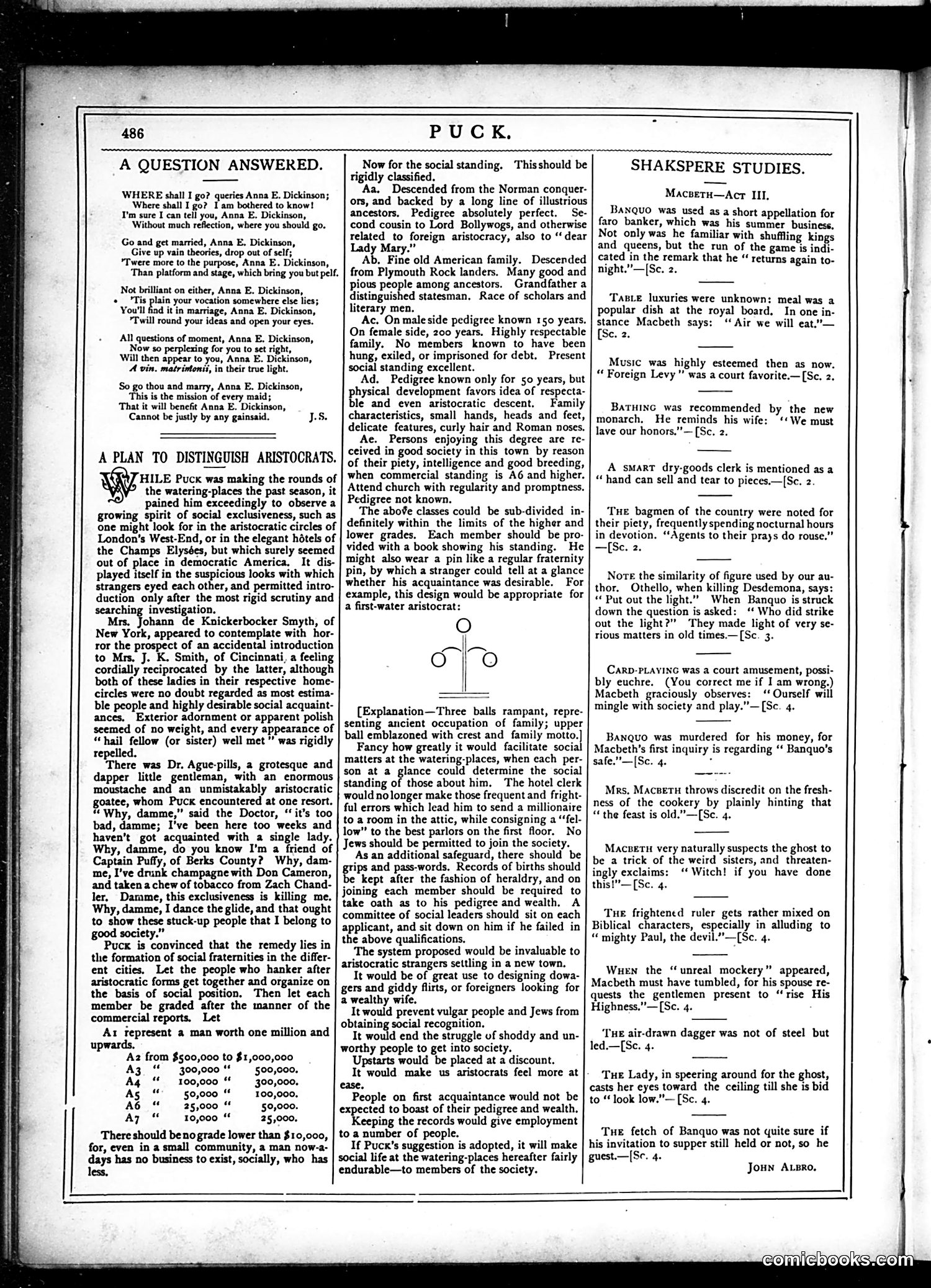
This satirical piece mocks late 19th-century American social pretension. It proposes a system using three interlocking circles (a heraldic design) to mark social standing at gatherings—allowing strangers to instantly identify someone's aristocratic rank. The joke targets the absurdity of nouveau riche Americans obsessing over European-style class distinctions and hereditary credentials. Puck ridicules how wealthy New Yorkers, lacking genuine aristocratic lineage, desperately mimicked Old World social hierarchies. The satire suggests that such visible ranking systems, while facilitating social climbing, reveal the shallow artificiality of American "aristocracy"—people judged by wealth rather than authentic bloodline or character. The proposal's ridiculous practicality (badges worn at parties) underscores the magazine's skepticism toward democratic America's embrace of unearned elitism.
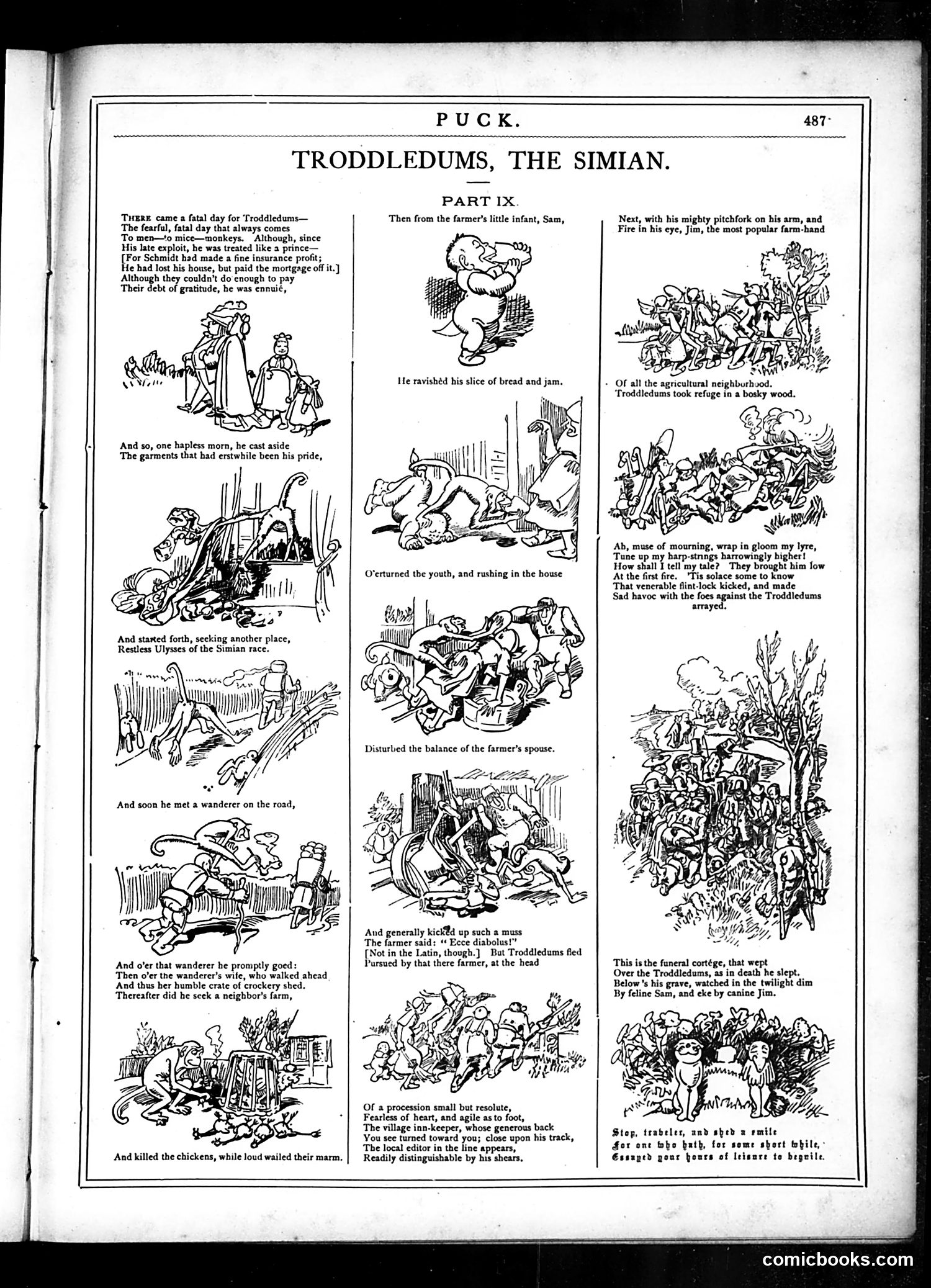
This Puck installment satirizes a character named "Troddledums" through an extended narrative poem with illustrations. The story describes a poor farmer's misfortunes when a wandering Simian (ape-like figure) arrives at his property. The creature ravages the farm—eating bread and jam, disturbing his wife, destroying his chickens, and causing general chaos and poverty. The satire appears to target either a specific politician or political faction through the "Simian" metaphor, using animal caricature to mock them as destructive and foolish. Without clearer historical context identifying which figure or event Troddledums represents, the exact political target remains unclear, though the overall message condemns the subject as ruinous to ordinary working people.
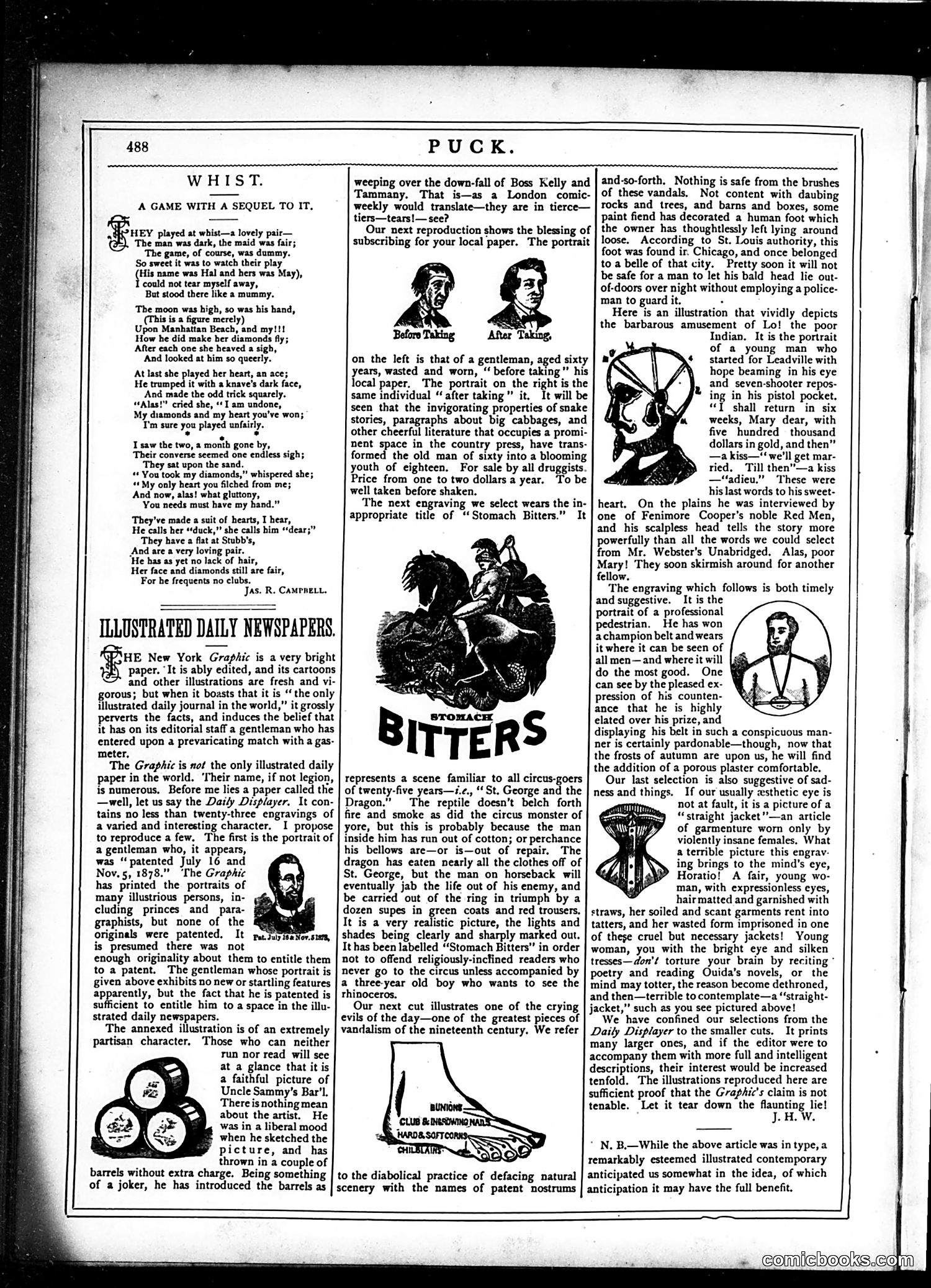
This page contains three main elements: a poem titled "Whist" (a card game), an article about illustrated daily newspapers, and a prominent advertisement for "Stomach Bitters." The article discusses *The New York Graphic*, praising it as the first illustrated daily newspaper with fresh, vigorous engravings. It credits the *Graphic* with introducing numerous innovative illustration techniques and patents. The piece defends the paper's use of sensational imagery—specifically mentioning a circus scene titled "St. George and the Dragon" depicting a man on horseback—against religious objections, arguing such illustrations serve important public purposes. The "Stomach Bitters" ad features a circus performer in a conspicuous belt and exaggerated pose, likely satirizing patent medicine marketing and the dubious health claims common in the era. The overall page reflects late 19th-century debates about journalism, illustration, and advertising ethics.
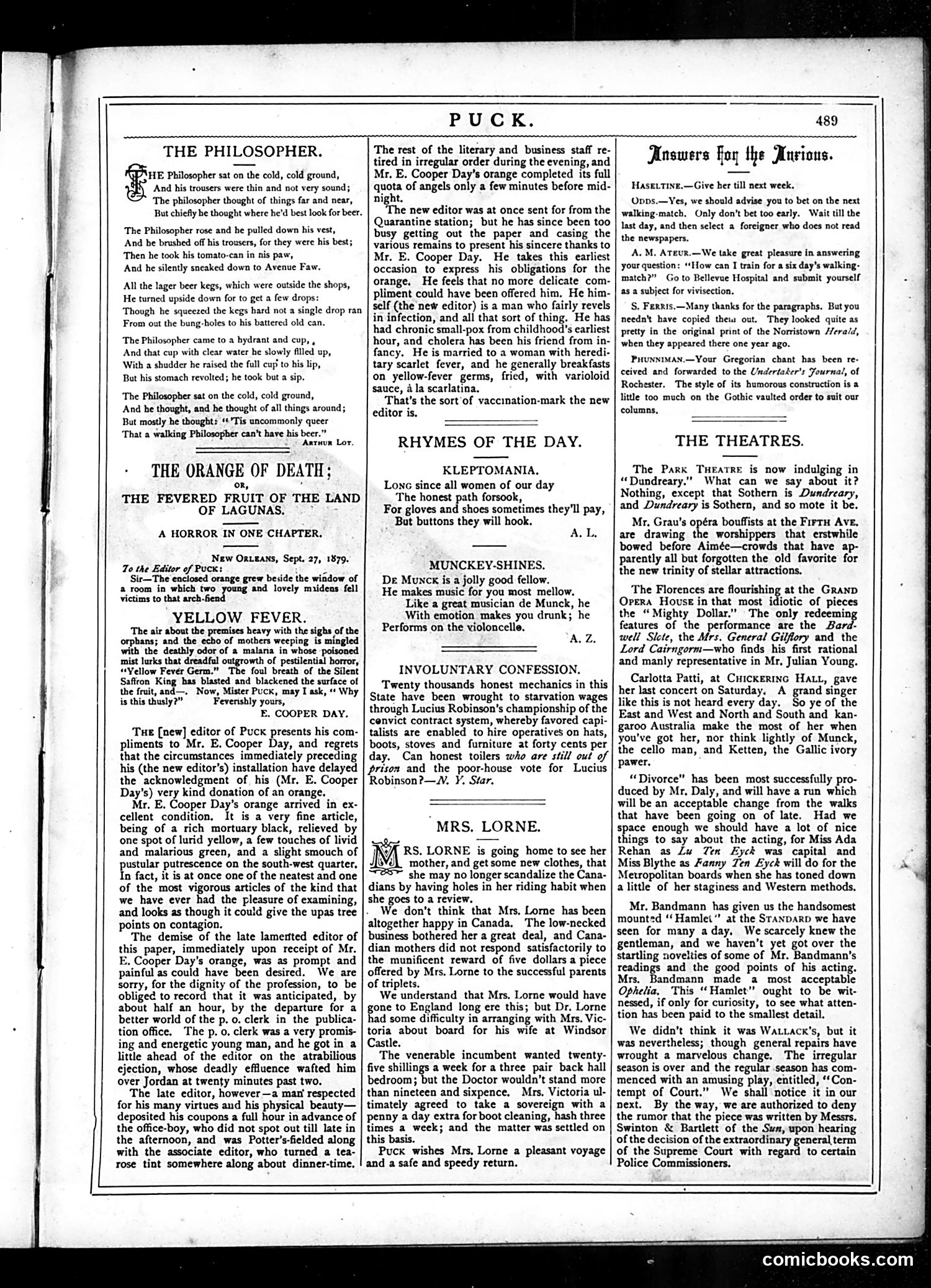
This page features a satirical poem called "The Philosopher" mocking an impractical intellectual. The poem describes a philosopher sitting in the cold, contemplating abstract ideas while ignoring practical discomforts—his legs ached, he's covered in beer stains, yet he's absorbed in thought. The satire targets the stereotype of the absent-minded academic divorced from reality. The accompanying verse mocks this detachment, suggesting the philosopher prioritizes useless theorizing over basic self-care and hygiene. The page also includes separate sections on theater reviews and social gossip ("Answers for the Curious"), typical of Puck's mixed content format. The overall tone ridicules intellectuals who neglect worldly concerns in pursuit of philosophy.
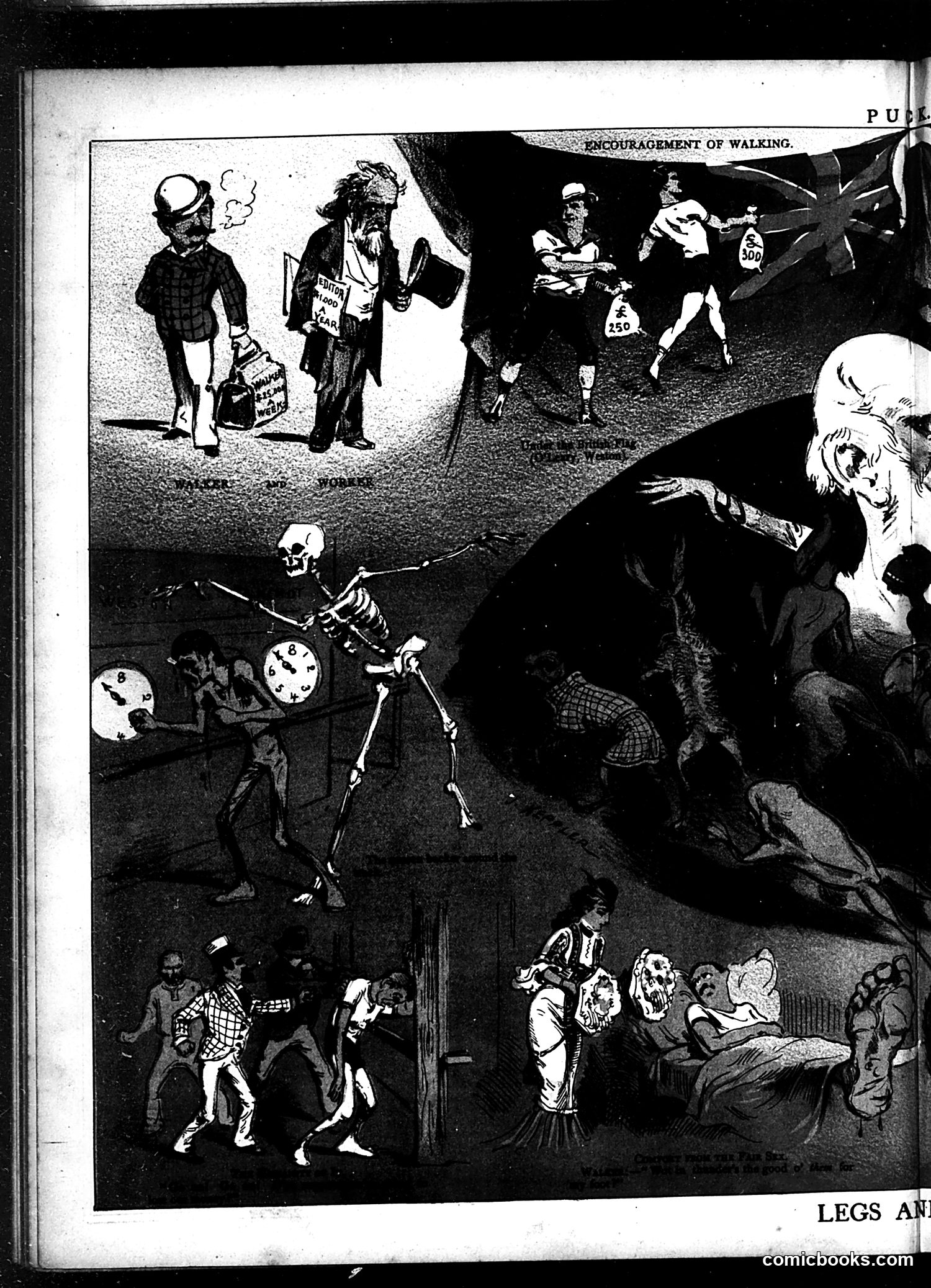
This page satirizes public health promotion around walking and exercise. The header reads "ENCOURAGEMENT OF WALKING," and the illustrations depict various scenarios—some showing people actively walking or exercising, while others feature skeletal Death figures and grim imagery alongside the activity. The satire appears to mock contemporary health crusades that promoted walking as a cure-all, suggesting the irony that such encouragement could lead to injury, exhaustion, or worse. The juxtaposition of Death with exercise scenes creates dark humor, questioning whether zealous "health improvement" campaigns might paradoxically endanger people. The skeleton holding a clock implies time running out—perhaps mocking the urgency behind these health fads or their dubious effectiveness.
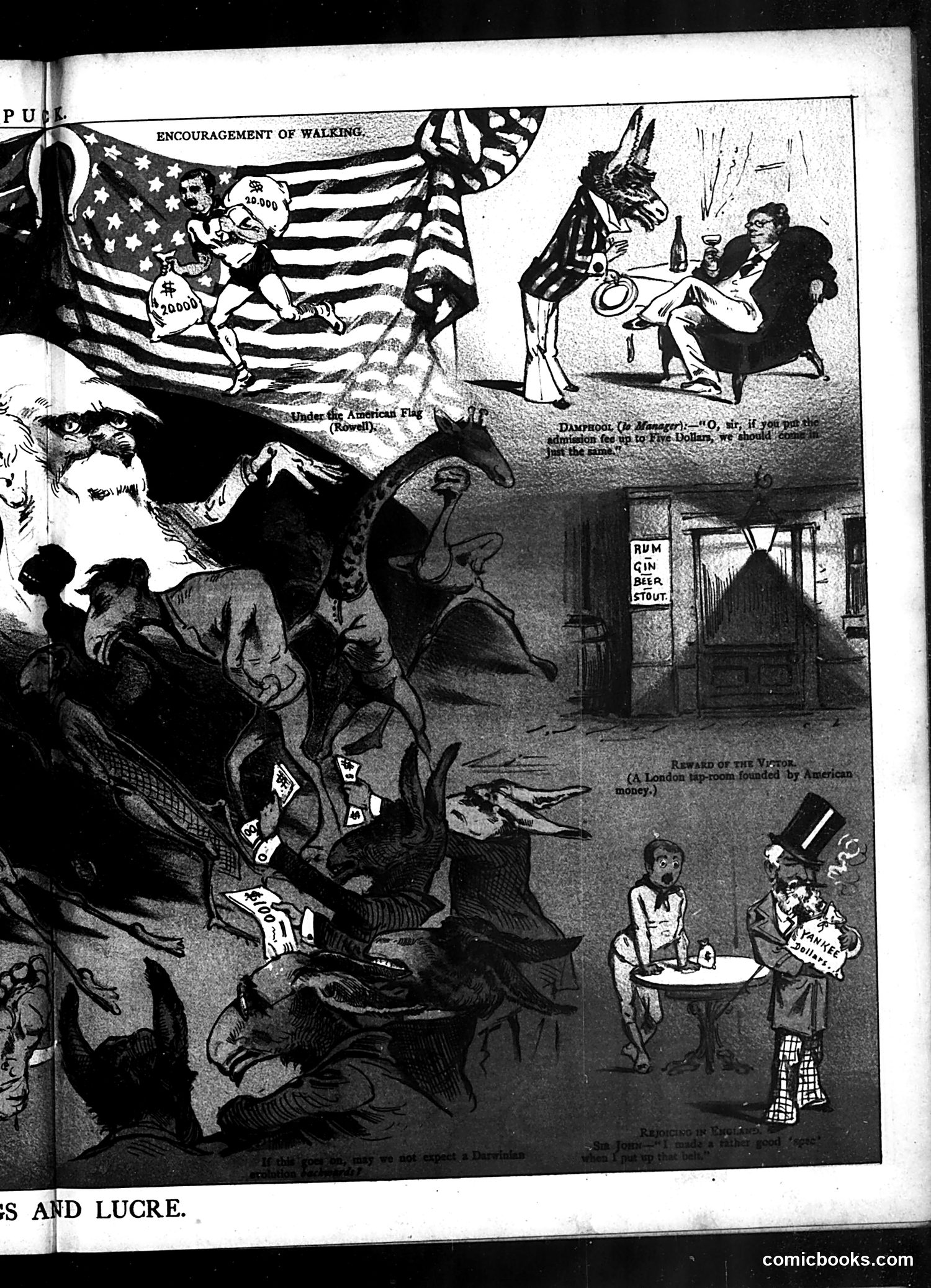
This page contains multiple satirical cartoons on the theme of "Encouragement of Walking" (visible at top). The cartoons appear to criticize American attitudes toward alcohol and temperance during what was likely the Prohibition era. The top panels show jingoistic imagery with American flags and money, seemingly mocking wealthy Americans' indulgence. The larger central cartoon depicts various figures engaged with alcohol (visible signage reads "RUM GIN BEER STOUT"), suggesting hypocrisy around temperance laws. The bottom panel labeled "Reward of the Victor" shows a London bar scene "founded by American money," implying American drinkers were funding foreign establishments while ostensibly supporting prohibition at home. The overall satire critiques the contradiction between America's official temperance stance and citizens' actual drinking habits and financial support of vice industries.
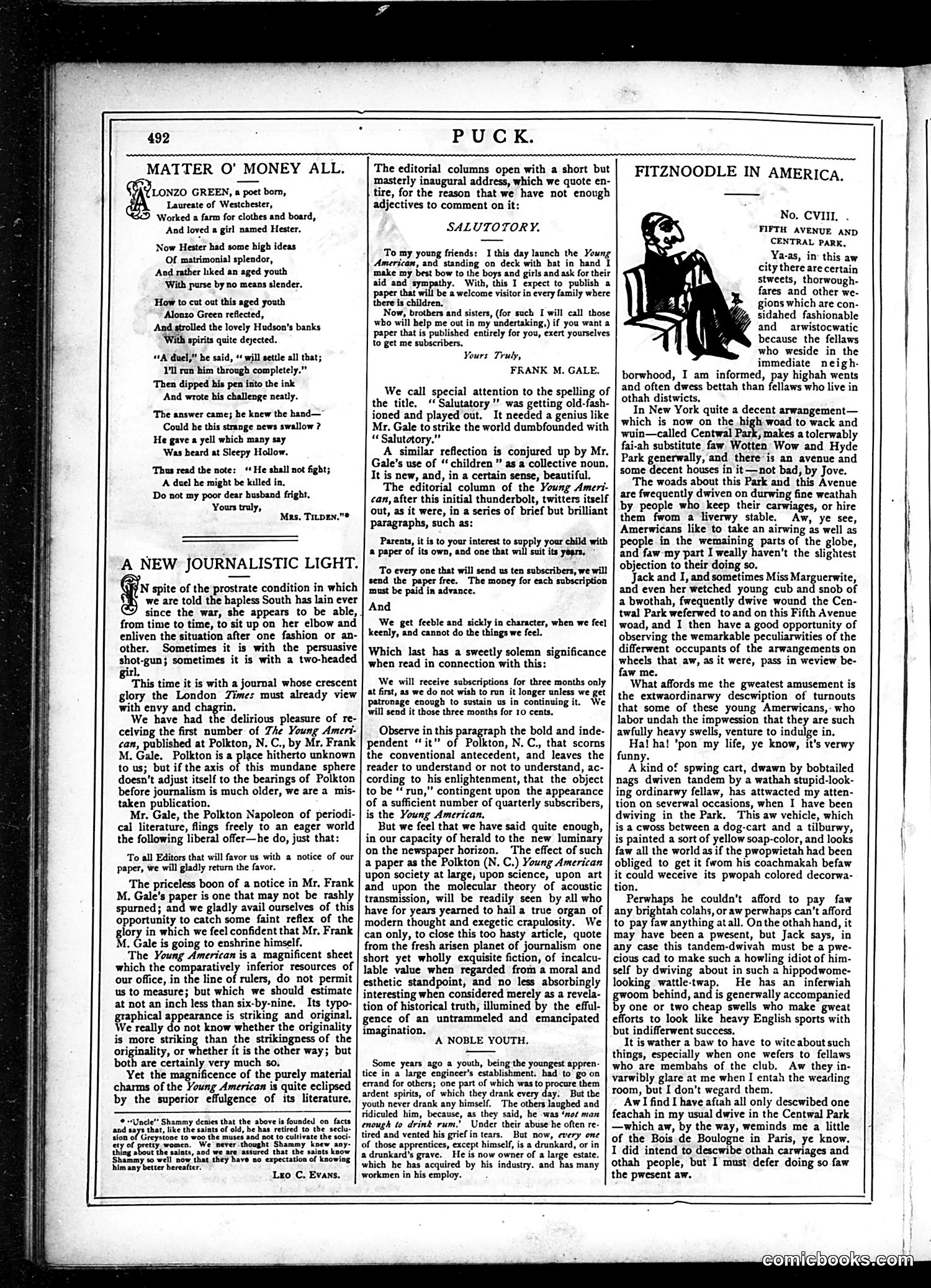
This cartoon satirizes Central Park carriage culture in New York City. The illustration shows a well-dressed gentleman observing the park's "fashionable" visitors—particularly wealthy people who hire carriages, drive in dog-carts, or employ livery services. The satire targets the pretentious behavior of these upper-class New Yorkers, who parade through the park in expensive vehicles as public displays of wealth and status. The accompanying text mocks how these "young Americans" use the park primarily for conspicuous consumption rather than genuine recreation. The piece critiques American social climbing and materialism, suggesting that fashionable society engages in hollow rituals of respectability. The cartoon's tone is one of bemused observation at how leisure activities become performances of social superiority.
This page is primarily **text content, not a cartoon**. It presents Chapter XXV of "Archie Gascoyne: A Romance of Skye," a serialized story by John Fraser written expressly for Puck magazine. The page contains narrative prose describing interactions between characters named Archie, Mademoiselle Thollier, and Mile. Thollier. The story appears to be a romantic adventure tale set in Scotland ("Skye"), featuring dialogue and character development rather than satirical commentary. No political or social satire is evident on this page—it's simply a continuation of serialized fiction that Puck magazine published alongside its cartoons and humorous content. The page number (493) indicates this was deep within the magazine's run.
This page is primarily **advertising and editorial content** rather than political cartoons. The main visual element is a small illustration labeled "Puck's Beginnings" showing chaotic figures, accompanied by humorous short items and jokes typical of Puck's format. The content includes satirical newspaper clippings and witty commentary on contemporary issues—references to political figures like Robinson, Weston, and Governor-General; social commentary on topics like small-pox prevention and school safety in San Francisco; and absurdist humor about everyday life. The bulk of the page features advertisements for clothing, corsets, and goods from H. O'Neill & Co., indicating this was a commercial publication balancing satire with revenue from retailers.
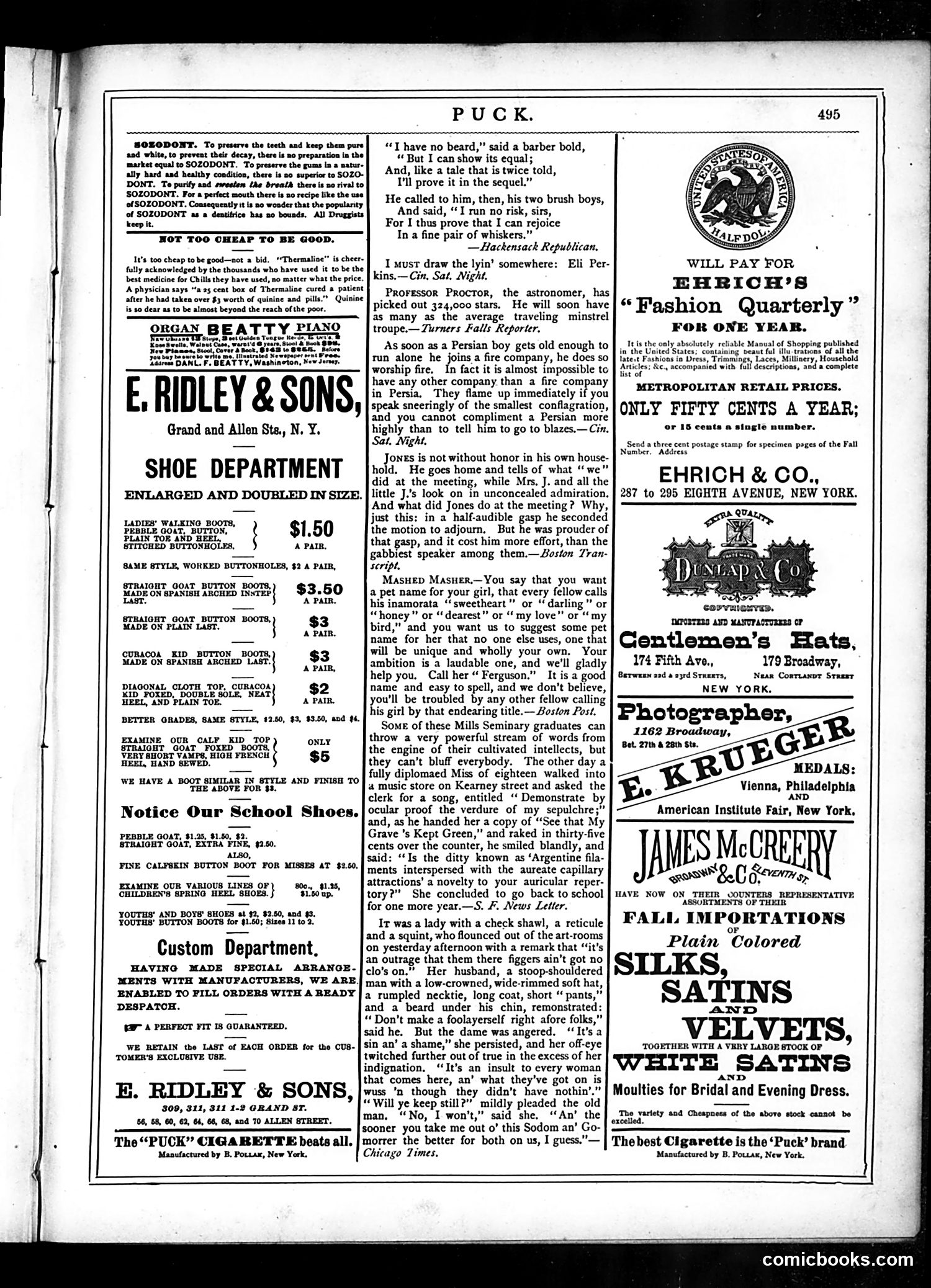
This page is **primarily advertisements** rather than satirical content. The visible material includes shoe department ads from E. Ridley & Sons (featuring boots and custom footwear), fashion and photography services, and notices for silks and satins. The text snippets that do appear (discussing a barber, fire worship in Persia, a Persian boy, and anecdotes about Jones and a masher) seem to be **filler content or brief humorous pieces** rather than major cartoons. They reference social situations of the era—fire worship, workplace meetings, and courtship customs—but without accompanying illustrations visible in this section, their satirical targets remain unclear. The page functions primarily as a **commercial vehicle** for period retailers and services.
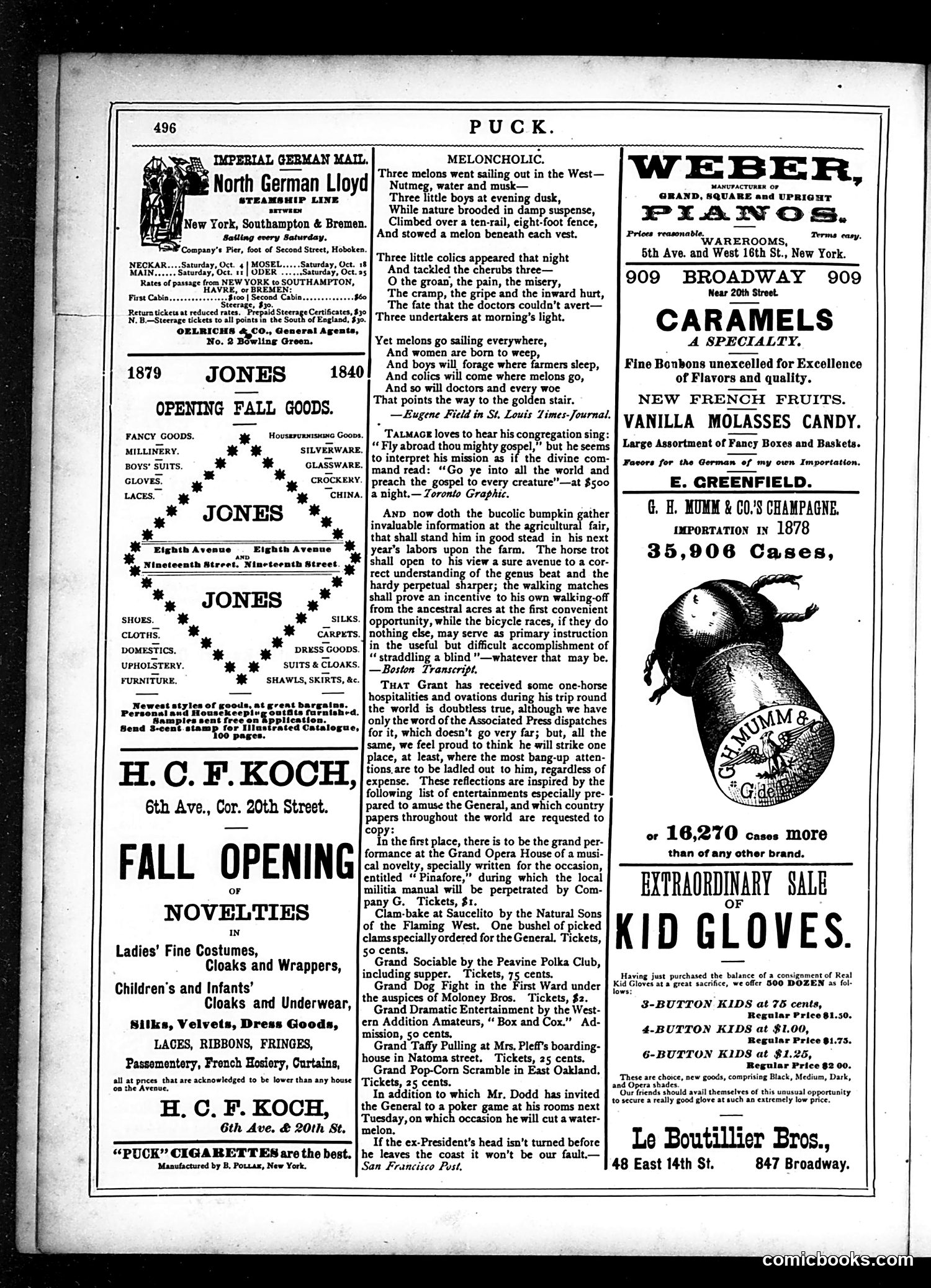
This page is **primarily advertising**, not a political cartoon. It contains multiple merchant advertisements for fall goods and services in what appears to be a late-19th-century American city (references to New York addresses appear throughout). Notable ads include: - Jones department store (opening fall goods) - H.C.F. Koch (fall opening novelties, clothing) - Weber (camels candy) - G.H. Mumm champagne - Le Boustillier Bros (kid gloves sale) The only editorial content is "Melancholic," a poem about melons and social commentary, along with brief commentary about General Grant's travels and various entertainments planned for him. The page reflects 1870s-80s American consumer culture and retail competition rather than political satire.
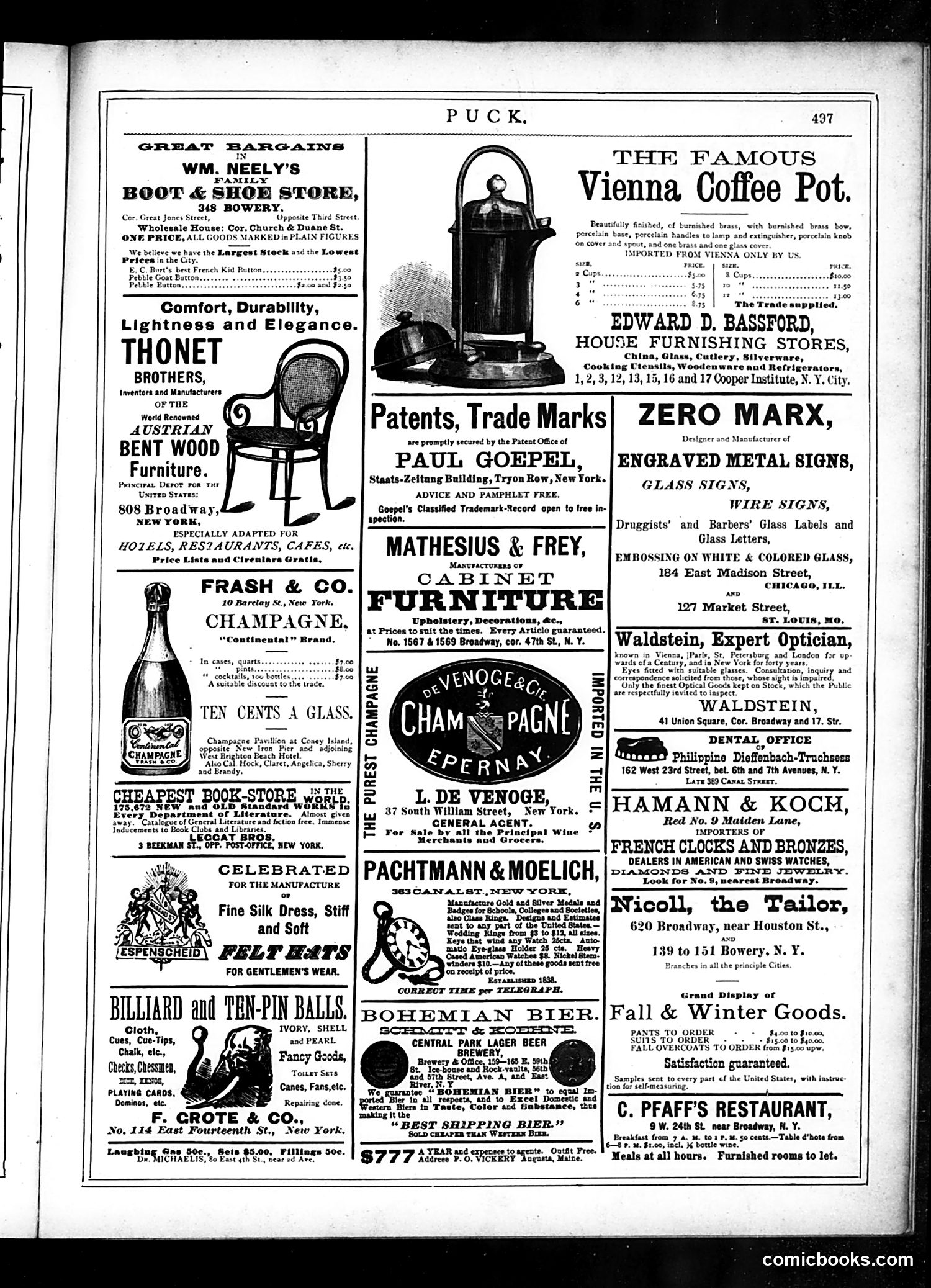
This page is primarily **advertising**, not political satire. It's page 497 from Puck magazine and contains commercial advertisements for various businesses including: - Boot and shoe stores - Furniture manufacturers - Coffee pots and house furnishings - Patent and trademark services - Champagne and beverages - Billiard tables and playing cards - Restaurants - Jewelry and clocks - Various other merchandise The advertisements feature product illustrations and company information typical of late 19th/early 20th-century magazine advertising. While Puck was known for satirical content, this particular page serves primarily as revenue-generating advertising space rather than containing political cartoons or social commentary requiring historical context to interpret.
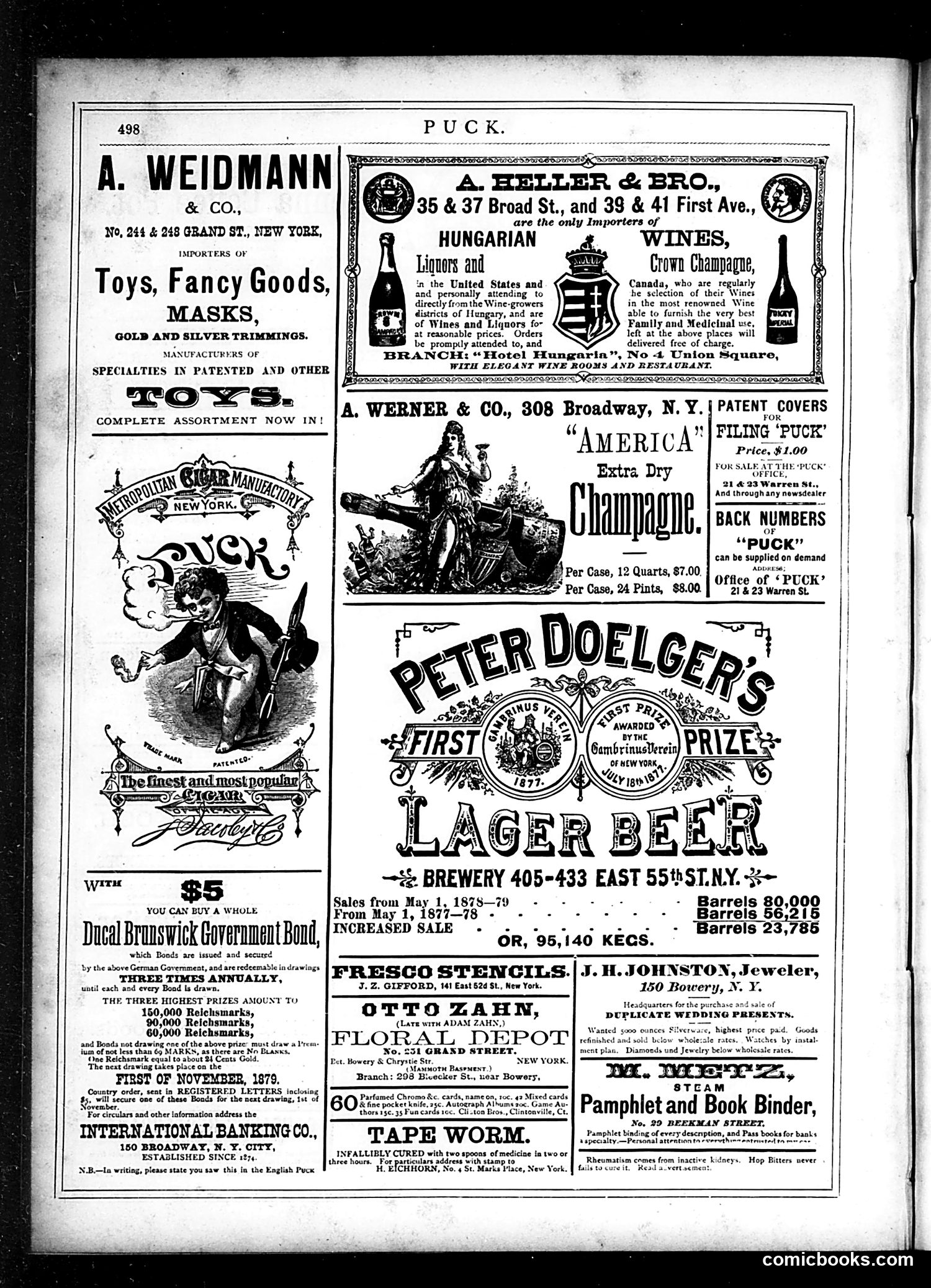
This page is primarily **advertising**, not political satire. It contains commercial advertisements for late 19th-century products and services: - A. Weidmann & Co. advertises toys and fancy goods - A. Beller & Bro. promotes Hungarian wines and champagne - Peter Doelger's Lager Beer claims "First Prize" awards - Otto Zahn offers a floral depot - J.H. Johnston advertises jewelry - W. Nighty & Co. promotes pamphlet and book binding The only illustration with potential satirical character is the Metropolitan Cigar Manufacturer logo, featuring a cherubic figure smoking a cigar—a common advertising trope rather than political commentary. This appears to be a standard **classified advertising section** from Puck magazine, where businesses purchased space to reach the publication's affluent readership.
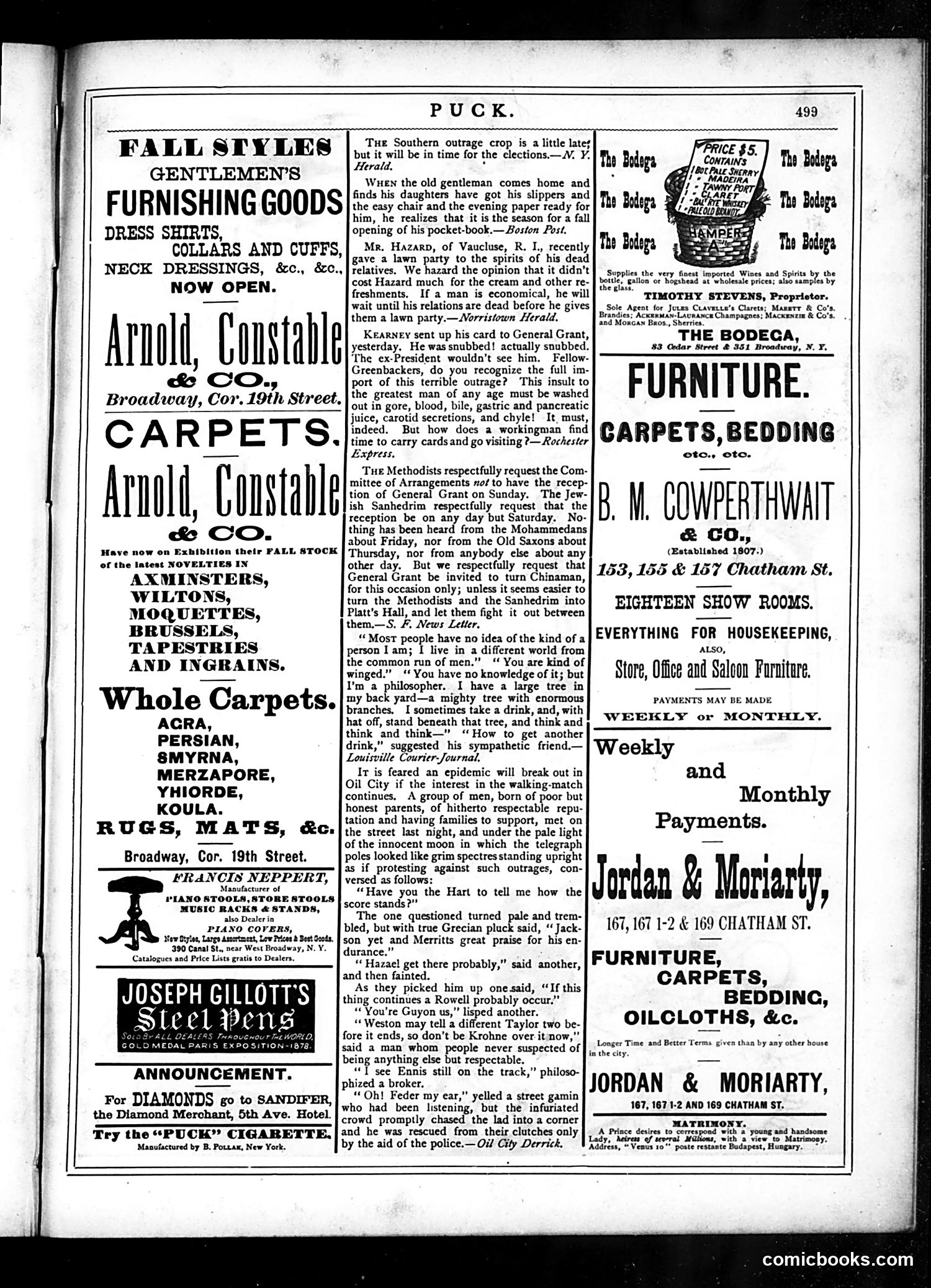
This page is primarily **advertisements** for furniture, carpets, and furnishing goods from late 19th-century New York businesses (Arnold Constable, B.M. Cowperthwait & Co., Jordan & Moriarty). The center contains **brief satirical pieces** rather than illustrated cartoons, including humorous anecdotes about: - An elderly man's lawn party (possibly mocking upper-class social rituals) - A street confrontation involving someone named Hazard and police intervention - Various social commentary on urban life and class differences The pieces reference newspapers like the *Boston Post*, *Rochester Express*, and *Louisville Courier-Journal*, suggesting Puck reprinted humor from regional sources. **No major political figures or clear caricatures are visible.** The satire targets general social pretensions and urban incidents rather than specific political events or personalities.
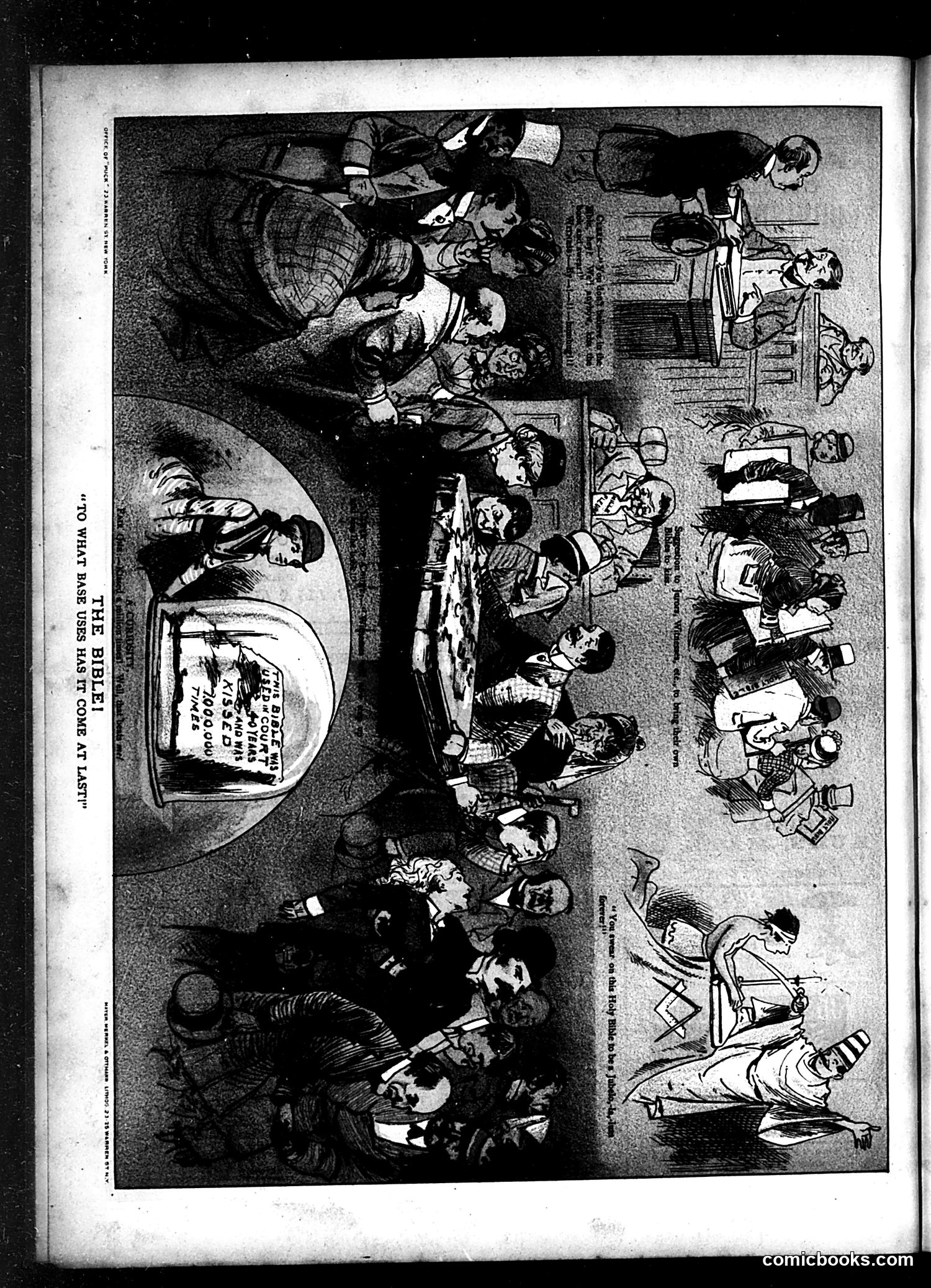
This page appears to contain multiple satirical cartoon panels arranged vertically, though the image quality makes specific details difficult to read with certainty. The OCR text is largely illegible in the provided excerpt. From the visible imagery, the cartoons appear to depict social or political commentary typical of Puck's satirical style—showing various figures in exaggerated poses and situations. There are what appear to be caricatured characters in Victorian-era clothing engaged in various scenarios. **Without clearer OCR text or more legible image details, I cannot confidently identify the specific political figures, events, or satirical points being made.** The artistic style and layout suggest early-to-mid Puck magazine content, but determining the exact subjects and commentary requires text clarity I cannot achieve from this reproduction.