
Puck, 1879-10-08 · page 5 of 18
Puck — October 8, 1879 — page 5: what you’re looking at
What you’re looking at
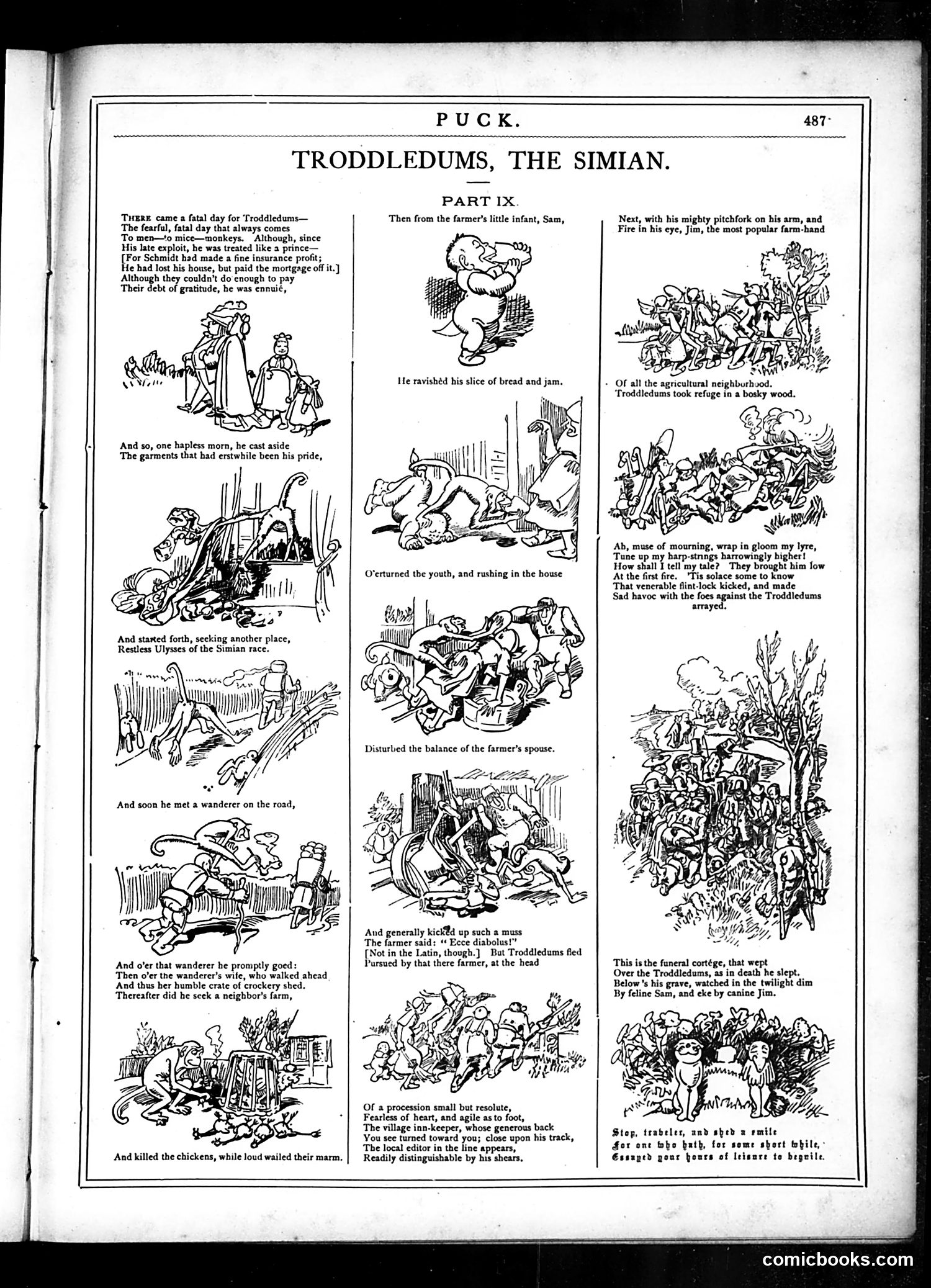
This Puck installment satirizes a character named "Troddledums" through an extended narrative poem with illustrations. The story describes a poor farmer's misfortunes when a wandering Simian (ape-like figure) arrives at his property. The creature ravages the farm—eating bread and jam, disturbing his wife, destroying his chickens, and causing general chaos and poverty. The satire appears to target either a specific politician or political faction through the "Simian" metaphor, using animal caricature to mock them as destructive and foolish. Without clearer historical context identifying which figure or event Troddledums represents, the exact political target remains unclear, though the overall message condemns the subject as ruinous to ordinary working people.
📄 Transcribed text from this page (OCR, searchable)
Machine-transcribed from the original scan — historical spelling and the odd misread are preserved.
PUCK. TRODDLEDUMS, THE SIMIAN. PART IX ‘THERE came a fatal day for ‘Troddledums— Then from the farmer’s little infant, Sam, Next, with his mighty pitchfork on his arm, and The fearful, fatal day that always comes Fire in his eye, Jim, the most popular farm-hand To men—to mice—monkeys. Although, since His late exploit, he was treated like a prince— [For Schmidt hed made a fine insurance profit; le had lost his house, but paid the mortgage off it.] Although they couldn't do enough to pay Their debt of gratitude, he was ennuié, + Of all the agricultural neighburhvod. ‘Troddledums took refuge in a bosky wood. a And so, one hapless morn, he cast aside ‘The garments that had erstwhile been his pride, That venerable flint-lock kicked, and made Sad havoc with the foes against the Troddledums arrayed. And started forth, seeking another place, Restless Ulysses of the Simian race. rh) et] And generally kick@d up such a muss The farmer said: ‘* Ecce diabolus!” [Not in the Latin, though.] But Troddledums fled And o'er that wanderer he promptly goed: Pursued by that there farmer, at the head ‘Then o'er the wanderer’s wile, who walked ahead And thus her humble crate of crockery shed. ‘Thereafter did he seek a neighbor's farm, This is the funeral cortége, that wept Over the Troddledums, as in death he slept. Below’'s his grave, watched in the twilight dim By feline Sam, and eke by canine Jim. Of a procession small but resolute, Fearless of heart, and agile as to foot, The village inn-keeper, whose generous back You see turned toward you; close upon his track, The local editor in the line appears, And killed the chickens, while loud wailed their marm. | Readily distinguishable by his shears. Stop, trabeler, amd shed x emile for ont bho bath, f Essxged gear bor or some short tobile,” of leisare to begeile. Ab, muse of mourning, wrap in gloom my lyre, Tune up my harp-stnngs harrowingly higher! How shall I tell my tale? They brought him fow At the first fire. | 'Tis solace some to know comicbooks.com