
Puck, 1879-10-08 · page 4 of 18
Puck — October 8, 1879 — page 4: what you’re looking at
What you’re looking at
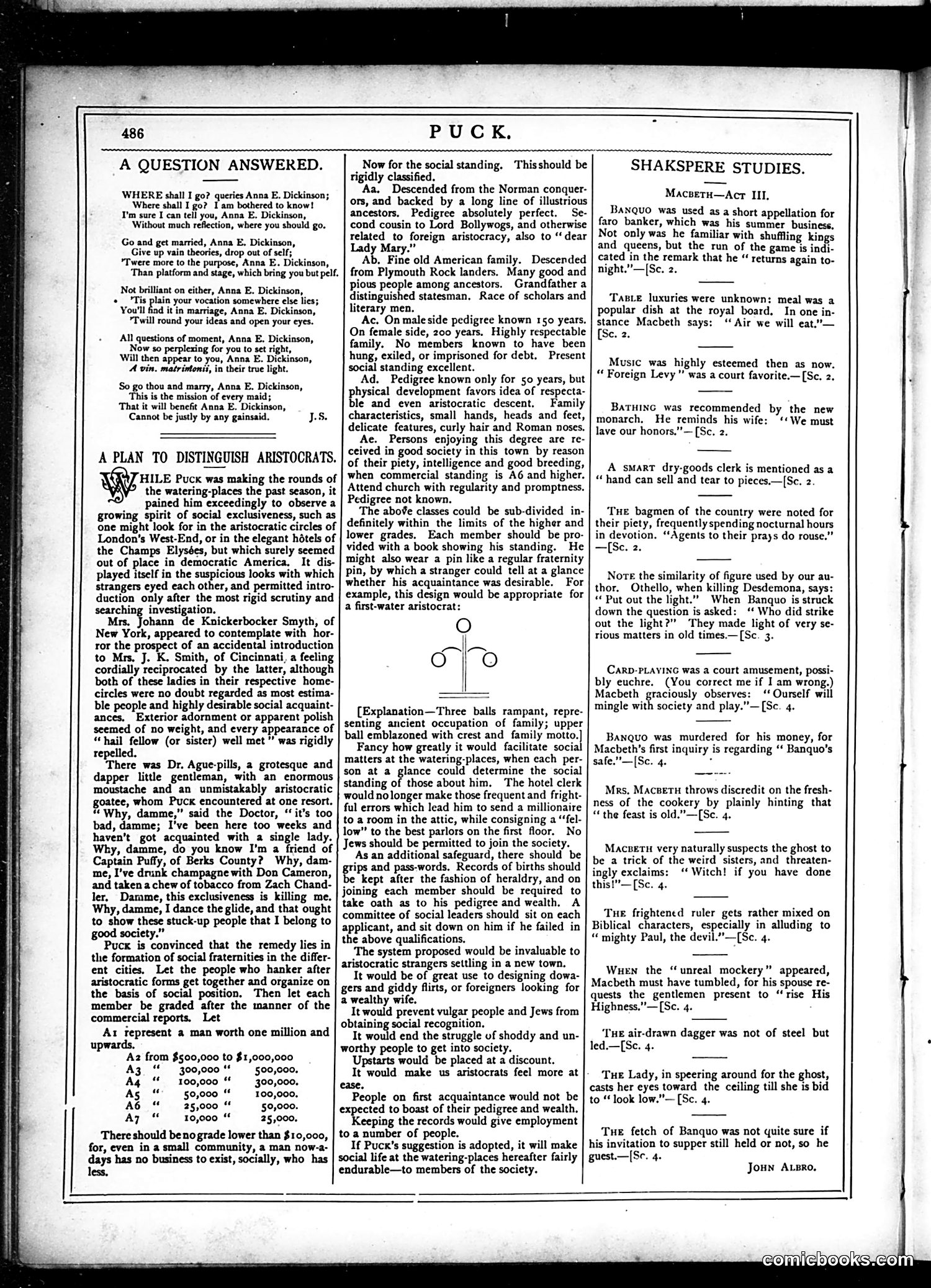
This satirical piece mocks late 19th-century American social pretension. It proposes a system using three interlocking circles (a heraldic design) to mark social standing at gatherings—allowing strangers to instantly identify someone's aristocratic rank. The joke targets the absurdity of nouveau riche Americans obsessing over European-style class distinctions and hereditary credentials. Puck ridicules how wealthy New Yorkers, lacking genuine aristocratic lineage, desperately mimicked Old World social hierarchies. The satire suggests that such visible ranking systems, while facilitating social climbing, reveal the shallow artificiality of American "aristocracy"—people judged by wealth rather than authentic bloodline or character. The proposal's ridiculous practicality (badges worn at parties) underscores the magazine's skepticism toward democratic America's embrace of unearned elitism.
📄 Transcribed text from this page (OCR, searchable)
Machine-transcribed from the original scan — historical spelling and the odd misread are preserved.
486 PUCK. A QUESTION ANSWERED. WHERE shall I go? queries Anna E. Dickinson; Where shall I go? I am bothered to know! I'm sure I can tell you, Anna E. Dickinson, Without much reflection, where you should go. Go and get married, Anna E. Dickinson, Give up vain theories, drop out of self; "Twere more to the purpose, Anna E. Dickinson, ‘Than platform and stage, which bring you but pelf. iant on either, Anna E. Dickinson, * eis plain your vocation somewhere else liess You'll find it in marriage, Anna E. Dickinson, "Twill round your ideas and open your eyes. All questions of moment, Anna E. Dickinson, Now so perplexing for you to set right, Will then appear to you, Anna E. Dickinson, A vin. matrimonii, in their true light. So go thou and marry, Anna E. Dickinson, This is the mission of every maid; That it will benefit Anna E. Dickinson, Cannot be justly by any gainsaid. Ls. A PLAN TO DISTINGUISH ARISTOCRATS. HILE Puck was making the rounds of the watering-places the past season, it pained him exceedingly to observe a growing spirit of social exclusiveness, such as one might look for in the aristocratic circles of London's West-End, or in the elegant hotels of the Champs Elysées, but which surely seemed out of place in democratic America, It dis- played itself in the suspicious looks with which strangers eyed each other, and permitted intro- duction only after the most rigid scrutiny and searching investigation, Mrs. Johann de Knickerbocker Smyth, of New York, appeared to contemplate with hor- ror the prospect of an accidental introduction to Mrs, J. K. Smith, of Cincinnati, a feeling cordially reciprocated by the latter, although both of these ladies in their respective home- circles were no doubt regarded as most estima- ble people and highly desirable social acquaint- ances, Exterior adornment or apparent polish seemed of no weight, and every appearance of “hail fellow (or sister) well met '? was rigidly repelled. There was Dr. Ague-pills, a grotesque and dapper little gentleman, with an enormous moustache and an unmistakably aristocratic goatee, whom Puck encountered at one resort. “Why, damme,” said the Doctor, ‘it’s too bad, damme; I’ve been here too weeks and haven’t got acquainted with a single lady. Why, damme, do you know I'm a friend of Captain Puffy, of Berks County? Why, dam- me, I’ve drank champagne with Don Cameron, and taken a chew of tobacco from Zach Chand- ler, Damme, this exclusiveness is killing me. Why, damme, I dance the glide, and that ought to show these stuck-up people that I belong to good society.” Pucx is convinced that the remedy lies in the formation of social fraternities in the differ- ent cities. Let the people who hanker after aristocratic forms get together and organize on the basis of social position. Then let each member be graded after the manner of the commercial reports, Let At represent a man worth one million and upwards, Az from $500,000 to $1,000,000 A3 ‘300,000 500,000. Aq ‘ = 100,000 “ 300,000, As ‘50,000 ‘100,000. A6 “ ~— 25,000 * 50,000. Az “10,000 “ 25,000, There should benograde lower than $10,000, for, even in a small community, a man now-a- days has no business to exist, socially, who has less, Now for the social standing. Thisshould be rigidly classified. Aa. Descended from the Norman conquer- ors, and backed by a long line of illustrious ancestors. Pedigree absolutely perfect. Se- cond cousin to Lord Bollywogs, and otherwise related to foreign aristocracy, also to “dear Lady Mary.” Ab. Fine old American family. Descended from Plymouth Rock landers. Many good and pious people among ancestors. Grandfather a Eistinguished statesman, Race of scholars and literary men. Ac, On male side pedigree known 150 years. On female side, 200 years. Highly respectable family. No members known to have been hung, exiled, or imprisoned for debt. Present social standing excellent. Ad. Pedigree known only for 50 years, but physical development favors idea of respecta- ble and even aristocratic descent, Family characteristics, small hands, heads and feet, delicate features, curly hair and Roman noses. ‘Ae. Persons enjoying this degree are re- ceived in good society in this town by reason of their piety, intelligence and good breeding, when commercial standing is A6 and higher. Attend church with regularity and promptness. Pedigree not known. The above classes could be sub-divided in- definitely within the limits of the higher and lower grades. Each member should be pro- vided with a book showing his standing. He might also wear a pin like a regular fraternity pin, by which a stranger could tell at a glance whether his acquaintance was desirable. For example, this design would be appropriate for a first-water aristocrat: [Explanation—Three balls rampant, repre- senting ancient occupation of family; upper ball emblazoned with crest and family mest Fancy how greatly it would facilitate soci matters at the watering-places, when cach per- son at a glance could determine the social standing of those about him, The hotel clerk would no longer make those frequent and fright- ful errors which lead him to send a millionaire to a room in the attic, while consigning a “‘fel- low” to the best parlors on the first floor. No Jews should be permitted to join the society. As an additional safeguard, there should be grips and pass-words. Records of births should be kept after the fashion of heraldry, and on joining each member should be required to take oath as to his pedigree and wealth, A committee of social leaders should sit on cach applicant, and sit down on him if he failed in the above qualifications. The system proposed would be invaluable to aristocratic strangers settling in a new town. It would be of great use to designing dowa- gers and giddy flirts, or foreigners looking for a wealthy wife. It would prevent vulgar people and Jews from obtaining social recognition, It would end the struggle of shoddy and un- worth; le to get into society, Upstarts would be placed at a discount. It would make us aristocrats feel more at case. People on first acquaintance would not be expected to boast of their pedigree and wealth, eeping the records would give employment to a number of people. If Puck's suggestion is adopted, it will make social life at the watering-places hereafter fairly endurable—to members of the society. SHAKSPERE STUDIES. MaceetH—Acr III, Banquo was used as a short appellati faro banker, which was his siaieer Dune Not only was he familiar with shuffling kings and queens, but the run of the game is indy- cated in the remark that he “ returns again to- night.”"—[Sc. 2. ‘Tawte luxuries were unknown: meal was a popular dish at the royal board, In one in- stance Macbeth says: “Air we will eat." [Se. 2. Music was highly esteemed then as now. “ Foreign Levy " was a court favorite.—[Sc. 2. BATHING was recommended by the new monarch, He reminds his wife: ‘‘*We must lave our honors.”—[Sc. 2. A smart dry-goods clerk is mentioned as a “hand can sell and tear to pieces.—[Sc. 2 ‘Tue bagmen of the country were noted for their piety, frequently spending nocturnal hours in devotion. ‘Agents to their prays do rouse.” —[Se. 2. Nore the similarity of figure used by our au- thor. Othello, when killing Desdemona, says: “Put out the light.” When Banquo is struck down the question is asked: ‘ Who did strike out the light?” They made light of very se- rious matters in old times.—[Sc. 3. CARD-PLAYING was a court amusement, possi- bly euchre. (You correct me if I am wrong.) Macbeth graciously observ “ Ourself will mingle with society and play.”—[Sc. 4. Banquo was murdered for his money, for Macbeth’s first inquiry is regarding “ Banquo’s safe."—[Sc. 4. : Mrs. Macsetu throws discredit on the fresh- ness of the cookery by plainly hinting that “the feast is old.”—[Sce. 4. Maczeti very naturally suspects the ghost to be a trick of the weird sisters, and threaten- ingly exclaims: “Witch! if you have done this!"—[Sc. 4. Tue frightened ruler gets rather mixed on Biblical characters, especially in alluding to “ mighty Paul, the devil"—[Sc. 4. Wuen the “unreal mockery” appeared, Macbeth must have tumbled, for his spouse re- quests the gentlemen present to “rise His Highness.”"—[Sc. 4. ‘Tue air-drawn dagger was not of steel but led.—[Sc. 4. Tue Lady, in speering around for the ghost, casts her eyes toward the ceiling till she is bid to “look low.""—[Sc. 4. Tue fetch of Banquo was not quite sure if his invitation to supper still held or not, so he guest.—[Se. 4. Joun ALsro. COMIECDOOKS*CO