
Puck, 1879-10-08 · page 10 of 18
Puck — October 8, 1879 — page 10: what you’re looking at
What you’re looking at
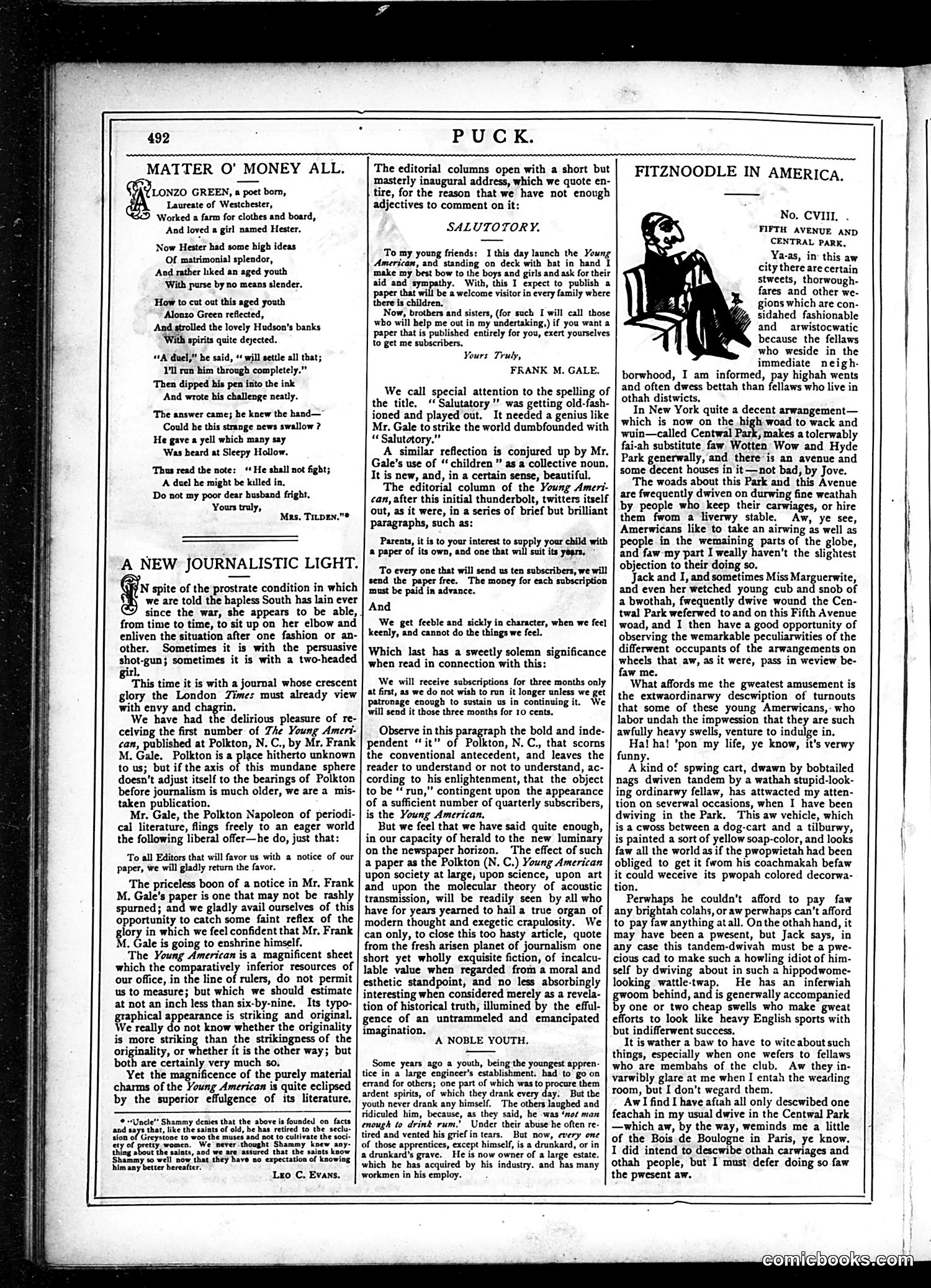
This cartoon satirizes Central Park carriage culture in New York City. The illustration shows a well-dressed gentleman observing the park's "fashionable" visitors—particularly wealthy people who hire carriages, drive in dog-carts, or employ livery services. The satire targets the pretentious behavior of these upper-class New Yorkers, who parade through the park in expensive vehicles as public displays of wealth and status. The accompanying text mocks how these "young Americans" use the park primarily for conspicuous consumption rather than genuine recreation. The piece critiques American social climbing and materialism, suggesting that fashionable society engages in hollow rituals of respectability. The cartoon's tone is one of bemused observation at how leisure activities become performances of social superiority.
📄 Transcribed text from this page (OCR, searchable)
Machine-transcribed from the original scan — historical spelling and the odd misread are preserved.
492 PUCK. MATTER O’ MONEY ALL. 'LONZO GREEN, a poet born, Laureate of Westchester, ‘Worked a farm for clothes and board, ‘And loved a girl named Hester. Now Hester had some high ideas Of matrimonial splendor, ‘And rather liked an aged youth ‘With purse by no means slender. How to cut out this aged youth ‘Alonzo Green reflected, And strolled the lovely Hudson’s banks ‘With spirits quite deyected. “+A duel,” he said, « will settle all that; 1'll run him through completely.” ‘Then dipped his pen inito the ink ‘And wrote his challenge neatly. ‘The answer came; he knew the hand— Could he this strange news swallow ? He gave a yell which many say ‘Was heard at Sleepy Hollow. Thus read the note: “He shall not fight; A deel he might be killed in. Do not my poor dear husband fright, Yours traly, Mas. TiLpEw.”* A NEW JOURNALISTIC LIGHT. 'N spite of the prostrate condition in which we are told the hapless South has lain ever since the war, she appears to be able, from time to time, to sit up on her elbow and enliven the situation after one fashion or an- other, Sometimes it is with the persuasive shot-gun; sometimes it is with a two-headed 1, This time it is with a journal whose crescent glory the London 7Zimes must already view with envy and chagrin. We have had the delirious pleasure of re- ceiving the first number of The Young Ameri- can, published at Polkton, N. C., by Mr. Frank M. Gale. Polkton is a place hitherto unknown to us; but if the axis of this mundane sphere doesn’t adjust itself to the bearings of Polkton before journalism is much older, we are a mis- taken publication, Mr. Gale, the Polkton Napoleon of periodi- cal literature, flings freely to an eager world the following liberal offer—he do, just that: To all Editors that will favor us with a notice of our paper, we will gladly return the favor. The priceless boon of a notice in Mr. Frank M. Gale's paper is one that may not be rashly spurned; and we gladly avail ourselves of this opportunity to catch some faint reflex of the lory in which we feel confident that Mr, Frank St Gale is going to enshrine himself. The Young American is a magnificent sheet which the comparatively inferior resources of our office, in the line of rulers, do not permit us to measure; but which we should estimate at not an inch less than six-by-nine. Its typo- graphical appearance is striking and original. We really do not know whether the originality is more striking than the strikingness of the originality, or whether it is the other way; but both are certainly very much so, Yet the magnificence of the purely material charms of the Young American is quite eclipsed by the superior effulgence of its literature, * Une! Leo C. Evans. The editorial columns open with a short but masterly inaugural address, which we quote en- tire, for the reason that we have not enough adjectives to comment on it: SALUTOTORY. To my young friends: I this day launch the Young American, and standing on deck with bat in hand I make my best bow to the boys and girls and ask for their aid and sympathy. With, this I expect to publish a paper that will be a welcome visitor in every family where there is children, Now, brothers and sisters, (for such I will call those who will help me out in my undertaking,) if you want a paper that is published entirely for you, exert yourselves to get me subscribers. Yours Truly, FRANK M. GALE. We call special attention to the spelling of the title. ‘Salutatory ” was getting old-fash- ioned and played out. It needed a genius like Mr. Gale to strike the world dumbfounded with “ Salutotory.”” A similar reflection is conjured up by Mr. Gale's use of “children ” as a collective noun. It is new, and, in a certain sense, beautiful. The editorial column of the Young Ameri- can, after this initial thunderbolt, twitters itself out, as it were, in a series of brief but brilliant paragraphs, such as: Parents, it is to your interest to supply your child with ‘8 paper of its own, and one that will suit its years, To every one that vil geod as ten subscribers, we will send the free. The money for each subscription must be paid in advance. oe And ‘We get feeble and sickly in character, when we feel keenly, and cannot do the things we feel. Which last has a sweetly solemn significance when read in connection with this: We will receive subscriptions for three months only at first, as we do not wish to run it longer unless we get patronage enough to sustain us in continuing it. We will send it those three months for 10 cents, Observe in this ph the bold and inde- pendent “it” of Polkton, N.C., that scorns the conventional antecedent, and leaves the reader to understand or not to understand, ac- cording to his enlightenment, that the object to be “run,” contingent upon the appearance of a sufficient number of quarterly subscribers, is the Young American, But we feel that we have said quite enough, in our capacity of herald to the new luminary on the newspaper horizon. The effect of such a paper as the Polkton (N. C.) Young American upon society at large, upon science, upon art and upon the molecular theory of acoustic transmission, will be readily seen by all who have for years yearned to hail a true organ of modern thought and exegetic crapulosity. We can only, to close this too hasty article, quote from the fresh arisen planet of journalism one short yet wholly exquisite fiction, of incalcu- lable value when regarded from a moral and esthetic standpoint, and no less absorbingly interesting when considered merely as a revela- tion of historical truth, illumined by the efful- gence of an untrammeled and emancipated imagination, A NOBLE YOUTH. Some years ago a youth, being the youngest appren- tice in a large engincer’s establishment. had to go on errand for others; one part of which was to procure them ardent spirits, of which they drank every day. But the youth never drank any himself. The others laughed and ridiculed him, because, as they said, he was ‘nof man enough to drink rum.’ Under their abuse he often re- tired and vented his grief in tears. But now, every one of those apprentices, except himself, is a drunkard, or in a drunkard’s grave. He is now owner of a large estate. which he has acquired by his industry. and has many workmen in his employ. FITZNOODLE IN AMERICA, No. CVIII, . FIFTH AVENUE AND CENTRAL PARK. _ Ya-as, in: this aw city there are certain stweets, thorwough- fares and other we- gions which are con- sidahed fashionable and arwistocwatic because the fellaws who weside in the immediate neigh- borwhood, I am informed, pay highah wents and often dwess bettah than fellaws who live in othah distwicts, In New York quite a decent arwangement— which is now on the high woad to wack and wuin—called Centwal Park, makes a tolerwably fai-ah substitute faw Wotten Wow and Hyde Park generwally, and there is an avenue and some decent houses in it—not bad, by Jove. The woads about this Park and this Avenue are fwequently dwiven on durwing fine weathah by people who keep their carwiages, or hire them fwom a liverwy stable. Aw, ye see, Amerwicans like to take an airwing as well as people in the wemaining parts of the globe, and faw-my part I weally haven’t the slightest objection to their doing so. Jack and I, and sometimes Miss Marguerwite, and even her wetched young cub and snob of a bwothah, fwequently dwive wound the Cen- twal Park weferwed to and on this Fifth Avenue woad, and I then have a good opportunity of observing the wemarkable peculiarwities of the differwent occupants of the arwangements on wheels that aw, as it were, pass in weview be- faw me. What affords me the gweatest amusement is the extwaordinarwy descwiption of turnouts that some of these young Amerwicans,: who labor undah the impwession that they are such awfully heavy swells, venture to indulge in. Hat! ha! 'pon my life, ye know, it's verwy funny. Akind of spwing cart, dwawn by bobtailed nags dwiven tandem by a wathah stupid-look- ing ordinarwy fellaw, has attwacted my atten- tion on severwal occasions, when I have been dwiving in the Park. This aw vehicle, which is a cwoss between a dog-cart and a tilburwy, is painted a sort of yellow soap-color, and looks faw all the world as if the pwopwietah had been obliged to get it fwom his coachmakah befaw it could weceive its pwopah colored decorwa- tion, Perwhaps he couldn't afford to pay faw any brightah colahs, or aw perwhaps can’t afford to pay faw anything at all. Onthe othah hand, it may have been a pwesent, but Jack says, in any case this tandem-dwivah must be a pwe- cious cad to make such a howling idiot of him- self by dwiving about in such a hippodwome- looking wattle-twap. He has an inferwiah srocn behind, and is generwally accompanied y one or two cheap swells who make gweat efforts to look like heavy English sports with but indifferwent success, It is wather a baw to have to wite about such things, especially when one wefers to fellaws who are membabs of the club. Aw they in- varwibly glare at me when I entah the weading room, but I don’t wegard them. Aw I find I have aftah all only descwibed one feachah in my usual dwive in the Centwal Park —which aw, by the way, weminds me a little of the Bois de Boulogne in Paris, ye know. I did intend to descwibe othah carwiages and othah people, but I must defer doing so faw the pwesent aw.