
Puck, 1879-10-08 · page 6 of 18
Puck — October 8, 1879 — page 6: what you’re looking at
What you’re looking at
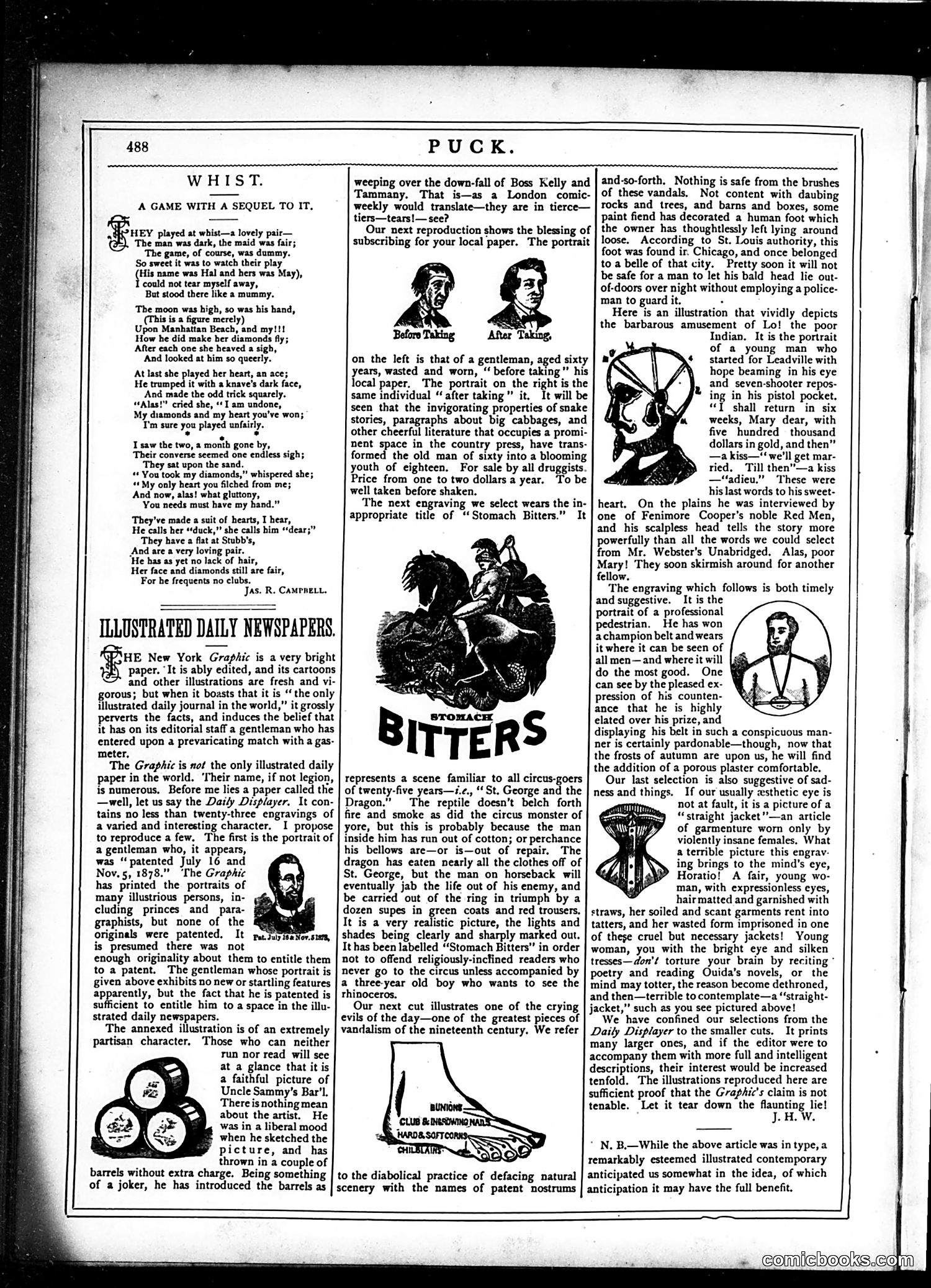
This page contains three main elements: a poem titled "Whist" (a card game), an article about illustrated daily newspapers, and a prominent advertisement for "Stomach Bitters." The article discusses *The New York Graphic*, praising it as the first illustrated daily newspaper with fresh, vigorous engravings. It credits the *Graphic* with introducing numerous innovative illustration techniques and patents. The piece defends the paper's use of sensational imagery—specifically mentioning a circus scene titled "St. George and the Dragon" depicting a man on horseback—against religious objections, arguing such illustrations serve important public purposes. The "Stomach Bitters" ad features a circus performer in a conspicuous belt and exaggerated pose, likely satirizing patent medicine marketing and the dubious health claims common in the era. The overall page reflects late 19th-century debates about journalism, illustration, and advertising ethics.
📄 Transcribed text from this page (OCR, searchable)
Machine-transcribed from the original scan — historical spelling and the odd misread are preserved.
PUCK. W HIST. A GAME WITH A SEQUEL TO IT, Fx played at whist—a lovely pair— ‘The man was dark, the maid was fair; The game, of course, was dummy. So sweet it was to watch their play (tls name was Hal and bers was May), could not tear myself away, Bat stood there like a mummy. The moon was high, so was his hand, (This is a figure merely) Upon Manhattan Beach, and my!!! How he did make her diamonds fly; After each one she heaved a sigh, ‘And looked at him so queerly. At last she played her heart, an ace; He trumped it with a knave's dark face, And made the odd trick squarely. “Alas!” cried she, I am undone, My diamonds and my heart you've won; T'm sure you played unfairly. fs I saw the two, a month gone by, ‘Their converse seemed one endless sigh; ‘They sat upon the sand. ++ You took my diamonds,” whispered she; «My only heart you filched from me; And now, alas! what glattony, You needs must have my hand.” They've made a suit of hearts, I hear, luck,” she calls him “dear;” Her face and diamonds still are fair, For he frequents no clubs. Jas. R. Carnet. ILLUSTRATED DAILY NEWSPAPERS. HE New York Graphic is a very bright paper. ‘It is ably edited, and its cartoons and other illustrations are fresh and vi- gorous; but when it boasts that it is “the only illustrated daily journal in the world,” it grossly perverts the facts, and induces the belief that it has on its editorial staff a gentleman who has entered upon a prevaricating match with a gas- meter, The Graphic is not the only illustrated daily paper in the world. ‘Their name, if not legion, is numerous. Before me lies a paper called the —well, let us say the Daily Displayer. It con- tains no less than twenty-three engravings of a varied and interesting character. 1 propose to reproduce a few, The first is the portrait of a gentleman who, it appears, was “patented July 16 and Nov.5, 1878." ‘The Graphic has printed the portraits of many illustrious persons, in- cluding princes and para- graphists, but none of the originals were patented. It is presumed there was not enough originality about them to entitle them to a patent. The gentleman whose portrait is given above exhibits no new or startling features apparently, but the fact that he is patented is sufficient to entitle him to a space in the illu- strated daily newspapers. The annexed illustration is of an extremely partisan character. Those who can neither run nor read will see at a glance that it is a faithful picture of Uncle Sammy’s Bar'l, There isnothing mean about the artist. He was in a liberal mood E when he sketched the A picture, and has thrown in a couple of barrels without extra charge. Being something Pat. July 18a Nov. 51978, weeping over the down-fall of Boss Kelly and Tammany. That is—as a London comic- weekly would translate—they are in tierce— tiers—tears!— see? Our next reproduction shows the blessing of subscribing for your local paper. The portrait Before Taking After ‘Taking, on the left is that of a gentleman, aged sixty ears, wasted and worn, “before taking" his local paper. The portrait on the right is the same individual “ after taking” it. It will be seen that the invigorating properties of snake stories, paragraphs about big cabbages, and other cheerful literature that occupies a promi- nent space in the country press, have trans- formed the old man of sixty into a blooming youth of eighteen. For sale by all druggists Price from one to two dollars a year. To be well taken before shaken. The next engraving we select wears the in- appropriate title of “Stomach Bitters.” It BitreRs represents a scene familiar to all circus-goers of twenty-five years—i.¢., “St. George and the Dragon.” The reptile doesn’t belch forth fire and smoke as did the circus monster of yore, but this is probably because the man inside him has run out of cotton; or perchance his bellows are—or is—out of repair. ‘The dragon has eaten nearly all the clothes off of St. George, but the man on horseback will eventually jab the life out of his enemy, and be carried out of the ring in triumph by a dozen supes in green coats and red trousers, It is a very realistic picture, the lights and shades being clearly and sharply marked out. It has been labelled “Stomach Bitters” in order not to offend religiously-inclined readers who never go to the circus unless accompanied by a three-year old boy who wants to sce the thinoceros. Our next cut illustrates one of the crying evils of the day—one of the greatest pieces of vandalism of the nineteenth century. We refer to the diabolical practice of defacing natural and-so-forth. Nothing is safe from the brushes of these vandals. Not content with daubing Hs rocks and trees, and barns and boxes, some paint fiend has decorated a human foot which the owner has thoughtlessly left lying around loose. According to St. Louis authority, this } foot was found ir. Chicago, and once belonged i to a belle of that city. Pretty soon it will not be safe for a man to let his bald head lie out- of-doors over night without employing a police- man to guard it. ‘ Here is an illustration that vividly depicts the barbarous amusement of Lo! the poor Indian. It is the portrait of a young man who started for Leadville with hope beaming in his eye and _seven-shooter repos- ing in his pistol pocket. “T shall return in six weeks, Mary dear, with five hundred thousand dollars in gold, and then” —a kiss—* we'll get mar- ried. Til —“adieu.” ‘These were his last words to his sweet- heart. On the plains he was interviewed by one of Fenimore Cooper's noble Red Men, and his scalpless head tells the story more powerfully than all the words we could select from Mr. Webster's Unabridged. Alas, poor Mary! They soon skirmish around for another fellow. ‘The engraving which follows is both timely and suggestive. It is the portrait of a professional pedestrian. He has won achampion belt and wears it where it can be seen of all men—and where it will do the most good. One can see by the pleased ex- pression of his counten- ance that he is highly elated over his prize, and displaying his belt in such a conspicuous man- ner is certainly pardonable—though, now that the frosts of autumn are upon us, he will find the addition of a porous plaster comfortable. Our last selection is also suggestive of sad- ness and things. If our usually zsthetic eye is not at fault, it is a picture of a “straight jacket —an article of garmenture worn only by violently insane females, What a terrible picture this engrav. ing brings to the mind's eye, Horatio! A fair, young wo- man, with expressionless eyes, hairmatted and garnished with straws, her soiled and scant garments rent into tatters, and her wasted form imprisoned in one of these cruel but necessary jackets! Young woman, you with the bright eye and silken tresses—don't torture your brain by reciting * poetry and reading Ouida’s novels, or the mind may totter, the reason become dethroned, and then—terrible to contemplate—a “‘straight- f jacket,”’ such as you see pictured above! We have confined our selections from the Daily Displayer to the smaller cuts. It prints many larger ones, and if the editor were to accompany them with more full and intelligent descriptions, their interest would be increased tenfold. The illustrations reproduced here are sufficient proof that the Graphic's claim is not tenable. Let it tear down the flaunting lie! j. H.W. hen" —a kiss { i} N. B.—While the above article was in type, a remarkably esteemed illustrated contemporary anticipated us somewhat in the idea, of which of a joker, he has introduced the barrels as | scenery with the names of patent nostrums | anticipation it may have the full benefit. ~ comichooks.cqnn