
Puck, 1879-10-08 · page 7 of 18
Puck — October 8, 1879 — page 7: what you’re looking at
What you’re looking at
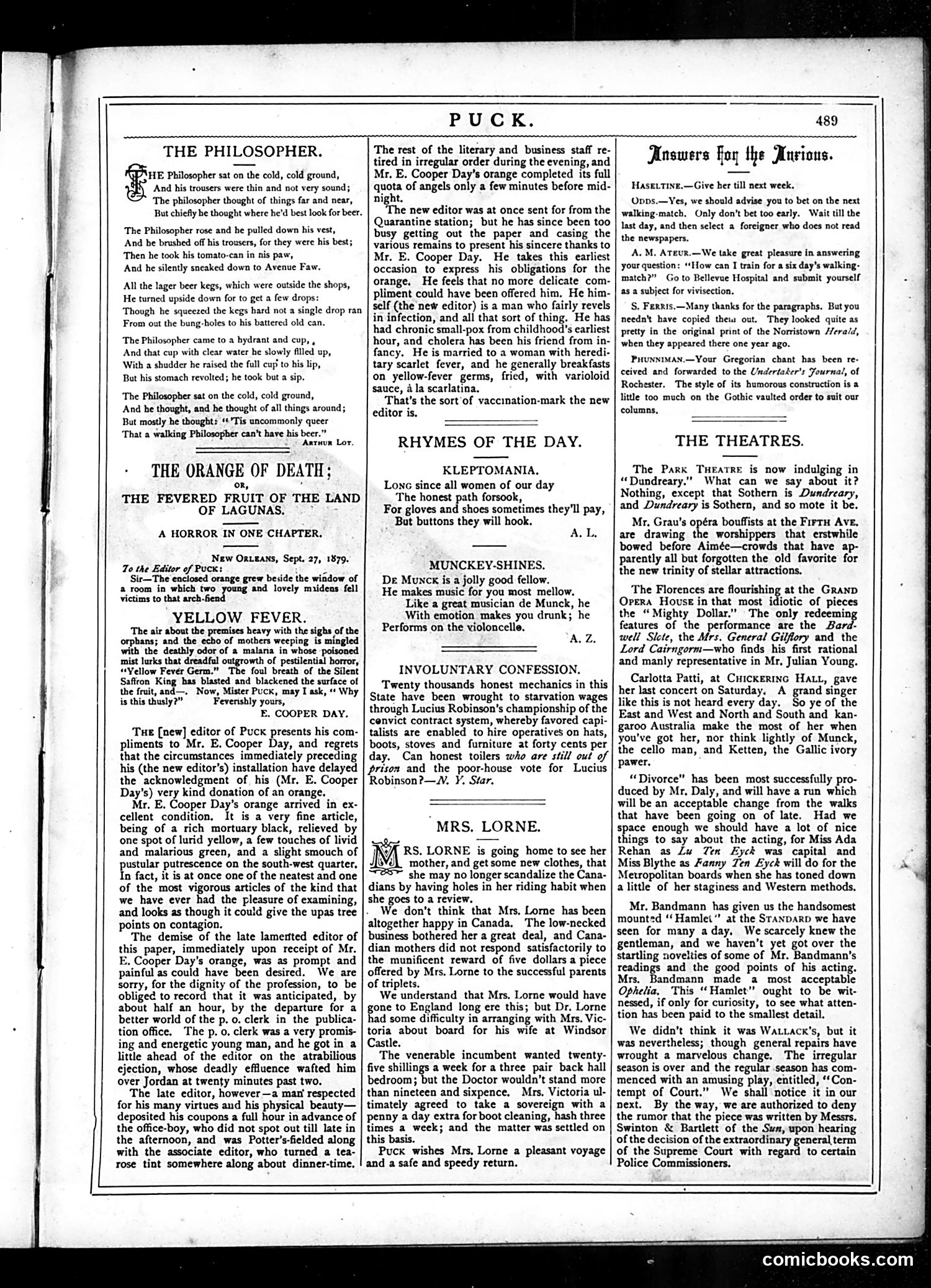
This page features a satirical poem called "The Philosopher" mocking an impractical intellectual. The poem describes a philosopher sitting in the cold, contemplating abstract ideas while ignoring practical discomforts—his legs ached, he's covered in beer stains, yet he's absorbed in thought. The satire targets the stereotype of the absent-minded academic divorced from reality. The accompanying verse mocks this detachment, suggesting the philosopher prioritizes useless theorizing over basic self-care and hygiene. The page also includes separate sections on theater reviews and social gossip ("Answers for the Curious"), typical of Puck's mixed content format. The overall tone ridicules intellectuals who neglect worldly concerns in pursuit of philosophy.
📄 Transcribed text from this page (OCR, searchable)
Machine-transcribed from the original scan — historical spelling and the odd misread are preserved.
PUCK. 489 THE PHILOSOPHER. k oe Philosopher sat on the cold, cold ground, And his trousers were thin and not very sound; ‘The philosopher thought of things far and near, But chiefly he thought where he'd best look for beer. ‘The Philosopher rose and he pulled down his vest, And he brushed off his trousers, for they were his best; Then he took his tomato-can in nis paw, And he silently sneaked down to Avenue Faw, All the lager beer kegs, which were outside the shops, He turned upside down for to get a few drops: Though he squeezed the kegs hard not a single drop ran From out the bung-holes to his battered old can. ‘The Philosopher came to a hydrant and cup, , And that cup with clear water he slowly filled up, With a shudder he raised the full cup to his lip, But his stomach revolted; he took but a sip. ‘The Philosopher sat on the cold, cold ground, And he thought, and he thought of all things around; Bat mostly he thoughts “Tis uncommonly queer ‘That a walking Philosopher can’t have his beer.” as - ate Axtnur Lor, THE ORANGE OF DEATH; THE FEVERED FRUIT OF THE LAND OF LAGUNAS, A HORROR IN ONE CHAPTER, New ORLEANS, Sept. 27, 1879. To the Editor of Puck: ae ‘Sir—The enclosed orange grew beside the window of a room in which two and lovely maidens fell victims to that arch. YELLOW FEVER. The air about the premises heavy with the sighs of the orphans; and the echo of mothers weeping is mingled with the deathly odor of a malana in whose poisoned mist lurks that dreadful outgrowth of pestilential horror, “Yellow Fever Germ.” The foul breath of the Silent Saffron King has blasted and blackened the surface of the fruit, and—. Now, Mister Puck, may I ask, “¢ Why is this thusly?” Fevenshly yours, E. COOPER DAY. Tue [new] editor of Puck presents his com- pliments to Mr. E, Cooper Day, and regrets that the circumstances immediately preceding his (the new editor's) installation have delayed the acknowledgment of his (Mr. E. Cooper Day's) very kind donation of an orange, Mr. E. Cooper Day’s orange arrived in ex- cellent condition. It is a very fine article, being of a rich mortuary black, relieved by ‘one spot of lurid yellow, a few touches of livid and malarious green, and a slight smouch of ustular putrescence on the south-west quarter, In fact, it is at once one of the neatest and one of the most vigorous articles of the kind that we have ever had the pleasure of examining, and looks as though it could give the upas tree points on contagion. The demise of the late lamertted editor of this paper, immediately upon receipt of Mr. E. Cooper Day's orange, was as prompt and painful as could have been desired. We are sorry, for the dignity of the profession, to be obliged to record that it was anticipated, by about half an hour, by the departure for a better world of the p. 0. clerk in the publica- tion office. The p. 0, clerk was a very promis- ing and energetic young man, and he got in a little ahead of the editor on the atrabilious ejection, whose deadly effluence wafted him over Jordan at twenty minutes past two. The late editor, however—a mam respected for his many virtues and his physical beauty— deposited his coupons a full hour in advance of the office-boy, who did not spot out till late in the afternoon, and was Potter’s-fielded along with the associate editor, who turned a tea- rose tint somewhere along about dinner-time, LU The rest of the literary and business staff re- tired in irregular order during the evening, and Mr. E. Cooper Day’s orange completed its full quota of angels only a few minutes before mid- night. ‘The new editor was at once sent for from the Quarantine station; but he has since been too busy getting out the paper and casing the various remains to present his sincere thanks to Mr. E. Cooper Day. He takes this earliest occasion to express his obligations for the orange, He feels that no more delicate com- pliment could have been offered him. He him- self (the 'new editor) is a man who fairly revels in infection, and all that sort of thing. He has had chronic small-pox from childhood’s earliest hour, and cholera has been his friend from in- fancy, He is married to a woman with heredi- tary scarlet fever, and he generally breakfasts on yellow-fever germs, fried, with varioloid sauce, a la scarlatina. That's the sort‘of vaccination-mark the new editor is, RHYMES OF THE DAY. KLEPTOMANIA, Lone since all women of our day The honest path forsook, For gloves and shoes sometimes they'll pay, But buttons they will hook. ALL. MUNCKEY-SHINES. De Munck is a jolly good fellow. He makes music for you most mellow. Like a great musician de Munck, he With emotion makes you drunk; he Performs on the violoncelle. A ~Z. INVOLUNTARY CONFESSION. Twenty thousands honest mechanics in this State have been wrought to starvation wages through Lucius Robinson's championship of the cenvict contract system, whereby favored capi- talists are enabled to hire operatives on hats, boots, stoves and furniture at forty cents per day. Can honest toilers who are still out of prison and the poor-house vote for Lucius Robinson?—W. Y. Star. MRS. LORNE. ] Ye RS. LORNE is going home to see her mother, and get some new clothes, that she may no longer scandalize the Cana- dians by having holes in her riding habit when she goes to a review. We don’t think that Mrs. Lorne has been altogether happy in Canada, The low-necked business bothered her a great deal, and Cana- dian mothers did not respond satisfactorily to the munificent reward of five dollars a piece offered by Mrs, Lorne to the successful parents of triplets. We understand that Mrs. Lorne would have gone to England long ere this; but Dr. Lorne ad some difficulty in arranging with Mrs. Vic- toria about board for his wife at Windsor Castle. The venerable incumbent wanted twenty- five shillings a week for a three pair back hall bedroom; but the Doctor wouldn’t stand more than nineteen and sixpence. Mrs. Victoria ul- timately agreed to take a sovereign with a penny a day extra for boot cleaning, hash three times a week; and the matter was settled on this basis. Puck wishes Mrs, Lorne a pleasant voyage and a safe and speedy return. Answers Foy the Anrions. HAsELTINE.—Give her till next week. Opps.—Yes, we should advise you to bet on the next walking-match, Only don’t bet too early. Wait till the last day, and then select a foreigner who does not read the newspapers. A.M. ATEUR.—We take great pleasure in answering your question: “How can I train for a six day's walking- match?” Go to Bellevue Hospital and submit yourself as a subject for vivisection. S. Fernis.—Many thanks for the paragraphs. But you needn't have copied thew out. They looked quite as pretty in the original print of the Norristown /erald, when they appeared there one year ago. PHUNNIMAN.—Your Gregorian chant has been re- ceived and forwarded to the Undertaker's Fournal, of Rochester. The style of its humorous construction is little too much on the Gothic vaulted order to suit our columns, THE THEATRES. The Park THEATRE is now indulging in “Dundreary.” What can we say about it? Nothing, except that Sothern is Dundreary, and Dundreary is Sothern, and so mote it be. Mr. Grau’s opéra bouffists at the FirtH AVE. are drawing the worshippers that erstwhile bowed before Aimée—crowds that have ap- parently all but forgotten the old favorite for the new trinity of stellar attractions. The Florences are flourishing at the Grand Orera Hovse in that most idiotic of pieces the “Mighty Dollar.” The only redeemin; features of the performance are the Bard- well Slete, the Mrs. General Gilflory and the Lord Cairngorm—who finds his first rational and manly representative in Mr. Julian Young. Carlotta Patti, at Cuickertnc Hatt, gave her last concert on Saturday, A grand singer like this is not heard every day. So ye of the East and West and North and South and kan- garoo Australia make the most of her when you've got her, nor think lightly of Munck, the cello man, and Ketten, the Gallic ivory pawer, “Divorce” has been most successfully pro- duced by Mr, Daly, and will have a run which will be an acceptable change from the walks that have been going on of late. Had we space enough we should have a lot of nice things to say about the acting, for Miss Ada Rehan as Lu Ten Eyck was capital and Miss Blythe as Fanny Ten Eyck will do for the Metropolitan boards when she has toned down a little of her staginess and Western methods, Mr. Bandmann has given us the handsomest mounted “Hamlet” at the Sranparp we have seen for many aday, We scarcely knew the gentleman, and we haven't yet got over the startling novelties of some of Mr. Bandmann’s readings and the good points of his acting. Mrs. Bandmann made a most acceptable Ophelia, This “Hamlet” ought to be wit- nessed, if only for curiosity, to see what atten- tion has been paid to the smallest detail. We didn’t think it was Wattack’s, but it was nevertheless; though general repairs have wrought a marvelous change, The irregular season is over and the regular season has com- menced with an amusing play, entitled, ‘‘Con- tempt of Court.” We shall notice it in our next. By the way, we are authorized to deny the rumor that the piece was written by Messrs. Swinton & Bartlett of the Sux, upon hearing of the decision of the extraordinary general term of the Supreme Court with regard to certain Police Commissioners. comicbooks.com