
A complete issue · 16 pages · 1879
Puck — June 25, 1879
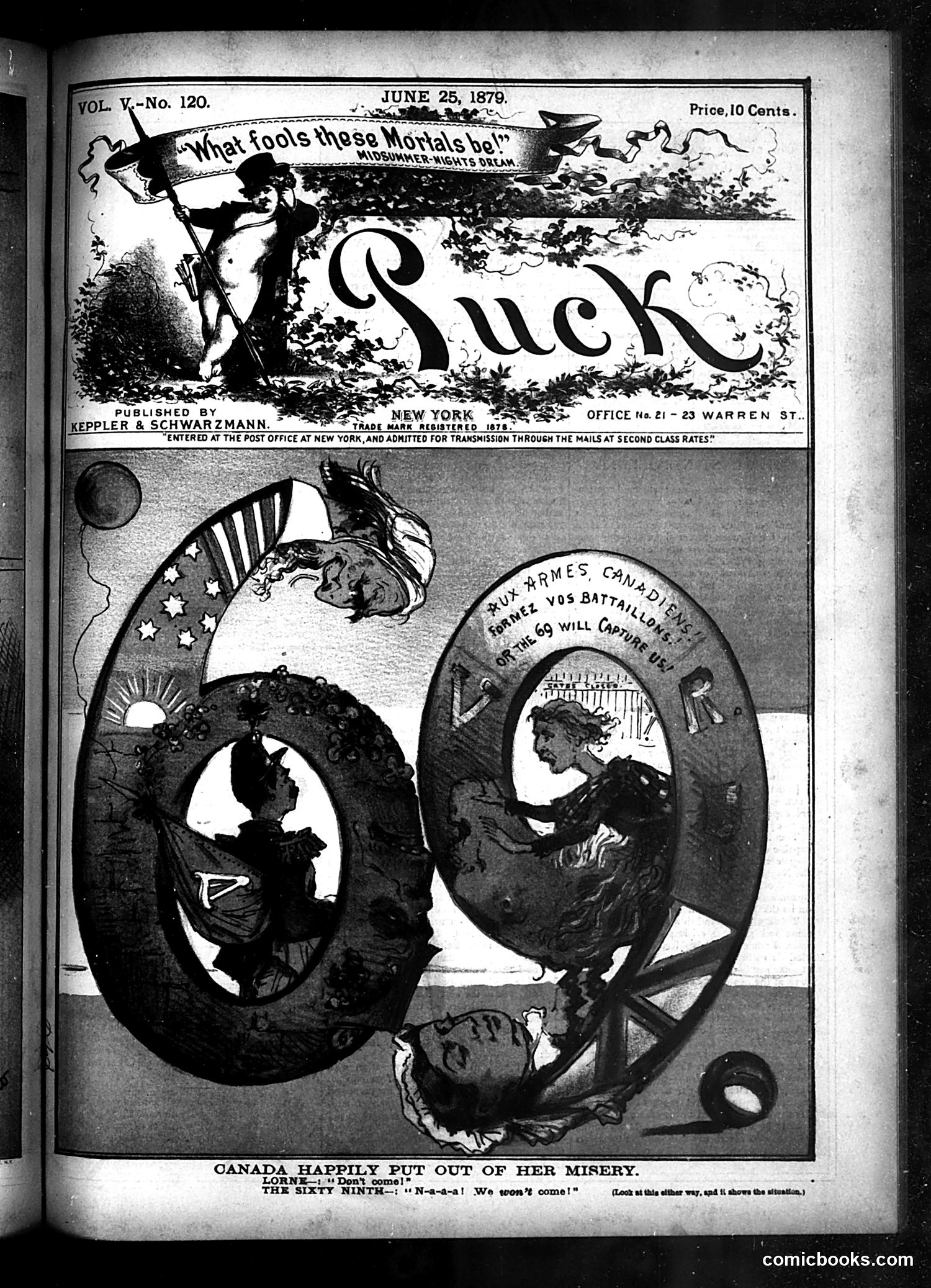
**"Canada Happily Put Out of Her Misery"** This cartoon satirizes Canada's political crisis during the "Sixty-Ninth" parliament. The large numbers "69" frame two figures: one labeled "Lorne" (likely the Governor General) saying "Don't come!" and another figure responding "N-n-a-a! We won't come!"—referring to politicians refusing to attend Parliament. The serpent at top represents political discord ("What fools these Mortals be!"). The cartoon mocks Canada's governmental paralysis and dysfunction, depicting the nation as suffering and unable to function. The satirical headline suggests Canada is being "put out of her misery" through this political collapse. This reflects real tensions in Canadian governance during this period.
This page is primarily **text content** rather than illustrated cartoons. The main article is a letter to Puck's editor discussing Colonel Austen of the 13th Regiment, N.G.S., N.Y. The writer critiques the Colonel's leadership, alleging he ignored soldiers' complaints after returning from Montreal and failed to enforce proper military discipline. Specific complaints include officers refusing to cut their hair to regulation length and showing "insubordination." The satirical point appears to be **mocking Colonel Austen's ineffective command**—the headline's pun "Hash Miller" suggests he's made a "hash" (mess) of his duties. The letter sarcastically questions whether he has the competence for his position, using detailed anecdotes of his failures to ridicule his authority. The remainder of the page contains miscellaneous humor items and advertisements typical of Puck magazine.
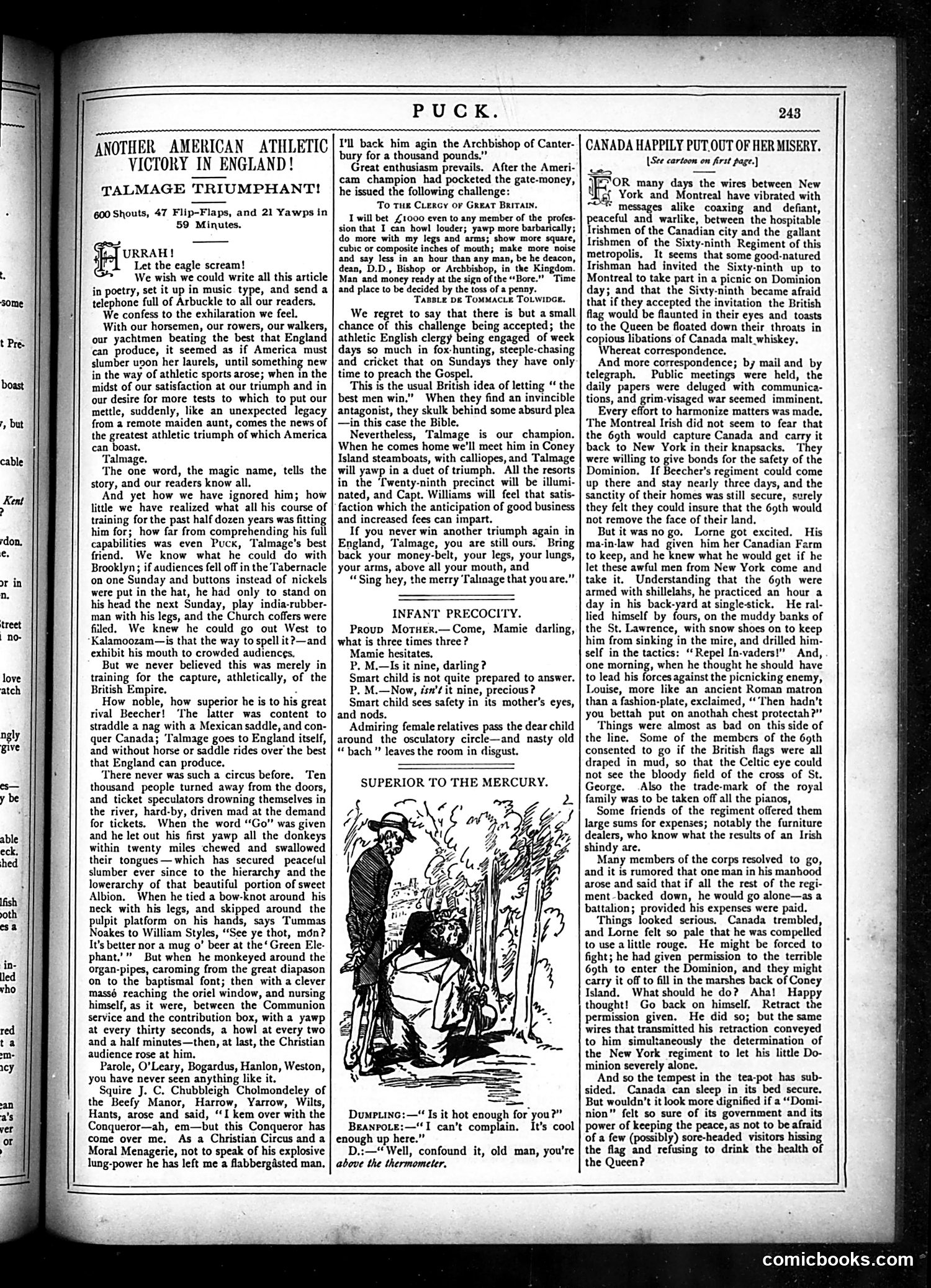
This page contains several satirical pieces. The main cartoon titled "SUPERIOR TO THE MERCURY" depicts a figure (likely a politician or public figure) being struck or attacked, illustrating conflict through physical comedy—common in Puck's visual satire. The text sections mock various targets: "ANOTHER AMERICAN ATHLETIC VICTORY IN ENGLAND" celebrates American sporting success over England; "CANADA HAPPILY PUT OUT OF HER MISERY" appears to satirize Canadian political troubles; and "INFANT PRECOCITY" presents a humorous dialogue about a clever child. The bottom cartoon shows two figures in conversation about temperature, with one appearing distressed. The overall page uses typical Puck conventions: mixing sports commentary, international relations humor, and everyday social satire to comment on contemporary American society and politics.
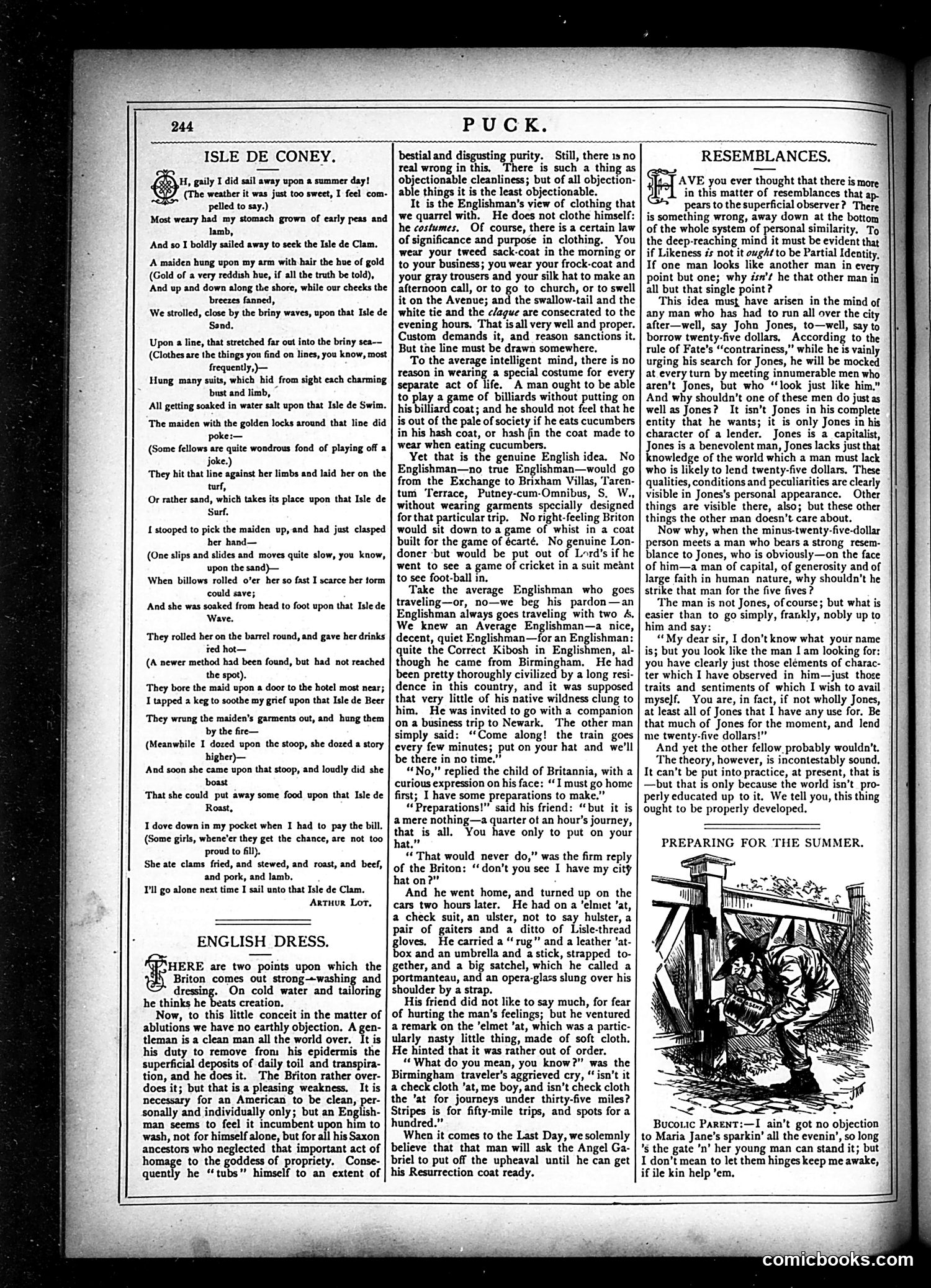
This page contains three separate articles with no political cartoons visible in the image. **"Isle de Coney"** is a humorous poem about a summer day at Coney Island, a popular beach resort near New York City. **"English Dress"** is a satirical essay mocking British fashion conventions and social pretension. It ridicules how Englishmen obsess over wearing "proper" clothing for specific occasions—special coats for business, church, cricket—even when impractical. The author argues this reflects English rigidity compared to American practicality. **"Resemblances"** discusses how people often resemble famous figures and offers anecdotes illustrating this phenomenon. **"Preparing for the Summer"** includes a small illustration showing travelers preparing for a journey. The page is primarily text-based social commentary rather than visual satire.
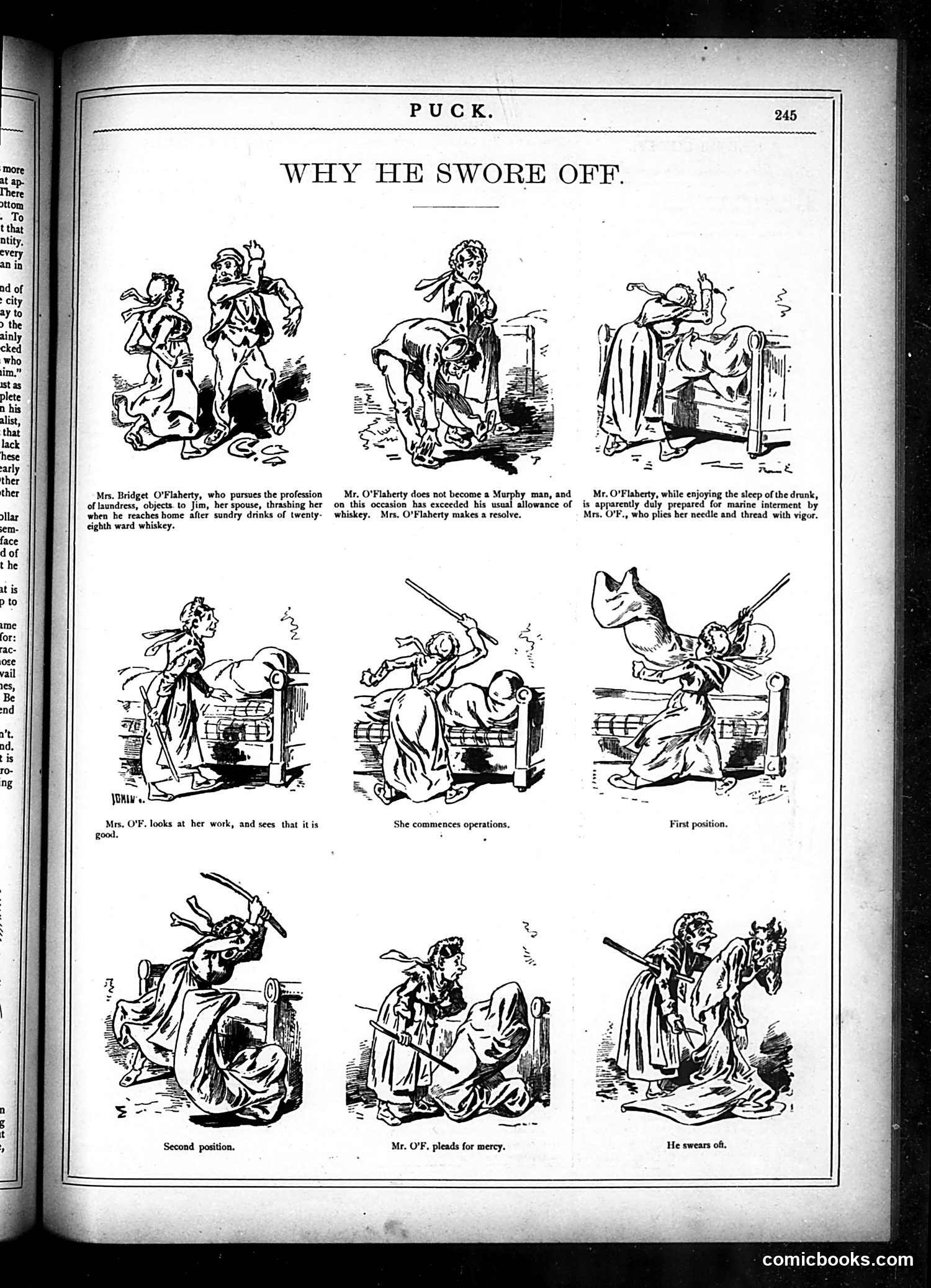
This satirical comic strip from *Puck* depicts Mr. O'Flaherty, an Irish character (identifiable by the name and stereotype caricature), progressively suffering consequences for excessive drinking. The narrative shows: his wife Mrs. Bridget O'Flaherty pursuing him after twenty drinks; him exceeding his "usual allowance of whiskey"; Mrs. O'Flaherty using a needle and thread as punishment while he sleeps; escalating violence as she attacks him with increasingly severe implements; and finally, his complete submission ("pleads for mercy" and "swears off"). The satire mocks Irish stereotypes regarding alcohol and domestic violence, presenting his renunciation of drinking as forced reform through spousal punishment rather than personal choice. The humor relies on period ethnic caricature conventions.
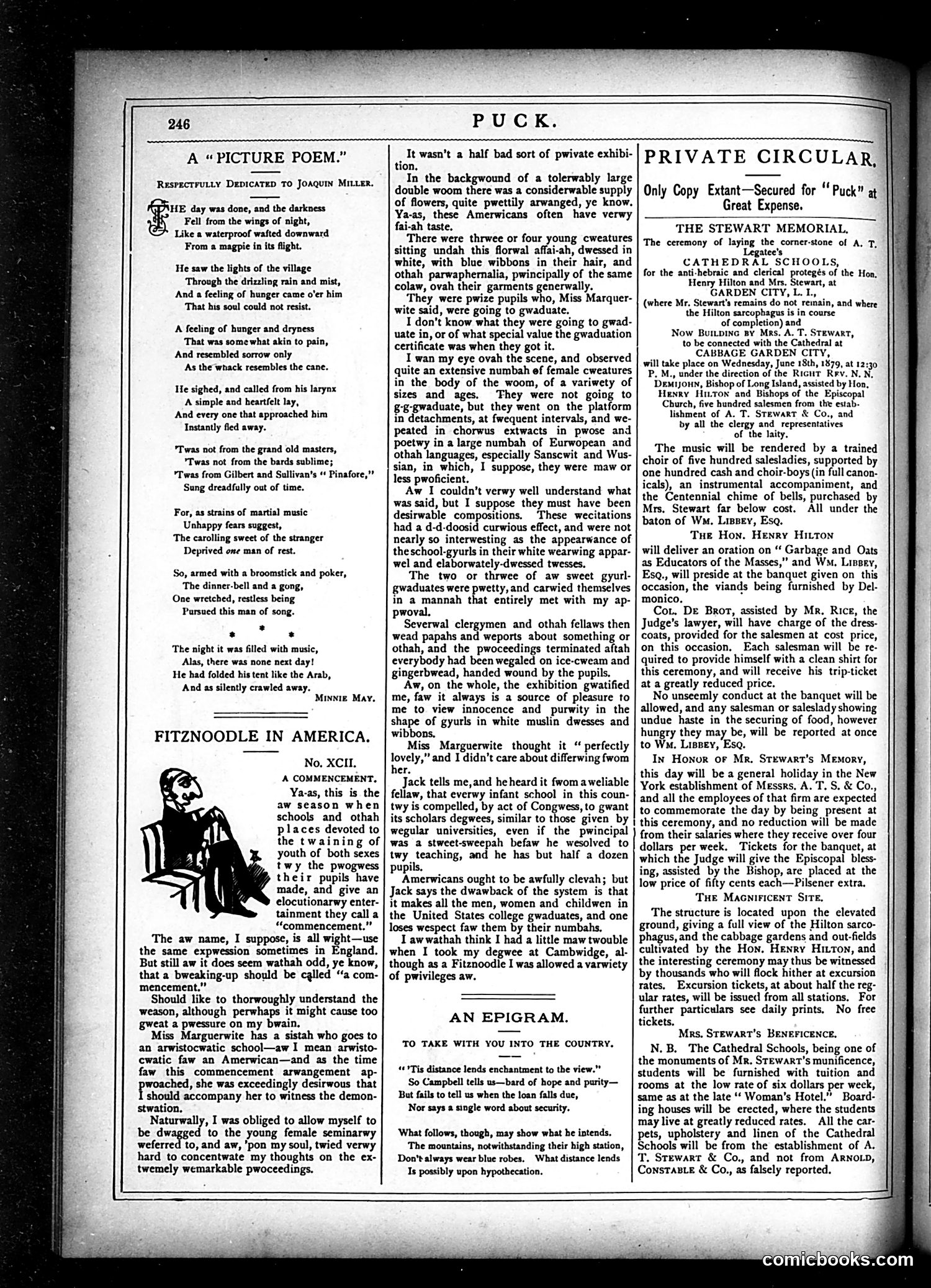
This satirical cartoon depicts a figure labeled "Fitznoodle" — apparently a stereotypical Irish immigrant or Irish-American character, based on the exaggerated facial features typical of 19th-century anti-Irish caricature. The accompanying text mocks Irish immigrants' educational aspirations and the American education system's treatment of them. The satire critiques how Irish-American families pursue degrees that grant them social status equivalent to university graduates, despite inferior preparation. The cartoon suggests Irish immigrants naively believe American credentials elevate them to equality with established Americans, while the system exploits their ambitions. The piece reflects period prejudice against Irish immigrants, portraying them as socially climbing and insufficiently educated for their aspirations.
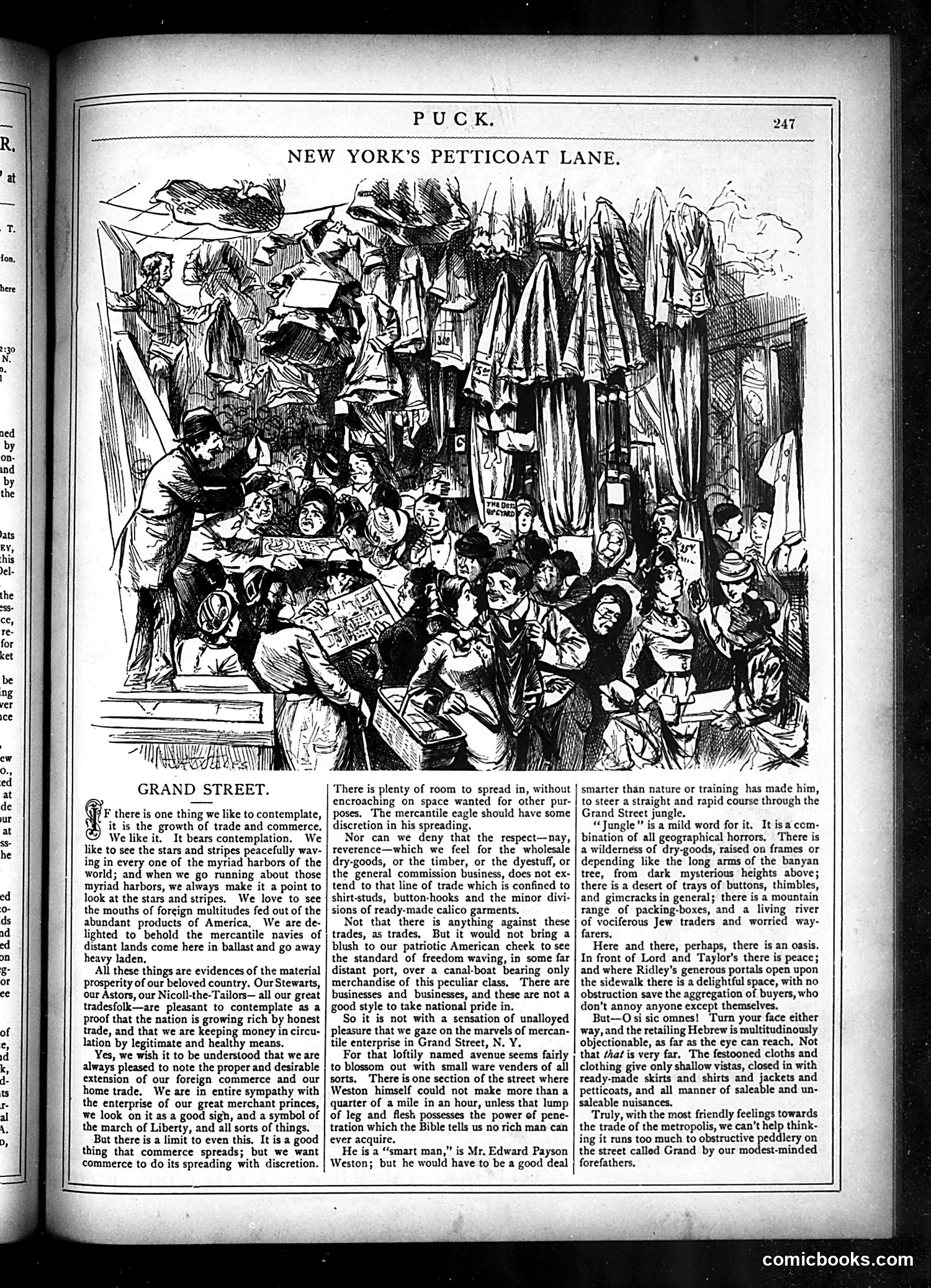
This satirical illustration depicts the crowded commercial district of Grand Street in New York, which the text identifies as a center for cheap clothing and dry goods merchants. The cartoon critiques what it calls the "mercantile eagle" and merchants who sell "ready-made calico garments" and other low-quality merchandise. The text expresses ambivalent attitudes toward commerce: while celebrating American trade and freedom, it mocks the street vendors and the poor-quality goods sold there—described as items "raised on frames or depending like the long arms of the banyan tree." The illustration shows a chaotic mass of pedestrians and merchandise, suggesting the crowded, disorderly nature of this working-class shopping district that contrasts with wealthier commercial areas.
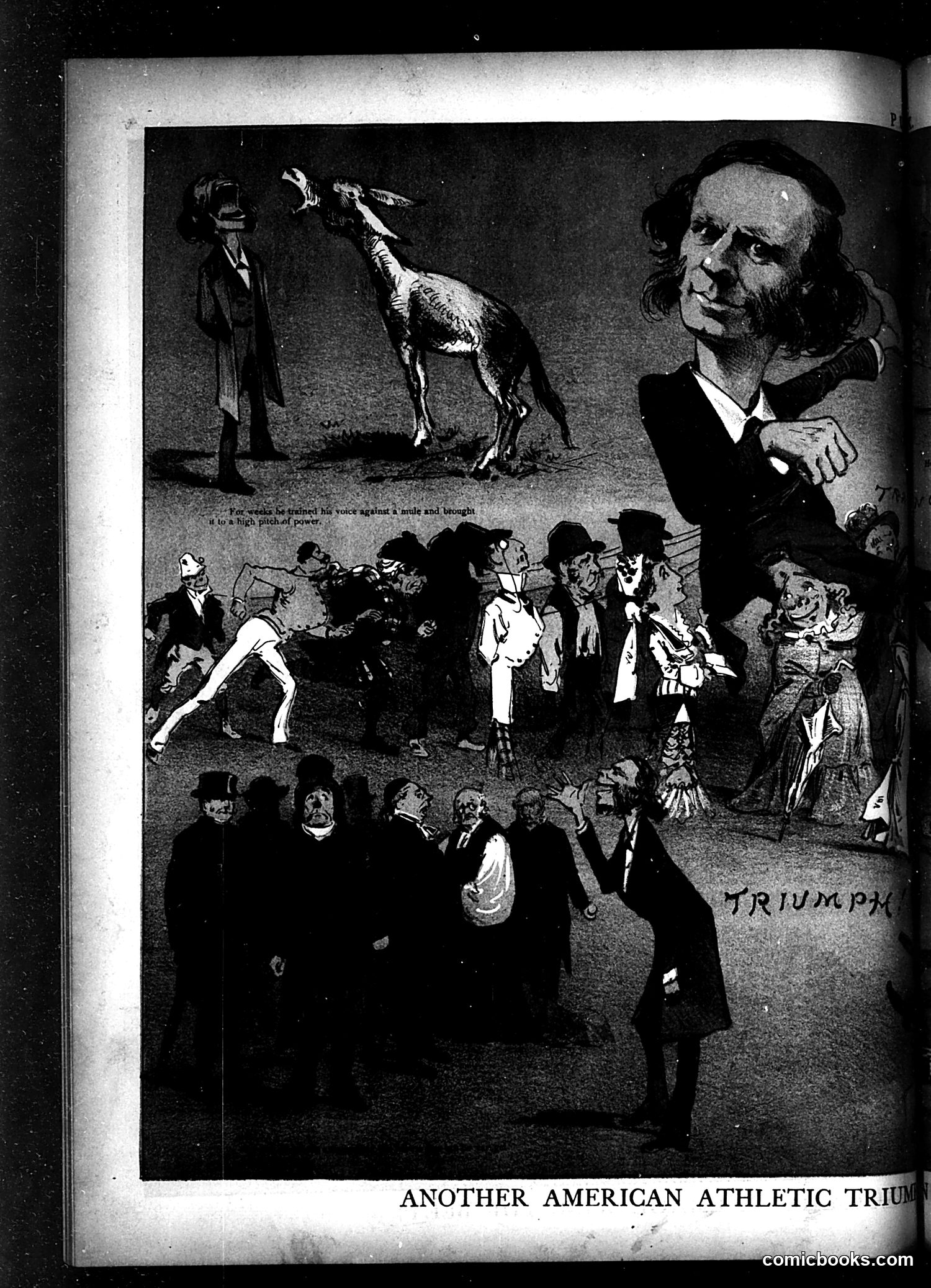
This satirical cartoon depicts what appears to be a mock athletic competition or "triump[h]" involving caricatured figures in formal dress. The composition shows: **Upper section**: A tall, distinguished gentleman (likely a political or social figure) observes while others perform acrobatic or undignified acts, including someone appearing to kick or contort themselves. **Lower section**: An audience of formally-dressed observers witnessing the spectacle. **The satire**: The cartoon mocks American achievement or national pride by portraying it as absurd physical comedy rather than genuine accomplishment. The title's ironic spelling ("triump" instead of "triumph") reinforces the mockery. The elegant setting contrasts with the ridiculous behavior, suggesting criticism of how Americans celebrate or define "triumphs"—likely commenting on contemporary political or social pretensions. The specific figures remain unclear without additional context.
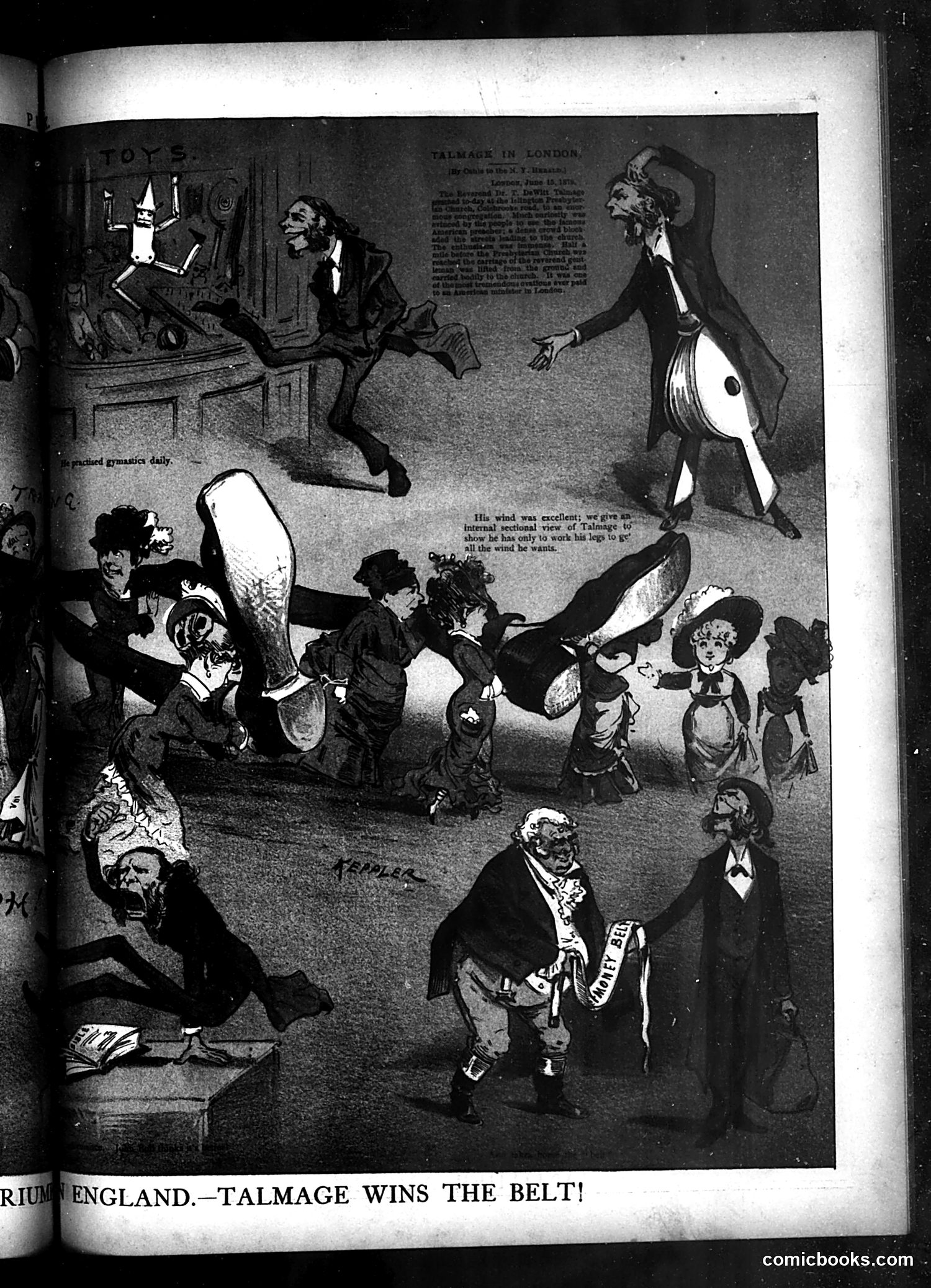
This Puck cartoon satirizes **Thomas DeWitt Talmage**, a prominent late-19th-century Brooklyn preacher known for fiery sermons and moral pronouncements. The caption "Talmage Wins the Belt" references boxing championship belts, treating his religious authority as a prize won in combat. The cartoon depicts Talmage (tall figure, right) as a theatrical performer dominating a London crowd of admirers and society figures. The satire mocks: 1. **Talmage's theatrical preaching style** - he's shown as an entertainer rather than spiritual guide 2. **His celebrity status** - portrayed winning adulation like a prizefighter 3. **His influence on London society** - the crowd's apparent fascination The joke targets both Talmage's sensationalism and public gullibility toward charismatic religious figures of the era.
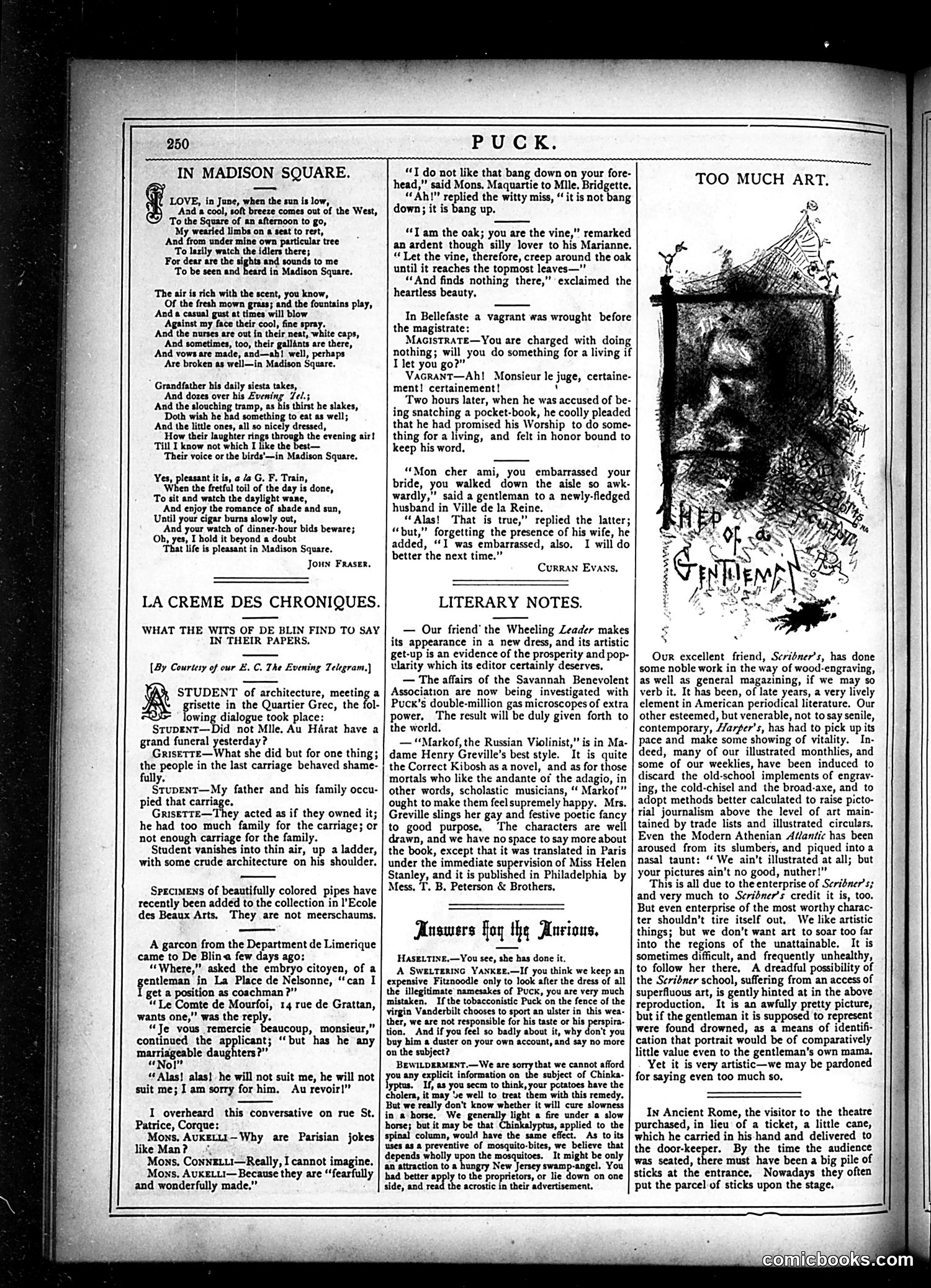
This cartoon satirizes pretentious or excessive artistic expression. The sketch shows a chaotic, deliberately crude drawing labeled "A Specimen of Gentlemen," with deliberately poor composition and messy linework. The accompanying text criticizes art that abandons skill and beauty in pursuit of novelty. The satire targets the "art for art's sake" movement of the late 19th/early 20th century—artists deliberately rejecting traditional technique and realism as a rebellious statement. Puck's position is conservative: they argue that such art, while claiming to be sophisticated, actually represents a failure of genuine artistic ability. The joke mocks both the artists who create "difficult" work and the critics who praise it as important innovation rather than admitting it's simply ugly or incompetent.
This page presents a serialized fictional story by John Fraser, not a political cartoon. The narrative appears to be a romantic tale set in Scotland (the Isle of Skye), featuring characters including Archie, Maggie, and the Doctor discussing Irish stereotypes and courtship customs. The text includes period-typical humor relying on Irish character caricatures ("Irish bulls are famous all over the world"). The story's dialogue showcases Victorian-era romantic comedy tropes, with exchanges about marriage proposals and social propriety among rural Scottish and Irish characters. This is entertainment literature rather than political satire—representative of Puck's mixed content combining humor writing with visual comics.
This page is primarily **advertising and editorial content** rather than political cartoons. The visible satirical elements include: **"Puck's Perlinges" section**: Short humorous anecdotes mocking social pretension and romantic mishaps among the upper classes—typical Puck fare. **"The Mosquito" poem**: A comedic verse about mosquitoes as pests, using military language ("Buz-z-z-zip!"). **Advertisements dominate**: Hooper's Extract, Angostura Bitters, Pollen's Cigarettes, and various patent medicines reflect late 19th/early 20th-century advertising. The "Boker's Bitters" warning about counterfeits suggests widespread product imitation. The page illustrates how Puck balanced satirical humor with substantial advertising revenue, typical of the era's magazine economics.
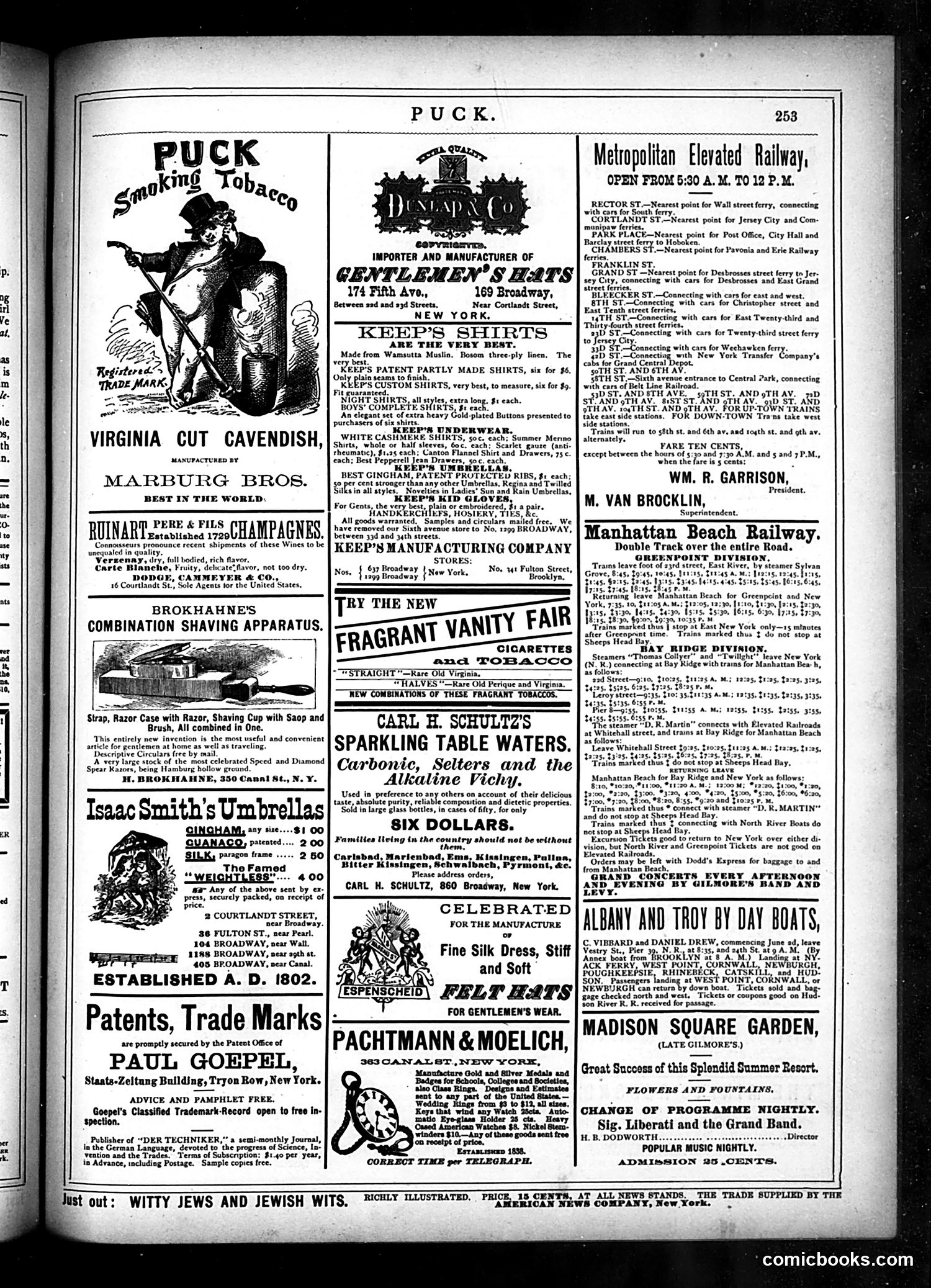
This page is primarily **advertising**, not satirical content. It contains numerous commercial advertisements for late 19th-century products and services, including: - Tobacco products (Puck brand smoking tobacco, Virginia Cut Cavendish) - Clothing and haberdashery (Dunlap & Co. gentlemen's furnishings, felt hats, silk dress shirts) - Personal grooming items (Borcharde's shaving apparatus, Isaac Smith's umbrellas) - Transportation services (Metropolitan Elevated Railway, Manhattan Beach Railway, Albany and Troy day boats) - Restaurants and entertainment venues (Madison Square Garden, Fragrantly Vanity Fair cigarettes) There is no apparent political cartoon or satirical content visible on this page. It functions as a standard advertising section within the Puck magazine, showcasing consumer goods and services of the era.
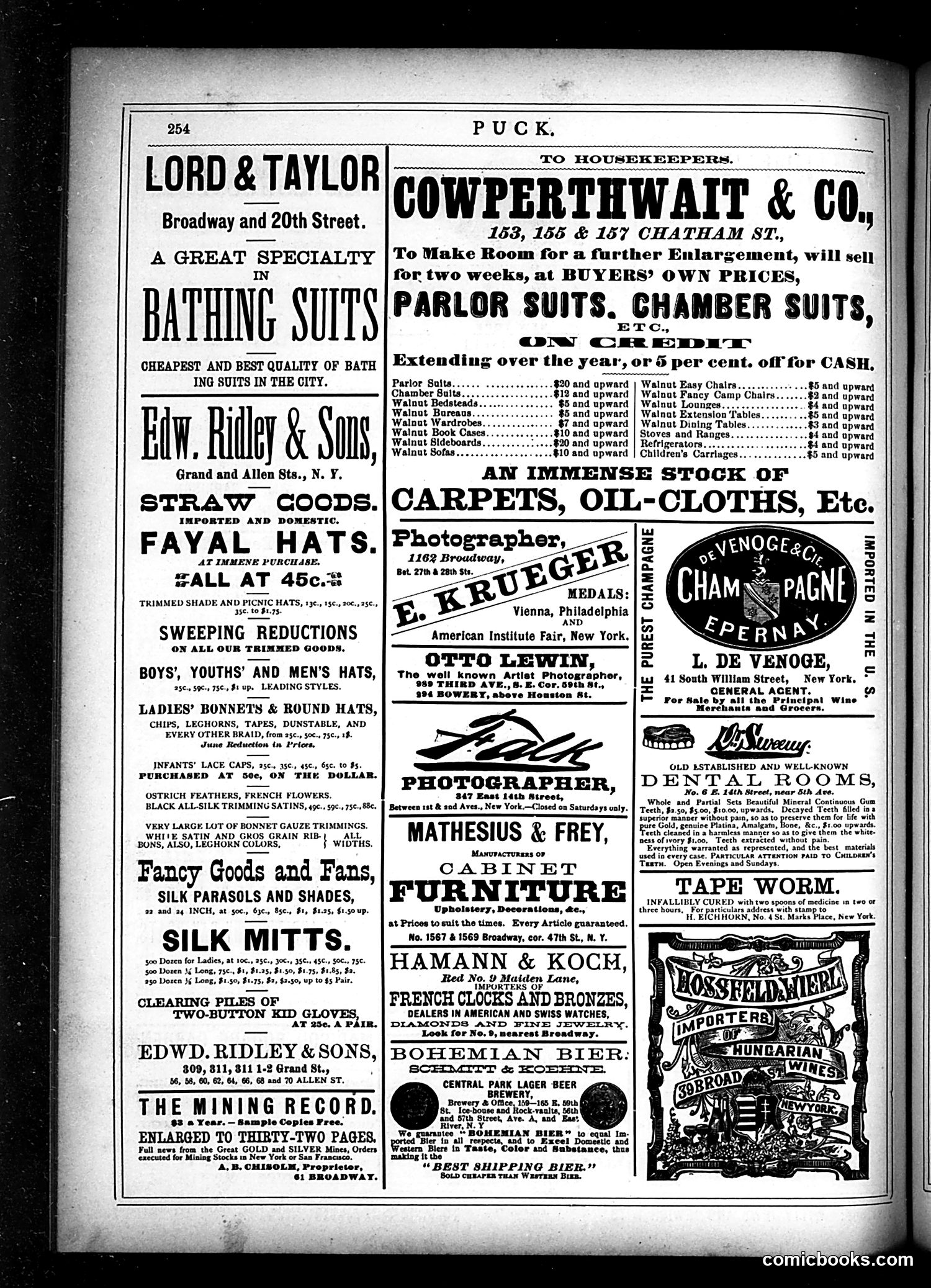
This appears to be primarily an **advertising page from Puck magazine** (page 254), not a political cartoon or satirical content page. The page is filled with late 19th-century advertisements for various merchants and products: Lord & Taylor (bathing suits), straw goods and hats, furniture makers, photographers, wine importers, and other commercial goods and services typical of the era. There is one small illustration—a **photographer's signature or mark** showing a hand holding a camera—but this is commercial rather than editorial content. The page reflects the magazine's business model of selling advertising space to support publication, rather than showcasing Puck's famous satirical cartoons. To understand Puck's actual editorial content and political commentary, one would need to examine pages dedicated to cartoons rather than advertisements.
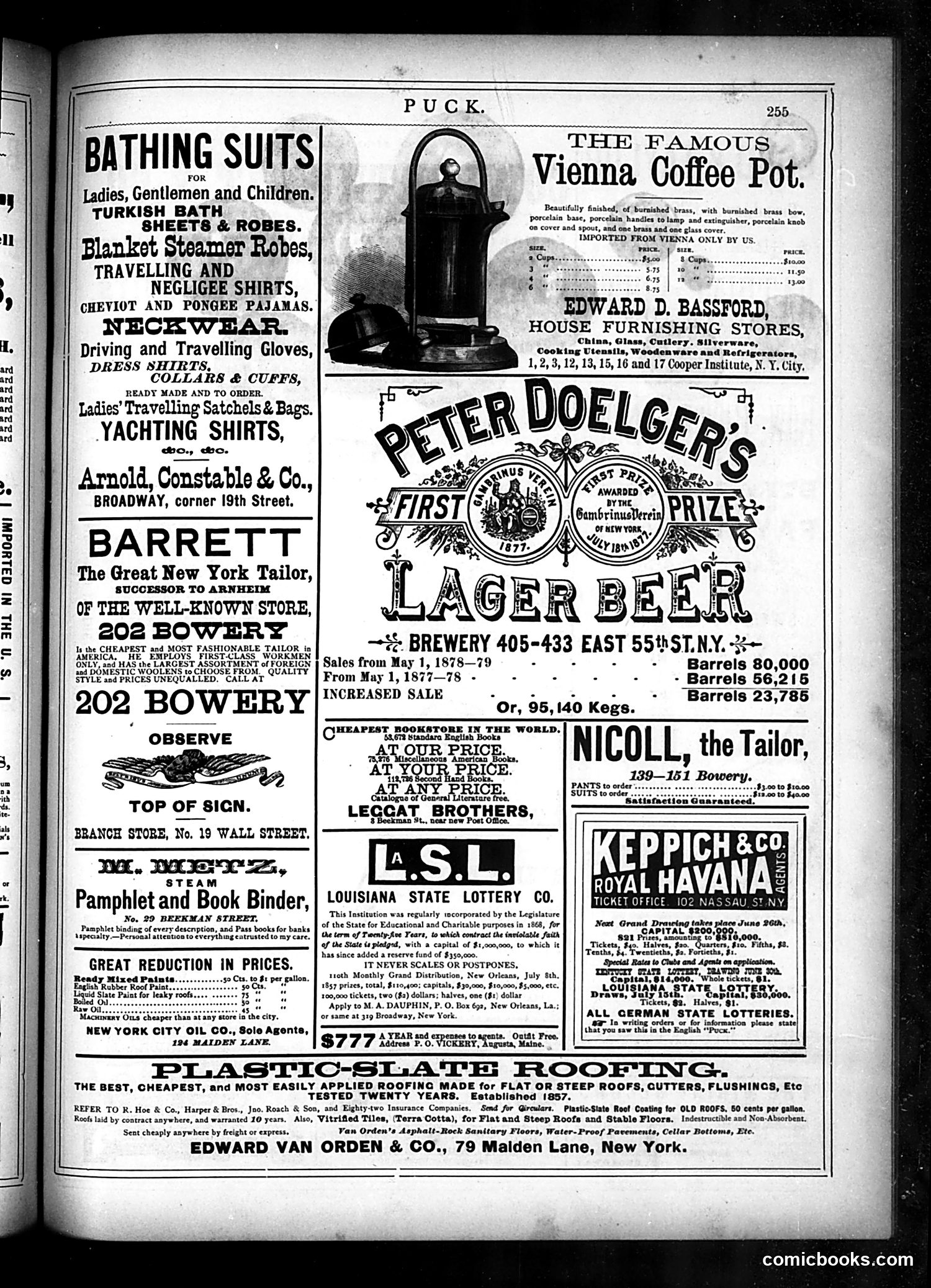
This is primarily an **advertising page** from Puck magazine (page 255), not a satirical cartoon page. The advertisements showcase late 19th-century New York commerce: bathing suits and traveling clothes from Arnold, Constable & Co.; tailoring services from Barrett and Nicoll; a Vienna Coffee Pot; Peter Doelger's Lager Beer; the Louisiana State Lottery; and roofing materials. The most prominent ad features **Peter Doelger's Lager Beer**, highlighting a brewery at 405-433 East 55th Street with sales figures from 1877-1879 and barrel quantities. This reflects the significant German immigrant brewing industry in New York during this period. The Louisiana State Lottery advertisement is notable—this was a historically controversial gambling operation. The page otherwise represents typical commercial advertisements of the Gilded Age.
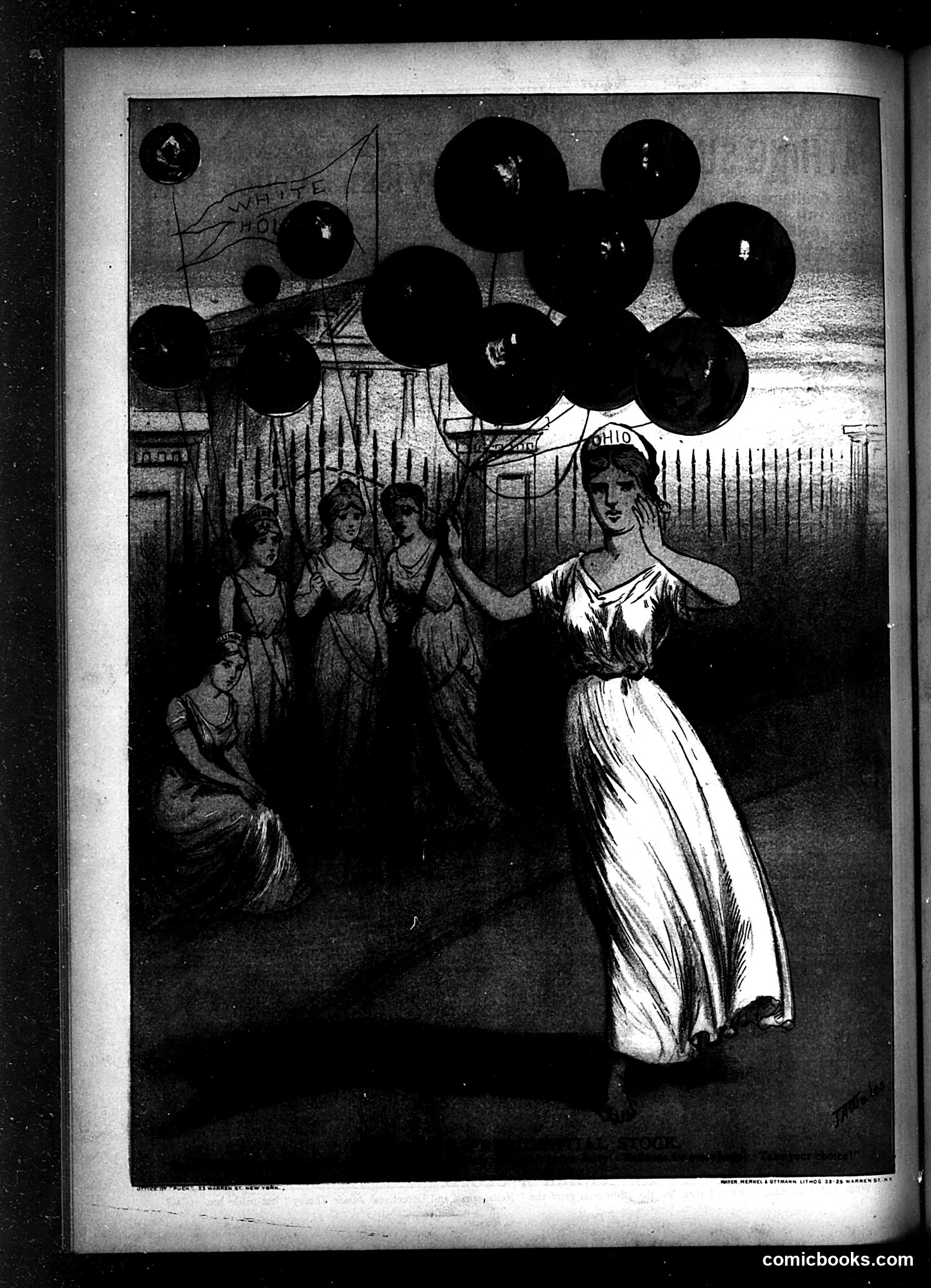
I can see this is a black and white illustration from Puck magazine showing a woman in a white dress on the right side, wearing what appears to be an "OHIO" sash or banner. She is depicted with several other figures (appearing to be women in darker clothing) and large black spheres or balloons floating above them. There is handwritten text at the top left that is difficult to read clearly in this reproduction. However, without being able to reliably read the OCR text or the handwritten annotations, I cannot confidently identify the specific political or social reference, the named figures being caricatured, or the precise satirical point being made. To provide accurate historical context, I would need clearer text or additional documentation about this particular Puck page's date and subject matter.