
Puck, 1879-06-25 · page 2 of 16
Puck — June 25, 1879 — page 2: what you’re looking at
What you’re looking at
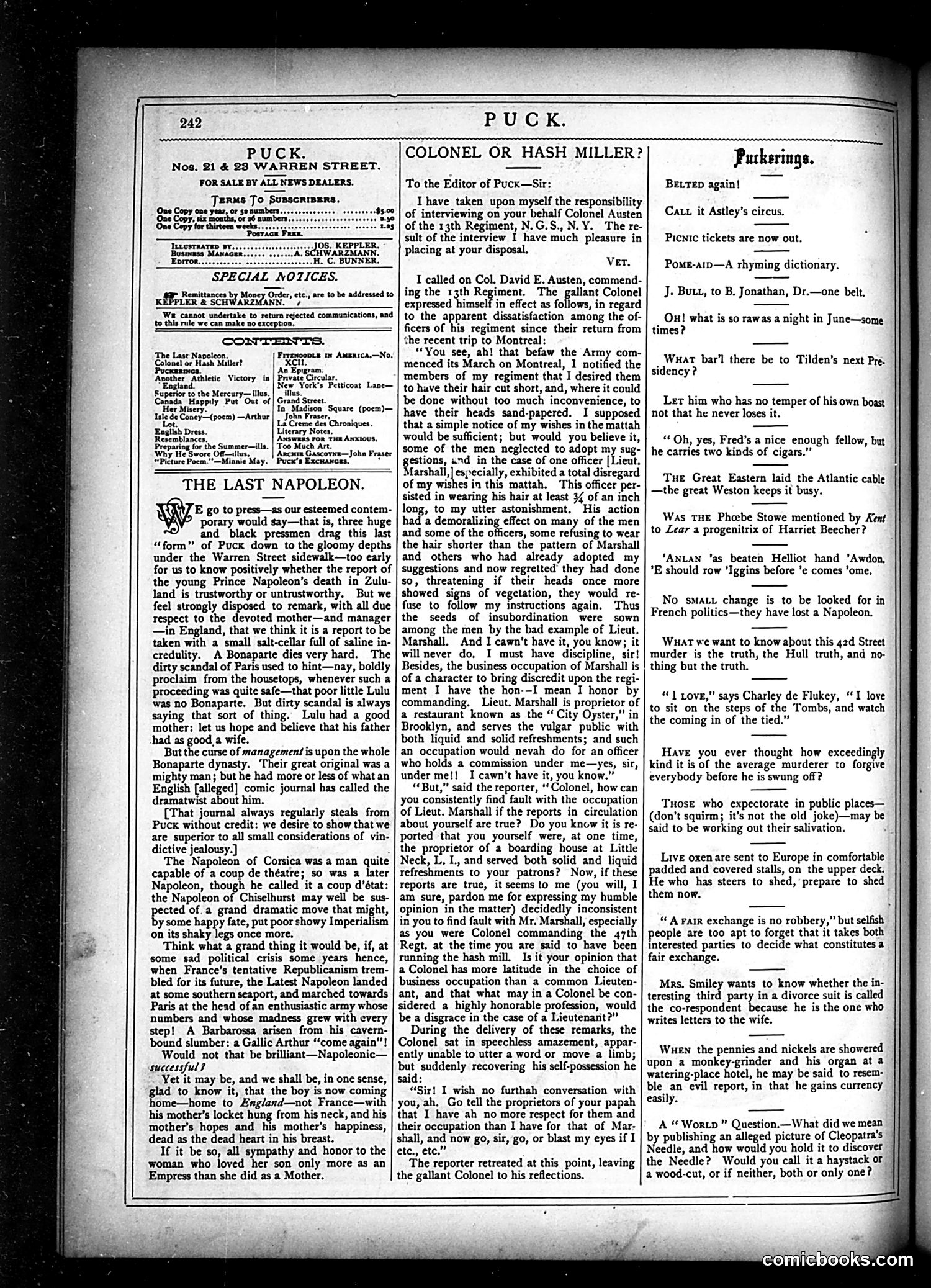
This page is primarily **text content** rather than illustrated cartoons. The main article is a letter to Puck's editor discussing Colonel Austen of the 13th Regiment, N.G.S., N.Y. The writer critiques the Colonel's leadership, alleging he ignored soldiers' complaints after returning from Montreal and failed to enforce proper military discipline. Specific complaints include officers refusing to cut their hair to regulation length and showing "insubordination." The satirical point appears to be **mocking Colonel Austen's ineffective command**—the headline's pun "Hash Miller" suggests he's made a "hash" (mess) of his duties. The letter sarcastically questions whether he has the competence for his position, using detailed anecdotes of his failures to ridicule his authority. The remainder of the page contains miscellaneous humor items and advertisements typical of Puck magazine.
📄 Transcribed text from this page (OCR, searchable)
Machine-transcribed from the original scan — historical spelling and the odd misread are preserved.
PUCK. PUCK. Nos. 21 & 23 WARREN STREET. VOR SALE BY ALL NEWS DEALERS. Jzras Jo Susscrisers year, or se numbers ‘months, or 96 num! SPECIAL NOTICES. Remittances *PLER & SCI ‘We cannot undertake to retura rejected communications, and to this rule we can make no excephon. CONTEITTS. Frerwooots m Asmnica,—No. axel. a Epigram. Private Greular. New York's Petticoat Lane— Money Order, etc., are to be addressed to JARZMANN, ‘ ‘The Last Napoleon. Colonel or Hash Biller? Puckaxiwes. Another Athletic Victory in England. Superior to the Mercury—illus,| "filus, Canada, Happily Put” Out of | Grand Street. Her Misery” Ta. Bladison. Square (poem)— Isle de Coney_{poem) —Arthur | “John Fraser, at 1a Grea des Coronigues. Dress. terary Notes. Resemblances, ‘Axswans ron Tnx Axxiovs. 1 Summer—itls. | Too Much Art ‘Ofmis, | Ancat Gascorwn—John Fraser a Puck's Excuanoss. THE LAST NAPOLEON. E go to press—as our esteemed contem- porary would say—that is, three huge and black pressmen drag this last “form” of Puck down to the gloomy depths under the Warren Street sidewalk—too early for us to know positively whether the report of the young Prince Napoleon's death in Zulu- land is trustworthy or untrustworthy. But we feel strongly disposed to remark, with all due respect to the devoted mother—and manager —in England, that we think it is a report to be taken with a small salt-cellar full of saline in- credulity. A Bonaparte dies very hard. The dirty scandal of Paris used to hint—nay, boldly proclaim from the housetops, whenever such a proceeding was quite safe—that poor little Lulu was no Bonaparte. But dirty scandal is always saying that sort of thing. Lulu had a good mother: let us hope and believe that his father had as good,a wife. But the curse of management is upon the whole Bonaparte dynasty. Their great original was a mighty man; but he had more or less of what an English [alleged] comic journal bas called the dramatwist about him. (That journal always regularly steals from Puck without credit: we desire to show that we are superior to all small considerations of vin- dictive jealousy.) The Napoleon of Corsica was a man quite capable of a coup de théatre; so was a later Napoleon, though he called it a coup d’état: the Napoleon of Chiselhurst may well be sus- pected of.a grand dramatic move that might, by some happy fate, put poor showy Imperialism on its shaky legs once more, Think what a grand thing it would be, if, at some sad political crisis some years hence, when France's tentative Republicanism trem- bled for its future, the Latest Napoleon landed at some southern seaport, and marched towards Paris at the head of an enthusiastic army whose numbers and whose madness grew with every step! A Barbarossa arisen from his cavern- bound slumber: a Gallic Arthur ‘‘come again"! Would not that be brilliant—Napoleonic— successful? Yet it may be, and we shall be, in one sense, gad to know it, that the boy is now coming me—home to England—not France—with his mother’s locket hung from his neck, and his mother’s hopes and his mother’s happiness, dead as the dead heart in his breast. If it be so, all sympathy and honor to the woman who loved her son only more as an Empress than she did as a Mother. COLONEL OR HASH MILLER? To the Editor of Puck—Sir: Ihave taken upon myself the responsibility of interviewing on your behalf Colonel Austen of the 13th Regiment, N.G.S., N.Y. The re- sult of the interview I have much pleasure in placing at your disposal. Ver. I called on Col. David E. Austen, commend- ing the 13th Regiment. The gallant Colonel expressed himself in effect as follows, in regard to the apparent dissatisfaction among the of- ficers of his regiment since their return from the recent trip to Montreal: “You see, ah! that befaw the Army com- menced its March on Montreal, 1 notified the members of my regiment that I desired them to have their hair cut short, and, where it could be done without too much inconvenience, to have their heads sand-papered. I supposed that a simple notice of my wishes in the mattah would be sufficient; but would you believe it, some of the men neglected to adopt my sug- gestions, and in the case of one officer [Lieut. Marshall,] especially, exhibited a total disregard of my wishes in this mattah. This officer per- sisted in wearing his hair at least 34 of an inch long, to my utter astonishment. His action had a demoralizing effect on many of the men and some of the officers, some refusing to wear the hair shorter than the pattern of Marshall and others who had already adopted my suggestions and now regretted they had done so, threatening if their heads once more showed signs of vegetation, they would re- fuse to follow my instructions again. Thus the seeds of insubordination were sown among the men by the bad example of Lieut. Marshall. And I cawn't have it, you know; it will never do, I must have discipline, sir! Besides, the business occupation of Marshall is of a character to bring discredit upon the regi- ment I have the hon--I mean I honor by commanding. Lieut. Marshall is proprietor of a restaurant known as the “ City Oyster,” in Brooklyn, and serves the vulgar public with both liquid and solid refreshments; and such an occupation would nevah do for an officer who holds a commission under me—yes, sir, under me!! I cawn’t have it, you know.” “But,” said the reporter, ‘Colonel, how can you consistently find fault with the occupation of Lieut. Marshall if the reports in circulation about yourself are true? Do you know it is re- ported that you yourself were, at one time, the proprietor of a boarding house at Little Neck, L, I, and served both solid and liquid refreshments to your patrons? Now, if these reports are true, it seems to me (you will, I am sure, pardon me for expressing my humble opinion in the matter) decidedly inconsistent in you to find fault with Mr, Marshall, especial, as you were Colonel commanding the ‘sith Regt. at the time you are said to have been running the hash mill. Is it your opinion that a Colonel has more latitude in the choice of business occupation than a common Lieuten- ant, and that what may in a Colonel be con- sidered a highly honorable profession, would be a disgrace in the case of a Lieutenarit?” During the delivery of these remarks, the Colonel sat in speechless amazement, appar- ently unable to utter a word or move a limb; but suddenly recovering his self-possession he “Sir! I wish no furthah conversation with you, ah. Go tell the proprietors of your papah that I have ah no more respect for them and their occupation than I have for that of Mar- shall, and now go, sir, go, or blast my eyes if I ete., etc.” The reporter retreated at this point, leaving the gallant Colonel to his reflections. Puckerings. Bere again! Cat it Astley’s circus, Picnic tickets are now out. Pome-aip—A rhyming dictionary, J. Butt, to B, Jonathan, Dr.—one belt. Ou! what is so rawas a night in June—some times? Wuart bar’l there be to Tilden’s next Pre. sidency ? Let him who has no temper of his own boast not that he never loses it. “Oh, yes, Fred’s a nice enough fellow, but he carries two kinds of cigars.” Tue Great Eastern laid the Atlantic cable —the great Weston keeps it busy. Was THE Phoebe Stowe mentioned by Kent to Lear a progenitrix of Harriet Beecher? "ANLAN ‘as beaten Helliot hand 'Awdon. "E should row ‘Iggins before ’e comes ‘ome. No sMatu change is to be looked for in French politics—they have lost a Napoleon. Wuat we want to know about this 42d Street murder is the truth, the Hull truth, and no- thing but the truth. “1 Love,” says Charley de Flukey, “I love to sit on the steps of the Tombs, and watch the coming in of the tied.” Have you ever thought how exceedingly kind it is of the average murderer to forgive everybody before he is swung off? Tuose who expectorate in public places— (don't squirm; it’s not the old joke)—may be said to be working out their salivation. 5 Live oxenare sent to Europe in comfortable padded and covered stalls, on the upper deck. He who has steers to shed, prepare to shed them now. “A vain exchange is no robbery,” but selfish people are too apt to forget that it takes both interested parties to decide what constitutes a fair exchange, Mrs, Smiley wants to know whether the in- teresting third party in a divorce suit is called the co-respondent because he is the one who writes letters to the wife. Wuen the pennies and nickels are showered upon a monkey-grinder and his organ at a watering-place hotel, he may be said to resem- ble an evil report, in that he gains currency easily. A “ Wortp ” Question.—What did we mean by publishing an alleged picture of Cleopatra's | Needle, and how would you hold it to discover | the Needle? Would you call it a haystack or a wood-cut, or if neither, both or only one? |]