
Puck, 1879-06-25 · page 4 of 16
Puck — June 25, 1879 — page 4: what you’re looking at
What you’re looking at
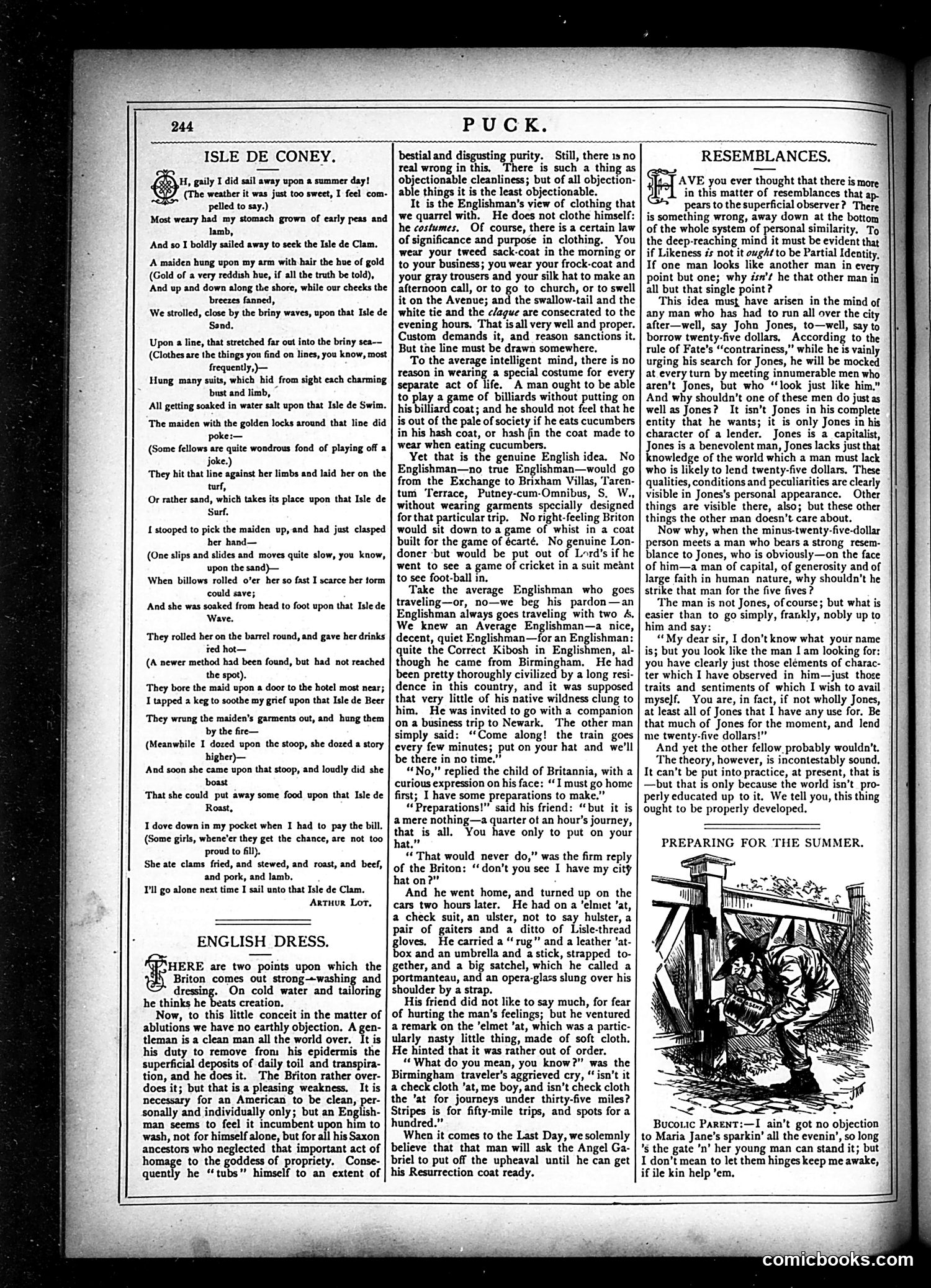
This page contains three separate articles with no political cartoons visible in the image. **"Isle de Coney"** is a humorous poem about a summer day at Coney Island, a popular beach resort near New York City. **"English Dress"** is a satirical essay mocking British fashion conventions and social pretension. It ridicules how Englishmen obsess over wearing "proper" clothing for specific occasions—special coats for business, church, cricket—even when impractical. The author argues this reflects English rigidity compared to American practicality. **"Resemblances"** discusses how people often resemble famous figures and offers anecdotes illustrating this phenomenon. **"Preparing for the Summer"** includes a small illustration showing travelers preparing for a journey. The page is primarily text-based social commentary rather than visual satire.
📄 Transcribed text from this page (OCR, searchable)
Machine-transcribed from the original scan — historical spelling and the odd misread are preserved.
PUCK. ISLE DE CONEY. H, gaily I did sail away upon a summer day! (The weather it was just too sweet, I feel com- pelled to say.) Most weary had my stomach grown of early peas and lamb, And so I boldly sailed away to seck the Isle de Clam. ‘A maiden hung upon my arm with hair the hue of gold (Gold of a very reddish hue, if all the truth be told), And up and down along the shore, while our cheeks the breezes fanned, We strolled, close by the briny waves, upon that Isle de Sond. Upon a line, that stretched far out into the briny sea— (Clothes are the things you find on lines, you know, most frequently,)— Hung many suits, which hid from sight each charming bust and limb, © All getting soaked in water salt upon that Isle de Swim, ‘The maiden with the golden locks around that line did poke:— (Some fellows are quite wondrous fond of playing off a joke.) ‘They hit that line against her limbs and laid her on the turf, Or rather sand, which takes its place upon that Isle de Surf. { stooped to pick the maiden up, and had just clasped her hand— (One slips and slides and moves quite slow, you know, upon the sand)— When billows rolled o'er her so fast I scarce her torm could save; ‘And she was soaked from head to foot upon that Isle de Wave. ‘They rolled her on the barrel round, and gave her drinks ted hot— (A newer method had been found, but had not reached the spot). They bore the maid upon a door to the hotel most near; I tapped a keg to soothe my grief upon that Isle de Beer ‘They wrung the maiden’s garments out, and hung them by the fire— (Meanwhile I dozed upon the stoop, she dozed a story higher)— And soon she came upon that stoop, and loudly did she boast ‘That she could put away some food upon that Isle de Roast, I dove down in my pocket when I had to pay the bill. (Some girls, whene’er they get the chance, are not too proud to fill). She ate clams fried, and stewed, and roast, and beef, and pork, and lamb. Till go alone next time I sail unto that Isle de Clam. Artur Lor, ENGLISH DRESS. eae are two points upon which the Briton comes out strong--washing and dressing. On cold water and tailoring he thinks he beats creation. Now, to this little conceit in the matter of ablutions we have no earthly objection. A gen- tleman is a clean man all the world over. It is his duty to remove from his epidermis the superficial deposits of daily toil and transpira- tion, and he does it. The Briton rather over- does it; but that is a pleasing weakness. It is necessary for an American to be clean, per- sonally and individually only; but an English- man seems to feel it incumbent upon him to wash, not for himself alone, but for all his Saxon ancestors who neglected that important act of homage to the goddess of propriety. Conse- quently he ‘tubs’ himself to an extent of bestial and disgusting purity. Still, there 1sno real wrong in this, There is such a thing as objectionable cleanliness; but of all objection- able things it is the least objectionable. It is the Englishman's view of clothing that we quarrel with. He does not clothe himself: he costumes. Of course, there is a certain law of significance and purpose in clothing. You wear your tweed sack-coat in the morning or to your business; you wear your frock-coat and your gray trousers and your silk hat to make an afternoon call, or to go to church, or to swell it on the Avenue; and the swallow-tail and the white tie and the c/ague are consecrated to the evening hours. That isall very well and proper. Custom demands it, and reason sanctions it. But the line must be drawn somewhere, To the average intelligent mind, there is no reason in wearing a special costume for every separate act of life. A man ought to be able to play a game of billiards without putting on his billiard coat; and he should not feel that he is out of the pale of society if he eats cucumbers in his hash coat, or hash fin the coat made to wear when eating cucumbers. Yet that is the genuine English idea. No Englishman—no true Englishman—would go from the Exchange to Brixham Villas, ‘Taren- tum ‘Terrace, Putney-cum-Omnibus, S, W., without wearing garments spccially designed for that particular trip. No right-feeling Briton would sit down to a game of whist in a coat built for the game of écarté. No genuine Lon- doner ‘but would be put out of Lord’s if he went to see a game of cricket in a suit meant to see foot-ball in, Take the average Englishman who goes traveling—or, no—we beg his pardon—an Englishman always goes traveling with two 4, We knew an Average Bagishman a nice, decent, quiet Englishman—for an Englishman: quite the Correct Kibosh in Englishmen, al- though he came from Birmingham, He had been pretty thoroughly civilized by a long resi- dence in this country, and it was supposed that very little of his native wildness clung to him. He was invited to go with a companion on a business trip to Newark. The other man simply said: ‘‘Come along! the train goes every few minutes; put on your hat and we'll be there in no time.” “No,” replied the child of Britannia, with a curious expression on his face: ‘I must go home first; I have some preparati “Preparations!” said his friend: “but it is a mere nothing—a quarter ot an hour’s journey, that is all. You have only to put on your hat.” “That would never do,” was the firm reply of the Briton: ‘don’t you see I have my city hat on?” And he went home, and turned up on the cars two hours later. He had on a 'elmet ’at, a check suit, an ulster, not to say hulster, a pair of gaiters and a ditto of Lisle-thread gloves. He carried a “ rug” and a leather ‘at- box and an umbrella and a stick, strapped to- gether, and a big satchel, which he called a portmanteau, and an opera-glass slung over his shoulder by a strap. His friend did not like to say much, for fear of hurting the man’s feelings; but he ventured a remark on the ’elmet ‘at, which was a partic- ularly nasty little thing, made of soft cloth. He hinted that it was rather out of order. ‘« What do you mean, you know?” was the Birmingham traveler's aggrieved cry, “isn't it a check cloth ‘at, me boy, and isn’t check cloth be tat ee journeys undes eurey ve mule tri is for fifty-mile trips, and spots for a hundred.” y i a When it comes to the Last Day, we solemnly believe that that man will ask the Angel Ga- briel to put off the upheaval until he can get his Resurrection coat ready. en are rn oe A naa RESEMBLANCES. AVE you ever thought that there is more in this matter of resemblances that ap- pears to the superficial observer? There is something wrong, away down at the bottom of the whole system of personal similarity. To the deep-reaching mind it must be evident that if Likeness #s not it ought to be Partial Identity, If one man looks like another man in ev. point but one; why ésn’¢ he that other man in all but that single point ? This idea must have arisen in the mind of any man who has had to run all over the city after—well, say John Jones, to—well, say to borrow twenty-five dollars, According to the tule of Fate's “‘contrariness,” while he is vainly urging his search for Jones, he will be mocked at every turn by meeting innumerable men who aren’t Jones, but who “look just like him.” And why shouldn't one of these men do just as well as Jones? It isn’t Jones in his complete entity that he wants; it is only Jones in his character of a lender. Jones is a capitalist, Jones is a benevolent man, Jones lacks just that knowledge of the world which a man must lack who is likely to lend twenty-five dollars, These qualities, conditions and peculiarities are clearly visible in Jones's personal appearance. Other things are visible there, also; but these other things the other man doesn’t care about. Now why, when the minus-twenty-five-dollar person meets a man who bears a strong resem- blance to Jones, who is obviously—on the face of him—a man of capital, of generosity and of large faith in human nature, why shouldn't he strike that man for the five fives? The man is not Jones, of course; but what is easier than to go simply, frankly, nobly up to him and say: “ My dear sir, I don't know what your name is; but you look like the man | am looking for: you have clearly just those eléments of charac- ter which I have observed in him—just those traits and sentiments of which I wish to avail myse}f. You are, in fact, if not wholly Jones, at least all of Jones that I have any use for, Be that much of Jones for the moment, and lend me twenty-five dollars!” And yet the other fellow probably wouldn't. The theory, however, is incontestably sound, It can’t be put into practice, at present, that is —but that is only because the world isn’t _pro- perly educated up to it. We tell you, this thing ought to be properly developed. PREPARING FOR THE SUMMER. Bucotic Parent:—I ain't got no objection to Maria Jane’s sparkin’ all the evenin’, so long ’s the gate 'n’ her young man can stand it; but I don’t mean to let them hinges keep me awake, if ile kin help ’em, ~ COMICDOOKS.com