
Puck, 1879-06-25 · page 10 of 16
Puck — June 25, 1879 — page 10: what you’re looking at
What you’re looking at
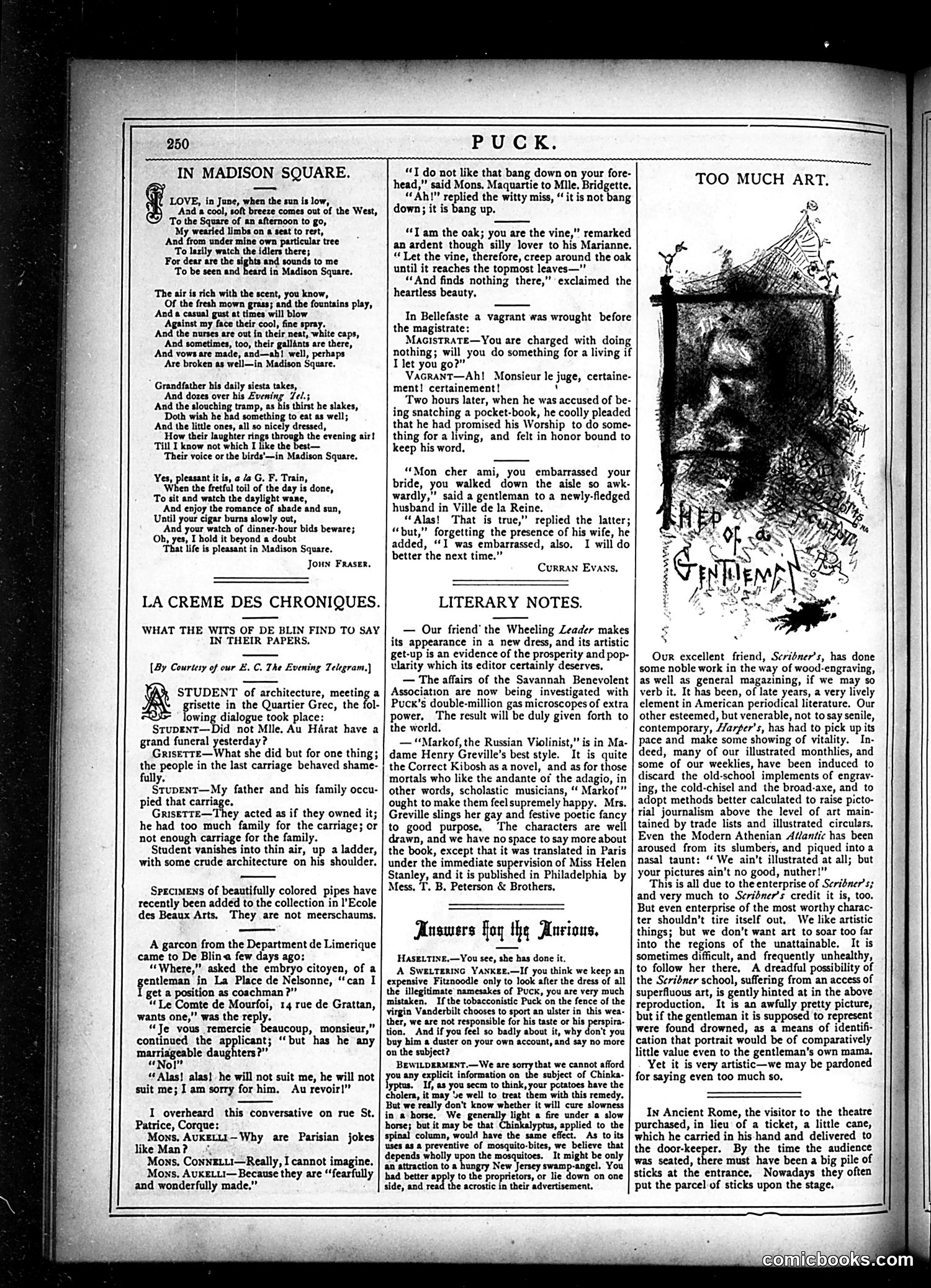
This cartoon satirizes pretentious or excessive artistic expression. The sketch shows a chaotic, deliberately crude drawing labeled "A Specimen of Gentlemen," with deliberately poor composition and messy linework. The accompanying text criticizes art that abandons skill and beauty in pursuit of novelty. The satire targets the "art for art's sake" movement of the late 19th/early 20th century—artists deliberately rejecting traditional technique and realism as a rebellious statement. Puck's position is conservative: they argue that such art, while claiming to be sophisticated, actually represents a failure of genuine artistic ability. The joke mocks both the artists who create "difficult" work and the critics who praise it as important innovation rather than admitting it's simply ugly or incompetent.
📄 Transcribed text from this page (OCR, searchable)
Machine-transcribed from the original scan — historical spelling and the odd misread are preserved.
PUCK. IN MADISON SQUARE. LOVE, in June, when the sun is low, And a cool, soft ze comes out of the West, To the Square of an afternoon to go, ‘My wearied limbs on a seat to rert, And from under mine own particular tree To lazily watch the idlers there; For dear are the sights and sounds to me To be seen and heard ia Madison Square. The air is rich with the scent, you know, Of the fresh mown grass; and the fountains play, And a casual gust at times will blow ‘Against my face their cool, fine spray. And the nurses are out in their neat, white caps, ‘And sometimes, too, their gallants are there, ‘And vows are made, and—ab! well, perhaps ‘Are broken as well—in Madison Square. Grandfather his daily siesta takes, ‘And dozes over his Evening el; And the slouching tramp, as his thirst he slakes, Doth wish he had something to eat as well; And the little ones, all so nicely dressed, How their nughier rings through the evening air! Till I know not which I like the best— Their voice or the birds'—in Madison Square. Yes, pleasant it is, a Za G, F. Train, ‘When the fretful toil of the day is done, To sit and watch the daylight wane, ‘And enjoy the romance of shade and sun, Until your cigar burns slowly out, ‘And your watch of dinner-hour bids beware; Ob, yes, I hold it beyond a doubt ‘That life is pleasant in Madison Square. Joun Fraser. LA CREME DES CHRONIQUES. WHAT THE WITS OF DE BLIN FIND TO SAY IN THEIR PAPERS. [By Courtesy of our E. C. The Evening Telegram.) STUDENT of architecture, meeting a isette in the Quartier Grec, the fol- lowing dialogue took place: Srupgent—Did not Mile. Au Hiirat have a grand funeral yesterday? GriseTrE—What she did but for one thing; the people in the last carriage behaved shame- fully. Stupent—My father and his family occu- pied that carri Grisetre—They acted as if they owned it; he had too much family for the carriage; or not enough carriage for the family. Student vanishes into thin air, up a ladder, with some crude architecture on his shoulder. Specimens of beautifully colored pipes have recently been added to the collection in I'Ecole des Beaux Arts, They are not meerschaums, A garcon from the Department de Limerique came to De Blina few days ago: “Where,” asked the embryo citoyen, of a entleman in La Place de Nelsonne, “can 1 f get a position as coachman?” “Le Comte de Mourfoi, 14 rue de Grattan, wants one,” was the reply. “Je vous remercie beaucoup, monsieur,” continued the applicant; ‘but has he any marriageable daughters?” “No!” “Alas! alas} he will not suit me, he will not suit me; I am sorry for him, Au revoir!" I overheard this conversative on rue St. Patrice, Corque: Mons, AuketLI~Why are Parisian jokes like Man? Mons. Conngiii—Really, I cannot imagine. Mons. AUKELLI—Because they are ‘‘fearfully and wonderfully made,” “TI do not like that bang down on your fore- head,” said Mons, Maquartie to Mile. Bridgette. “Ah!” replied the witty miss, “ it is not bang down; it is bang up. “Tam the oak; you are the vine,” remarked an ardent though silly lover to his Marianne. “Let the vine, therefore, creep around the oak until it reaches the topmost leaves—”’ “And finds nothing there,” exclaimed the heartless beauty. In Bellefaste a vagrant was wrought before the magistrate: Macistrate—You are charged with doing nothing; will you do something for a living if Tet you go?” Vacrant—Ah! Monsieur le juge, certaine- ment! certainement! ‘ Two hours later, when he was accused of be- ing snatching a pocket-book, he coolly pleaded that he had promised his Worship to do some- thing for a living, and felt in honor bound to keep his word, “Mon cher ami, you embarrassed your bride, you walked down the aisle so awk- wardly,” said a gentleman to a newly-fledged husband in Ville de la Reine. “Alas! That is true,” replied the latter; “but,” forgetting the presence of his wife, he added, ‘I was embarrassed, also. I will do better the next time.” Curran Evans, LITERARY NOTES. — Our friend’ the Wheeling Leader makes its appearance in a new dress, and its artistic get-up is an evidence of the prosperity and pop- vlarity which its editor certainly deserves, — The affairs of the Savannah Benevolent Association are now being investigated with Puck’s double-million gas microscopes of extra power, The result will be duly given forth to the world. — “Markof, the Russian Violinist,” is in Ma- dame Henry Greville’s best style. It is quite the Correct Kibosh as a novel, and as for those mortals who like the andante of the adagio, in other words, scholastic musicians, ‘ Markof” ought to make them feelsupremely happy. Mrs. Greville slings her gay and festive poetic fancy to good purpose. ‘The characters are well drawn, and we have no space to say more about the book, except that it was translated in Paris under the immediate supervision of Miss Helen Stanley, and it is published in Philadelphia by Mess, T. B. Peterson & Brothers, Answers foy the Anrious, Haseit1vg.—You see, she has done it. A SwELteRINc YaNKge.—If you think we keep an expensive Fitznoodle only to look after the dress of all the illegitimate namesakes of Puck, you are very much mistaken. If the tobacconistic Puck on the fence of the virgin Vanderbilt chooses to sport an ulster in this wea ther, we are not responsible for his taste or his perspira- tion, And if you feel so badly about it, why don't you buy bim a duster on your own account, and say no more on the subject? BEWILDERMENT.—We are sorry that we cannot afford ou any explicit information on the subject of Chinka- 5 If, as you secm to think, your potatoes have the cholera, it may Ye well to treat them with this remedy. But we really don't know whether it will cure slowness in a horse, We generally light a fire under a slow horse; but it may be that aialyptes, applied to the spinal column, would have the same effect. As to its uses as a preventive of mosquito-bites, we believe that depends wholly upon the mosquitoes. "It might be only an attraction to a hungry New Jersey swamp-angel. You had better apply to the proprietors, or lie down on one side, and read the acrostic in their advertisement. TOO MUCH ART, Our excellent friend, Scribner's, has done some noble work in the way of wood-engraving, as well as general magazining, if we may so verb it. It has been, of late years, a very lively element in American periodical literature. Our other esteemed, but venerable, not to say senile, contemporary, Harfer’s, has had to pick up its pace and make some showing of vitality. In- deed, many of our illustrated monthlies, and some of our weeklies, have been induced to discard the old-school implements of engrav- ing, the cold-chisel and the broad-axe, and to adopt methods better calculated to raise picto- rial journalism above the level of art main- tained by trade lists and illustrated circulars, Even the Modern Athenian Adantic has been aroused from its slumbers, and piqued into a nasal taunt: “ We ain't illustrated at all; but your pictures ain't no good, nuther!”” This is all due to the enterprise of Scribner's; and very much to Scridner’s credit it is, too. But even enterprise of the most worthy charac- ter shouldn’t tire itself out, We like artistic things; but we don’t want art to soar too far into the regions of the unattainable. It is sometimes difficult, and frequently unhealthy, to follow her there, A dreadful possibility of the Scribner school, suffering from an access of superfluous art, is gently hinted at in the above reproduction, It is an awfully pretty picture, but if the gentleman it is supposed to represent were found drowned, as a means of identifi- cation that portrait would be of comparatively little value even to the gentleman's own mama. Yet it is very artistic—we may be pardoned for saying even too much so, In Ancient Rome, the visitor to the theatre purchased, in lieu of a ticket, a little cane, which he carried in his-hand and delivered to the door-keeper. By the time the audience was seated, there must have been a big pile of sticks at the entrance, Nowadays they often put the parcel of sticks upon the stage,