
Puck, 1879-06-25 · page 11 of 16
Puck — June 25, 1879 — page 11: what you’re looking at
What you’re looking at
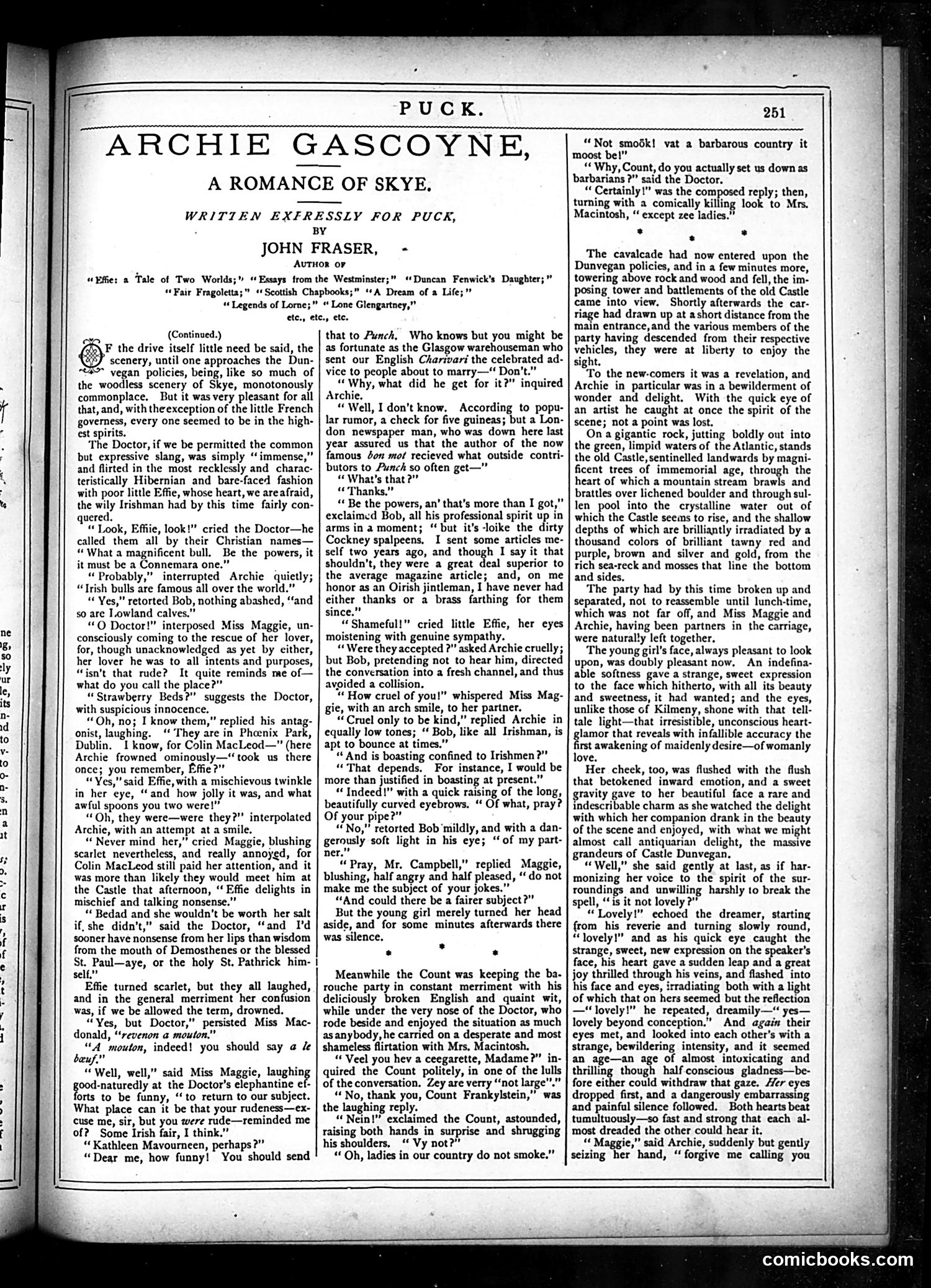
This page presents a serialized fictional story by John Fraser, not a political cartoon. The narrative appears to be a romantic tale set in Scotland (the Isle of Skye), featuring characters including Archie, Maggie, and the Doctor discussing Irish stereotypes and courtship customs. The text includes period-typical humor relying on Irish character caricatures ("Irish bulls are famous all over the world"). The story's dialogue showcases Victorian-era romantic comedy tropes, with exchanges about marriage proposals and social propriety among rural Scottish and Irish characters. This is entertainment literature rather than political satire—representative of Puck's mixed content combining humor writing with visual comics.
📄 Transcribed text from this page (OCR, searchable)
Machine-transcribed from the original scan — historical spelling and the odd misread are preserved.
BROT KM we RAE A Sen oe geen! ARCHIE GASCOYNE, A ROMANCE OF SKYE, WRITTEN EXFRESSLY FOR PUCK, + BY JOHN FRASER, AUTHOR oF «Effie: a Tale of Two Worlds; “Essays from the Westminster;” ‘Duncan Fenwick's Daughter; ” «Fair Fragoletta;” Scottish Chapbooks;" “A Dream of a Life;” + Legends of Lorne;” “ Lone Glengartney,”” ete., etc, etc, (Continued.) F the drive itself little need be said, the scenery, until one approaches the Dun- > vegan policies, being, like so much of the woodless scenery of Skye, monotonously commonplace. But it was very pleasant for all that, and, with theexception of the little French governess, every one seemed to be in the high- est spirits. ‘The Doctor, if we be permitted the common but expressive slang, was simply “immense,” and flirted in the most recklessly and charac- teristically Hibernian and bare-faced fashion with poor little Effie, whose heart, we areafraid, the wily Irishman had by this time fairly con- quered. “ Look, Effiie, look!” cried the Doctor—he called them all by their Christian names— “What a magnificent bull. Be the powers, it it must be a Connemara one.” “Probably,” interrupted Archie quietly; “Trish bulls are famous all over the world.” “Yes,” retorted Bob, nothing abashed, ‘‘and so are Lowland calves,” “O Doctor!" interposed Miss Maggie, un- consciously coming to the rescue of her lover, for, though unacknowledged as yet by cither, her lover he was to all intents and purposes, “isn't that rude? It quite reminds me of— what do you call the place?” “Strawberry Beds?” suggests the Doctor, with suspicious innocence. “Oh, no; I know them,” replied his antag- onist, laughing. “ ‘They are in Phoenix Park, Dublin. I know, for Colin MacLeod—" (here Archie frowned ominously—* took us there once; you remember, Effie?” “Yes,” said Effie, with a mischievous twinkle in her eye, ‘and how jolly it was, and what awful spoons you two were!” “Oh, they were—were they?” interpolated Archie, with an attempt at a smile. “Never mind her,” cried Maggie, blushing scarlet nevertheless, and really annoyed, for Colin MacLeod still paid her attention, and it was more than likely they would meet him at the Castle that afternoon, “Effie delights in mischief and talking nonsense.” “ Bedad and she wouldn't be worth her salt if, she didn’t,” said the Doctor, “and I'd sooner have nonsense from her lips than wisdom from the mouth of Demosthenes or the blessed St. Paul—aye, or the holy St, Pathrick him- self.” Effie turned scarlet, but they all laughed, and in the general merriment her confusion was, if we be allowed the term, drowned. “Yes, but Doctor,” persisted Miss Mac- donald, “revenon a mouton,” “(A mouton, indeed! you should say @ /e bauf.”” “Well, well,” said Miss Maggie, laughin; good-naturedly at the Doctor's elephantine ef- forts to be funny, “‘ to return to our subject. What place can it be that your rudeness—ex- cuse me, sir, but you were rude—reminded me of? Some Irish fair, I think.” “ Kathleen Mavourneen, perhaps?” “Dear me, how funny! You should send that to Punch, Who knows but you might be as fortunate as the Glasgow warehouseman who sent our English Charivari the celebrated ad- vice to people about to marry—‘ Don’t.” “Why, what did he get for it?” inquired Archie. “ Well, I don’t know. According to popu- lar rumor, a check for five guineas; but a Lon- don newspaper man, who was down here last year assured us that the author of the now famous bon mot recieved what outside contri- butors to Punch so often get—"" “What's that ?”” “Thanks,” “ Be the powers, an’ that’s more than I got,” exclaimed Bob, all his professional spirit up in arms in a moment; “ but it’s -loike the dirty Cockney spalpeens, I sent some articles me- self two years ago, and though I say it that shouldn't, they were a great deal superior to the average magazine article; and, on me honor as an Oirish jintleman, I have never had either thanks or a brass farthing for them since.” “Shameful!” cried little Effie, her eyes moistening with genuine sympathy. “Were they accepted ?” asked Archie cruelly; but Bob, pretending not to hear him, directed the conversation into a fresh channel, and thus avoided a collision. “ How cruel of you!” whispered Miss Mag- gie, with an arch smile, to her partner, “Cruel only to be kind,” replied Archie in equally low tones; “ Bob, like all Irishman, is apt to bounce at times.” “ And is boasting confined to Irishmen?” “That depends. For instance, I would be more than justified in boasting at present.” “ Indeed!" with a quick raising of the long, beautifully curved eyebrows. “ Of what, pray? Of your pipe?” “No,” retorted Bob‘mildly, and with a dan- gerously soft light in his eye; “of my part- ner.” “Pray, Mr. Campbell,” replied Maggie, blushing, half angry and half pleased, “do not make me the subject of your jokes.” “And could there be a fairer subject?” But the young girl merely turned her head aside, and for some minutes afterwards there was silence, a Meanwhile the Count was keeping the ba- rouche party in constant merriment with his deliciously broken English and quaint wit, while under the very nose of the Doctor, who rode beside and enjoyed the situation as much asanybody, he carried on a desperate and most shameless flirtation with Mrs. Macintosh. ‘ Veel you hev a ceegarette, Madame?” in- quired the Count politely, in one of the lulls of the conversation. Zey are verry ‘“‘not large”’.” “No, thank you, Count Frankylstein,” was the laughing reply. “Nein!” exclaimed the Count, astounded, raising both hands in surprise and shrugging his shoulders, ‘ Vy not?” “Oh, ladies in our country do not smoke.” “Not smodk! vat a barbarous country it moost be!" «Why, Count, do you actually set us down as barbarians ?” said the Doctor. “ Certainly !” was the coi d reply; then, turning with a comically killing look to Mrs. Macintosh, “ except zee ladies.” * A Py The cavalcade had now entered upon the Dunvegan policies, and in a few minutes more, towering above rock and wood and fell, the im- posing tower and battlements of the old Castle came into view. Shortly afterwards the car- riage had drawn up at ashort distance from the main entrance, and the various members of the party having descended from their respective vehicles, they were at liberty to enjoy the sight. To the new-comers it was a revelation, and Archie in particular was in a bewilderment of wonder and delight. With the quick eye of an artist he caught at once the spirit of the scene; not a point was lost. On a gigantic rock, jutting boldly out into the green, limpid waters of the Atlantic, stands the old Castle, sentinelled landwards by magni- ficent trees of immemorial age, through the heart of which a mountain stream brawls and brattles over lichened boulder and through sul- len pool into the crystalline water out of which the Castle seems to rise, and the shallow depths of which are brilliantly irradiated by a thousand colors of brilliant tawny red and purple, brown and silver and gold, from the rich sea-reck and mosses that line the bottom and sides. ‘The party had by this time broken up and separated, not to reassemble until lunch-time, which was not far off, and Miss Maggie and Archie, having been partners in the carriage, were naturally left together, ‘The young girl's face, always pleasant to look upon, was doubly pleasant now. An indefina- able softness gave a strange, sweet expression to the face which hitherto, with all its beauty and sweetness, it had wanted; and the eyes, unlike those of Kilmeny, shone with that tell- tale light—that irresistible, unconscious heart- lamor that reveals with infallible accuracy the frst awakening of maidenly desire—of womanly love. Her cheek, too, was flushed with the flush that betokened inward emotion, and a sweet gravity gave to her beautiful face a rare and indescribable charm as she watched the delight with which her companion drank in the beauty of the scene and enjoyed, with what we might almost call antiquarian delight, the massive grandeurs of Castle Dunvegan, “Well,” she said gently at last, as if har- monizing her voice to the spirit of the sur- roundings and unwilling harshly to break the spell, ‘is it not lovely 2” “ Lovely!” echoed the dreamer, starting from his reverie and turning slowly round, “lovely!” and as his quick eye caught the strange, sweet, new expression on the speaker's face, his heart gave a sudden leap and a great joy thrilled through his veins, and flashed into his face and eyes, irradiating both with a light of which that on hers seemed but the reflection —lovely!" he repeated, dreamily— yes— lovely beyond conception.” And again their eyes met, and looked into each other's with a strange, bewildering intensity, and it seemed an age—an age of almost intoxicating and thrilling though halfconscious gladness—be- fore either could withdraw that gaze. Her eyes dropped first, and a dangerously embarrassing and painful silence followed. Both hearts beat tumultuously—so fast and strong that each al- most dreaded the other could hear it, “ Maggie,” said Archie, suddenly but gently seizing her hand, “forgive me calling you comicbooks.com