
Puck, 1879-06-25 · page 7 of 16
Puck — June 25, 1879 — page 7: what you’re looking at
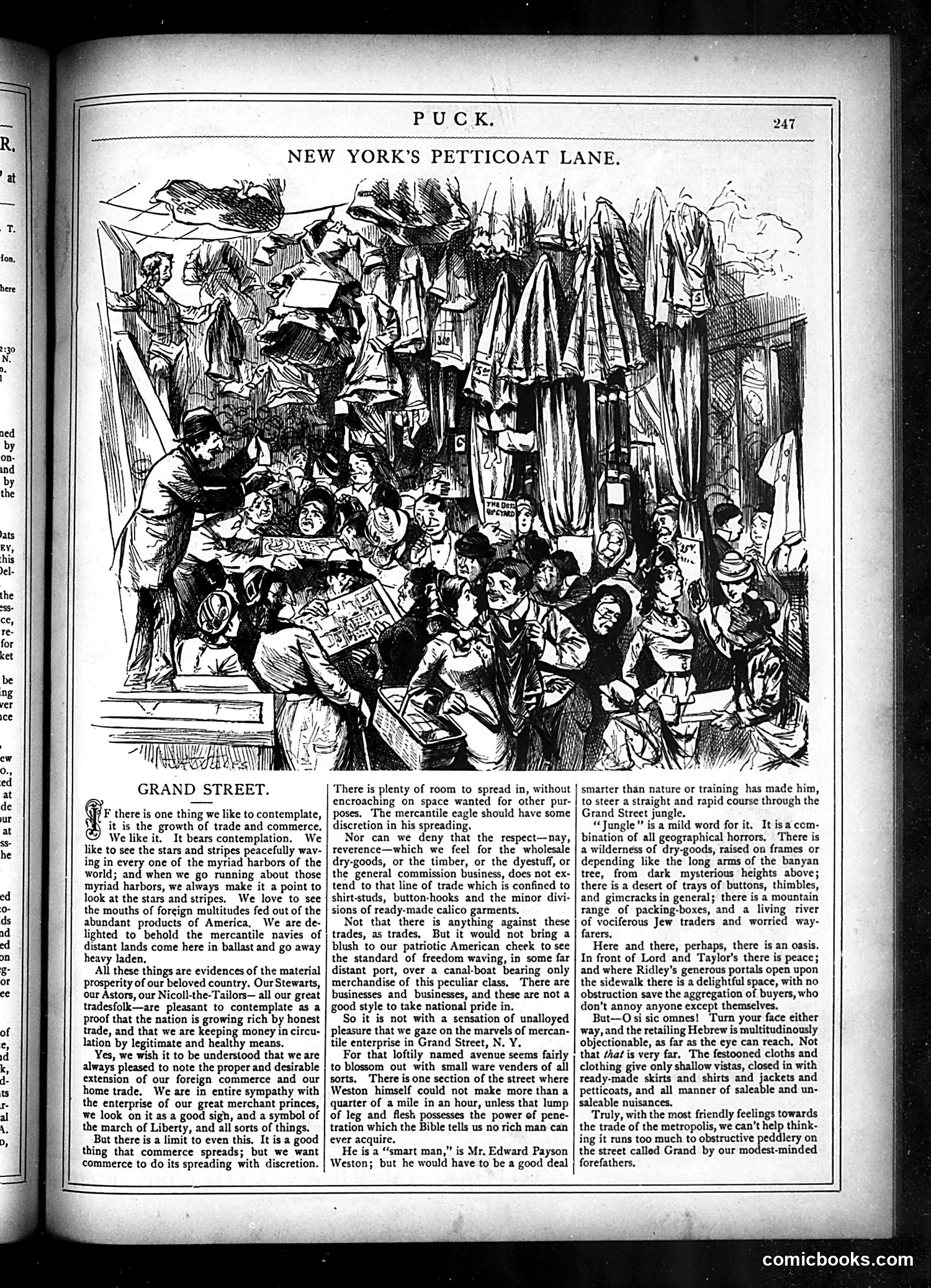
What you’re looking at
This satirical illustration depicts the crowded commercial district of Grand Street in New York, which the text identifies as a center for cheap clothing and dry goods merchants. The cartoon critiques what it calls the "mercantile eagle" and merchants who sell "ready-made calico garments" and other low-quality merchandise. The text expresses ambivalent attitudes toward commerce: while celebrating American trade and freedom, it mocks the street vendors and the poor-quality goods sold there—described as items "raised on frames or depending like the long arms of the banyan tree." The illustration shows a chaotic mass of pedestrians and merchandise, suggesting the crowded, disorderly nature of this working-class shopping district that contrasts with wealthier commercial areas.
📄 Transcribed text from this page (OCR, searchable)
Machine-transcribed from the original scan — historical spelling and the odd misread are preserved.
PUCK. NEW YORK’S PETTICOAT LANE. S=—=,. SS== GRAND STREET. F there is one thing we like to contemplate, it is the growth of trade and commerce, We like it. It bears contemplation. We like to see the stars and stripes peacefully wav- ing in every one of the myriad harbors of the world; and when we go running about those myriad harbors, we always make it a point to look at the stars and stripes. We love to see the mouths of foreign multitudes fed out of the abundant products of America, We are de- lighted to behold the mercantile navies of distant lands come here in ballast and go away heavy laden. All these things are evidences of the material prosperity of our beloved country. Our Stewarts, our Astors, our Nicoll-the-Tailors— all our great tradesfolk—are pleasant to contemplate as a proof that the nation is growing rich by honest trade, and that we are keeping money in circu- lation by legitimate and healthy means. Yes, we wish it to be understood that we are always pleased to note the proper and desirable extension of our foreign commerce and our home trade. We are in entire sympathy with the enterprise of our great merchant princes, we look on it as a good sigh, and a symbol of the march of Liberty, and all sorts of things. But there is a limit to even this. It is a good thing that commerce spreads; but we want commerce to do its spreading with discretion. There is plenty of room to spread in, without encroaching on space wanted for other pur- poses. The mercantile eagle should have some discretion in his spreading. Nor can we deny that the respect—nay, reverence—which we feel for the wholesale dry-goods, or the timber, or the dyestuff, or the general commission business, does not ex- tend to that line of trade which is confined to shirt-studs, button-hooks and the minor divi- sions of ready-made calico garments. Not that there is anything against these trades, as trades, But it would not bring a blush to our patriotic American cheek to see the standard of freedom waving, in some far distant port, over a canal-boat bearing only merchandise of this peculiar class, There are businesses and businesses, and these are not a good style to take national pride in. So it is not with a sensation of unalloyed pleasure that we gaze on the marvels of mercan- tile enterprise in Grand Street, N. Y. For that loftily named avenue seems fairly to blossom out with small ware venders of all sorts. There is one section of the street where Weston himself could not make more than a quarter of a mile in an hour, unless that lump of leg and flesh possesses the power of pene- tration which the Bible tells us no rich man can ever acquire. He is a “smart man,” is Mr, Edward Payson Weston; but he would have to be a good deal smarter than nature or training has made him, to steer a straight and rapid course through the Grand Street jungle. “Jungle” is a mild word for it. It isa com- bination of all geographical horrors, There is a wilderness of dry-goods, raised on frames or depending like the long arms of the banyan tree, from dark mysterious heights above; there is a desert of trays of buttons, thimbles, and gimeracks in general; there is a mountain range of packing-boxes, and a living river of vociferous Jew traders and worried way- farers. Here and there, perhaps, there is an oasis, In front of Lord and Taylor's there is peace; and where Ridley’s generous portals open upon the sidewalk there is a delightful space, with no obstruction save the aggregation of buyers, who don’t annoy anyone except themselves. But—O si sic omnes! Turn your face either way, and the retailing Hebrew is multitudinously objectionable, as far as the eye can reach, Not that hat is very far. The festooned cloths and clothing give only shallow vistas, closed in with ready-made skirts and shirts and jackets and petticoats, and all manner of saleable and un- saleable nuisances, Truly, with the most friendly feelings towards the trade of the metropolis, we can’t help think- ing it runs too much to obstructive peddlery on the street called Grand by our modest-minded forefathers, ——_____. comicbooks.com