
A complete issue · 16 pages · 1879
Puck — April 30, 1879
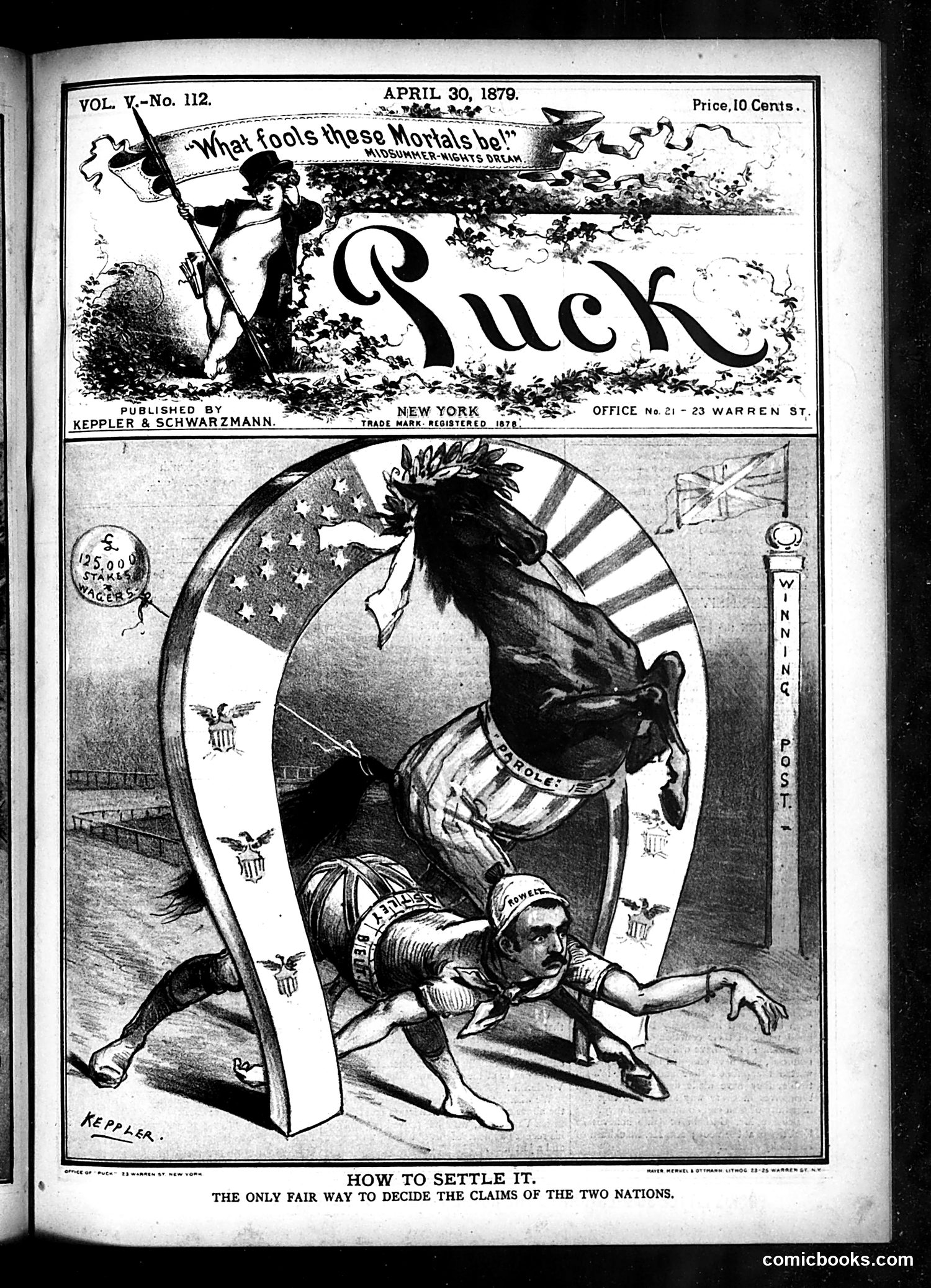
This April 30, 1879 *Puck* cartoon satirizes international dispute resolution between two nations (indicated by the flags and shields bearing American eagles and British symbols). The central image shows two figures inside a large horseshoe—a traditional symbol of luck and fortune. The caption "THE ONLY FAIR WAY TO DECIDE THE CLAIMS OF THE TWO NATIONS" ironically suggests that settling territorial or diplomatic disputes through chance (gambling/luck) rather than negotiation is equally valid to whatever serious methods are actually being employed. The cartoon mocks the apparent absurdity or futility of current diplomatic efforts, implying that leaving outcomes to luck would be no worse than the actual negotiations occurring between the nations.
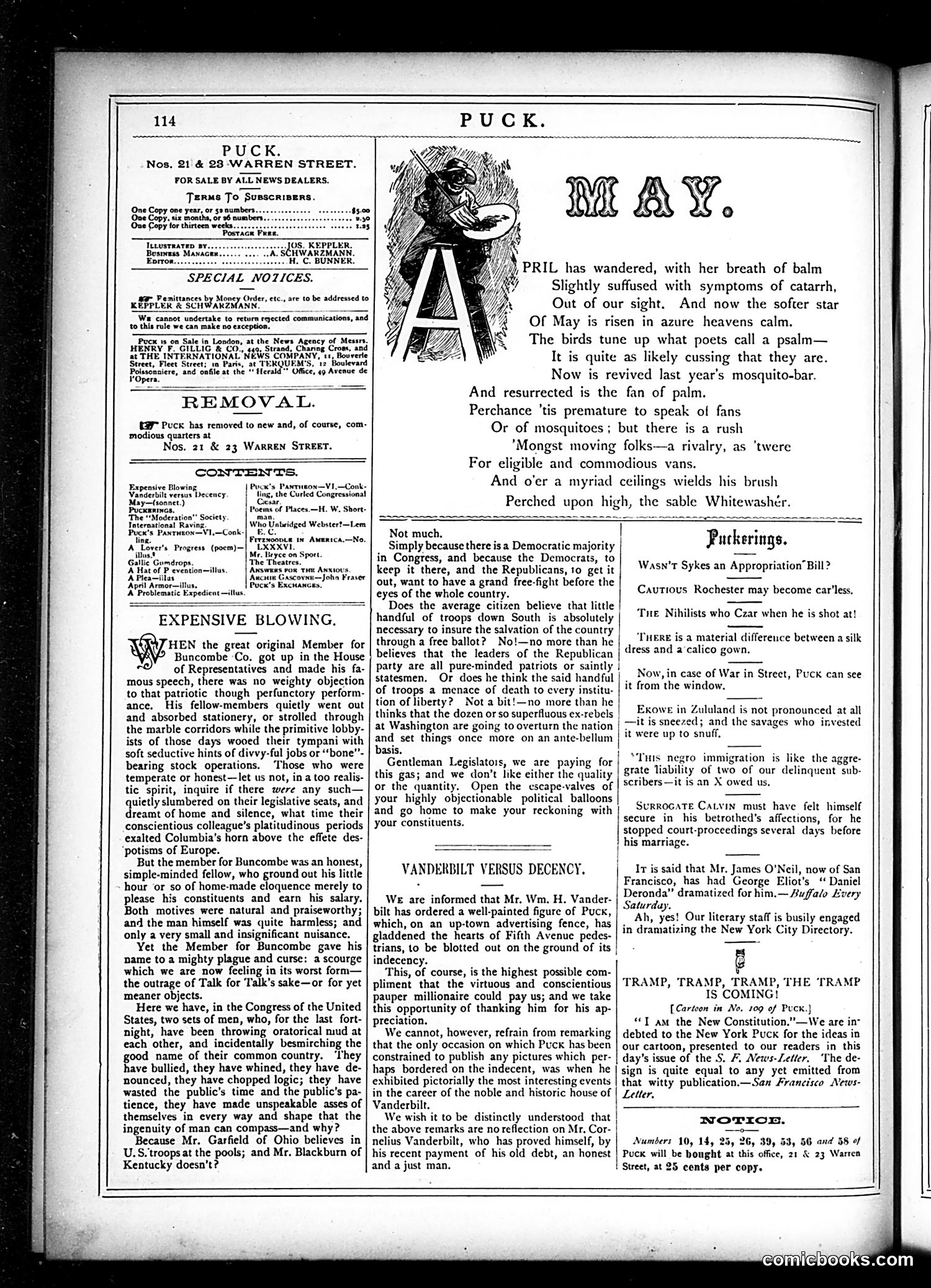
The main cartoon features **Puck himself** (the publication's mascot—a mischievous sprite) perched atop a large letter "A," illustrating a poem about May's arrival. This is decorative rather than political satire. The page's political content appears in the **"Putterings"** section and articles below. These target: - A Democratic appropriations bill ("Wasn't Sykes an Appropriation Bill?") - Republican political strategy regarding Southern troops and the nation's stability - Criticism of "objectionable political balloons" and political corruption The **"Vanderbilt versus Decency"** section mocks wealthy industrialist William Vanderbilt's tasteless Fifth Avenue mansion advertising, contrasting his wealth with ethical concerns. Overall, this page blends seasonal verse with sharp political commentary on Gilded Age corruption and party politics.
This page contains three separate articles with no visible cartoons: 1. **"The 'Moderation' Society"** satirizes temperance reformers ("Washingtonians," "Neal Dows") who advocate prohibition while hypocritically consuming alcohol themselves. The joke is their selective enforcement—pushing abstinence on working-class men while exempting themselves. 2. **"International Racing"** mocks American overconfidence in horse racing. The text describes failed attempts to prove American horses superior to British ones, with amusing anecdotes about impractical schemes (sending a man to England, walking a horse against England). The satire targets American arrogance and nationalism. 3. **"Puck's Pantheon VI"** offers satirical praise of Senator Conkling, implying he's self-absorbed and politically unreliable despite his oratorical gifts. The page is primarily text-based satire rather than visual cartooning.
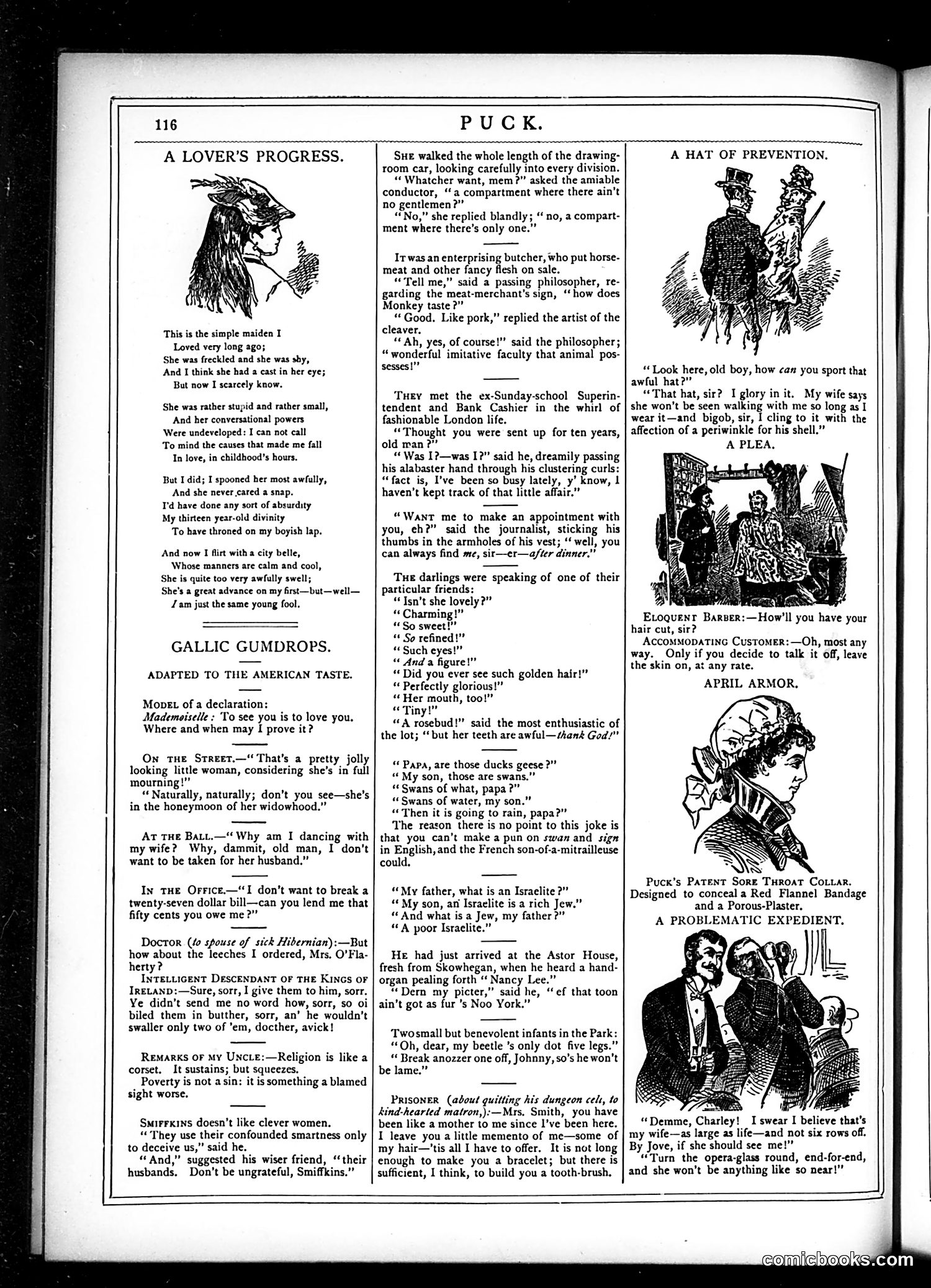
This page contains primarily **humorous literary sketches and anecdotes** rather than political cartoons. The pieces include "A Lover's Progress" (romantic poetry about courtship), "Gallic Gumdrops" (French-style romantic declarations), and various comic dialogues mocking contemporary social types—including a butcher, philosopher, and office workers. The illustrations are character sketches accompanying these humorous pieces. "A Hat of Prevention" depicts two gentlemen discussing a peculiar hat. "April Armor" shows a barber. Other small vignettes illustrate comedic scenarios from the text. The **satire targets social pretension and absurdity** rather than specific political figures or events—poking fun at affected speech, foolish romantic declarations, and workplace absurdities. This represents Puck's lighter, entertainment-focused content rather than hard-hitting political commentary.
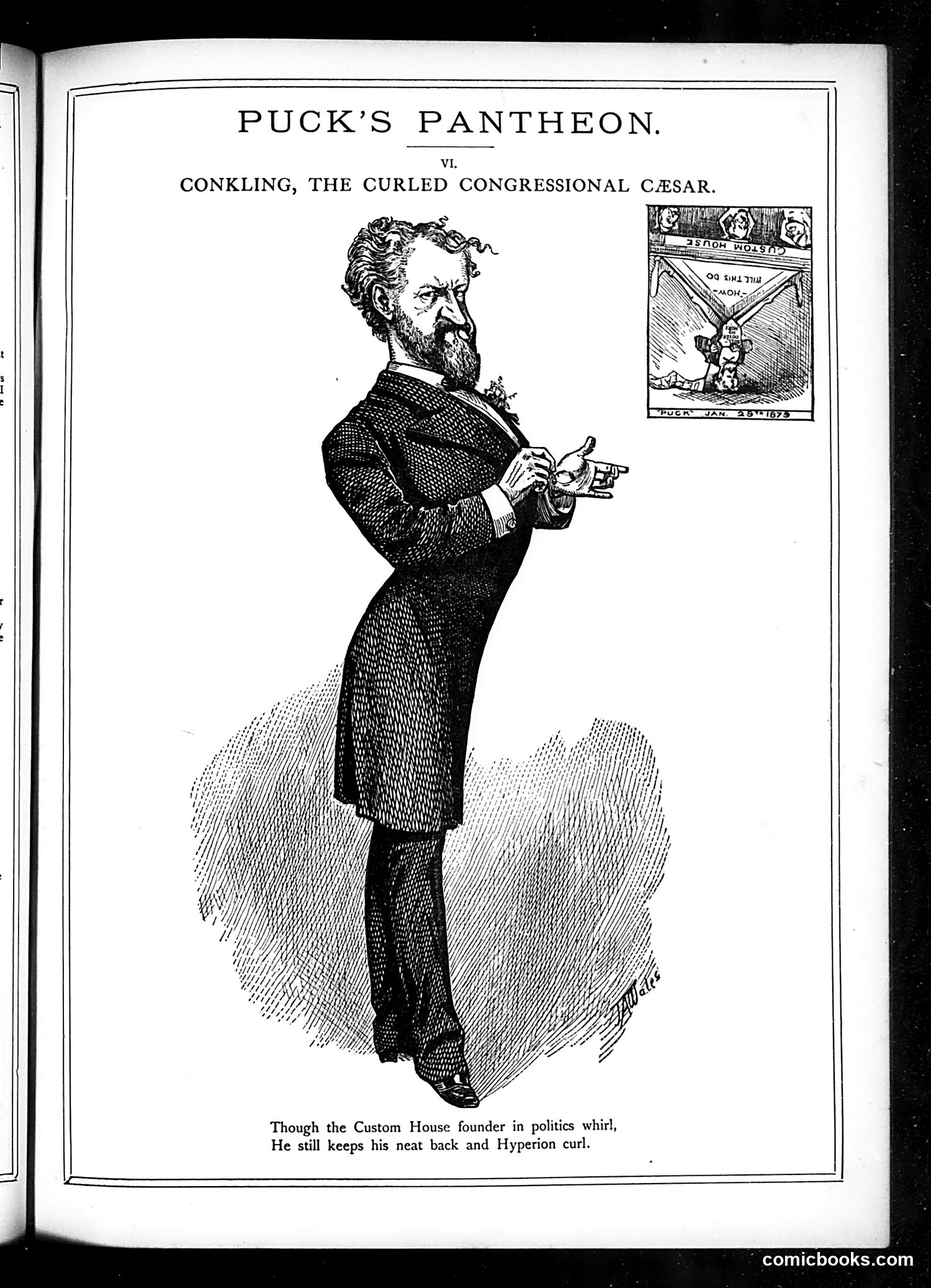
This Puck cartoon satirizes **Roscoe Conkling**, a prominent Republican senator and political boss of the Gilded Age. The title mockingly compares him to Julius Caesar, while the visual emphasizes his vanity: the figure displays carefully curled hair and holds a revolver, suggesting both his political aggression and his reputation for personal grooming. The caption's pun on "Custom House" references Conkling's control over New York's Custom House patronage—a major source of political power. The joke attacks his contradiction: despite causing "politics whirl," he remains preoccupied with his appearance ("neat back and Hyperion curl"). This ridicules Conkling's vanity alongside his ruthless political machine tactics during the contentious Reconstruction and post-Reconstruction era.
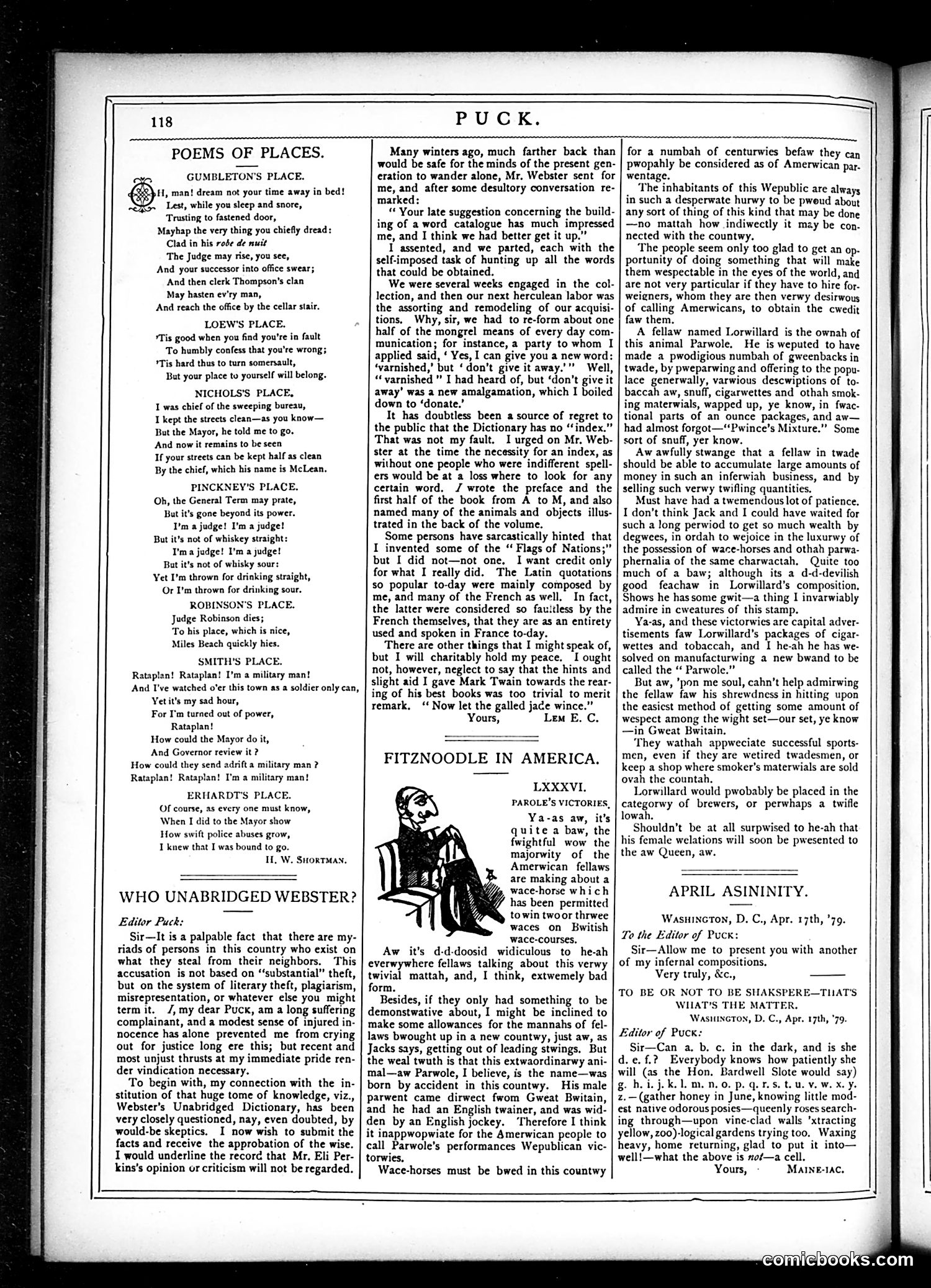
This page contains primarily **letters to the editor and poetry**, not political cartoons. The content includes reader submissions about Webster's Dictionary (discussing an "unabridged" edition and indexing issues), commentary on American horse-racing, and satirical verse about various places. The one small illustration shows a seated figure labeled "**Fitznoodle in America**" - apparently a character used for commentary. The letters discuss dictionary compilation, American racehorses permitted to win British races, and social observations about American life. The page represents Puck's typical format: combining humorous reader contributions with light satire rather than hard-hitting political commentary. Without clearer visual context or more specific historical references in the text, the exact satirical targets remain somewhat obscured to modern readers.
This page is primarily **text content**, not a cartoon. It contains three sections: 1. **"Mr. Bryce on Sport"** — A lengthy article praising Lloyd Bryce's literary contributions to the *North American Review*, particularly his essay "A Plea for Sport." The writer defends Bryce against criticism that he's intellectually frivolous, arguing his work shows sophistication and wit. 2. **"The Theatres"** — Brief reviews of current Broadway productions, including German dialect comedy and plays at various theaters. 3. **"Answers for the Anxious"** — A advice column addressing reader questions. The page represents Puck's format of combining satirical commentary with cultural criticism and entertainment coverage, typical of late 19th-century American humor magazines.
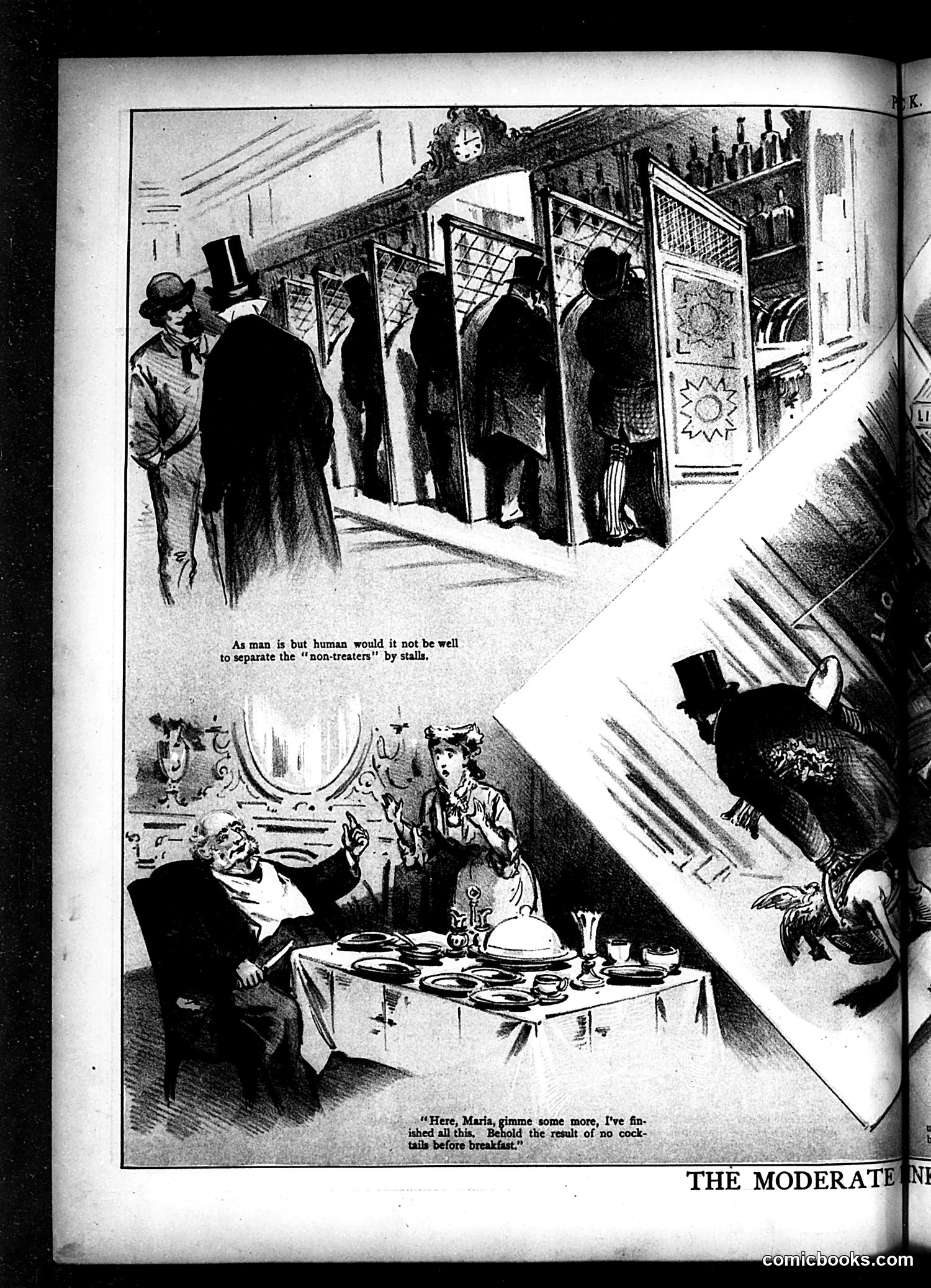
This satirical cartoon depicts class division in dining establishments. The upper panel shows well-dressed men (wearing top hats) queuing at what appears to be exclusive dining stalls or booths, with the caption: "As man is but human would it not be well to separate the 'non-treaters' by stalls." The lower panel contrasts this with a modest meal scene where a man and woman dine simply. The dialogue reads: "Here, Maria, gimme some more. I've finished all this. Behold the result of no cocktails before breakfast." The satire criticizes wealth-based social segregation in restaurants while mocking pretentious dining customs among the wealthy. The "non-treaters" refers to those who don't spend lavishly, suggesting the proposal to separate diners by economic status—a commentary on American class consciousness and commercialism.
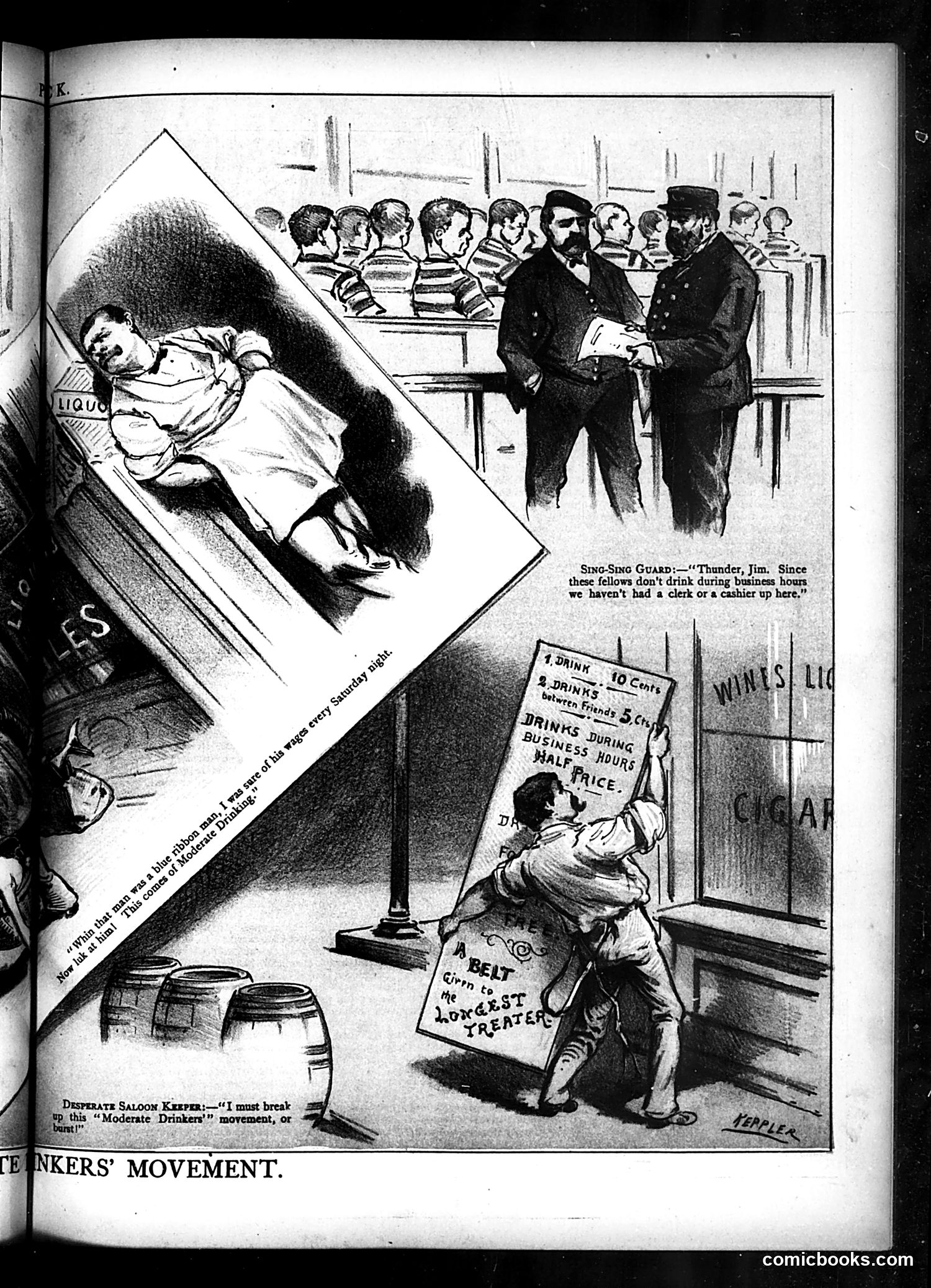
This Puck cartoon satirizes the temperance movement's "moderate drinking" compromise position. The page shows three scenes: **Upper panel**: A courtroom or official setting where two men (likely temperance advocates) discuss their strategy, with spectators in background. **Left panel**: A sleeping drunk man labeled "LIQUOR," suggesting the movement's ineffectiveness. **Lower panel**: A desperate saloon keeper holding signs advertising cheap drinks ("10 Cents," "Half Price," "Drinks During Business Hours") to a small figure, captioned: "I must break in the 'Moderate Drinkers' movement, or be ruined!" The satirist argues that the "moderate drinking" compromise actually *helps* the alcohol industry by legitimizing drinking rather than stopping it—making the saloon keeper's business sustainable. The cartoon mocks the movement's naïveté.
This page is primarily **text content, not a cartoon**. It's Chapter II of "Archie Gascoyne, A Romance of Skye," a serialized story written expressly for Puck by John Fraser. The page features narrative prose describing Scottish characters and rural scenery—dialogue between figures like Effie, Flora, Maggie, Alister, and others discussing fishing, travel directions, and local matters. There are decorative initial letters and period illustrations, but no political satire or caricature. This appears to be **serialized fiction**, a common feature in 19th-century magazines like Puck, which combined humor and literary content for entertainment rather than political commentary on this particular page.
This page is primarily **text narrative, not a political cartoon**. It contains Chapter III of what appears to be a serialized story titled "Puck," featuring characters named Archie Gascoyne, Jenny, John, and Mrs. Fenton. The narrative discusses a wealthy young student at Glasgow University—Archie Gascoyne—who is described as well-connected, talented, and socially accomplished. The story focuses on romantic entanglements and domestic affairs rather than political satire. Since this is a Puck magazine page from the serialized fiction section rather than the satirical cartoon section, it lacks the political/social commentary typically expected from the publication. The content appears to be Victorian-era romantic literature aimed at general entertainment rather than satire or social criticism.
This page contains two main sections: a poem titled "Puck's Brilanques" (likely "Brilliances") addressing "To a Dragon Fly," and a section titled "In the Spring." The left column is a humorous poem featuring numerous satirical quips and observations about contemporary American life, society, and politics. References include critiques of military figures (Captain Williams), editors, and various social hypocrisies. The right column consists of brief satirical commentary items on diverse topics: nihilism, Zulu customs, Boston newspaper culture, whiskey preferences, and various social absurdities. Rather than a single political cartoon, this page functions as a miscellaneous humor and satire collection typical of Puck's format—sharp, disconnected jabs at contemporary figures, institutions, and social follies without sustained narrative or visual caricature.
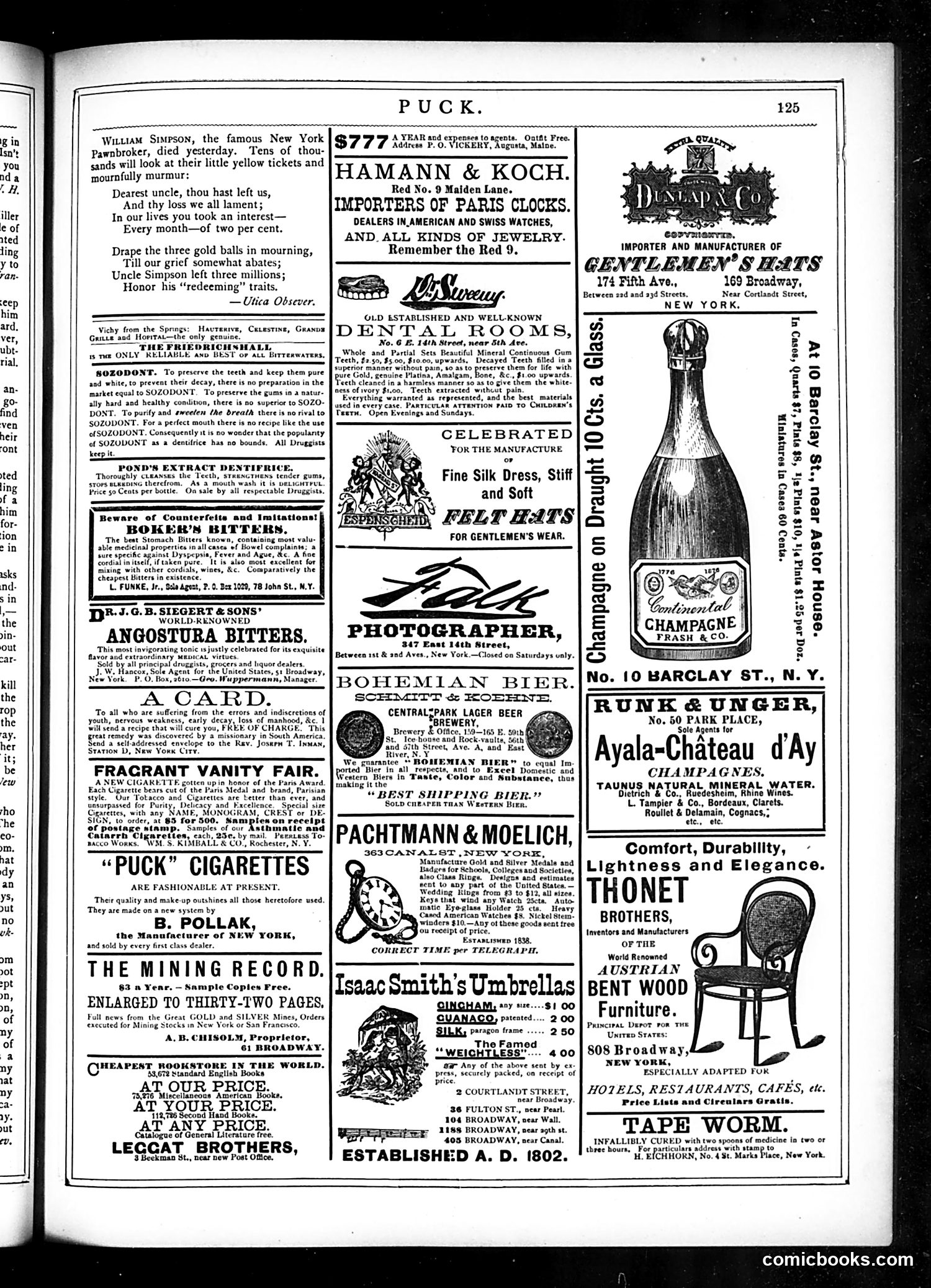
This is primarily an **advertisement page** rather than political satire. It contains numerous commercial ads for late 19th-century products and services: cigars ("Puck" brand), dental products, watches, hats, champagne, furniture, umbrellas, and other goods. Notable advertisers include Hamann & Koch (Paris clocks and watches), a dental practice, and various New York merchants. One ad mentions "Bohemian Bier" from a Central Park brewery. The page demonstrates Puck's business model: satirical content subsidized by paid advertisements. While some ads include decorative illustrations (bottles, furniture, umbrellas), **there is no evident political cartoon or social satire on this particular page**—it serves primarily as a revenue-generating advertisement section of the magazine.
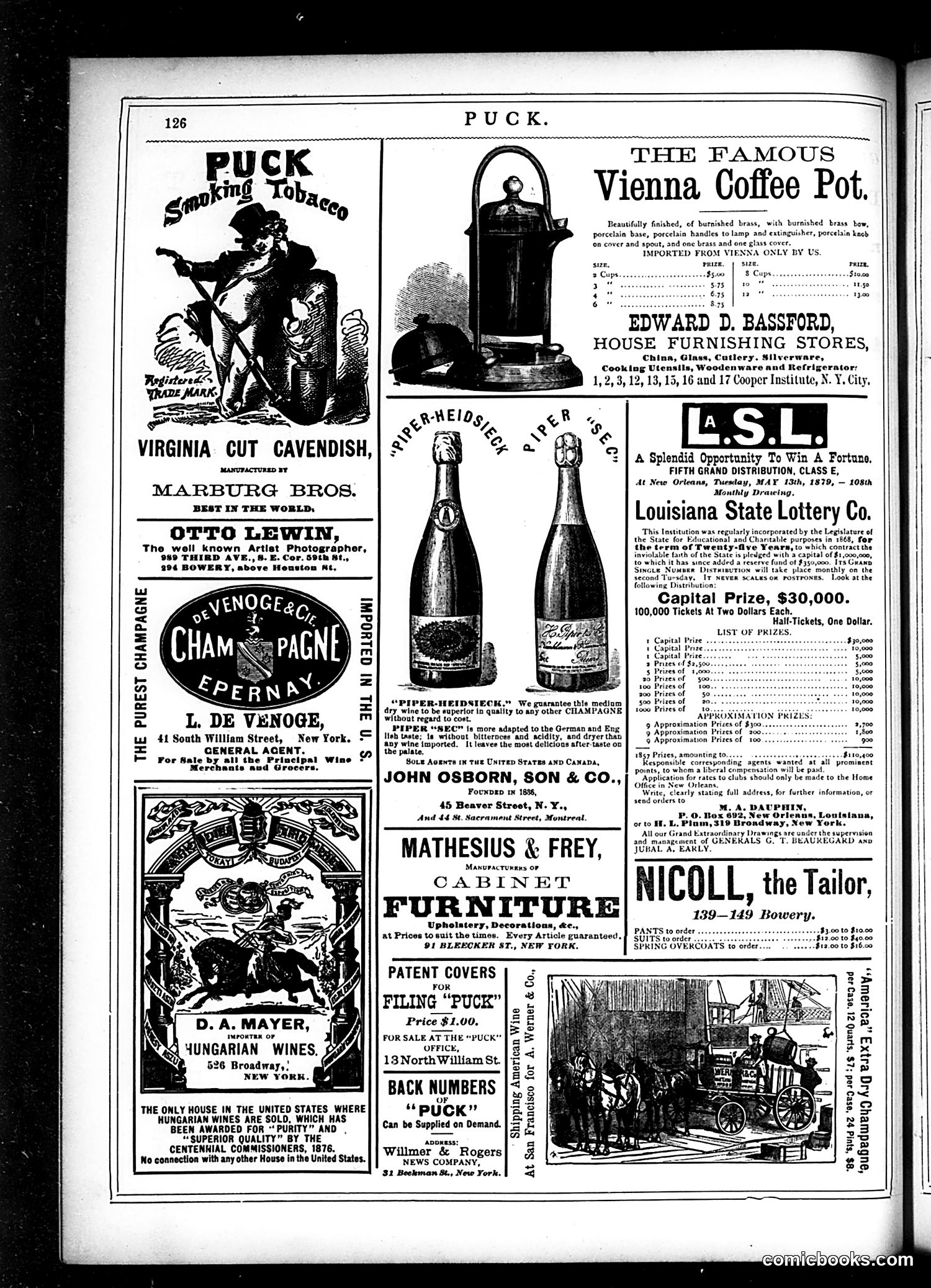
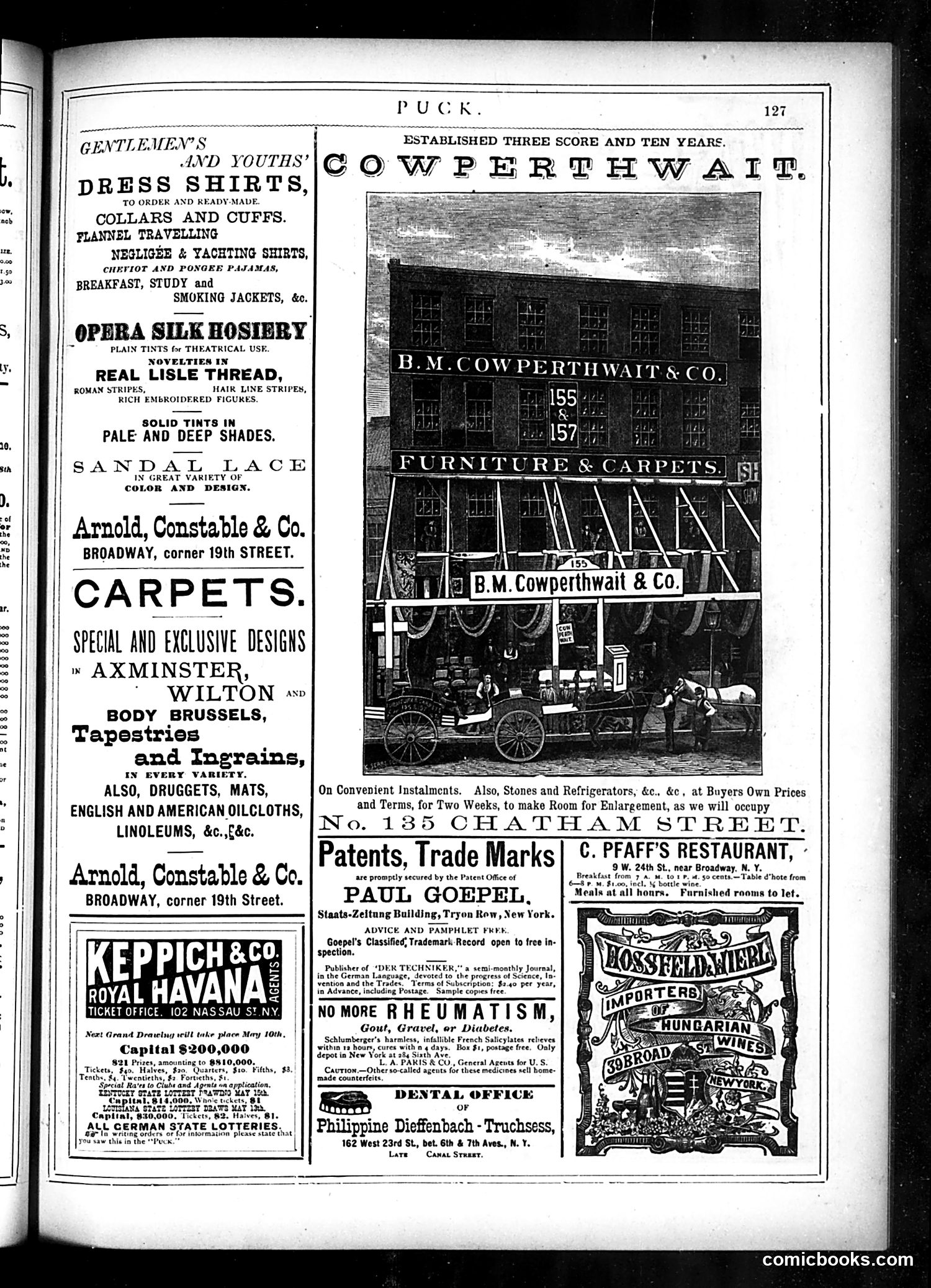
This page is primarily **advertising content** rather than editorial cartoons or satire. The main image shows a storefront photograph of **B.M. Cowperthwait & Co.**, a furniture and carpets business located at 155-157 Chatham Street, with a delivery wagon in front. The accompanying text advertises their goods "On Convenient Instalments" and other purchase terms. The left side contains advertisements for various merchants (Arnold, Constable & Co.; Keppich & Co.), while the right side advertises patent/trademark services, restaurants, dental offices, and wine importers. There is **no political cartoon or satire visible** on this page—it functions as a commercial advertising section typical of Puck's revenue model during this period.
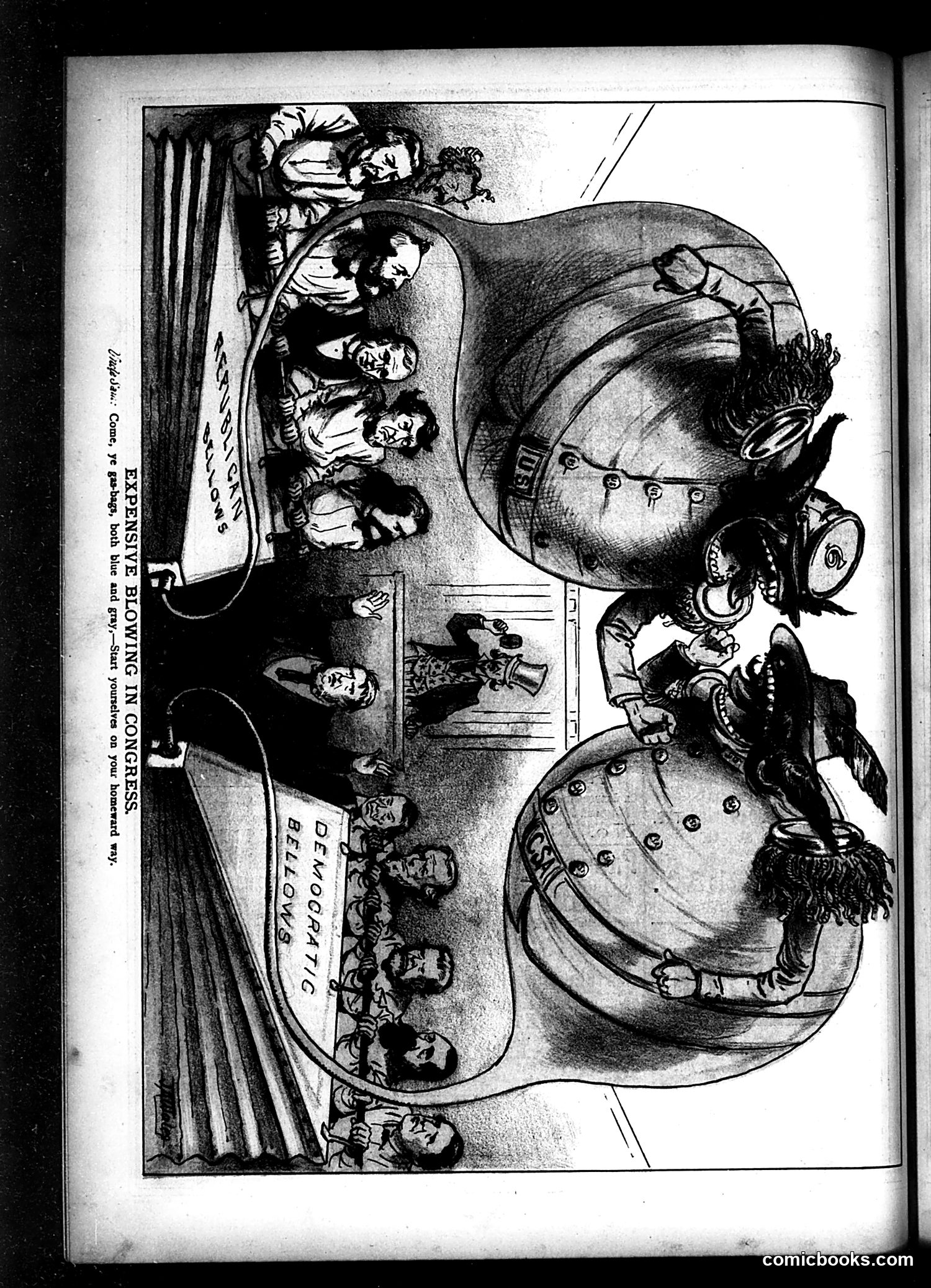
This appears to be a Puck magazine satirical cartoon about "Expensive Blooming in Congress." The image shows two large, bloated figures labeled "Democratic Bellows" on the left side, depicted as balloons or inflated forms. On the right are two similarly exaggerated, rotund figures, suggesting politicians or congressional members whose bellies have swollen—likely satirizing wasteful government spending or corruption. The cartoon critiques congressional extravagance during what appears to be a Democratic administration. The "bellows" metaphor suggests these politicians are inflating themselves (getting rich) while in office. The visual exaggeration of their physical forms represents moral and financial excess. This reflects late 19th/early 20th-century popular criticism of politicians benefiting personally from their positions while neglecting constituents.