
Puck, 1879-04-30 · page 4 of 16
Puck — April 30, 1879 — page 4: what you’re looking at
What you’re looking at
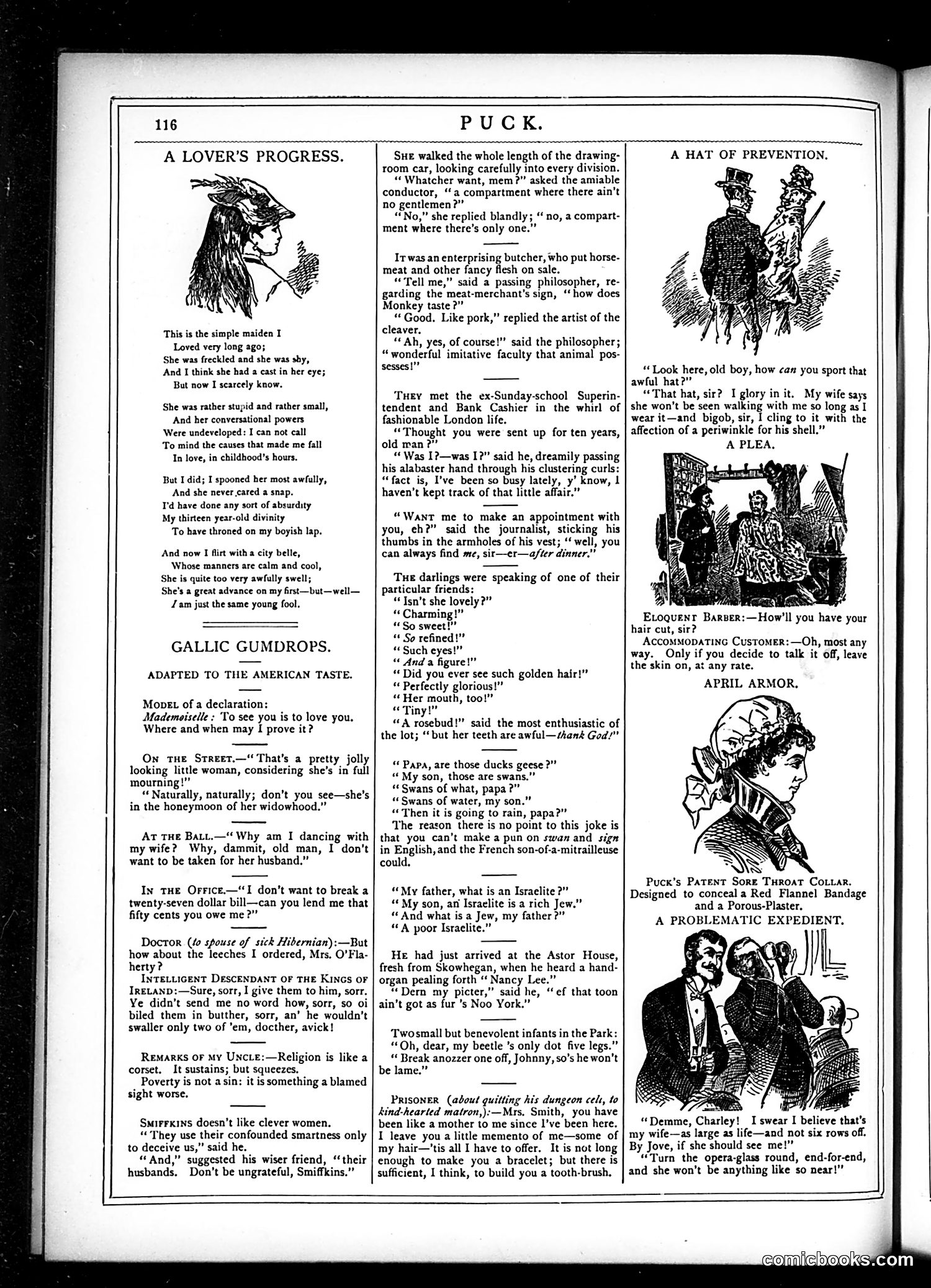
This page contains primarily **humorous literary sketches and anecdotes** rather than political cartoons. The pieces include "A Lover's Progress" (romantic poetry about courtship), "Gallic Gumdrops" (French-style romantic declarations), and various comic dialogues mocking contemporary social types—including a butcher, philosopher, and office workers. The illustrations are character sketches accompanying these humorous pieces. "A Hat of Prevention" depicts two gentlemen discussing a peculiar hat. "April Armor" shows a barber. Other small vignettes illustrate comedic scenarios from the text. The **satire targets social pretension and absurdity** rather than specific political figures or events—poking fun at affected speech, foolish romantic declarations, and workplace absurdities. This represents Puck's lighter, entertainment-focused content rather than hard-hitting political commentary.
📄 Transcribed text from this page (OCR, searchable)
Machine-transcribed from the original scan — historical spelling and the odd misread are preserved.
116 PUCK. A LOVER’S PROGRESS. This is the simple maiden I Loved very long ago; She was freckled and she was shy, And I think she had a cast in her eye; But now I scarcely know. She was rather stupid and rather small, ‘And her conversational powers ‘Were undeveloped: I can not call To mind the causes that made me fall In love, in childhood’s hours. But I did; I spooned her most awfully, ‘And she never cared a snap. T'd have done any sort of absurdity My thirteen year-old divinity To have throned on my boyish lap. And now I flirt with a city belle, ‘Whose manners are calm and cool, She is quite too very awfully swell; She's a great advance on my first—but—well— am just the same young fool. GALLIC GUMDROPS. ADAPTED TO THE AMERICAN TASTE. Mons of a declaration: Mademeiselle : To see you is to love you. Where and when may I prove it? On tHe Srreet.—‘‘ That's a pretty jolly looking little woman, considering she’s in full mourning!” “Naturally, naturally; don’t you see—she’s in the honeymoon of her widowhood.” Ar THe BaLt.— Why am I dancing with my wife? Why, dammit, old man, I don't want to be taken for her husband.” In THE OrFice.—‘I don’t want to break a twenty-seven dollar bill—can you lend me that fifty cents you owe me?” Doctor (lo spouse of sick Hibernian):—But how about the leeches I ordered, Mrs, O’Fla- herty? INTELLIGENT DESCENDANT OF THE KinGs oF IrELAND:—Sure, sorr, I give them to him, sorr. Ye didn’t send me no word how, sorr, so oi biled them in butther, sorr, an’ he wouldn't swaller only two of ‘em, docther, avick! REMARKS OF MY UNcLE:—Religion is like a corset. It sustains; but squeezes. Poverty is not asin: it issomething a blamed sight worse, Smirrxins doesn’t like clever women. “ They use their confounded smartness only to deceive us,” said he, “And,” suggested his wiser friend, “their husbands. Don't be ungrateful, Smiffkins.”” Sue walked the whole length of the drawing- room car, looking carefully into every division. “« Whatcher want, mem?” asked the amiable conductor, “a compartment where there ain’t no gentlemen?” “*No,” she replied blandly; “ no, a compart- ment where there's only one.”” It was an enterprising butcher, who put horse- meat and other fancy flesh on sale. “Tell me,” said a passing philosopher, re- garding the meat-merchant's sign, “how does Monkey taste?” “Good. Like pork,” replied the artist of the cleaver. “Ah, yes, of course!” said the philosopher; “wonderful imitative faculty that animal pos- sesses!’? ‘THey met the ex-Sunday-school Superin- tendent and Bank Cashier in the whirl of fashionable London life. “Thought you were sent up for ten years, old man?” “ Was 1?—was 1?” said he, dreamily passing his alabaster hand through his clustering curls: “fact is, ’'ve been so busy lately, y’ know, 1 haven’t kept track of that little affair.” “Want me to make an appointment with you, eh?” said the journalist, sticking his thumbs in the armholes of his vest; “well, you can always find me, sir—er—a/ter dinner.” Tue darlings were speaking of one of their particular friends: “ Isn't she lovely?” “Charming!” “So sweet!” “ So refined!” “ Such eyes!” “And a figure!” “Did you ever see such golden hair!” “ Perfectly glorious!” “Her mouth, too!” “Tiny!” “A rosebud!” said the most enthusiastic of the lot; ‘‘but her teeth are awful—/hank God?” « Papa, are those ducks geese ?” “ My son, those are swans.” “Swans of what, papa?” “ Swans of water, my son.” “ Then it is going to rain, papa?” The reason there is no point to this joke is that you can’t make a pun on swan and sign in English, and the French son-of-a-mitrailleuse could, “My father, what is an Israelite ?” “ My son, an Israelite is a rich Jew.” “And what is a Jew, my father?” “A poor Israelite.” He had just arrived at the Astor House, fresh from Skowhegan, when he heard a hand- organ pealing forth “ Nancy Lee.” “Dern my picter,” said he, ‘ef that toon ain't got as fur ’s Noo York.” Twosmall but benevolent infants in the Park: “Oh, dear, my beetle 's only dot five legs.” “ Break anozzer one off, Johnny, so’s he won't be lame.” PRISONER (about guitting his dungeon celt, to kind-hearted matron,):—Mrs, Smith, you have been like a mother to me since I’ve been here. I leave you a little memento of me—some of my hair—'tis all I have to offer. It is not long enough to make you a bracelet; but there is sufficient, I think, to build you a tooth-brush, “Look here, old boy, how ¢an you sport that awful hat?” “That hat, sir? I glory in it. My wife says she won't be seen walking with me so long as I wear it—and bigob, sir, I cling to it with the affection of a periwinkle for his shell.” Eroquenr Barper: hair cut, sir? ACCOMMODATING CustoMER:—Oh, most any way. Only if you decide to talk it off, leave the skin on, at any rate. APRIL ARMOR. —How’'ll you have your Puck's Patent Sore THROAT COLLAR. Designed to conceal a Red Flannel Bandage and a Porous-Plaster. A PROBLEMATIC EXPEDIENT. “Demme, Charley! _I swear I believe that’s my wife—as large as life—and not six rows off. By Jove, if she should see me!” “Turn the opera-glass round, end-for-end, and she won't be anything like so near!”