
Puck, 1879-04-30 · page 10 of 16
Puck — April 30, 1879 — page 10: what you’re looking at
What you’re looking at
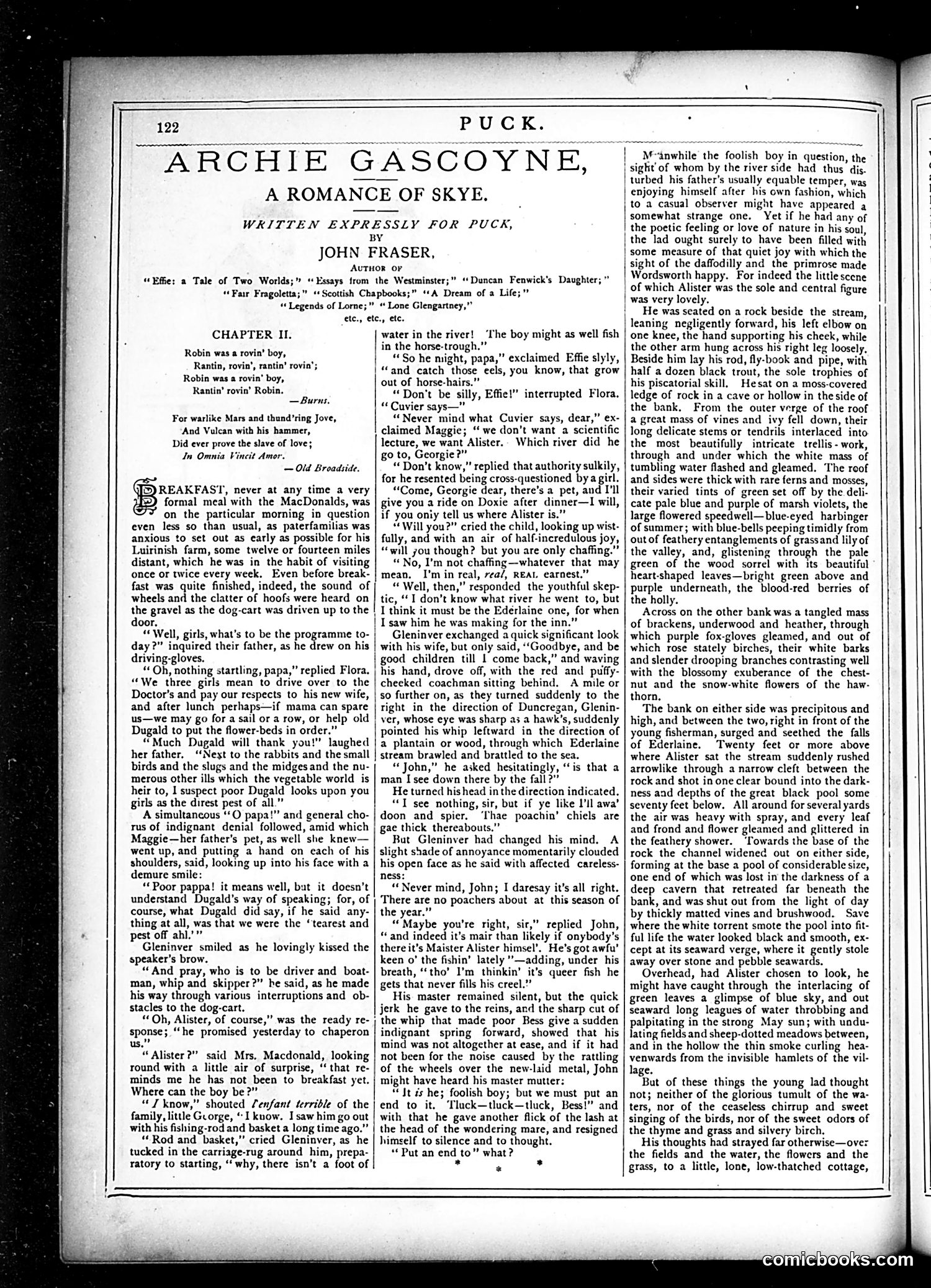
This page is primarily **text content, not a cartoon**. It's Chapter II of "Archie Gascoyne, A Romance of Skye," a serialized story written expressly for Puck by John Fraser. The page features narrative prose describing Scottish characters and rural scenery—dialogue between figures like Effie, Flora, Maggie, Alister, and others discussing fishing, travel directions, and local matters. There are decorative initial letters and period illustrations, but no political satire or caricature. This appears to be **serialized fiction**, a common feature in 19th-century magazines like Puck, which combined humor and literary content for entertainment rather than political commentary on this particular page.
📄 Transcribed text from this page (OCR, searchable)
Machine-transcribed from the original scan — historical spelling and the odd misread are preserved.
PUCK. ARCHIE GASCOYNE, A ROMANCE OF SKYE. WRITTEN EXPRESSLY FOR PUCK, BY JOHN FRASER, AUTHOR OF “Effie: a Tale of Two Worlds; ‘Essays from the Westminster;” “Duncan Fenwick's Daughter; ” «Far Fragoletta;" ‘Scottish Chapbooks;” ‘A Dream of a Life;”” «Legends of Lorn « Lone Glengartney,” etc., etc., etc. CHAPTER II. Robin was a rovin’ boy, Rantin, rovin’, rantin’ rovin’; Robin was a rovin’ boy, Rantin’ rovin’ Robin. —Burns. For warlike Mars and thund’ring Jove, ‘And Vulcan with his hammer, Did ever prove the slave of love; In Omnia Vincit Amor. —Old Broadside. REAKFAST, never at any time a very formal meal with the MacDonalds, was on the particular morning in question even less so than usual, as paterfamilias was anxious to set out as early as possible for his Luirinish farm, some twelve or fourteen miles distant, which he was in the habit of visiting once or twice every week. Even before break- fast was quite finished, indeed, the sound of wheels and the clatter of hoofs were heard on the gravel as the dog-cart was driven up to the | door, “Well, girls, what’s to be the programme to- | day?” inquired their father, as he drew on his | driving-gloves. “Oh, nothing startling, papa,” replied Flora. “We three girls mean to drive over to the Doctor’s and pay our respects to his new wife, and after lunch perhaps—if mama can spare us—we may go for a sail or a row, or help old Dugald to put the flower-beds in order.” “Much Dugald will thank you! laughed her father. ‘Next to the rabbits and the small birds and the slugs and the midges and the nu- merous other ills which the vegetable world is heir to, I suspect poor Dugald looks upon you girls as the direst pest of all.” A simultancous ‘O papa!” and general cho- tus of indignant denial followed, amid which Maggie—her father’s pet, as well she knew— went up, and putting a hand on each of his shoulders, said, looking up into his face with a demure smile: ‘Poor pappa! it means well, but it doesn’t understand Dugald’s way of speaking; for, of course, what Dugald did say, if he said any- thing at all, was that we were the ‘tearest and pest off ahl.’” Gleninver smiled as he lovingly kissed the speaker’s brow. “And pray, who is to be driver and boat- man, whip and skipper?” he said, as he made his way through various interruptions and ob- stacles to the dog-cart. “Oh, Alister, of course,” was the ready re- j sponse; “he promised yesterday to chaperon us,” “Alister?” said Mrs, Macdonald, looking round with a little air of surprise, ‘‘ that re- minds me he has not been to breakfast yet. Where can the boy be ?” “7 know,” shouted Senfant terrible of the family, little George, “I know. I saw him go out with his fishing-rod and basket a long time ago.” “Rod and basket,” cried Gleninver, as he tucked in the carriage-rug around him, prepa- ratory to starting, ‘‘why, there isn’t a foot of water in the river! in the horse-trough. | So he might, papa,” exclaimed Effie slyly, | “and catch those eels, you know, that grow out of horse-hairs.” “Don't be silly, Effie!” interrupted Flora, “ Cuvier says: “Never mind what Cuvier says, dear,” ex- claimed Maggie; “we don’t want a scientific lecture, we want Alister.. Which river did he go to, Georgie?” “Don't know,” replied that authority sulkily, for he resented being cross-questioned bya gitl. “Come, Georgie dear, there’s a pet, and I'll give you a ride on Doxie after dinner—I will, if you oniy tell us where Alister is.” “Will you?” cried the child, looking up wist- fully, and with an air of half-incredulous joy, “will zou though? but you are only chafing.” “No, I'm not chaffing—whatever that may mean. I’min real, rea/, REAL earnest.” “ Well, then,” responded the youthful skep- tic, “I don’t know what river he went to, but I think it must be the Ederlaine one, for when | I saw him he was making for the inn.” Gleninver exchanged a quick significant look with his wife, but only said, ““Goodbye, and be | good children till 1 come back,” and waving his hand, drove off, with the red and puffy: cheeked coachman sitting behind. A mile or so further on, as they turned suddenly to the right in the direction of Duncregan, Glenin- ver, whose eye was sharp as a hawk’s, suddenly pointed his whip leftward in the direction of a plantain or wood, through which Ederlaine stream brawled and brattled to the sea. “John,” he asked hesitatingly, ‘is that a man I see down there by the fall?” He turned his head in the direction indicated. “T see nothing, sir, but if ye like I'll awa’ doon and spier. ‘hae poachin’ chiels are gae thick thereabouts.” Bat Gleninver had changed his mind. A slight shade of annoyance momentarily clouded his open face as he said with affected careless- ness: “Never mind, John; I daresay it’s all right. ‘There are no poachers about at this season of the year.” “Maybe you're right, sir,” replied John, “and indeed it’s mair than likely if onybody’s there it’s Maister Alister himsel’. He's got awfu’ keen o' the fishin’ lately "—adding, under his breath, ‘tho’ I’m thinkin’ it’s queer fish he gets that never fills his creel.” His. master remained silent, but the quick jerk he gave to the reins, and the sharp cut of the whip that made poor Bess give a sudden indignant spring forward, showed that his mind was not altogether at ease, and if it had not been for the noise caused by the rattling of the wheels over the new-laid metal, John might have heard his master mutter: “Its he; foolish boy; but we must put an end to it. ‘Tluck—tluck—tluck, Bess!” and with that he gave another flick of the lash at the head of the wondering mare, and resigned himself to silence and to thought. “Put an end to” what? * ‘The boy might as well fish * | M-anwhile’ the foolish boy in question, the | sight’ of whom by the river side had thus’ dis. turbed his father’s usually equable temper, was enjoying himself after his own fashion, which | to a casual observer might have appeared a somewhat strange one. Yet if he had any of the poetic feeling or love of nature in his soul, | the lad ought surely to have been filled with | some measure of that quiet joy with which the sight of the daffodilly and the primrose made | Wordsworth happy. For indeed the little scene of which Alister was the sole and central figure | was very lovely. | He was seated on a rock beside the stream, leaning negligently forward, his left elbow on | one knee, the hand supporting his cheek, while the other arm hung across his right leg loosely, Beside him lay his rod, fly-book and pipe, with half a dozen black trout, the sole trophies of his piscatorial skill. Hesat on a moss-covered ledge of rock in a cave or hollow in the side of the bank, From the outer verge of the roof a great mass of vines and ivy fell down, their long delicate stems or tendrils interlaced into the most beautifully intricate trellis - work, through and under which the white mass of tumbling water flashed and gleamed. The roof and sides were thick with rare ferns and mosses, their varied tints of green set off by the deli- cate pale blue and purple of marsh violets, the large flowered speedwell—blue-eyed harbinger of summer; with blue-bells peeping timidly from outof feathery entanglements of grassand lily of the valley, and, glistening through the pale green of the wood sorrel with its beautiful heart-shaped leaves—bright green above and purple underneath, the blood-red berries of the holly. Across on the other bank was a tangled mass of brackens, underwood and heather, through which purple fox-gloves gleamed, and out of which rose stately birches, their white barks and slender drooping branches contrasting well with the blossomy exuberance of the chest- nut and the snow-white flowers of the haw- thorn, ‘The bank on either side was precipitous and high, and between the two, right in front of the young fisherman, surged and seethed the falls of Ederlaine. Twenty feet or more above where Alister sat the stream suddenly rushed arrowlike through a narrow cleft between the rock and shot in one clear bound into the dark- ness aad depths of the great black pool some seventy feet below. All around for several yards the air was heavy with spray, and every leaf and frond and flower gleamed and glittered in the feathery shower. ‘Towards the base of the rock the channel widened out on either side, forming at the base a pool of considerable size, one end of which was lost in the darkness of a deep cavern that retreated far beneath the bank, and was shut out from the light of day by thickly matted vines and brushwood. Save where the white torrent smote the pool into fit- ful life the water looked black and smooth, ex- cept at its seaward verge, where it gently stole away over stone and pebble seawards. Overhead, had Alister chosen to look, he might have caught through the interlacing of green leaves a glimpse of blue sky, and out seaward long leagues of water throbbing and palpitating in the strong May sun; with undu- lating fields and sheep-dotted meadows between, and in the hollow the thin smoke curling hea- venwards from the invisible hamlets of the vil- lage. But of these things the young lad thought not; neither of the glorious tumult of the wa- ters, nor of the ceaseless chirrup and sweet singing of the birds, nor of the sweet odors of the thyme and grass and silvery birch, His thoughts had strayed far otherwise—over the fields and the water, the flowers and the grass, to a little, lone, low-thatched cottage,