
Puck, 1879-04-30 · page 11 of 16
Puck — April 30, 1879 — page 11: what you’re looking at
What you’re looking at
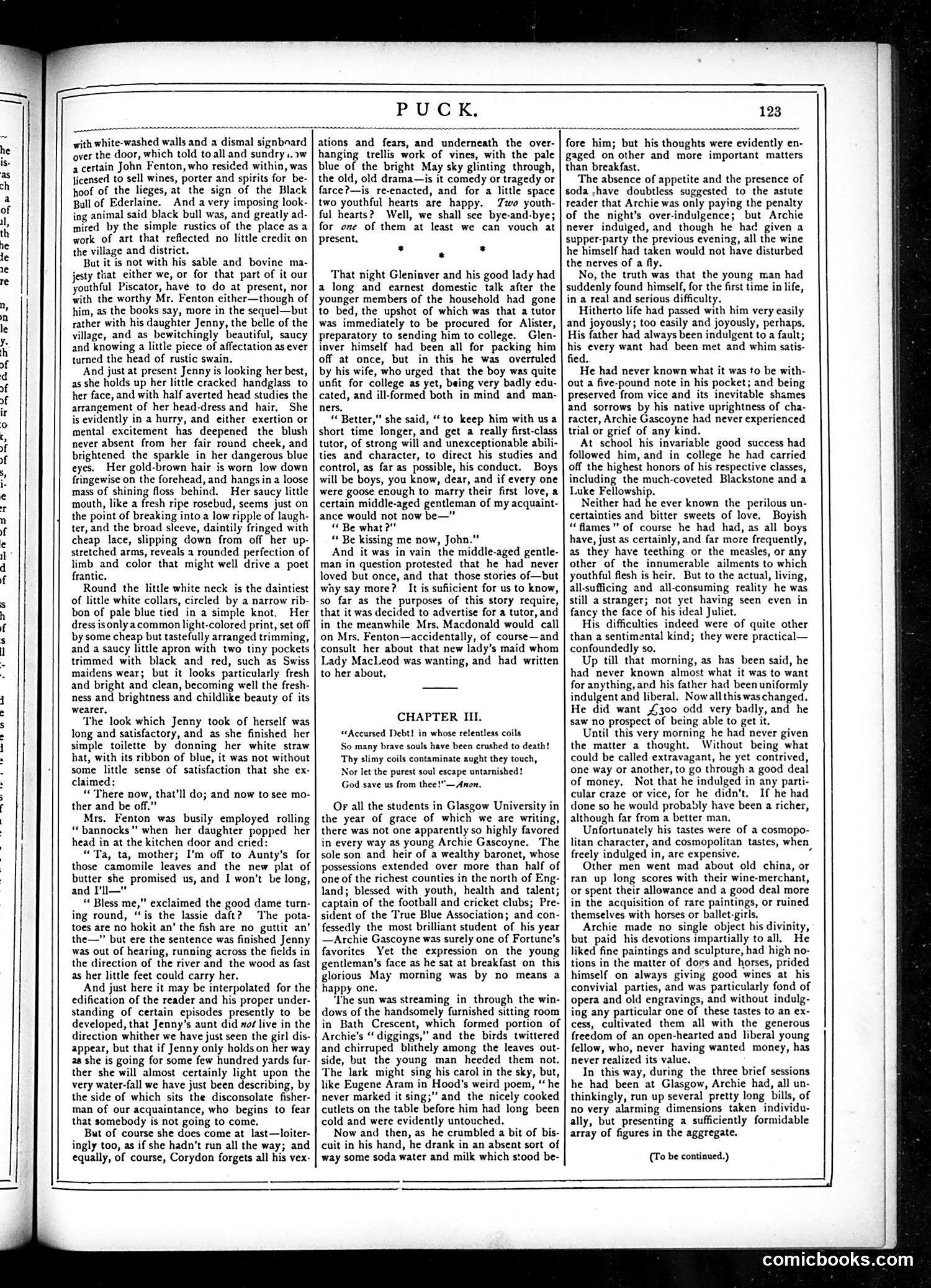
This page is primarily **text narrative, not a political cartoon**. It contains Chapter III of what appears to be a serialized story titled "Puck," featuring characters named Archie Gascoyne, Jenny, John, and Mrs. Fenton. The narrative discusses a wealthy young student at Glasgow University—Archie Gascoyne—who is described as well-connected, talented, and socially accomplished. The story focuses on romantic entanglements and domestic affairs rather than political satire. Since this is a Puck magazine page from the serialized fiction section rather than the satirical cartoon section, it lacks the political/social commentary typically expected from the publication. The content appears to be Victorian-era romantic literature aimed at general entertainment rather than satire or social criticism.
📄 Transcribed text from this page (OCR, searchable)
Machine-transcribed from the original scan — historical spelling and the odd misread are preserved.
with white-washed walls and a dismal signboard over the door, which told toall and sundry ..ow a certain John Fenton, who resided within, was licensed to sell wines, porter and spirits for be- hoof of the lieges, at the sign of the Black Bull of Ederlaine. And a very imposing look- ing animal said black bull was, and greatly ad- mired by the simple rustics of the place as a work of art that reflected no little credit on the village and district. But it is not with his sable and bovine ma- jesty that either we, or for that part of it our youthful Piscator, have to do at present, nor with the worthy Mr. Fenton either—though of him, as the books say, more in the sequel—but rather with his daughter Jenny, the belle of the village, and as bewitchingly beautiful, saucy and knowing a little piece of affectation as ever turned the head of rustic swain, ‘And just at present Jenny is looking her best, as she holds up her little cracked handglass to her face, and with half averted head studies the arrangement of her head-dress and hair. She is evidently in a hurry, and either exertion or mental excitement has deepened the blush never absent from her fair round cheek, and brightened the sparkle in her dangerous blue eyes. Her gold-brown hair is worn low down fringewise on the forehead, and hangs in a loose mass of shining floss behind. Her saucy little mouth, like a fresh ripe rosebud, seems just on the point of breaking into a low ripple of laugh- ter, and the broad sleeve, daintily fringed with cheap lace, slipping down from off her up- stretched arms, reveals a rounded perfection of limb and color that might well drive a poet frantic. Round the little white neck is the daintiest of little white collars, circled by a narrow rib- bon of pale blue tied in a simple knot. Her dress is only acommon light-colored print, set off by some cheap but tastefully arranged trimming, and a saucy little apron with two tiny pockets trimmed with black and red, such as Swiss maidens wear; but it looks particularly fresh and bright and clean, becoming well the fresh- ness and brightness and childlike beauty of its wearer, The look which Jenny took of herself was long and satisfactory, and as she finished her simple toilette by donning her white straw hat, with its ribbon of blue, it was not without some little sense of satisfaction that she ex- claimed: “ There now, that'll do; and now to see mo- ther and be off.” Mrs. Fenton was busily employed rolling “bannocks” when her daughter popped her head in at the kitchen door and cried: “Ta, ta, mother; I’m off to Aunty’s for those camomile leaves and the new plat of butter she promised us, and I won't be long, and l’ll—" “Bless me,” exclaimed the good dame turn- ing round, ‘is the lassie daft? ‘The pota- toes are no hokit an’ the fish are no guttit an’ the—" but ere the sentence was finished Jenny was out of hearing, running across the fields in the direction of the river and the wood as fast as her little feet could carry her. And just here it may be interpolated for the edification of the reader and his proper under- standing of certain episodes presently to be developed, that Jenny’s aunt did nof live in the direction whither we have just seen the girl dis- appear, but that if Jenny only holds on her way as she is going for some few hundred yards fur- ther she will almost certainly light upon the very water-fall we have just been describing, by the side of which sits the disconsolate fisher- man of our acquaintance, who begins to fear that somebody is not going to come. But of course she does come at last—loiter- ingly too, as if she hadn't run all the way; and equally, of course, Corydon forgets all his vex- PUCK. ations and fears, and underneath the over- hanging trellis work of vines, with the pale blue of the bright May sky glinting through, the old, old drama—is it comedy or tragedy or farce?—is re-enacted, and for a little space two youthful hearts are happy. wo youth- ful hearts? Well, we shall see bye-and-bye; for one of them at least we can vouch at present. . * * That night Gleninver and his good lady had a long and earnest domestic talk after the younger members of the household had gone to bed, the upshot of which was that a tutor was immediately to be procured for Alister, preparatory to sending him to college. Glen- inver himself had been all for packing him off at once, but in this he was overtuled by his wife, who urged that the boy was quite unfit for college as yet, being very badly edu- cated, and ill-formed both in mind and man- ners. “« Better,” she said, to keep him with us a short time longer, and get a really first-class tutor, of strong will and unexceptionable abili- ties and character, to direct his studies and control, as far as possible, his conduct. Boys will be boys, you know, dear, and if every one were goose enough to marry their first love, a certain middle-aged gentleman of my acquaint- ance would not now be—" “ Be what?” “ Be kissing me now, John.” And it was in vain the middle-aged gentle- man in question protested that he had never loved but once, and that those stories of—but why say more? It is sufiicient for us to know, so far as the purposes of this story require, that it was decided to advertise for a tutor, and in the meanwhile Mrs, Macdonald would call on Mrs, Fenton—accidentally, of course—and consult her about that new lady’s maid whom Lady MacLeod was wanting, and had written to her about, CHAPTER III. “Accursed Debt! in whose relentless coils So many brave souls have been crushed to death! Thy slimy coils contaminate aught they touch, Nor let the purest soul escape untarnished! God save us from thee!"—Anon. Or all the students in Glasgow University in the year of grace of which we are writing, there was not one apparently so highly favored in every way as young Archie Gascoyne. The sole son and heir of a wealthy baronet, whose possessions extended over more than half of one of the richest counties in the north of Eng- land; blessed with youth, health and talent; captain of the football and cricket clubs; Pre- sident of the True Blue Association; and con- fessedly the most brilliant student of his year —Archie Gascoyne was surely one of Fortune's favorites Yet the expression on the young gentleman’s face as he sat at breakfast on this glorious May morning was by no means a happy one. ‘Ihe sun was streaming in through the win- dows of the handsomely furnished sitting room in Bath Crescent, which formed portion of Archie's “ diggings,” and the birds twittered and chirruped blithely among the leaves out- le, but the young man heeded them not. The lark might sing his carol in the sky, but, like Eugene Aram in Hood’s weird poem, “he never marked it sing; and the nicely cooked cutlets on the table before him had long been cold and were evidently untouched. Now and then, as he crumbled a bit of bis- cuit in his hand, he drank in an absent sort of way some soda water and milk which stood be- fore him; but his thoughts were evidently en- gaged on other and more important matters than breakfast. The absence of appetite and the presence of soda -have doubtless suggested to the astute reader that Archie was only paying the penalty of the night’s over-indulgence; but Archie never indulged, and though he had given a supper-party the previous evening, all the wine he himself had taken would not have disturbed the nerves of a fly. No, the truth was that the young man had suddenly found himself, for the first time in life, in a real and serious difficulty. Hitherto life had passed with him very easily and joyously; too easily and joyously, perhaps, His father had always been indulgent to a fault; his every want had been met and whim satis- fied. He had never known what it was to be with- out a five-pound note in his pocket; and being preserved from vice and its inevitable shames and sorrows by his native uprightness of cha- racter, Archie Gascoyne had never experienced trial or grief of any kind. At school his invariable good success had followed him, and in college he had carried off the highest honors of his respective classes, including the much-coveted Blackstone and a Luke Fellowship. Neither had he ever known the perilous un- certainties and bitter sweets of love. Boyish “flames” of course he had had, as all boys have, just as certainly, and far more frequently, as they have teething or the measles, or any other of the innumerable ailments to which youthful flesh is heir. But to the actual, living, all-sufficing and all-consuming reality he was still a stranger; not yet having seen even in fancy the face of his ideal Juliet. His difficulties indeed were of quite other than a sentimental kind; they were practical— confoundedly so. Up till that morning, as has been said, he had never known almost what it was to want for anything, and his father had been uniformly indulgent and liberal. Now allthis was changed. He did want £300 odd very badly, and he saw no prospect of being able to get it. Until this very morning he had never given the matter a thought. Without being what could be called extravagant, he yet contrived, one way or another, to go through a good deal of money. Not that he indulged in any parti- cular craze of vice, for he didn’t. If he had done so he would probably have been a richer, although far from a better man. Unfortunately his tastes were of a cosmopo- litan character, and cosmopolitan tastes, when freely indulged in, are expensive. fi Other men went mad about old china, or ran up long scores with their wine-merchant, or spent their allowance and a good deal more in the acquisition of rare paintings, or ruined themselves with horses or ballet-girls, Archie made no single object his divinity, but paid his devotions impartially to all. He liked fine paintings and sculpture, had high no- tions in the matter of dogs and horses, prided himself on always giving good wines at his convivial parties, and was particularly fond of opera and old engravings, and without indulg- ing any particular one of these tastes to an ex- cess, cultivated them all with the generous freedom of an open-hearted and liberal young fellow, who, never having wanted money, has never realized its value. In this way, during the three brief sessions he had been at Glasgow, Archie had, all un- thinkingly, run up several pretty long bills, of no very alarming dimensions taken individu- ally, but presenting a sufficiently formidable array of figures in the aggregate. (To be continued.) = comicbooks.com