
Puck, 1879-04-30 · page 7 of 16
Puck — April 30, 1879 — page 7: what you’re looking at
What you’re looking at
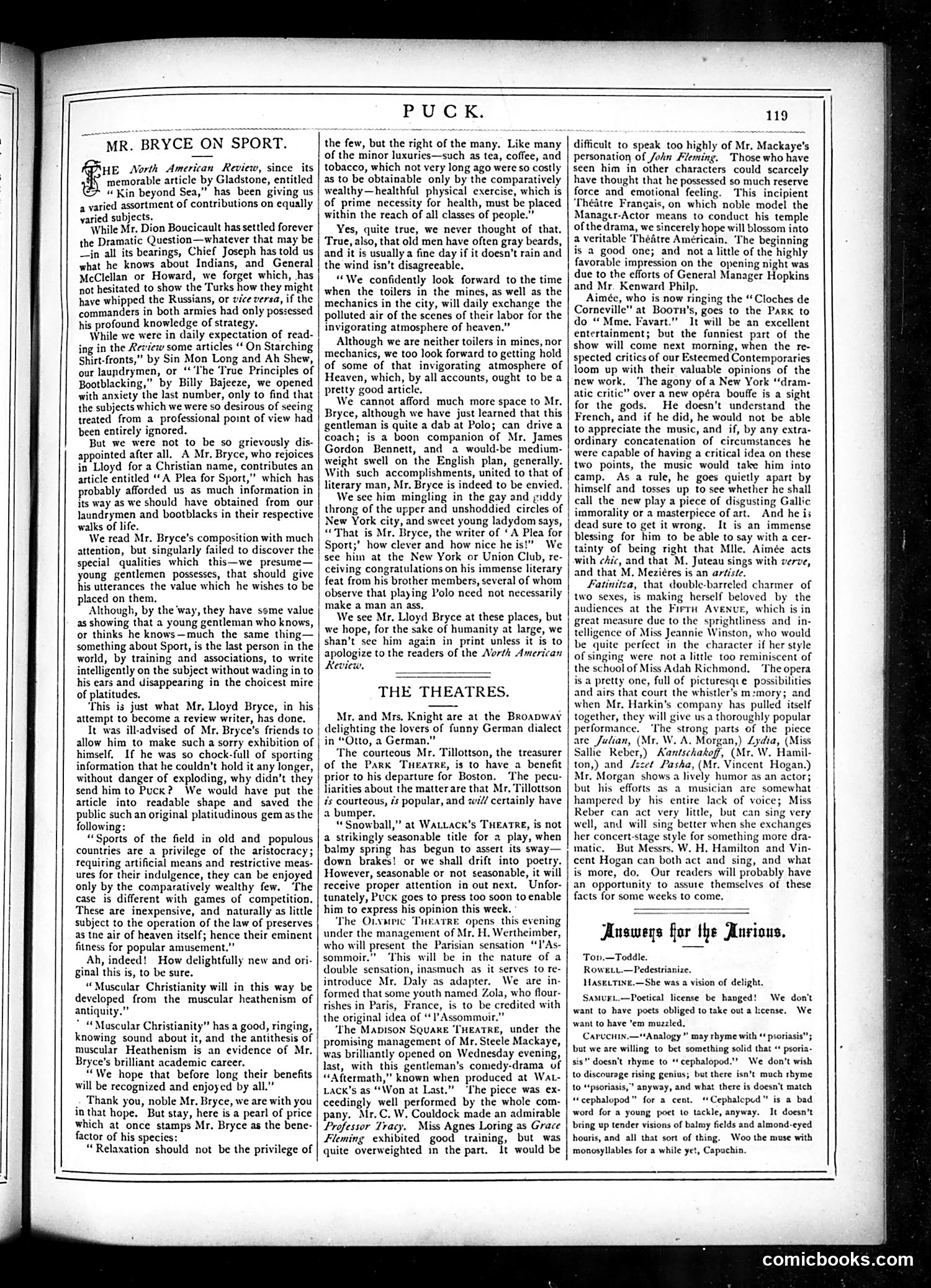
This page is primarily **text content**, not a cartoon. It contains three sections: 1. **"Mr. Bryce on Sport"** — A lengthy article praising Lloyd Bryce's literary contributions to the *North American Review*, particularly his essay "A Plea for Sport." The writer defends Bryce against criticism that he's intellectually frivolous, arguing his work shows sophistication and wit. 2. **"The Theatres"** — Brief reviews of current Broadway productions, including German dialect comedy and plays at various theaters. 3. **"Answers for the Anxious"** — A advice column addressing reader questions. The page represents Puck's format of combining satirical commentary with cultural criticism and entertainment coverage, typical of late 19th-century American humor magazines.
📄 Transcribed text from this page (OCR, searchable)
Machine-transcribed from the original scan — historical spelling and the odd misread are preserved.
MR. BRYCE ON SPORT. HE North American Review, since its memorable article by Gladstone, entitled «Kin beyond Sea,” has been giving us a varied assortment of contributions on equally | ried subjects. va\nile Mr, Dion Boucicault has settled forever the Dramatic Question—whatever that may be win all its bearings, Chief Joseph has told us what he knows about Indians, and General McClellan or Howard, we forget which, has not hesitated to show the Turks how they might have whipped the Russians, or vice versa, if the commanders in both armies had only possessed his profound knowledge of strategy. While we were in daily expectation of read- ing in the Review some articles “‘ On Starching Shirt-fronts,” by Sin Mon Long and Ah Shew, our laundrymen, or ‘The ‘True Principles of Bootblacking,” by Billy Bajeeze, we opened with anxiety the last number, only to find that the subjects which we were so desirous of seeing treated from a professional point of view had been entirely ignored. But we were not to be so grievously dis- appointed after all. A Mr. Bryce, who rejoices in Lloyd for a Christian name, contributes an article entitled ‘A Plea for Sport,” which has probably afforded us as much information in its way as we should have obtained from our laundrymen and bootblacks in their respective walks of life. We read Mr. Bryce’s composition with much attention, but singularly failed to discover the special qualities which this—we presume— young gentlemen possesses, that should give his utterances the value which he wishes to be placed on them, Although, by the way, they have some value as showing that a young gentleman who knows, or thinks he knows—much the same thing— something about Sport, is the last person in the world, by training and associations, to write intelligently on the subject without wading in to his ears and disappearing in the choicest mire of platitudes. This is just what Mr, Lloyd Bryce, in his attempt to become a review writer, has done. It was ill-advised of Mr. Bryce's friends to allow him to make such a sorry exhibition of himself. If he was so chock-full of sporting information that he couldn’t hold it any longer, without danger of exploding, why didn’t they send him to Puck? We would have put the article into readable shape and saved the public such an original platitudinous gem as the following: “Sports of the field in old and populous countries are a privilege of the aristocracy; requiring artificial means and restrictive meas- ures for their indulgence, they can be enjoyed only by the comparatively wealthy few. ‘The case is different with games of competition. These are inexpensive, and naturally as little subject to the operation of the law of preserves as tne air of heaven itself; hence their eminent fitness for popular amusement.” Ah, indeed! How delightfully new and ori- ginal this is, to be sure. “Muscular Christianity will in this way be developed from the muscular heathenism of antiquity.” * “Muscular Christianity” has a good, ringing, knowing sound about it, and the antithesis of | muscular Heathenism is an evidence of Mr. Bryce’s brilliant academic career. “We hope that before long their benefits will be recognized and enjoyed by all _. Thank you, noble Mr. Bryce, we are with you inthat hope. But stay, here is a pearl of price which at once stamps Mr. Bryce as the bene- factor of his species: “Relaxation should not be the privilege of PUCK. the few, but the right of the many. Like many of the minor luxuries—such as tea, coffee, and tobacco, which not very long ago were so costly as to be obtainable only by the comparatively wealthy—healthful physical exercise, which is of prime necessity for health, must be placed within the reach of all classes of people.” Yes, quite true, we never thought of that. True, also, that old men have often gray beards, and it is usually a fine day if it doesn’t rain and the wind isn’t disagreeable, “We confidently look forward to the time when the toilers in the mines, as well as the mechanics in the city, will daily exchange the polluted air of the scenes of their labor for the invigorating atmosphere of heaven. Although we are neither toilers in mines, nor mechanics, we too look forward to getting hold of some of that invigorating atmosphere of Heaven, which, by all accounts, ought to be a pretty good article, We cannot afford much more space to Mr. Bryce, although we have just learned that this gentleman is quite a dab at Polo; can drivea coach; is a boon companion of Mr, James Gordon Bennett, and a would-be medium- weight swell on the English plan, generally. With such accomplishments, united to that of literary man, Mr. Bryce is indeed to be envied. We sec him mingling in the gay and giddy throng of the upper and unshoddied circles of New York city, and sweet young ladydom says, “That is Mr. Bryce, the writer of ‘A Plea for Sport;’ how clever and how nice he is!” We see him at the New York or Union Club, re- ceiving congratulations on his immense literary feat from his brother members, several of whom observe that playing Polo nced not necessarily make a man an ass. We see Mr, Lloyd Bryce at these places, but we hope, for the sake of humanity at large, we shan’t see him ag: in print unless it is to apologize to the readers of the North American Review, THE THEATRES. Mr. and Mrs. Knight are at the Broapway delighting the lovers of funny German dialect in “Otto, a German.” The courteous Mr. Tillottson, the treasurer of the Park TuHeatrE, is to have a benefit prior to his departure for Boston. The pecu- liarities about the matter are that Mr, Tillottson is courteous, és popular, and zi certainly have a bumper. “ Snowball,” at WALLACk’s THEATRE, is not a strikingly seasonable title for 2 play, when balmy spring has begun to assert its sway— down brakes! or we shall drift into poetry. However, seasonable or not seasonable, it will receive proper attention in out next. Unfor- tunately, Puck goes to press too soon to enable him to express his opinion this week. The OLyaric THEATRE opens. this evening under the management of Mr, H. Wertheimber, who will present the Parisian sensation ‘I’As- sommoir.” This will be in the nature of a inasmuch as it serves to re- introduce Mr. Daly as adapter. We are in- formed that some youth named Zola, who flour- rishes in Paris, France, is to be credited with the original idea of “1’Assommoir.” ‘The Mapison Square ‘THEATRE, under the promising management of Mr. Steele Mackaye, was brilliantly opened on Wednesday evening, last, with this gentleman's comedy-drama of “Aftermath,” known when produced at WaL- Lackx’s as “Won at Last.” ‘Ihe piece was ex- ceedingly well performed by the whole com- pany. Mr.C. W. Couldock made an admirable Professor Tracy, Miss Agnes Loring as Grace Fleming exhibited good training, but was quite overweighted in the part. It would be 119 difficult to speak too highly of Mr. Mackaye’s personation of John Fleming. Those who have seen him in other characters could scarcely have thought that he possessed so much r force and emotional feeling. This inci ‘Théitre Frangais, on which noble model the Manager-Actor means to conduct his temple of the drama, we sincere! pe blossom into a veritable Thé“itre Américain. The beginning is a good one; and not a little of the highly favorable impression on the opening night was due to the efforts of General Manager Hopkins and Mr. Kenward Philp. Aiméc, who is now ringing the “Cloches de Corneville” at Bootn's, goes to the Park to do “ Mme, Favart.”” It will be an excellent entertainment; but the funniest part of the show will come next morning, when the re- spected critics of our Esteemed Contemporaries loom up with their valuable opinions of the new work. ‘The agony of a New York “dram- atic critic” over a new opéra bouffe is a sight for the gods. He doesn’t understand the French, and if he did, he would not be able to appreciate the music, and if, by any extra- ordinary concatenation of circumstances he were capable of having a critical idea on these two points, the music would take him into camp. As a rule, he goes quietly apart by | himself and tosses up to see whether he shall call the new play a piece of disgusting Gallic immorality or a masterpiece of art. And he is dead sure to get it wrong. It is an immense blessing for him to be able to say with a cer- tainty of being right that Mlle. Aimée acts with chic, and that M. Juteau sings with verve, and that M. Meziéres is an artiste. Fatinitza, that double-barreled charmer of two sexes, is making herself beloved by the audiences at the Fiera Avenue, which is in great measure due to the sprightliness and in- telligence of Miss Jeannie Winston, who would be quite perfect in the character if her style of singing were nota little too reminiscent of the school of Miss Adah Richmond. ‘The opera is a pretty one, full of picturesqie possibilities and airs that court the whistler’s m:mory; and when Mr. Harkin’s company has pulled itself together, they will give usa thoroughly popular performance. ‘The strong parts of the piece are Julian, (Mr. W. A. Morgan,) Lydia, (Miss Sallie Reber,) Aantschakof, (Mr. W. Hamil- ton,) and /:ze¢ Pasha, (Mr. Vincent Hogan.) Mr. Morgan shows a lively humor as an actor; but his efforts as a musician are somewhat hampered by his entire lack of voice; Miss Reber can act very little, but can sing very well, and will sing better when she exchanges her concert-stage style for something more dra- matic. But Messrs. W. H. Hamilton and Vin- cent Hogan can both act and sing, and what is more, do. Our readers will probably have an opportunity to assure themselves of these facts for some weeks to come. Answers fr the Rurious. Ton.—Toddle. Rowett.—Pedestrianize. Hasevtine.—She was a vision of delight. We don't We SaMUp1.—Poetical license be hanged! want to have poets obliged to take out a I:cense, want to have "em muzzled, Carvcitin.—‘Analogy” may rhyme with psoriasis”; but we are willing to bet something solid that “ psoria- sis” doesn't rhyme to * cephalopod.” We don’t wish to discourage rising genius; but there isn’t much rhyme to “psoriasis,” anyway, and what there is doesn't match “cephalopod” for a cent. Cephalcped” is a bad word for a young poet to tackle, anyway. It doesn’t bring up tender visions of balmy fields and almond-eyed houris, and all that sort of thing. Woo the muse with monosyllables for a while yet, Capuchin, comicbooks.com