
A complete issue · 16 pages · 1879
Puck — April 23, 1879
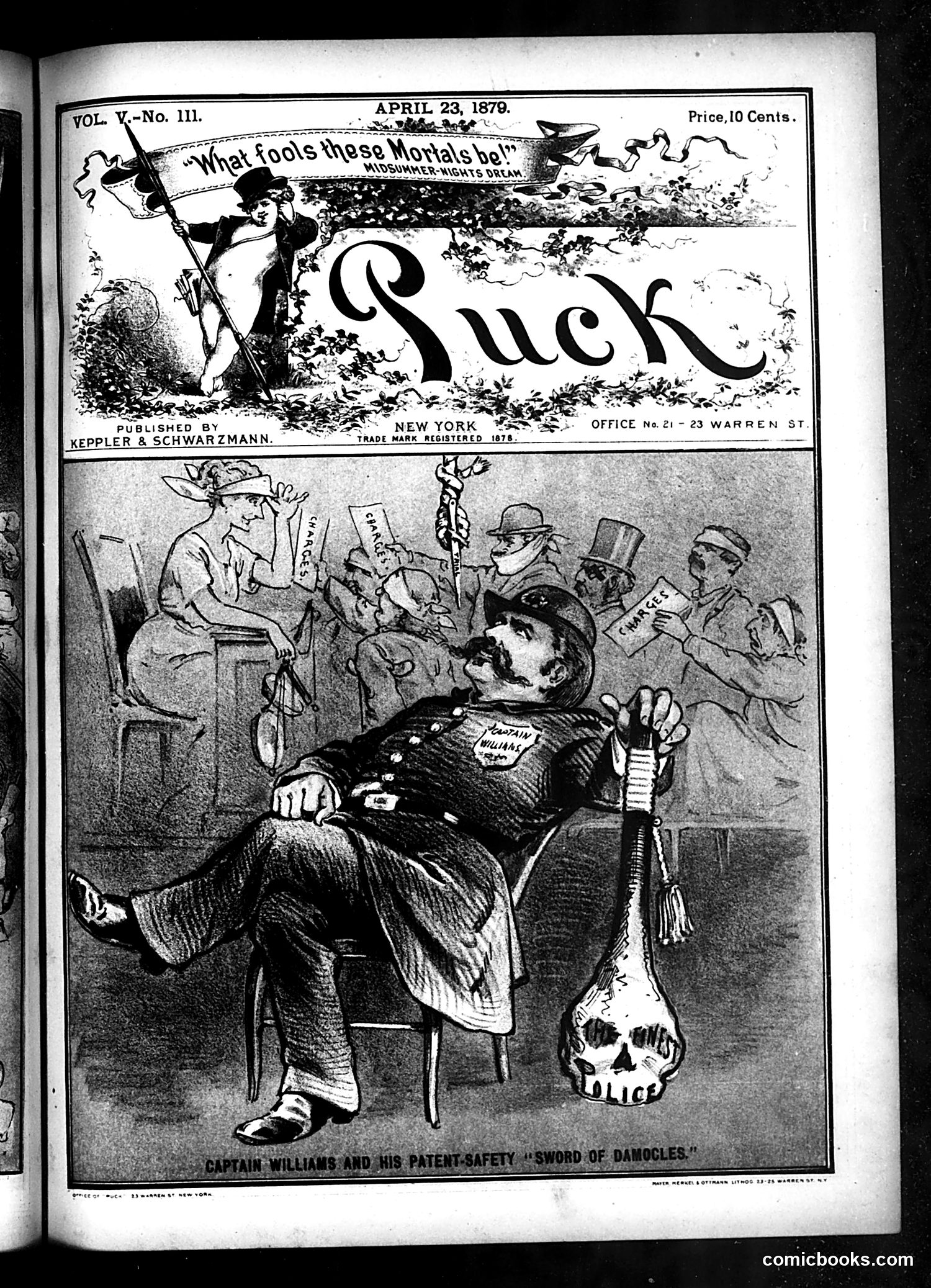
**Main Cartoon: "Captain Williams and His Patent-Safety 'Sword of Damocles'"** The satire depicts a military officer (Captain Williams) lounging comfortably in a chair while a skull-topped sword hangs precariously above him—a reference to the classical "Sword of Damocles" allegory about danger lurking beneath apparent safety. The surrounding figures appear to represent various social or political groups observing this situation, though their specific identities are unclear from the image alone. The cartoon likely satirizes either a military safety innovation or a political figure's precarious position despite claimed protections. The title suggests ironic commentary: Williams' "safety" device is itself dangerous, mocking either false security measures or hollow political promises made in 1879.
This page is primarily **text-based editorial content** rather than political cartoons. The main article, "Royalty Throws Up the Sponge," critiques **Queen Victoria** and the British monarchy's response to financial pressures. The piece sarcastically suggests Victoria should exploit her position—having carriages with "undistinguished persons" as decoys, using dummies as targets for assassination attempts—to draw "a few millions of dollars a year" from Parliament. It's biting social commentary on royal privilege and the monarchy's financial demands. The accompanying "Puckerings" section contains brief satirical quips about various public figures and topics, including references to Charles R. Thorne Jr. and Harvard University. The tone throughout is **irreverent, mocking aristocratic pretension** during the Victorian era.
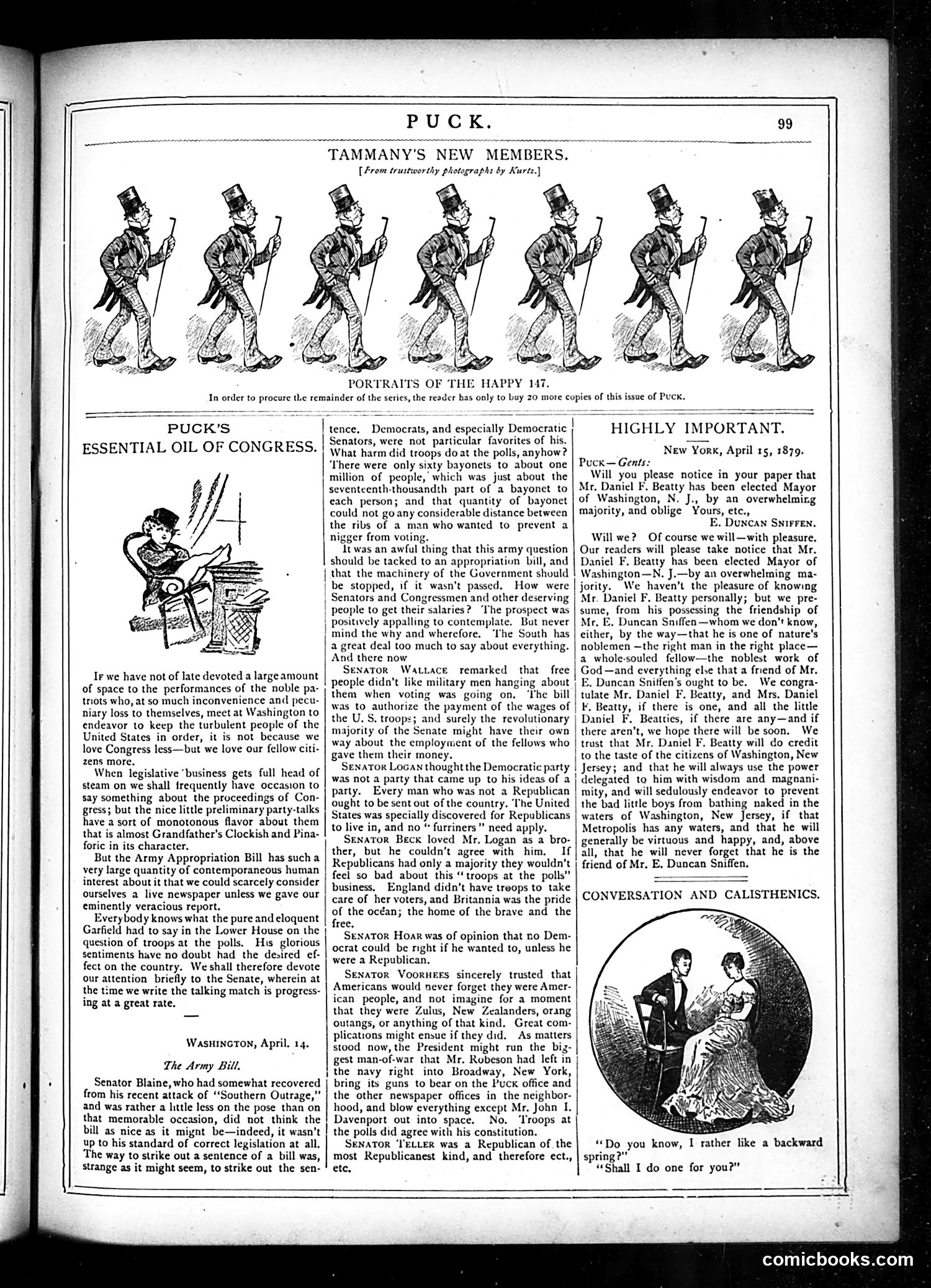
**"Tammany's New Members"** (top): Seven identical figures in top hats represent new members of Tammany Hall, the Democratic political machine. The repetitive, identical depiction satirizes how these politicians are interchangeable apparatchiks serving the organization rather than individuals with distinct principles. **"Puck's Essential Oil of Congress"** (left): A caricatured figure squeezes a bag labeled with legislative items, suggesting Congress produces only "essential oil"—concentrated partisan talk while accomplishing little substantive work. The cartoon mocks congressional inefficiency and excessive political rhetoric. **"Highly Important" section**: Commentary on Daniel F. Beatty's election as Washington D.C. Mayor, with satirical congratulations emphasizing machine politics and backroom dealings rather than merit-based governance.
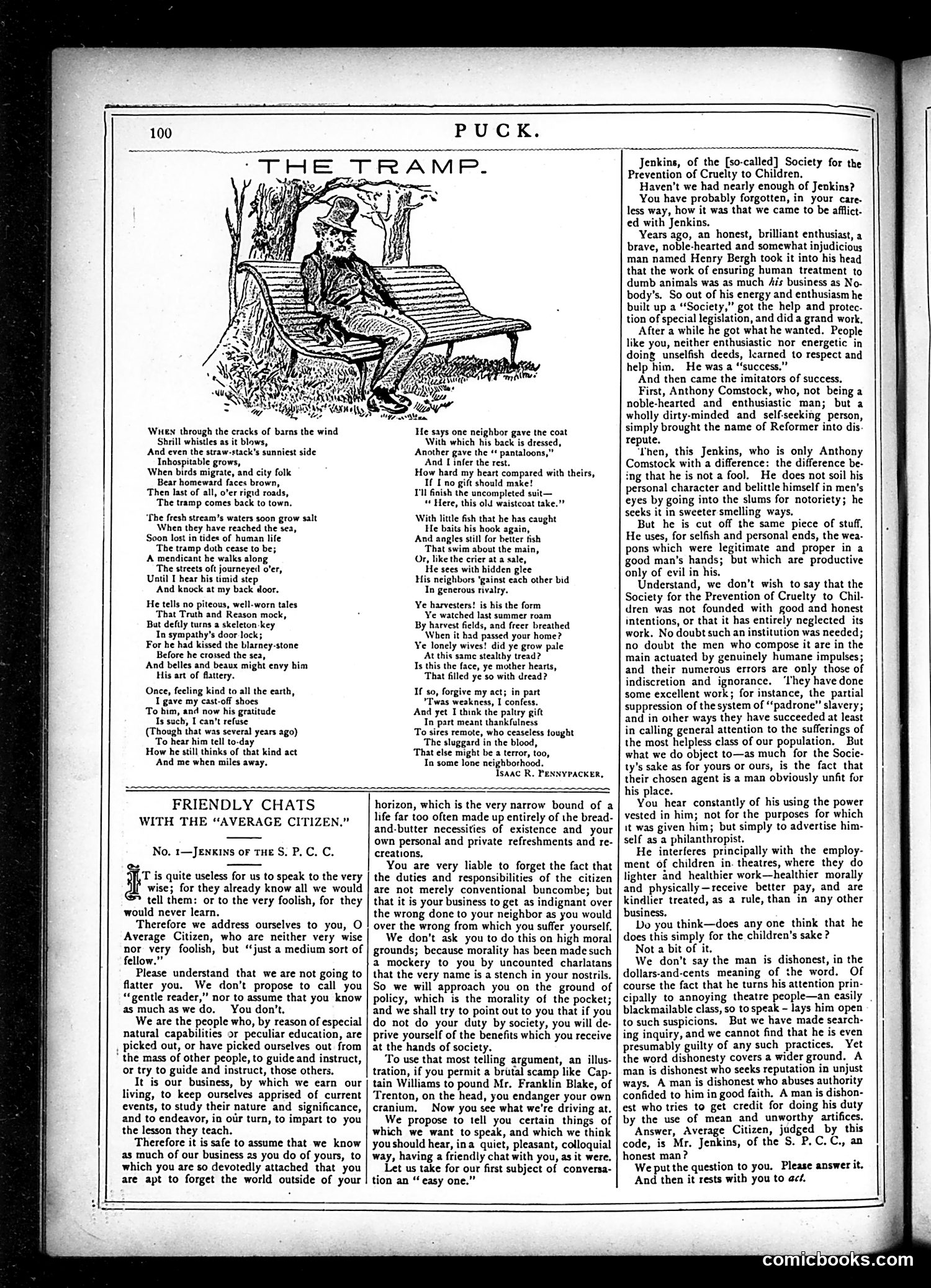
This poem satirizes a vagrant ("tramp") who survives through begging and petty theft—a common figure in Gilded Age America. The illustration shows a shabby man resting against a tree, depicting urban poverty. The narrative voice ironically documents the tramp's survival strategies: accepting charity ("one neighbor gave the coat"), stealing when necessary, and exploiting social sympathy. Lines like "He tells one neighbor tales" and references to "hidden glee" suggest the speaker views the tramp as cunning rather than genuinely destitute. The satire appears directed at both vagrants themselves and perhaps at the gullible public who enable them through charity. This reflects late-19th-century anxieties about distinguishing "deserving" from "undeserving" poor—a period when vagrancy was heavily criminalized and debated.
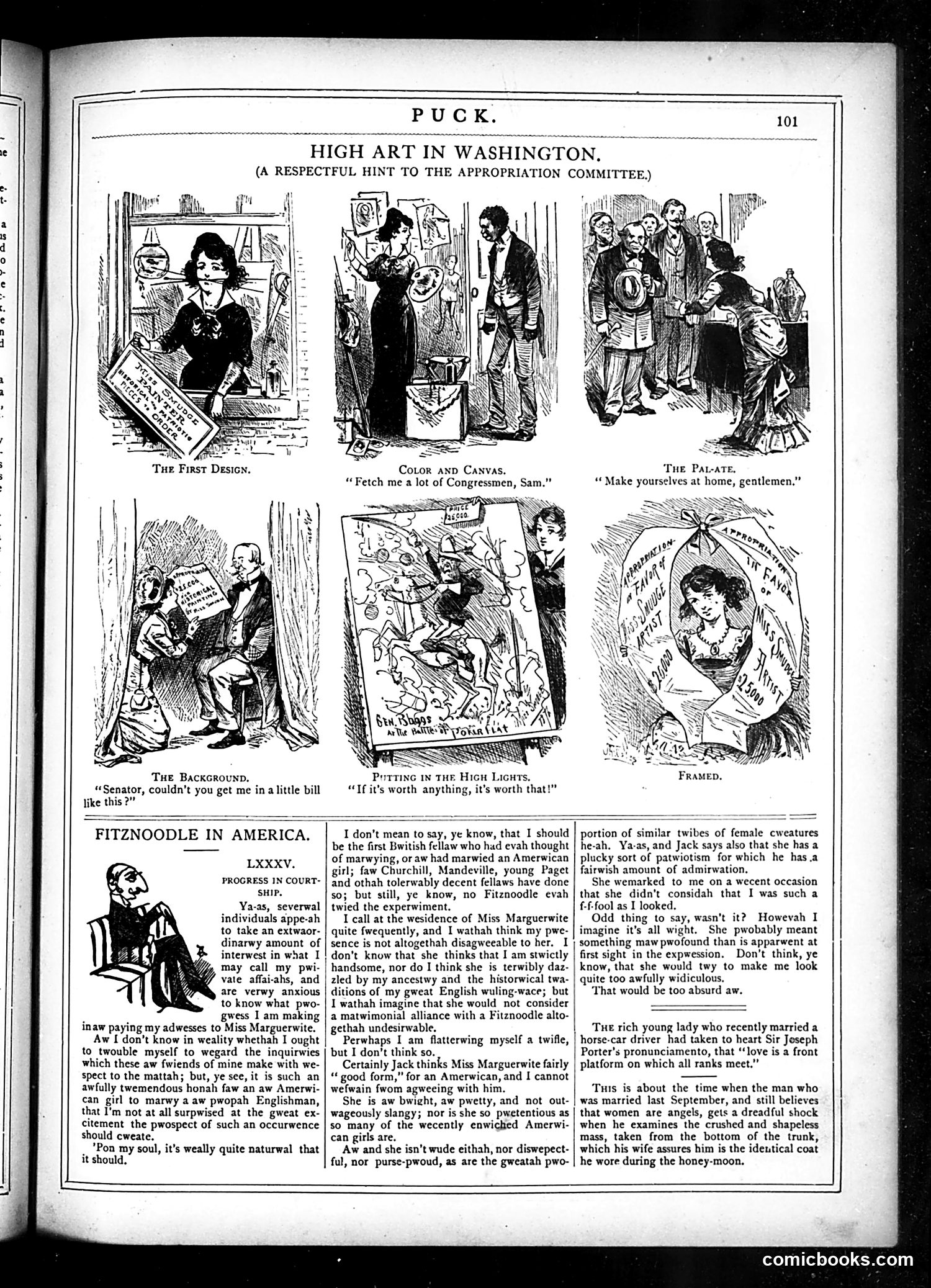
**"High Art in Washington"** satirizes proposed government art patronage. The six panels mock bureaucratic incompetence in funding visual arts: congressmen appear clueless about art, requesting practical portraits instead; a "palate" scene shows gentlemen literally making themselves "at home" in an artist's studio; senators haggle over costs. The satire targets the Appropriation Committee's ignorance about aesthetic merit. **"Fitznoodle in America"** is a serialized narrative mocking British attitudes toward American marriage. The protagonist appears to be a British gentleman discussing—somewhat condescendingly—his fascination with American women, particularly a Miss Marguerwite who married an American. The text ridicules both British snobbery and American social ambitions, suggesting cultural anxiety about transatlantic courtship and class.
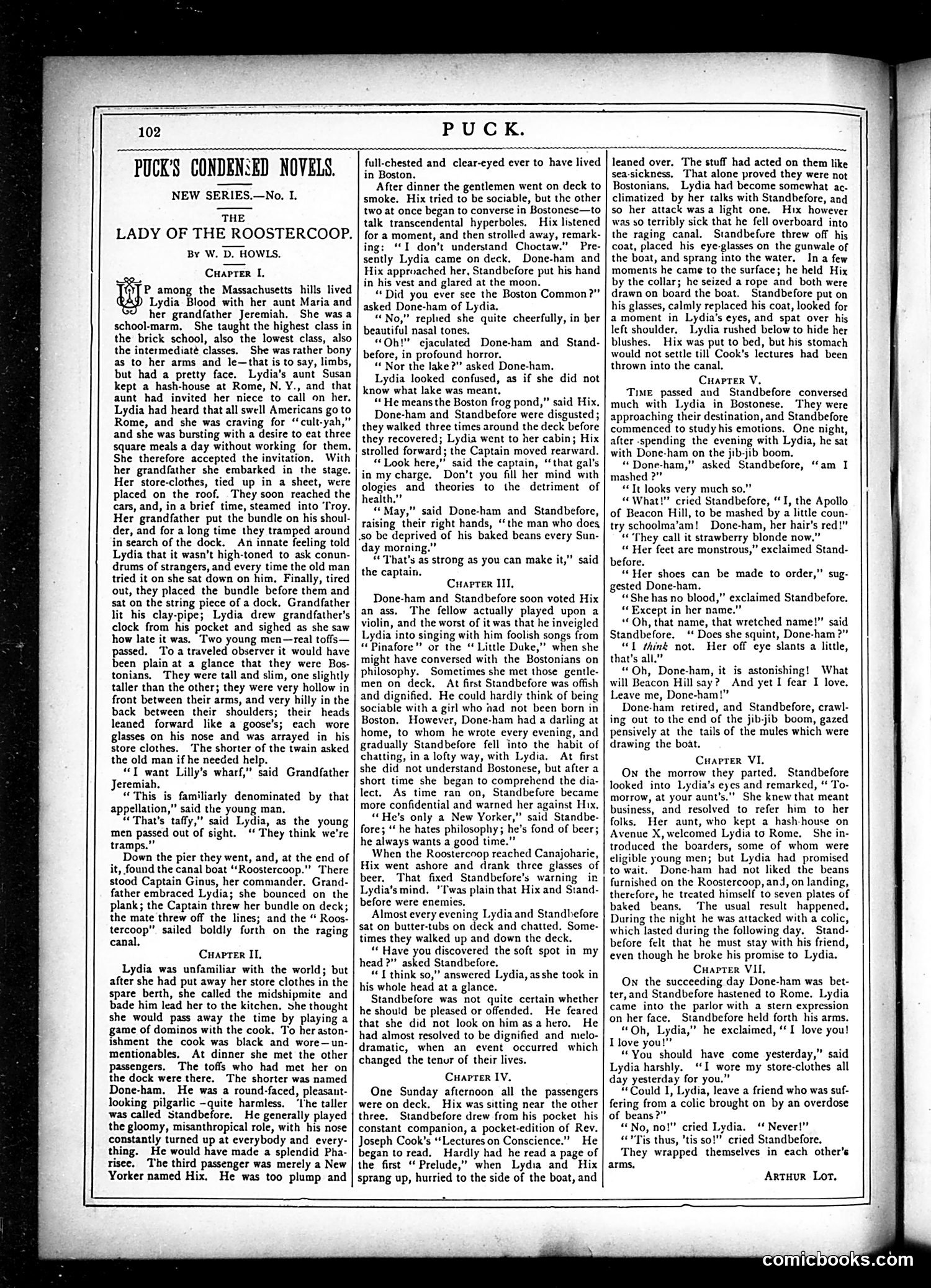
This page contains **no political cartoon or satire**. Instead, it presents "The Lady of the Roostercoop," a serialized short story by W.D. Howells, part of Puck's "Condensed Novels" series. The narrative follows Lydia, a Massachusetts woman traveling by canal boat to Troy with her aunt. The story satirizes the social conventions and pretensions of 19th-century American travel, featuring characters like the pompous Done-ham and Standefore, who engage in comedic banter and misadventures aboard the vessel. This is **literary fiction**, not political commentary—typical of Puck's content mix, which combined satirical humor with serialized stories for entertainment alongside its famous cartoons.
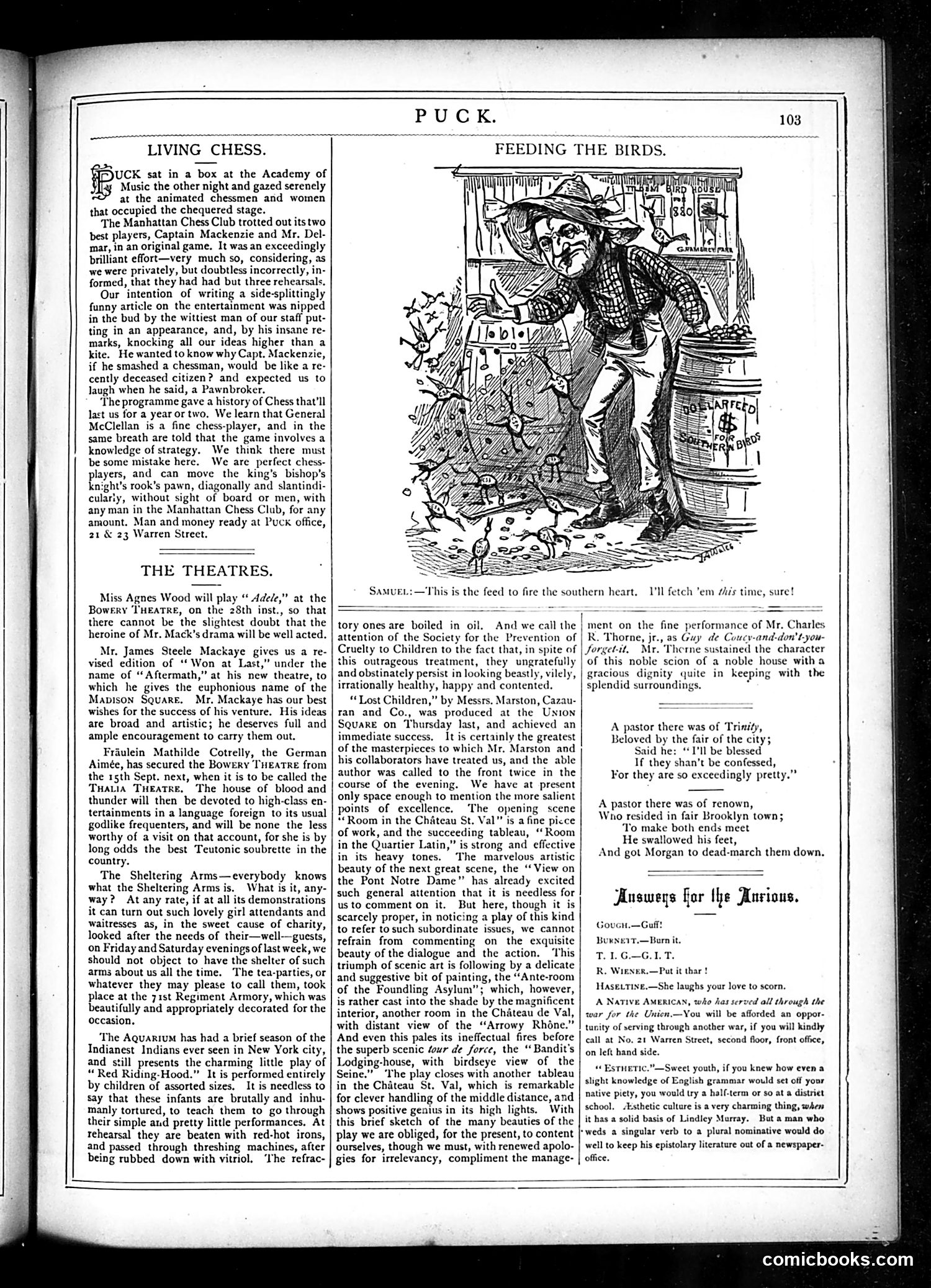
This cartoon depicts a disheveled man labeled "Samuel" scattering feed from a box marked "DOLLARS" while birds gather below. The caption reads: "This is the feed to fire the southern heart. I'll fetch 'em this time, sure!" The satire targets **political patronage and vote-buying**, specifically aimed at the American South during the Reconstruction or Gilded Age era. "Samuel" appears to represent a Northern politician or carpetbagger attempting to win Southern support through financial inducements ("dollars"). The birds represent Southern voters being cynically manipulated. The cartoon mocks the notion that money alone can "fire" Southern enthusiasm or loyalty, suggesting such crude appeals to self-interest are transparent and insulting to Southern pride—a common Puck theme criticizing Northern political manipulation of the post-Civil War South.
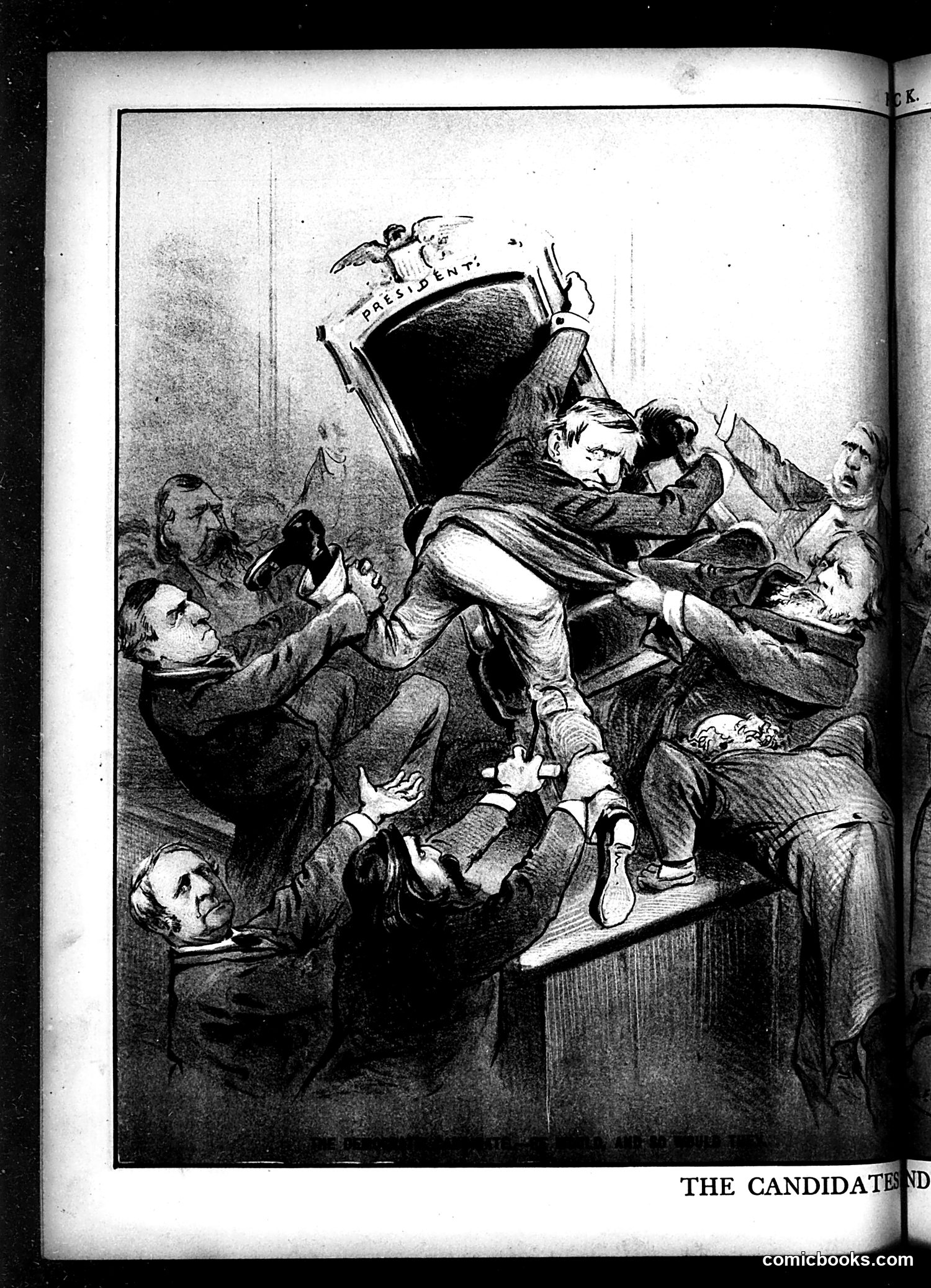
This Puck cartoon depicts what appears to be a presidential candidate being physically manipulated and controlled by multiple political figures and handlers. The chair labeled "PRESIDENT" sits prominently at top, suggesting the prize being contested. The candidate—shown as a somewhat passive or helpless figure—is literally being grabbed, pulled, and shaped by surrounding politicians and operatives. The satire critiques how presidential candidates are constructed and controlled by political machines rather than representing authentic leadership. The various hands reaching in suggest competing interests, party bosses, and special interests molding the candidate into an acceptable but hollow vessel. This reflects late 19th-century anxieties about authenticity in American politics and the power of party establishments over individual candidates.
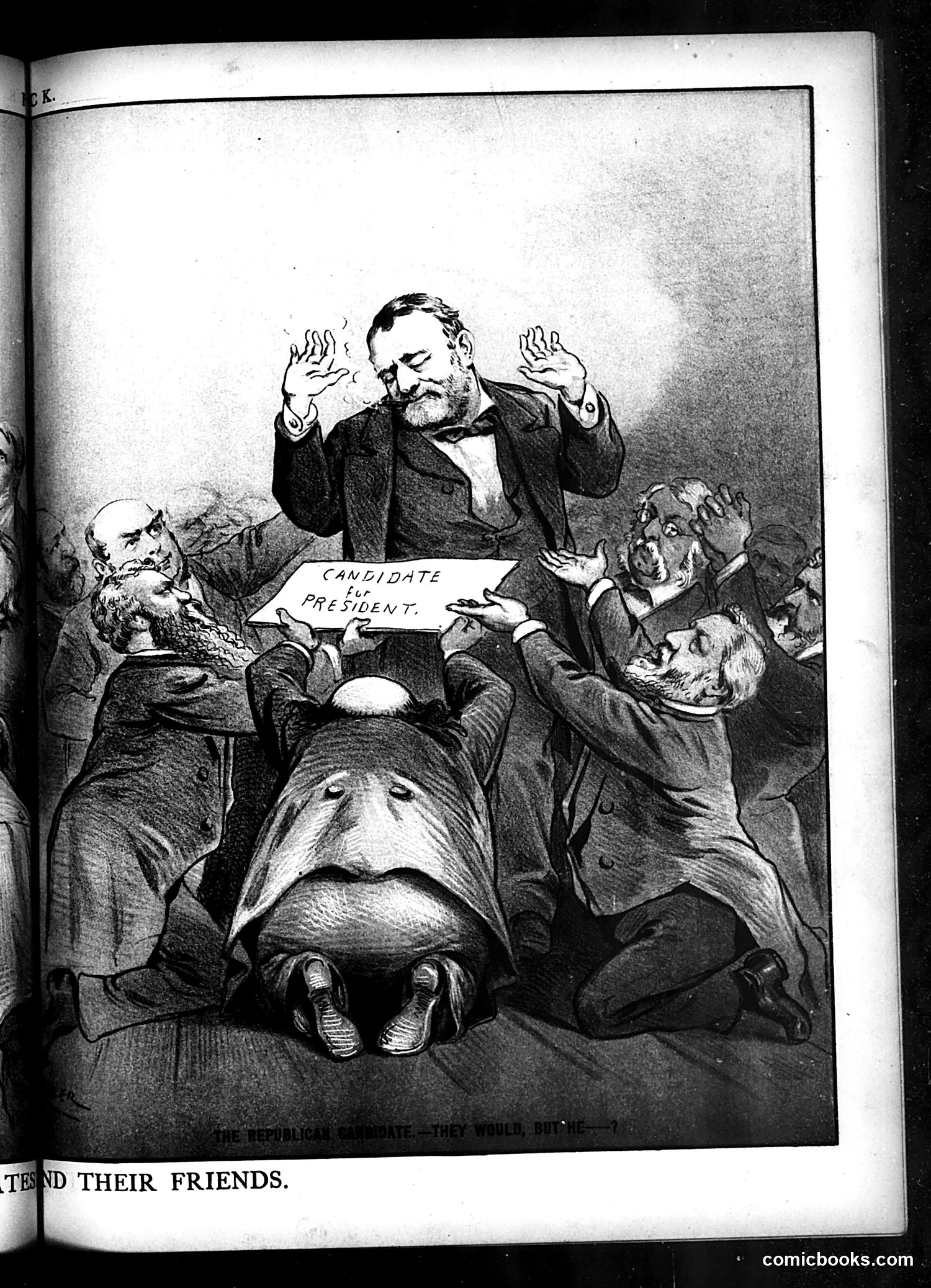
This Puck magazine cartoon satirizes the Republican presidential nomination process. A central figure (likely a Republican party leader or kingmaker) stands elevated, holding a sign reading "CANDIDATE FOR PRESIDENT" while manipulating several caricatured men below him—depicted as grotesque or animalistic figures, some appearing to grovel or compete for the nomination. The satire suggests that Republican presidential candidates are essentially puppets controlled by party elites, lacking genuine independence or dignity. The exaggerated, unflattering caricatures of the candidates emphasize this critique. The bottom caption reads "THEY WOULD, BUT—" (partially visible), implying these figures would pursue the presidency if not constrained by party manipulation. This reflects late-19th-century cynicism about American political processes and elite control.
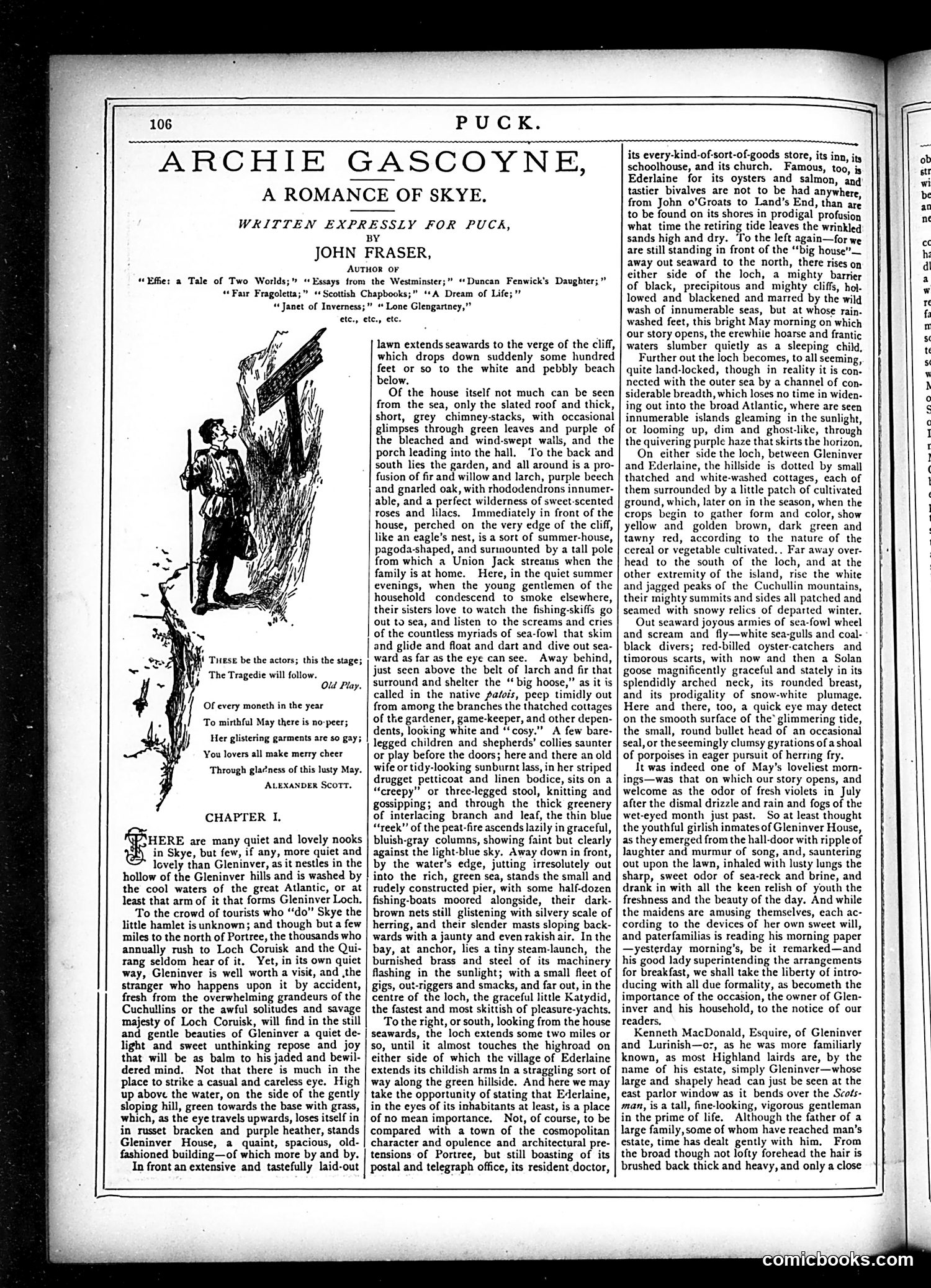
This is **not a political cartoon**—it's the opening page of a serialized fiction story titled "Archie Gascoyne: A Romance of Skye," written by John Fraser specifically for Puck magazine. The left side features an illustration of a Highland Scottish man in traditional dress standing on a cliff. The text is a romantic narrative about a remote Scottish estate on the Isle of Skye, describing its landscape, architecture, and inhabitants in detailed prose. This page represents Puck's entertainment content rather than its satirical purpose. The magazine mixed humor, commentary, and serialized fiction to engage readers. The Scottish setting and romantic tone suggest this story appealed to 19th-century readers' tastes for exotic, picturesque narratives about rural Britain.
This page is primarily **text, not a cartoon**—it's a biographical essay about the Macdonald family of Scotland, focusing on the character and accomplishments of various family members, particularly women. The piece describes Lord Macdonald's estates, family members' education and roles, and praises several women for their intelligence, independence, and character—including Helen Macdonald, described as beautiful and possessing "lyrical poetry" and "grace," and her sister who was an accomplished horsewoman. Without visible satirical illustrations on this page, it appears to be a straightforward celebratory article rather than political satire. **The content supports no clear satirical point visible here**—it reads as genuine biographical praise rather than mockery.
This page features a satirical poem about a decorative fan allegedly owned by the Marquise de Pompadour, the famous 18th-century mistress of King Louis XV of France. The illustration shows an ornate fan with elaborate Rococo imagery. The satire likely mocks Victorian-era fascination with aristocratic historical artifacts and the romanticization of European nobility. By presenting this "fan arrangement," Puck ridicules how Americans collected and treasured European relics as status symbols. The poem's detailed description of the fan's painted scenes—cherubs, cardinals, and courtly figures—emphasizes the absurdity of venerating such frivolous objects. The piece satirizes both the pretentiousness of collectors and the leisured decadence of the French aristocracy.
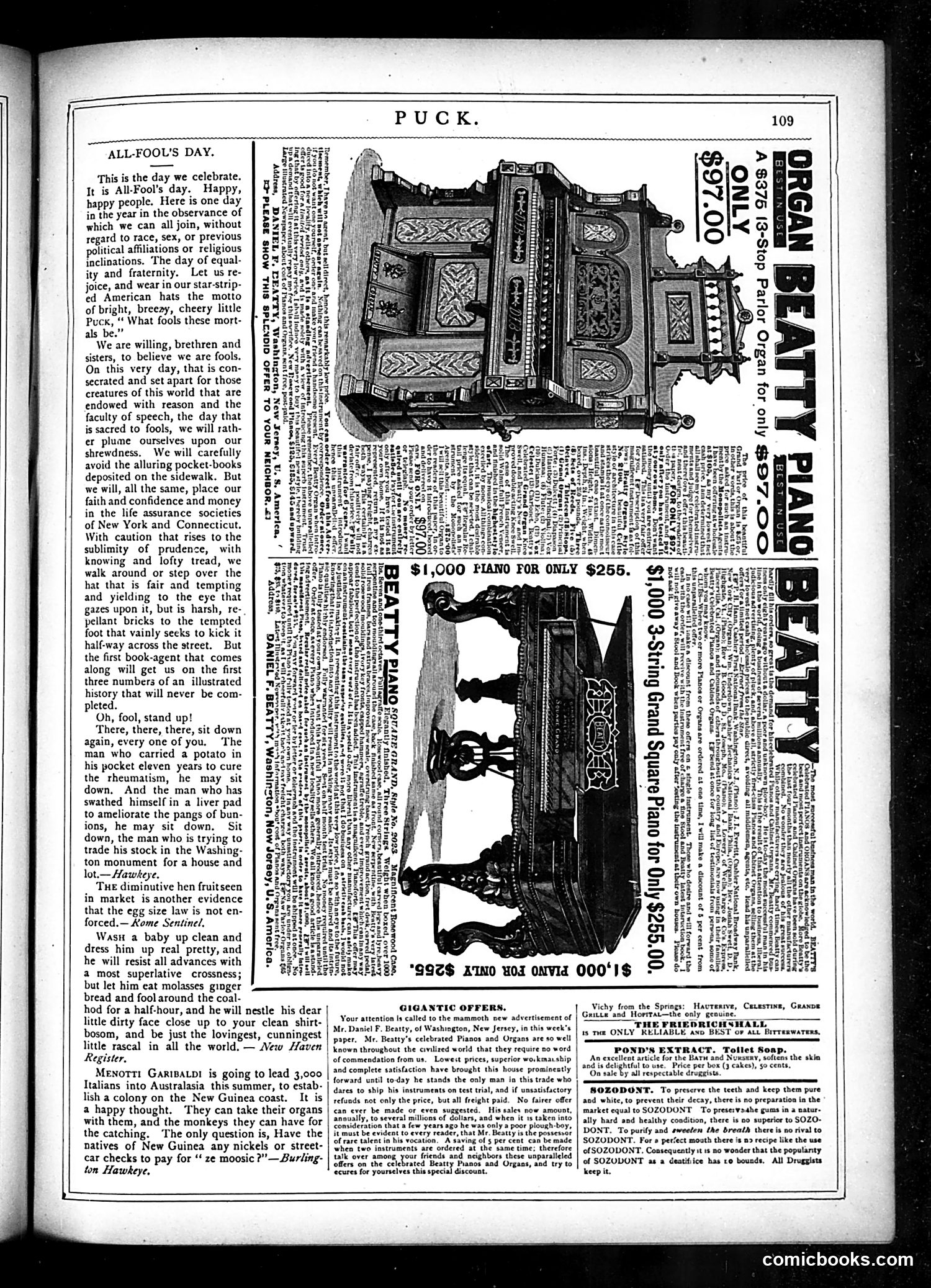
This page is primarily **advertising**, not political satire. The main content consists of large advertisements for: 1. **Organ and Piano sales** (top right) - offering pianos for $255 2. **Beauty/Health products** (center) - including what appears to be beauty treatments and remedies 3. **Toilet soap and other goods** (bottom right) The left column contains the article **"All Fool's Day,"** which discusses April 1st traditions—celebrating foolishness, equality, and fraternity through pranks and wearing "fool's caps." This is editorial content rather than political commentary. The page demonstrates how 19th-century magazines like *Puck* supported themselves: mixing satirical articles with extensive advertisements for consumer goods, patent medicines, and household products aimed at middle-class readers.
This page is primarily **advertising**, not political satire. It contains commercial notices for late 19th-century products and services: Angostura Bitters, Puck cigarettes, Paris clocks, champagne, umbrellas, dental rooms, photographers, and financial instruments (Oldenburg Government Bonds). The only illustration with narrative content shows a **cherub or cupid figure** associated with what appears to be a cigar advertisement ("The finest and most popular CIGAR"). This is generic commercial imagery rather than political commentary. The page represents Puck magazine's revenue model—satirical content subsidized by advertisements. While Puck was known for sharp political cartoons, this particular page showcases the publication's advertising business rather than editorial satire.
This is primarily an **advertising page** from Puck magazine (page 111), not a political cartoon or satire page. The page contains commercial advertisements for various late 19th-century products and services, including: - **Hosiery** by Arnold, Constable & Co. - **Billiard tables** by J.M. Brunswick & Balke Co. - **Furniture** by Mathesius & Frey - **Wine imports** by A. Heller & Bro. (Hungarian wines and champagne) - **Tailoring services** by Nicoll - **Patent services** by Paul Goeppel There is one decorative illustration showing **Kurtz's Portraits** (Madison Square, New York), featuring cherub-like figures in a classical style. The page reflects typical Puck magazine revenue sources and advertiser demographics targeting affluent urban readers in New York during this period.
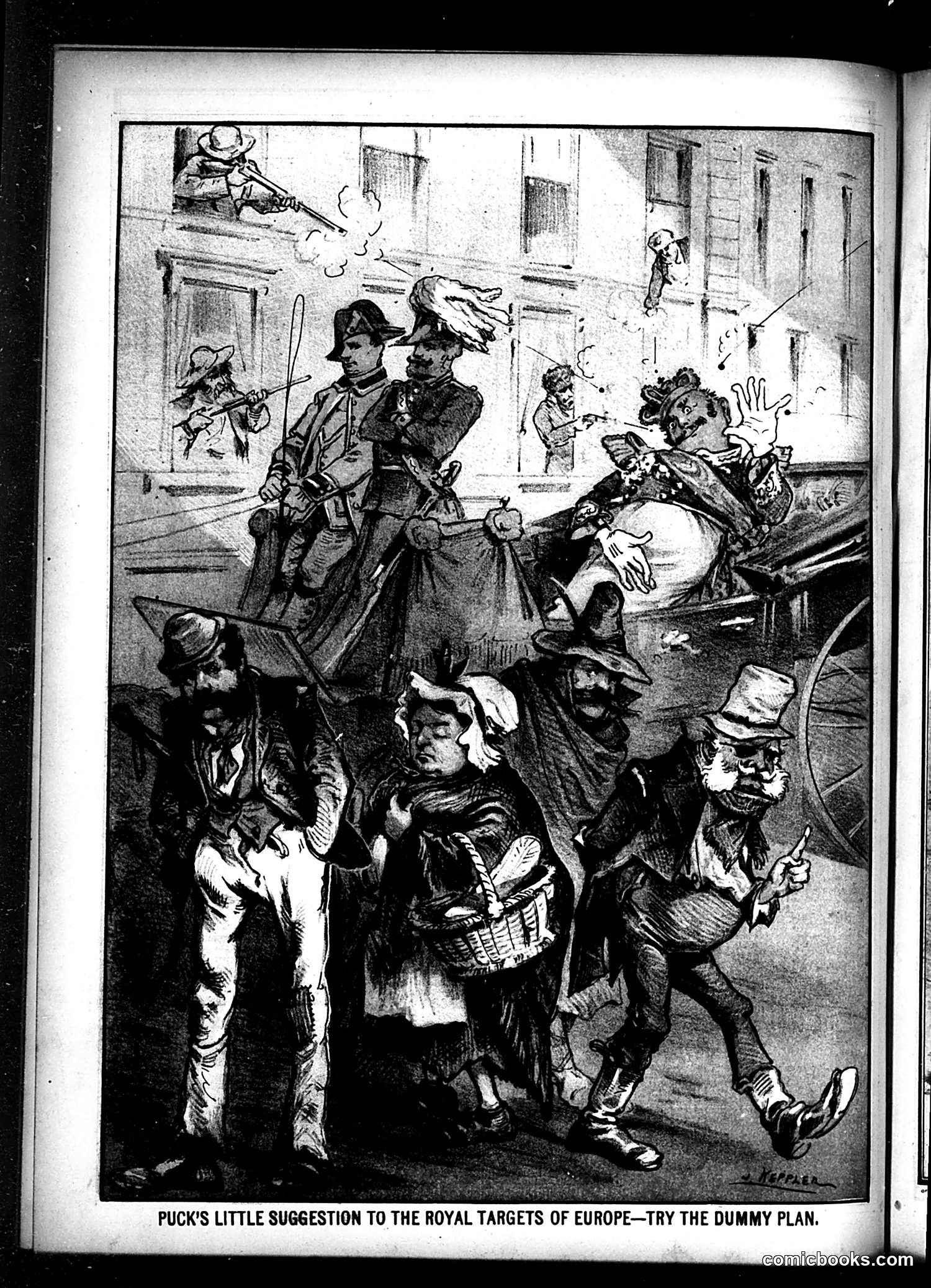
This satirical cartoon depicts European royalty as targets for anarchist violence. The "dummy plan" caption suggests using practice dummies instead of real assassination attempts—a darkly ironic commentary on late 19th/early 20th-century anarchist attacks on European monarchs. The cartoon shows armed soldiers or anarchists surrounding what appear to be caricatured royal figures (identifiable by crowns and formal dress). The building backdrop and multiple assailants suggest a coordinated political threat. The satire critiques both the vulnerability of Europe's royal establishment and, likely, the perceived absurdity or inevitability of anarchist threats during this period of political instability. The title's bitter humor reflects contemporary anxieties about regicide and political assassination.