
Puck, 1879-04-23 · page 10 of 16
Puck — April 23, 1879 — page 10: what you’re looking at
What you’re looking at
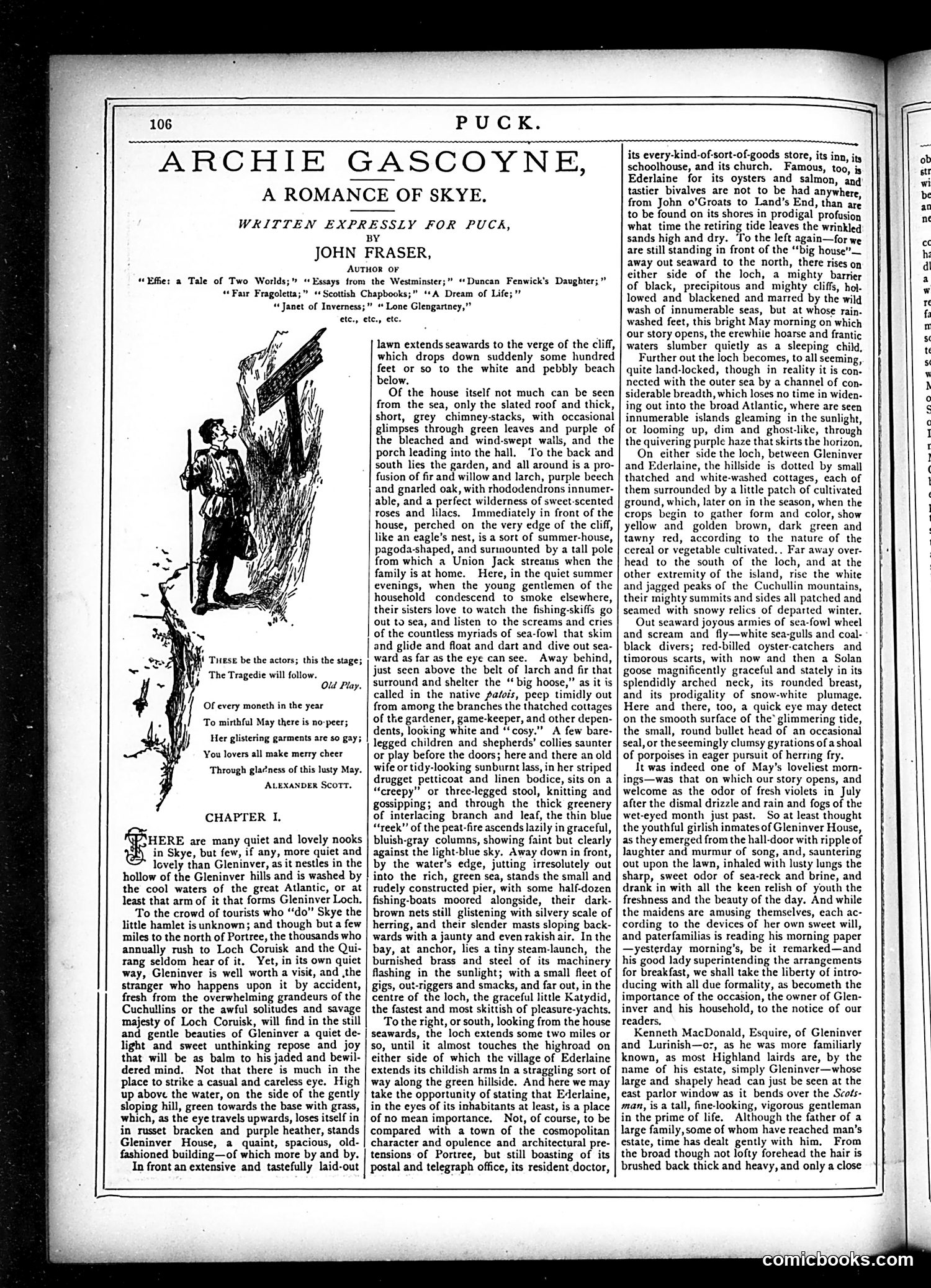
This is **not a political cartoon**—it's the opening page of a serialized fiction story titled "Archie Gascoyne: A Romance of Skye," written by John Fraser specifically for Puck magazine. The left side features an illustration of a Highland Scottish man in traditional dress standing on a cliff. The text is a romantic narrative about a remote Scottish estate on the Isle of Skye, describing its landscape, architecture, and inhabitants in detailed prose. This page represents Puck's entertainment content rather than its satirical purpose. The magazine mixed humor, commentary, and serialized fiction to engage readers. The Scottish setting and romantic tone suggest this story appealed to 19th-century readers' tastes for exotic, picturesque narratives about rural Britain.
📄 Transcribed text from this page (OCR, searchable)
Machine-transcribed from the original scan — historical spelling and the odd misread are preserved.
106 PUCK. “Effie: a Tale of Two Worlds; «« Fair Fragoletta; Tutese be the actors; this the stage; + The Tragedie will follow. y Old Play. Of every moneth in the year To mirthful May there is no:peer; Her glistering garments are so gay; You lovers all make merry cheer ‘Through glacness of this lusty May. ALEXANDER SCOTT. CHAPTER I. HERE are many quiet and lovely nooks in Skye, but few, if any, more quiet and lovely than Gleninver, as it nestles in the hollow of the Gleninver hills and is washed by the cool waters of the great Atlantic, or at least that arm of it that forms Gleninver Loch, To the crowd of tourists who “do” Skye the little hamlet is unknown; and though but a few miles to the north of Portree, the thousands who annually rush to Loch Coruisk and the Qui- rang seldom hear of it. Yet, in its own quiet way, Gleninver is well worth a visit, and ,the stranger who happens upon it by accident, fresh from the overwhelming grandeurs of the Cuchullins or the awful solitudes and savage majesty of Loch Coruisk, will find in the still and gentle beauties of Gleninver a quiet de- light and sweet unthinking repose and joy that will be as balm to his jaded and bewil- dered mind. Not that there is much in the place to strike a casual and careless eye. High up above the water, on the side of the gently sloping hill, green towards the base with grass, which, as the eye travels upwards, loses itself in in russet bracken and purple heather, stands Gleninver House, a quaint, spacious, old- fashioned building—of which more by and by. In front an extensive and tastefully laid-out ARCHIE GASCOYNE, A ROMANCE OF SKYE. WRITTEN EXPRESSLY FOR PUCK, BY JOHN FRASER, AUTHOR oF “Essays from the Westminster;” “Duncan Fenwick's Daughter; ” “+ Scottish Chapbooks;” ‘A Dream of Life;”” “Janet of Inverness; ” etc., etc., etc. Lone Glengartney,”” lawn extends seawards to the verge of the cliff, which drops down suddenly some hundred feet or so to the white and pebbly beach below. Of the house itself not much can be seen from the sea, only the slated roof and thick, short, grey chimney-stacks, with occasional glimpses through green leaves and purple of the bleached and wind-swept walls, and the porch leading into the hall. ‘Io the back and south lies the garden, and all around is a pro- fusion of fir and willow and larch, purple beech and gnarled oak, with rhododendrons innumer- able, and a perfect wilderness of sweet-scented roses and lilacs. Immediately in front of the house, perched on the very edge of the cliff, like an eagle’s nest, is a sort of summer-house, pagoda-shaped, and surmounted by a tall pole from which a Union Jack streams when the family is at home. Here, in the quiet summer evenings, when the young gentlemen of the household condescend to smoke elsewhere, their sisters love to watch the fishing-skiffs go out to sea, and listen to the screams and cries of the countless myriads of sea-fowl that skim and glide and float and dart and dive out sea- ward as far as the eye can see. Away behind, just seen above the belt of larch and fir that surround and shelter the ‘ big hoose,” as it is called in the native pa/ois, peep timidly out from among the branches the thatched cottages of the gardener, game-keeper, and other depen- dents, looking white and ‘cosy. A few bare- legged children and shepherds’ collies saunter or play before the doors; here and there an old wife or tidy-looking sunburnt lass, in her striped drugget petticoat and linen bodice, sits on a “creepy” or three-legged stool, knitting and gossipping; and through the thick greenery of interlacing branch and leaf, the thin blue “reek” of the peat-fire ascends lazily in graceful, bluish-gray columns, showing faint but clearly against the light-blue sky. Away down in front, by the water’s edge, jutting irresolutely out into the rich, green sea, stands the small and rudely constructed pier, with some half-dozen fishing-boats moored alongside, their dark- brown nets still glistening with silvery scale of herring, and their slender masts sloping back- wards with a jaunty and even rakish air, In the bay, at anchor, lies a tiny steam-launch, the burnished brass and steel of its machinery flashing in the sunlight; with a small fleet of gigs, out-riggers and smacks, and far out, in the centre of the loch, the graceful little Katydid, the fastest and most skittish of pleasure-yachts, To the right, or south, looking from the house seawards, the loch extends some two miles or so, until it almost touches the highroad on either side of which the village of Ederlaine extends its childish arms in a straggling sort of way along the green hillside, And here we may take the opportunity of stating that Ederlaine, in the eyes of its inhabitants at least, is a place of no mean importance. Not, of course, to be compared with a town of the cosmopolitan character and opulence and architectural pre- tensions of Portree, but still boasting of its its every-kind-of-sort-of-goods store, its inn, ity schoolhouse, and its church, Famous, too, is. Ederlaine for its oysters and salmon, and tastier bivalves are not to be had anywhere, from John o'Groats to Land’s End, than are to be found on its shores in prodigal profusion what time the retiring tide leaves the wrinkled sands high and dry. ‘To the left again—for we are still standing in front of the ‘big house” away out seaward to the north, there rises on either side of the loch, a mighty barrier of black, precipitous and mighty cliffs, hol- lowed and blackened and marred by the wild wash of innumerable seas, but at whose rain. washed feet, this bright May morning on which our story opens, the erewhile hoarse and frantic waters slumber quietly as a sleeping child, Further out the loch becomes, to all seeming, quite land-locked, though in reality it is con. nected with the outer sea by a channel of con- siderable breadth, which loses no time in widen- ing out into the broad Atlantic, where are seen innumerable islands gleaming in the sunlight, or looming up, dim and ghost-like, through the quivering purple haze that skirts the horizon, On either side the loch, between Gleninver and Ederlaine, the hillside is dotted by small thatched and white-washed cottages, each of them surrounded by a little patch of cultivated ground, which, later on in the season, when the crops begin to gather form and color, show yellow and golden brown, dark green and tawny red, according to the nature of the cereal or vegetable cultivated.. Far away over- head to the south of the loch, and at the other extremity of the island, rise the white and jagged peaks of the Cuchullin mountains, their mighty summits and sides all patched and seamed with snowy relics of departed winter. Out seaward joyous armies of sea-fowl wheel and scream and fly—white sea-gulls and coal- black divers; red-billed oyster-catchers and timorous scarts, with now and then a Solan goose magnificently graceful and stately in its splendidly arched neck, its rounded breast, and its prodigality of snow-white plumage. Here and there, too, a quick eye may detect on the smooth surface of the glimmering tide, the small, round bullet head of an occasional seal, or the seemingly clumsy gyrations of a shoal of porpoises in eager pursuit of herring fry. It was indeed one of May’s loveliest morn- ings—was that on which our story opens, and welcome as the odor of fresh violets in July after the dismal drizzle and rain and fogs of the wet-eyed month just past. So at least thought the youthful girlish inmates of Gleninver House, as they emerged from the hall-door with ripple of laughter and murmur of song, and, sauntering out upon the lawn, inhaled with lusty lungs the sharp, sweet odor of sea-reck and brine, and drank in with all the keen relish of youth the freshness and the beauty of the day. And while the maidens are amusing themselves, each ac- cording to the devices of her own sweet will, and paterfamilias is reading his morning paper —yesterday morning's, be it remarked—and his good lady superintending the arrangements for breakfast, we shall take the liberty of intro- ducing with all due formality, as becometh the importance of the occasion, the owner of Glen- inver and his household, to the notice of our readers, Kenneth MacDonald, Esquire, of Gleninver and Lurinish—o:, as he was more familiarly known, as most Highland lairds are, by the name of his estate, simply Gleninver—whose large and shapely head can just be seen at the east parlor window as it bends over the Scofs- man, is a tall, fine-looking, vigorous gentleman in the prime of life, Although the father of a large family, some of whom have reached man’s estate, time has dealt gently with him, From the broad though not lofty forehead the hair is postal and telegraph office, its resident doctor, brushed back thick and heavy, and only a close