
Puck, 1879-04-23 · page 4 of 16
Puck — April 23, 1879 — page 4: what you’re looking at
What you’re looking at
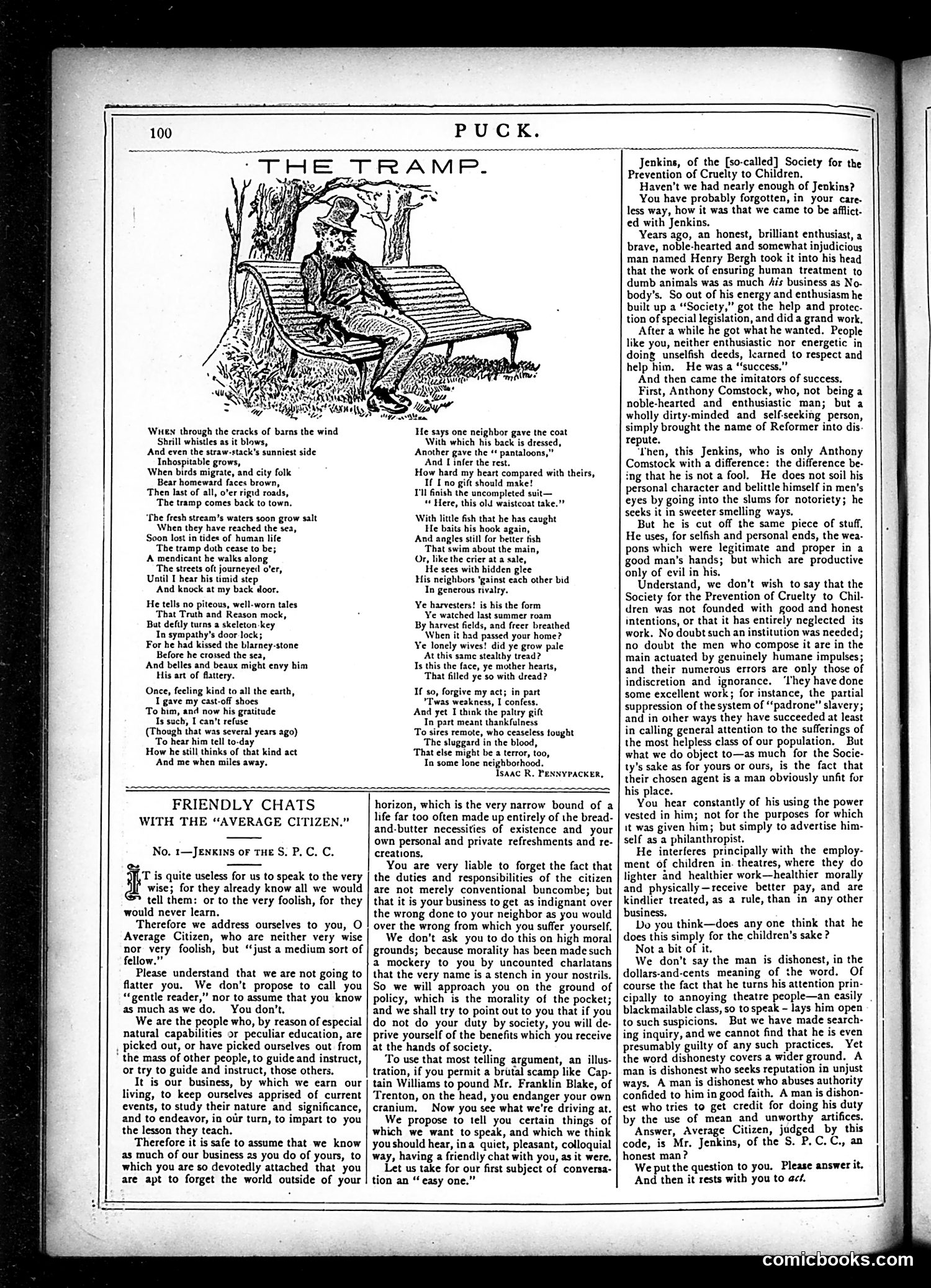
This poem satirizes a vagrant ("tramp") who survives through begging and petty theft—a common figure in Gilded Age America. The illustration shows a shabby man resting against a tree, depicting urban poverty. The narrative voice ironically documents the tramp's survival strategies: accepting charity ("one neighbor gave the coat"), stealing when necessary, and exploiting social sympathy. Lines like "He tells one neighbor tales" and references to "hidden glee" suggest the speaker views the tramp as cunning rather than genuinely destitute. The satire appears directed at both vagrants themselves and perhaps at the gullible public who enable them through charity. This reflects late-19th-century anxieties about distinguishing "deserving" from "undeserving" poor—a period when vagrancy was heavily criminalized and debated.
📄 Transcribed text from this page (OCR, searchable)
Machine-transcribed from the original scan — historical spelling and the odd misread are preserved.
Wuen through the cracks of barns the wind Shrill whistles as it blows, And even the straw-stack’s sunniest side Inhospitable grows, When birds migrate, and city folk Bear homeward faces brown, Then last of all, o'er rigid roads, ‘The tramp comes back to town. ‘The fresh stream’s waters soon grow salt ‘When they have reached the sea, Soon lost in tides of human life The tramp doth cease to be; ‘A mendicant he walks along The streets oft journeyed! oer, Until I hear his timid step ‘And knock at my back door. He tells no piteous, well-worn tales ‘That Truth and Reason mock, Bat defily turns a skeleton-key In sympathy’s door lock; For he had kissed the blarney-stone Before he crossed the sea, And belles and beaux might envy him His art of flattery. Once, feeling kind to all the earth, I gave my cast-off shoes To him, and now his gratitude Is such, I can’t refuse (Though that was several years ago) To hear him tell to-day How he still thinks of that kind act ‘And me when miles away. He says one neighbor gave the coat With which his back is dressed, Another gave the ‘ pantaloons,”” ‘And [infer the rest. How hard my heart compared with theirs, If Eno gift should make! T'll finish the uncompleted suit— “Here, this old waistcoat take.” With little fish that he has caught He baits his hook again, And angles still for better fish That swim about the main, Or, like the crier at a sale, He sees with hidden glee His neighbors ‘gainst each other bid In generous rivalry. Ye harvesters! is his the form Ye watched last summer roam By harvest fields, and freer breathed ‘When it had passed your home? Ye lonely wives! did ye grow pale At this same stealthy tread? Is this the face, ye mother hearts, That filled ye so with dread? If $0, forgive my act; in part "Twas weakness, I confess. And yet I think the paltry gift In part meant thankfulness To sires remote, who ceaseless fought ‘The sluggard in the blood, ‘That else might be a terror, too, In some lone neighborhood Isaac R. PENNYPACKER, FRIENDLY CHATS WITH THE “AVERAGE CITIZEN.” No. 1—Jenxins oF THE S, P, C. C. wise; for they already know all we would tell them: or to the very foolish, for they would never learn, Therefore we address ourselves to you, O Average Citizen, who are neither very wise nor very foolish, but ‘just a medium sort of fellow.” Please understand that we are not going to flatter you. We don’t propose to call you “gentle reader,” nor to assume that you know as much as we do. You don’t. We are the people who, by reason of especial natural capabilities or peculiar education, are , Picked out, or have picked ourselves out from the mass of other people, to guide and instruct, or try to guide and instruct, those others. It is our business, by which we earn our living, to keep ourselves apprised of current events, to study their nature and significance, and to endeavor, in our turn, to impart to you the lesson they teach. Therefore it is safe to assume that we know as much of our business 2s you do of yours, to which you are so devotedly attached that you are apt to forget the world outside of your Ir is quite useless for us to speak to the very horizon, which is the very narrow bound of a life far too often made up entirely of the bread- and-butter necessities of existence and your own personal and private refreshments and re- creations, You are very liable to forget the fact that the duties and responsibilities of the citizen are not merely conventional buncombe; but that it is your business to get as indignant over the wrong done to your neighbor as you would over the wrong from which you suffer yourself. We don't ask you to do this on high moral grounds; because morality has been made such a mockery to you by uncounted charlatans that the very name is a stench in your nostrils. So we will approach you on the ground of policy, which is the morality of the pocket; and we shall try to point out to you that if you do not do your duty by society, you will de- prive yourself of the benefits which you receive at the hands of society. To use that most telling argument, an illus- tration, if you permit a bratal scamp like Cap- tain Williams to pound Mr. Franklin Blake, of Trenton, on the head, you endanger your own cranium, Now you see what we're driving at. We propose to tell you certain things of which we want to speak, and which we think you should hear, ina quiet, pleasant, colloquial way, having a friendly chat with you, as it were, _ Let us take for our first subject of conversa- tion an “ easy one.” Jenkins, of the [so-called] Society for the Prevention of Cruelty to Children, Haven't we had nearly enough of Jenkins? You have probably forgotten, in your care. less way, how it was that we came to be afflict- ed with Jenkins. Years ago, an honest, brilliant enthusiast, a brave, noble-hearted and somewhat injudicious man named Henry Bergh took it into his head that the work of ensuring human treatment to dumb animals was as much Ais business as No- body’s. So out of his energy and enthusiasm he built up a “Society,” got the help and protec. tion of special legislation, and did a grand work, After a while he got what he wanted. People like you, neither enthusiastic nor energetic in doing unselfish deeds, learned to respect and help him. He was a “‘success.” And then came the imitators of success. First, Anthony Comstock, who, not being a noble-hearted and enthusiastic man; but a wholly dirty-minded and self-seeking person, simply brought the name of Reformer into dis- repute. "Then, this Jenkins, who is only Anthony Comstock with a difference: the difference be- ing that he is not a fool. He does not soil his personal character and belittle himself in men’s eyes by going into the slums for notoriety; he seeks it in sweeter smelling ways. But he is cut off the same piece of stuff. He uses, for selfish and personal ends, the wea- pons which were legitimate and proper in a good man’s hands; but which are productive only of evil in his. Understand, we don’t wish to say that the Society for the Prevention of Cruelty to Chil- dren was not founded with good and honest intentions, or that it has entirely neglected its work. No doubt such an institution was needed; no doubt the men who compose it are in the main actuated by genuinely humane impulses; and their numerous errors are only those of indiscretion and ignorance. ‘hey have done some excellent work; for instance, the partial suppression of the system of “‘padrone” slavery; and in other ways they have succeeded at least in calling general attention to the sufferings of the most helpless class of our population, But what we do object to—as much for the Socie- ty’s sake as for yours or ours, is the fact that their chosen agent is a man obviously unfit for his place. You hear constantly of his using the power vested in him; not for the purposes for which it was given him; but simply to advertise him- self as a philanthropist. He interferes principally with the employ- ment of children in. theatres, where they do lighter and healthier work—healthier morally and physically—receive better pay, and are kindlier treated, as a rule, than in any other business. Do you think—does any one think that he does this simply for the children’s sake ? Not a bit of it. We don’t say the man is dishonest, in the dollars-and-cents meaning of the word. Of course the fact that he turns his attention prin- cipally to annoying theatre people—an easily blackmailable class, so to speak - lays him open to such suspicions. But we have made search- ing inquiry, and we cannot find that he is even presumably guilty of any such practices. Yet the word dishonesty covers a wider ground. A man is dishonest who seeks reputation in unjust ways, A man is dishonest who abuses authority confided to him in good faith. A man is dishon- est who tries to get credit for doing his duty by the use of mean and unworthy artifices. Answer, Average Citizen, judged by this code, is Mr. Jenkins, of the S. P.C.C., an honest man? . We put the question to you. Please answer it. And then it rests with you to act.