
Puck, 1879-04-23 · page 3 of 16
Puck — April 23, 1879 — page 3: what you’re looking at
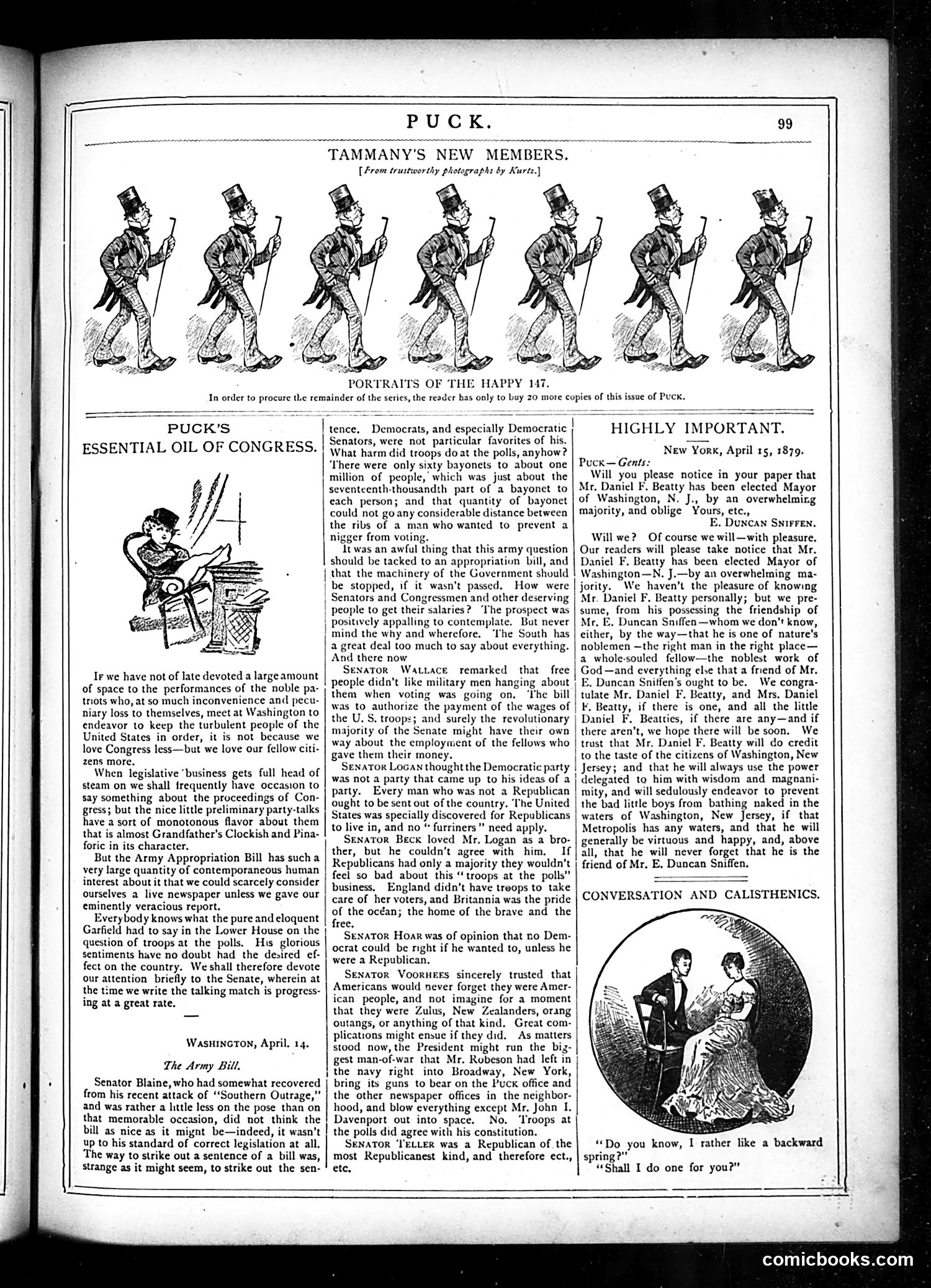
What you’re looking at
**"Tammany's New Members"** (top): Seven identical figures in top hats represent new members of Tammany Hall, the Democratic political machine. The repetitive, identical depiction satirizes how these politicians are interchangeable apparatchiks serving the organization rather than individuals with distinct principles. **"Puck's Essential Oil of Congress"** (left): A caricatured figure squeezes a bag labeled with legislative items, suggesting Congress produces only "essential oil"—concentrated partisan talk while accomplishing little substantive work. The cartoon mocks congressional inefficiency and excessive political rhetoric. **"Highly Important" section**: Commentary on Daniel F. Beatty's election as Washington D.C. Mayor, with satirical congratulations emphasizing machine politics and backroom dealings rather than merit-based governance.
📄 Transcribed text from this page (OCR, searchable)
Machine-transcribed from the original scan — historical spelling and the odd misread are preserved.
PUCK. TAMMANY'S NEW MEMBERS. [From trustworthy photographs by Kurtz.) PORTRAITS OF THE HAPPY 147. In order to procure the remainder of the series, the reader has only to buy 20 more copies of this issue of Puck. PUCK’S ESSENTIAL OIL OF CONGRESS. Ir we have not of late devoted a large amount of space to the performances of the noble pa- triots who, at so much inconvenience and pecu- niary loss to themselves, meet at Washington to endeavor to keep the turbulent people of the United States in order, it is not because we love Congress less—but we love our fellow citi- zens more. When legislative ‘business gets full head of steam on we shall frequently have occasion to say something about the proceedings of Con- gress; but the nice little preliminary party-talks have a sort of monotonous flavor about them that is almost Grandfather's Clockish and Pina- foric in its character. But the Army Appropriation Bill has such a very large quantity of contemporaneous human interest about it that we could scarcely consider ourselves a live newspaper unless we gave our eminently veracious report. Everybody knows what the pure and eloquent Garfield had to say in the Lower House on the question of troops at the polls. His glorious sentiments have no doubt had the desired ef- fect on the country. We shall therefore devote our attention briefly to the Senate, wherein at the time we write the talking match is progress- ing at a great rate. Wasuincton, April. 14, The Army Bill, Senator Blaine, who had somewhat recovered from his recent attack of ‘Southern Outrage,” and was rather a little less on the pose than on that memorable occasion, did not think the bill as nice as it mignt be—indeed, it wasn’t up to his standard of correct legislation at all. The way to strike out a sentence of a bill was, Strange as it might seem, to strike out the sen- | be stopped, if it wasn’t passed, | Senators and Congressmen and other deserving tence. Democrats, and especially Democratic | Senators, were not particular favorites of his. What harm did troops do at the polls, anyhow? ‘There were only sixty bayonets to about one million of people, which was just about the seventeenth-thousandth part of a bayonct to each person; and that quantity of bayonet could not go any considerable distance between the ribs of a man who wanted to prevent a nigger from voting. twas an awful thing that this army question should be tacked to an appropriation Dill, and that the machinery of the Government should How were people to get their salaries? ‘I'he prospect was positively appalling to contemplate. But never mind the why and wherefore. ‘Ihe South has a great deal too much to say about everything. And there now Senator Wattace remarked that free people didn’t like military men hanging about them when voting was going on. ‘The bill was to authorize the payment of the wages of the U.S. troops; and surely the revolutionary majority of the Senate might have their own way about the employment of the fellows who gave them their money. Senator Locan thought the Democratic party was not a party that came up to his ideas of a | party, Every man who was not a Republican ought to be sent out of the country, ‘he United States was specially discovered for Republicans | to live in, and no * furriners” need apply. SenaToR Beck loved Mr. Logan as a bro- ther, but he couldn't agree with him. If Republicans had only a majority they wouldn't feel so bad about this “troops at the polls” business, England didn’t have treops to take care of her voters, and Britannia was the pride of the océan; the home of the brave and the free. Senator Hoar was of opinion that no Dem- ocrat could be right if he wanted to, unless he were a Republican. Senator Voornees sincerely trusted that Americans would never forget they were Amer- ican people, and not imagine for a moment that they were Zulus, New Zealanders, orang outangs, or anything of that kind. Great com- plications might ensue if they did, As matters stood now, the President might run the biz- gest man-of-war that Mr. Robeson had left in | the navy right into Broadway, New York, bring its guns to bear on the Puck office and the other newspaper offices in the neighbor- hood, and blow everything except Mr. John I. Davenport out into space. No. ‘l'roops at the polls did agree with his constitution. SENATOR ‘TELLER was a Republican of the most Republicanest kind, and therefore ect., ete, HIGHLY IMPORTANT. New York, April r5, 1879. Puck—Gents: Will you please notice in your paper that Mr. Daniel F. Beatty has been elected Mayor of Washington, N. J., by an overwhelming majority, and oblige Yours, etc., E. Duncan SNiFFEN. Will we? Of course we will—with pleasure, Our readers will please take notice that Mr. Daniel F. Beatty has been elected Mayor of Washington—N, J.—by an overwhelming ma- jority. We haven't the pleasure of knowing Mr. Daniel F, Beatty personally; but we pre- sume, from his possessing the friendship of Mr. E, Duncan Sniffen—whom we don't know, either, by the way—that he is one of nature's noblemen —the right man in the right place— a whole-souled fellow—the noblest work of God—and everything else that a friend of Mr. E, Duncan Sniffen’s ought to be. We congra- tulate Mr. Daniel F, Beatty, and Mrs. Daniel KF, Beatty, if there is one, and all the little Daniel F. Beatties, if there are any—and if there aren't, we hope there will be soon. We trust that Mr. Daniel F. Beatty will do credit to the taste of the citizens of Washington, New Jersey; and that he will always use the power delegated to him with wisdom and magnani- mity, and will sedulously endeavor to prevent the bad little boys from bathing naked in the waters of Washington, New Jersey, if that Metropolis has any waters, and that he will generally be virtuous and happy, and, above all, that he will never forget that he is the friend of Mr. E. Duncan Sniffen, CONVERSATION AND CALISTHENICS. “Do you know, I rather like a backward spring?” “Shall I do one for you?” comicbooks.com