
Puck, 1879-04-23 · page 6 of 16
Puck — April 23, 1879 — page 6: what you’re looking at
What you’re looking at
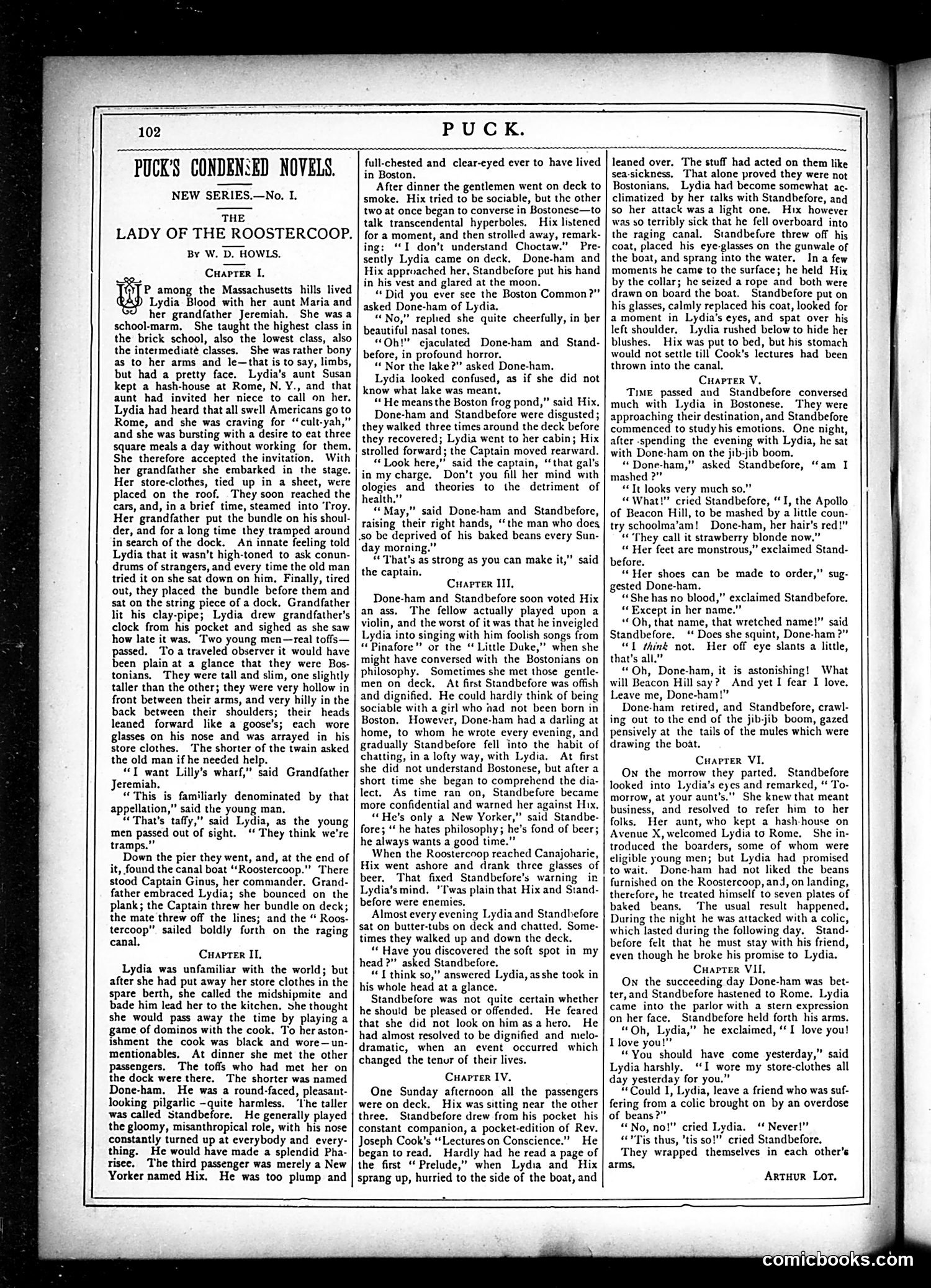
This page contains **no political cartoon or satire**. Instead, it presents "The Lady of the Roostercoop," a serialized short story by W.D. Howells, part of Puck's "Condensed Novels" series. The narrative follows Lydia, a Massachusetts woman traveling by canal boat to Troy with her aunt. The story satirizes the social conventions and pretensions of 19th-century American travel, featuring characters like the pompous Done-ham and Standefore, who engage in comedic banter and misadventures aboard the vessel. This is **literary fiction**, not political commentary—typical of Puck's content mix, which combined satirical humor with serialized stories for entertainment alongside its famous cartoons.
📄 Transcribed text from this page (OCR, searchable)
Machine-transcribed from the original scan — historical spelling and the odd misread are preserved.
PUCK. PUCK'S CONDENSED NOVELS. NEW SERIES.—No. I. THE LADY OF THE ROOSTERCOOP. By W. D. HOWLS. Cuarter I, ey P among the Massachusetts hills lived Lydia Blood with her aunt Maria and her grandfather Jeremiah. She was a school-marm. She taught the highest class in the brick school, also the lowest class, also the intermediate classes. She was rather bony as to her arms and le—that is to say, limbs, but had a pretty face. Lydia’s aunt Susan kept a hash-house at Rome, N. Y., and that aunt had invited her niece to call on her. Lydia had heard that all swell Americans go to Rome, and she was craving for “cult-yah,” and she was bursting with a desire to eat three square meals a day without working for them, She therefore accepted the invitation, With her grandfather she embarked in the stage. Her store-clothes, tied up in a sheet, were placed on the roof. They soon reached the cars, and, in a brief time, steamed into ‘Troy. Her grandfather put the bundle on his shoul- der, and for a long time they tramped around in search of the dock. An innate feeling told Lydia that it wasn’t high-toned to ask conun- drums of strangers, and every time the old man tried it on she sat down on him, Finally, tired out, they placed the bundle before them and sat on the string piece of a dock, Grandfather lit his clay-pipe; Lydia drew grandfather's clock from his pocket and sighed as she saw how late it was. Two young men—real toffs— passed. To a traveled observer it would have been plain at a glance that they were Bos- tonians. They were tall and slim, one slightly taller than the other; they were very hollow in front between their arms, and very hilly in the back between their shoulders; their heads leaned forward like a goose’s; each wore glasses on his nose and was arrayed in his store clothes. ‘The shorter of the twain asked the old man if he needed help. “I want Lilly’s wharf,” said Grandfather Jeremiah. “This is familiarly denominated by that appellation,” said the young man, “That's taffy,” said Lydia, as the young men passed out of sight.“ They think we're tramps.” Down the pier they went, and, at the end of it, found the canal boat ‘Roostercoop.” There stood Captain Ginus, her commander. Grand- father embraced Lydia; she bounced on the plank; the Captain threw her bundle on deck; the mate threw off the lines; and the “ Roos- tercoop” sailed boldly forth on the raging canal, Cuapter II, Lydia was unfamiliar with the world; but after she had put away her store clothes in the spare berth, she called the midshipmite and bade him lead her to the kitchen. she thought she would pass away the time by playing a game of dominos with the cook. To her aston- ishment the cook was black and wore—un- mentionables. At dinner she met the other passengers. The toffs who had met her on the dock were there. The shorter was named Done-ham. He was a round-faced, pleasaut- looking pilgarlic quite harmless. ‘I'he taller was called Standbefore. He generally played the gloomy, misanthropical role, with his nose constantly turned up at everybody and every- thing. He would have made a splendid Pha- risee. The third passenger was merely a New Yorker named Hix. He was too plump and full-chested and clear-eyed ever to have lived in Boston. After dinner the gentlemen went on deck to smoke. Hix tried to be sociable, but the other two at once began to converse in Bostonese—to talk transcendental hyperboles. Hix listened for a moment, and then strolled away, remark- ing: ‘I don't understand Choctaw.” Pre- sently Lydia came on deck. Done-ham and Hix approached her, Standbefore put his hand in his vest and glared at the moon. “Did you ever see the Boston Common?” asked Done-ham of Lydia. “No,” replied she quite cheerfully, in ber beautiful nasal tones. “Oh!” ejaculated Done-ham and Stand- before, in profound horror. “Nor the lake?” asked Done-ham. Lydia looked confused, as if she did not know what lake was meant. “ He means the Boston frog pond,” said Hix. Done-ham and Standbefore were disgusted ; they walked three times around the deck before they recovered; Lydia went to her cabin; Hix strolled forward; the Captain moved rearward. “Look here,” said the captain, “that gal’'s in my charge. Don’t you fill her mind with ologies and theories to the detriment of health.” “ May,” said Done-ham and Standbefore, raising their right hands, “the man who does so be deprived of his baked beans every Sun- day morning.” “ That's as strong as you can make it,” said the captain. Cuarter III, Done-ham and Standbefore soon voted Hix an ass. The fellow actually played upon a violin, and the worst of it was that he inveigled Lydia into singing with him foolish songs from “Pinafore” or the ‘ Little Duke,” when she might have conversed with the Bostonians on philosophy. Sometimes she met those gentle- men on deck, At first Standbefore was offish and dignified. He could hardly think of being sociable with a girl who nad not been born in Boston, However, Done-ham had a darling at home, to whom he wrote every evening, and gradually Standbefore fell into the habit of chatting, in a lofty way, with Lydia. At first she did not understand Bostonese, but after a short time she began to comprehend the dia- lect. As time ran on, Standbefure became more confidential and warned her against Hix. “He's only a New Yorker,” said Standbe- fore; “ he hates philosophy; he’s fond of beer; he always wants a good time.” When the Roostercoop reached Canajoharie, Hix went ashore and drank three glasses of beer, That fixed Standbefore’s warning in Lydia's mind. ‘Twas plain that Hix and Stand- before were enemies, Almost every evening Lydiaand Standbefore sat on butter-tubs on deck and chatted, Some- times they walked up and down the deck, “ Have you discovered the soft spot in my head ?” asked Standbefore. “I think so,” answered Lydia, as she took in his whole head at a glance. Standbefore was not quite certain whether he should be pleased or offended. He feared that she did not look on him asa hero, He had almost resolved to be dignified and melo- dramatic, when an event occurred which changed the tenor of their lives. Cuaprter IV. One Sunday afternoon all the passengers were on deck. Hix was sitting near the other three, Standbefore drew from his pocket his constant companion, a pocket-edition of Rev. Joseph Cook's “‘Lectureson Conscience.” He began to read. Hardly had he read a page of the first ‘“ Prelude,” when Lydia and Hix sprang up, hurried to the side of the boat, and leaned over. The stuff had acted on them like sea-sickness, That alone proved they were not Bostonians, Lydia had become somewhat ac climatized by her talks with Standbefore, and so her attack was a light one. Hix however was so terribly sick that he fell overboard into the raging canal. Standbefure threw off his coat, placed his eye-glasses on the gunwale of the boat, and sprang into the water. In a few moments he came to the surface; he held Hix by the collar; he seized a rope and both were drawn on board the boat. Standbefore put on his glasses, calmly replaced his coat, looked for a moment in Lydia’s eyes, and spat over his left shoulder, Lydia rushed below to hide her blushes. Hix was put to bed, but his stomach would not settle till Cook's lectures had been thrown into the canal, Cuaprer V. Time passed and Standbefore conversed much with Lydia in Bostonese. They were approaching their destination, and Standbefore commenced to study his emotions. One night, after -spending the evening with Lydia, he sat with Done-ham on the jib-jib boom. “ Done-ham,” asked Standbefore, ‘am I mashed ?” “Tt looks very much so.” “What!” cried Standbefore, “I, the Apollo of Beacon Hill, to be mashed by a little coun- try schoolma’am! Done-ham, her hair's red!” “They call it strawberry blonde now.” “ Her feet are monstrous,” exclaimed Stand- before. “Her shoes can be made to order, gested Done-ham. “She has no blood,” exclaimed Standbefore. “Except in her name.” “Oh, that name, that wretched name!” said Standbefore. ‘‘ Does she squint, Done-ham ?” “1 think not. Her off eye slants a little, that’s all.” “Oh, Done-ham, it is astonishing! What will Beacon Hill say? And yet I fear I love. Leave me, Done-ham!” Done-ham retired, and Standbefore, crawl- ing out to the end of the jib-jib boom, gazed pensively at the tails of the mules which were drawing the boat. Cuaprer VI. On the morrow they parted. Standbefore looked into Lydia’s eyes and remarked, “ To- morrow, at your aunt's." She knew that meant business, and resolved to refer him to her folks. Her aunt, who kept a hash-house on Avenue X, welcomed Lydia to Rome. She in- troduced the boarders, some of whom were eligible young men; but Lydia had promised to wait. Done-ham had not liked the beans furnished on the Roostercoop, and, on landing, therefore, he treated himself to seven plates of baked beans. The usual result happened. During the night he was attacked with a colic, which lasted during the following day. Stand- before felt that he must stay with his friend, even though he broke his promise to Lydia. Carrer VII, Ow the succeeding day Done-ham was bet- ter, and Standbefore hastened to Rome. Lydia came into the parlor with a stern expression on her face, Standbefore held forth his arms. “Oh, Lydia,” he exclaimed, ‘1 love you! I love you!” “You should have come yesterday,” said Lydia harshly. “I wore my store-clothes all day yesterday for you.” “Could I, Lydia, leave a friend who was suf- fering from a colic brought on by an overdose of beans?” “No, no!” cried Lydia. ‘‘ Never!”” “Tis thus, ’tis so!” cried Standbefore, They wrapped themselves in each other's arms, sug- Artuur Lor. icbooks.com