
Puck, 1879-04-23 · page 7 of 16
Puck — April 23, 1879 — page 7: what you’re looking at
What you’re looking at
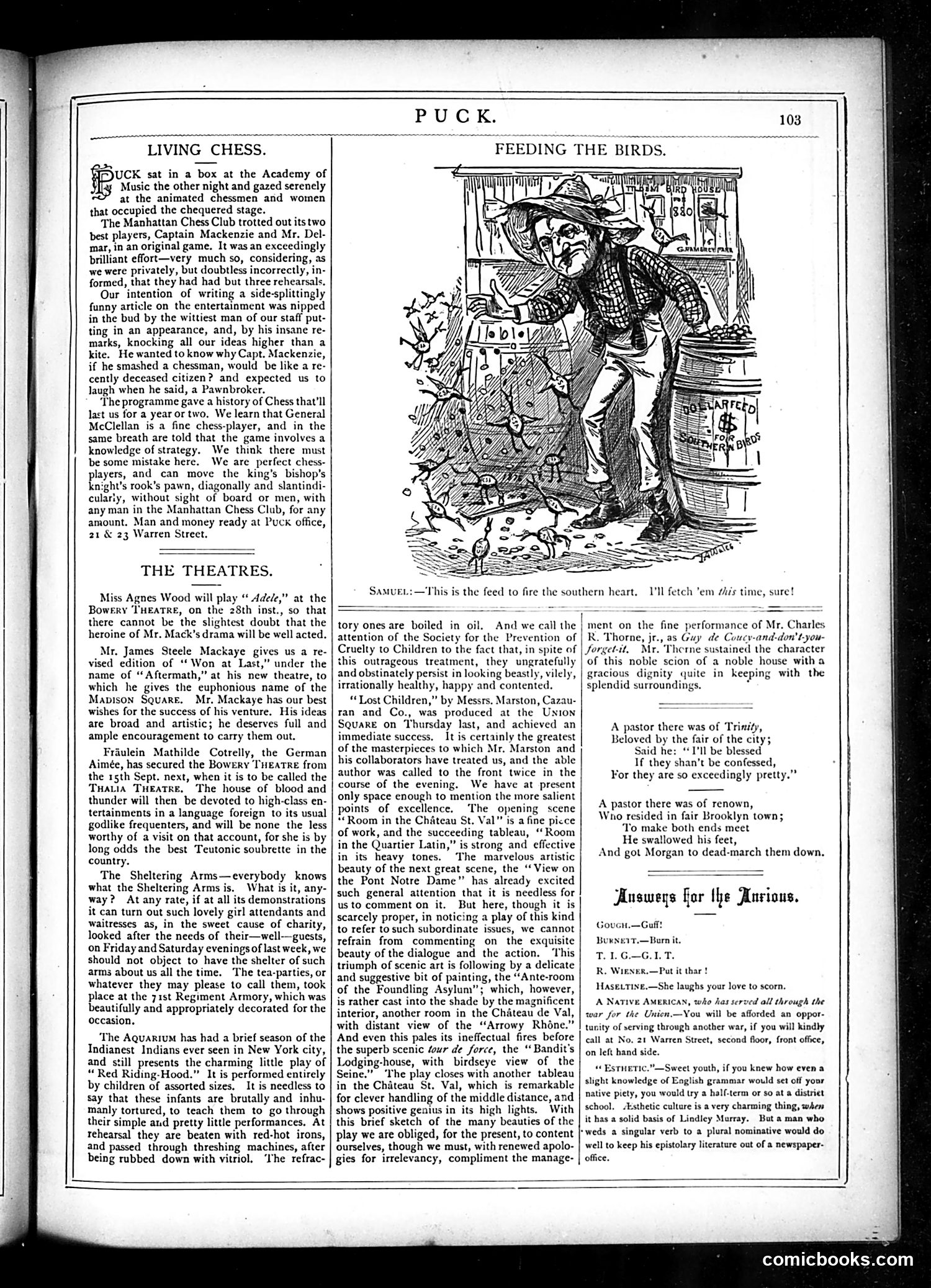
This cartoon depicts a disheveled man labeled "Samuel" scattering feed from a box marked "DOLLARS" while birds gather below. The caption reads: "This is the feed to fire the southern heart. I'll fetch 'em this time, sure!" The satire targets **political patronage and vote-buying**, specifically aimed at the American South during the Reconstruction or Gilded Age era. "Samuel" appears to represent a Northern politician or carpetbagger attempting to win Southern support through financial inducements ("dollars"). The birds represent Southern voters being cynically manipulated. The cartoon mocks the notion that money alone can "fire" Southern enthusiasm or loyalty, suggesting such crude appeals to self-interest are transparent and insulting to Southern pride—a common Puck theme criticizing Northern political manipulation of the post-Civil War South.
📄 Transcribed text from this page (OCR, searchable)
Machine-transcribed from the original scan — historical spelling and the odd misread are preserved.
LIVING CHESS. (SUCK sat in a box at the Academy of Music the other night and gazed serenely at the animated chessmen and women that occupied the chequered stage. The Manhattan Chess Club trotted out its two best players, Captain Mackenzie and Mr. Del- mar, in an original game. It was an exceedingly brilliant effort—very much so, considering, as we were privately, but doubtless incorrectly, in- formed, that they had had but three rehearsals. Our intention of writing a side-splittingly funny article on the entertainment was nipped in the bud by the wittiest man of our staff put- ting in an appearance, and, by his insane re- marks, knocking all our ideas higher than a kite. He wanted to know why Capt. Mackenzie, if he smashed a chessman, would be like a re- cently deceased citizen? and expected us to Jaugh when he said, a Pawnbroker. ‘The programme gave a history of Chess that'll last us for a year or two. We learn that General McClellan is a fine chess-player, and in the same breath are told that the game involves a knowledge of strategy. We think there must be some mistake here. We are perfect chess- players, and can move the king’s bishop's knight's rook’s pawn, diagonally and slantindi- culariy, without sight of board or men, with any man in the Manhattan Chess Club, for any amount. Man and money ready at Puck office, 21 & 23 Warren Street. THE THEATRES. Miss Agnes Wood will play “ Adede,” at the Bowery ‘THEATRE, on the 28th inst., so that there cannot be the slightest doubt that the heroine of Mr. Mack’s drama will be well acted. Mr, James Steele Mackaye gives us a re- vised edition of ‘Won at Last,” under the name of “Aftermath,” at his new theatre, to which he gives the euphonious name of the Mapison Square. Mr. Mackaye has our best wishes for the success of his venture. His ideas are broad and artistic; he deserves full and ample encouragement to carry them out. Fraulein Mathilde Cotrelly, the German Aimée, has secured the Bowery THEATRE from the 1sth Sept. next, when it is to be called the THALIA THEATRE. The house of blood and thunder will then be devoted to high-class en- tertainments in a language foreign to its usual godlike frequenters, and will be none the less worthy of a visit on that account, for she is by long odds the best Teutonic soubrette in the country. The Sheltering Arms—everybody knows what the Sheltering Arms is. What is it, any- way? At any rate, if at all its demonstrations it can turn out such lovely girl attendants and waitresses as, in the sweet cause of charity, looked after the needs of their—well-—guests, on Friday and Saturday evenings of last week, we should not object to have the shelter of such arms about us all the time. The tea-parties, or whatever they may please to call them, took place at the 71st Regiment Armory, which was beautifully and appropriately decorated for the occasion, ‘The Aquarium has had a brief season of the Indianest Indians ever seen in New York city, and still presents the charming little play of “Red Riding-Hood.” It is performed entirely by children of assorted sizes. It is needless to say that these infants are brutally and inhu- manly tortured, to teach them to go through their simple and pretty little performances. At rehearsal they are beaten with red-hot irons, and passed through threshing machines, after being rubbed down with vitriol. ‘Ihe refrac- PUCK. FEEDING THE BIRDS. his is the feed to fire the southern heart, tory ones are boiled in oil. attention of the Society for the Prevention of Cruelty to Children to the fact that, in spite of this outrageous treatment, they ungratefully and obstinately persist in looking beastly, vilely, irrationally healthy, happy and contented. ‘Lost Children,” by Messrs. Marston, Cazau- ran and Co., was produced at the 'Usiow Square on Thursday last, and achieved an immediate success. It is certainly the greatest of the masterpieces to which Mr. Marston and his collaborators have treated us, and the able author was called to the front twice in the course of the evening. We have at present only space enough to mention the more salient points of excellence. ‘The opening scene “Room in the Chateau St. Val” is a fine picce of work, and the succeeding tableau, “Room in the Quartier Latin,” is strong and effective in its heavy tones. The marvelous artistic beauty of the next great scene, the ‘View on the Pont Notre Dame” has already excited such general attention that it is needless for us to comment on it. But here, though it is scarcely proper, in noticing a play of this kind to refer to such subordinate issues, we cannot refrain from commenting on the exquisite beauty of the dialogue and the action. ‘This triumph of scenic art is following by a delicate and suggestive bit of painting, the ““Ante-room of the Foundling Asylum”; which, however, is rather cast into the shade by the magnificent interior, another room in the Chiiteau de Val, with distant view of the “Arrowy Rhone.” And even this pales its ineffectual fires before the superb scenic tour de force, the “Bandit's Lodging-house, with birdseye view of the Seine.” ‘The play closes with another tableau in the Chateau St. Val, which is remarkable for clever handling of the middle distance, and shows positive genius in its high lights. With this brief sketch of the many beauties of the play we are obliged, for the present, to content ourselves, though we must, with renewed apolo- gies for irrelevancy, compliment the manage- j And we call the | I'll fetch 'em “is time, sure! ment on the fine performance of Mr. Charles | R. Thorne, jr., as Guy de Coucy-and-don't-you- | Jerget-it, Mr. ‘Thorne sustained the character | of this noble scion of a noble house witha | gracious dignity quite in keeping with the splendid surroundings. : A pastor there was of Trinity, Beloved by the fair of the city; Said he: ‘I'll be blessed If they shan’t be confessed, For they are so exceedingly pretty.”” A pastor there was of renown, Who resided in fair Brooklyn town; ‘To make both ends meet He swallowed his feet, And got Morgan to dead-march them down, neweys for the Anrious. Govcu.—Guff! Burnert.—Burn it. T.1.6.—G.1.T. R. Wiener. HMASELTIN A Native AMERICAN, who has served all through the war for the Unien.—You will be afforded an oppor- tunity of serving through another war, if you will kindly call at No, 21 Warren Street, second floor, front office, on left hand side. Put it thar! She laughs your love to scorn. «« EstnEric."—Sweet youth, if you knew how even a slight knowledge of English grammar would set off your native piety, you would try a half-term or so at a distriet school. Esthetic culture is a very charming thing, when it has a solid basis of Lindley Murray. But a man who |‘ weds a singular verb to a plural nominative would do well to keep his epistolary literature out of a newspaper- office. comicbooks.com