
A complete issue · 16 pages · 1879
Puck — April 9, 1879
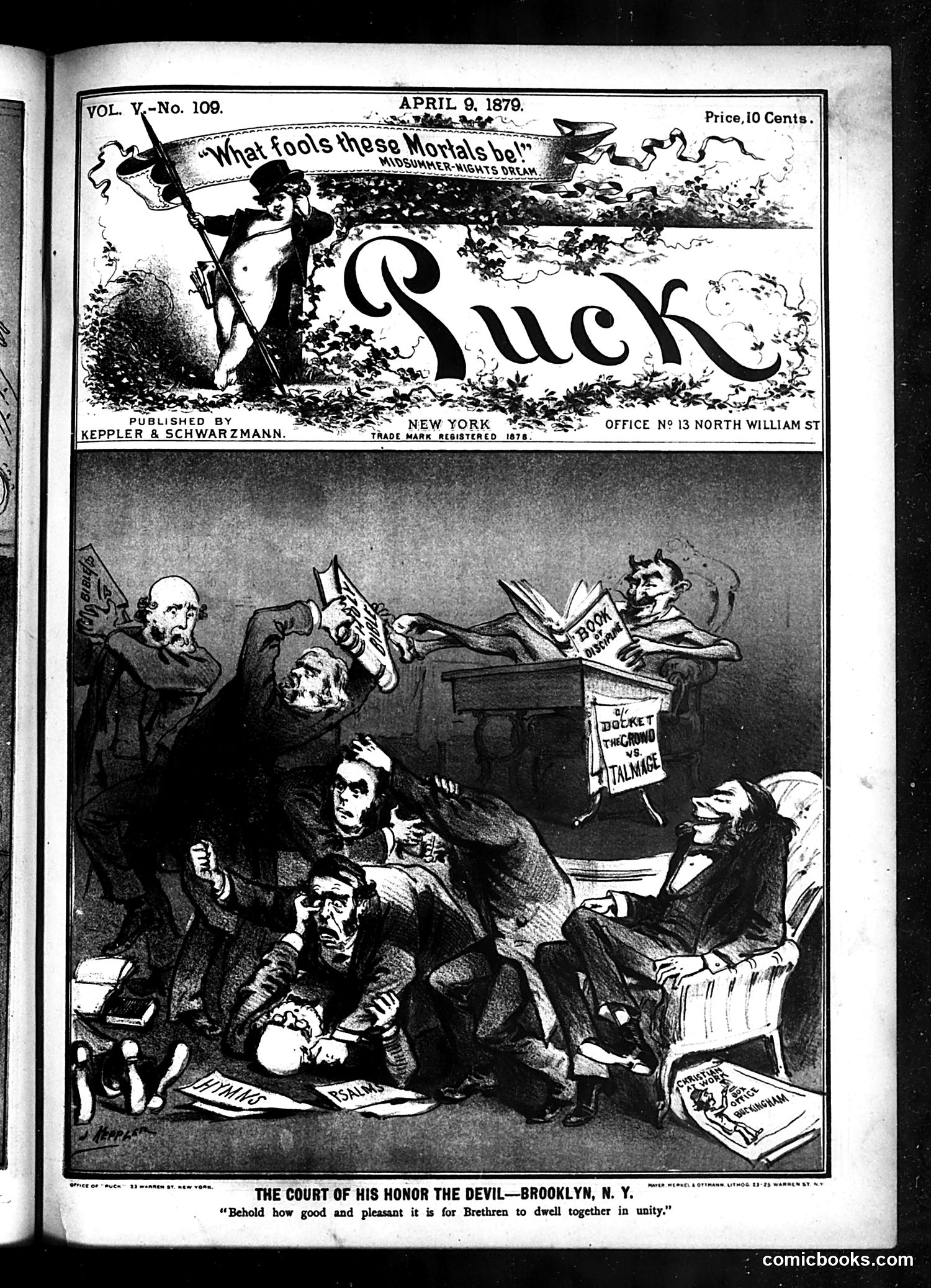
This satirical cartoon depicts "The Court of His Honor the Devil—Brooklyn, N.Y." The main image shows multiple demonic or devilish figures gathered in what appears to be a courtroom or gathering space. References visible include books labeled "Book of Tricks" and what seems to be legal or governmental documents, suggesting the cartoon critiques Brooklyn's political corruption or judicial system. The title banner quotes Scripture ("Behold how good and pleasant it is for Brethren to dwell together in unity"), using religious language ironically to mock the apparent collusion of corrupt officials. The specific political figures or scandals referenced remain unclear without additional historical context, but the satire targets Brooklyn's governance as inherently corrupt—equating local politicians with devils conducting illicit business.
This page contains several satirical articles and sections typical of Puck's format, rather than a single political cartoon. The main illustrated piece titled "Spring" uses poetic language to describe the season's arrival—depicting spring as a maiden emerging hesitantly into the world. The substantive content includes "Killing No Murder," a lengthy satirical essay criticizing perceived social injustices. It appears to mock wealthy individuals like "Deacon Hoesle" and "Colonel de Mashe" for their exploitation of working-class people, particularly in labor practices and child welfare. The piece uses sharp irony to expose hypocrisy in how the wealthy treat the poor while maintaining social respectability. The remaining sections ("Puckerings," "Notice") contain brief humorous observations and magazine notices rather than sustained political commentary.
This page contains three distinct sections of satirical commentary rather than illustrated cartoons: 1. **"A Historical Freeze-Out"** mocks social dynamics among young men, using dialogue to satirize pretentious behavior and changing friendships. 2. **"Victoria's Manners"** attacks Mr. Gladstone (the British Prime Minister) and Mrs. Victoria for their allegedly rude treatment of Mr. Welsh, a visiting dignitary. The satire criticizes them for making an uninvited guest uncomfortable—suggesting their behavior was cheap and vulgar rather than befitting their station. 3. **"Puck's Pantheon"** humorously compares Senator Roscoe Conkling to General Burnside, praising Conkling's eloquence while mocking his vanity about his appearance. The page relies on textual satire rather than visual caricature to deliver its political and social commentary.
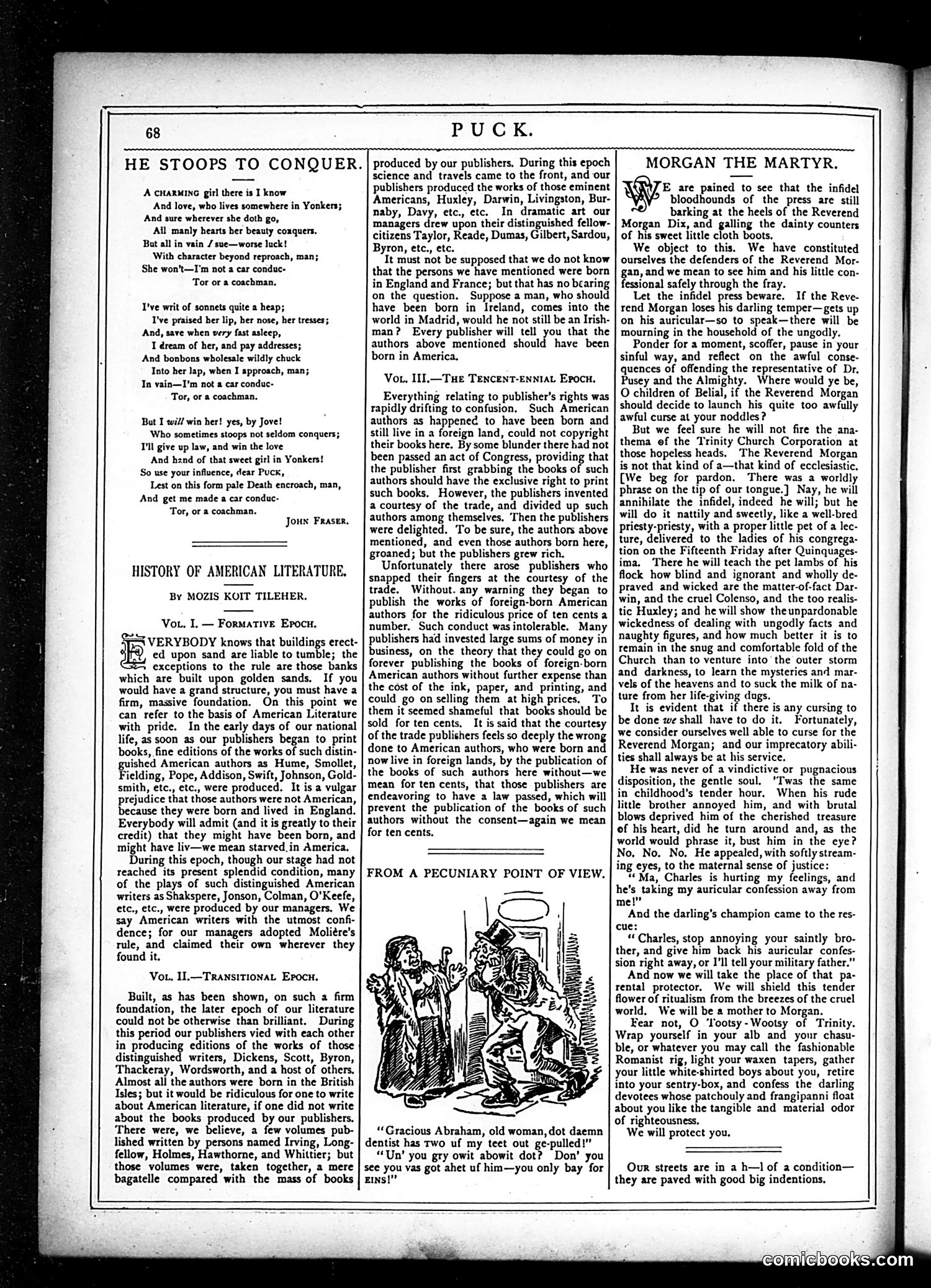
The page contains satirical articles rather than traditional political cartoons. The main content includes: 1. **"He Stoops to Conquer"** — A poem likely mocking someone's descent into compromising behavior, with references to Irish identity ("Yankers," "girl in Yankers"). 2. **"History of American Literature"** — A lengthy essay by Mozis Kott Tilieher critiquing American publishing practices. It discusses how foreign-born authors faced copyright issues and how American publishers exploited these authors' works, reprinting them without compensation. 3. **A small cartoon** shows two figures in what appears to be a confrontational scene, with dialogue about teeth and religious matters ("Gracious Abraham..."), likely satirizing class or religious tensions. The page's primary focus is institutional critique of American publishing's exploitative practices toward foreign writers rather than partisan politics.
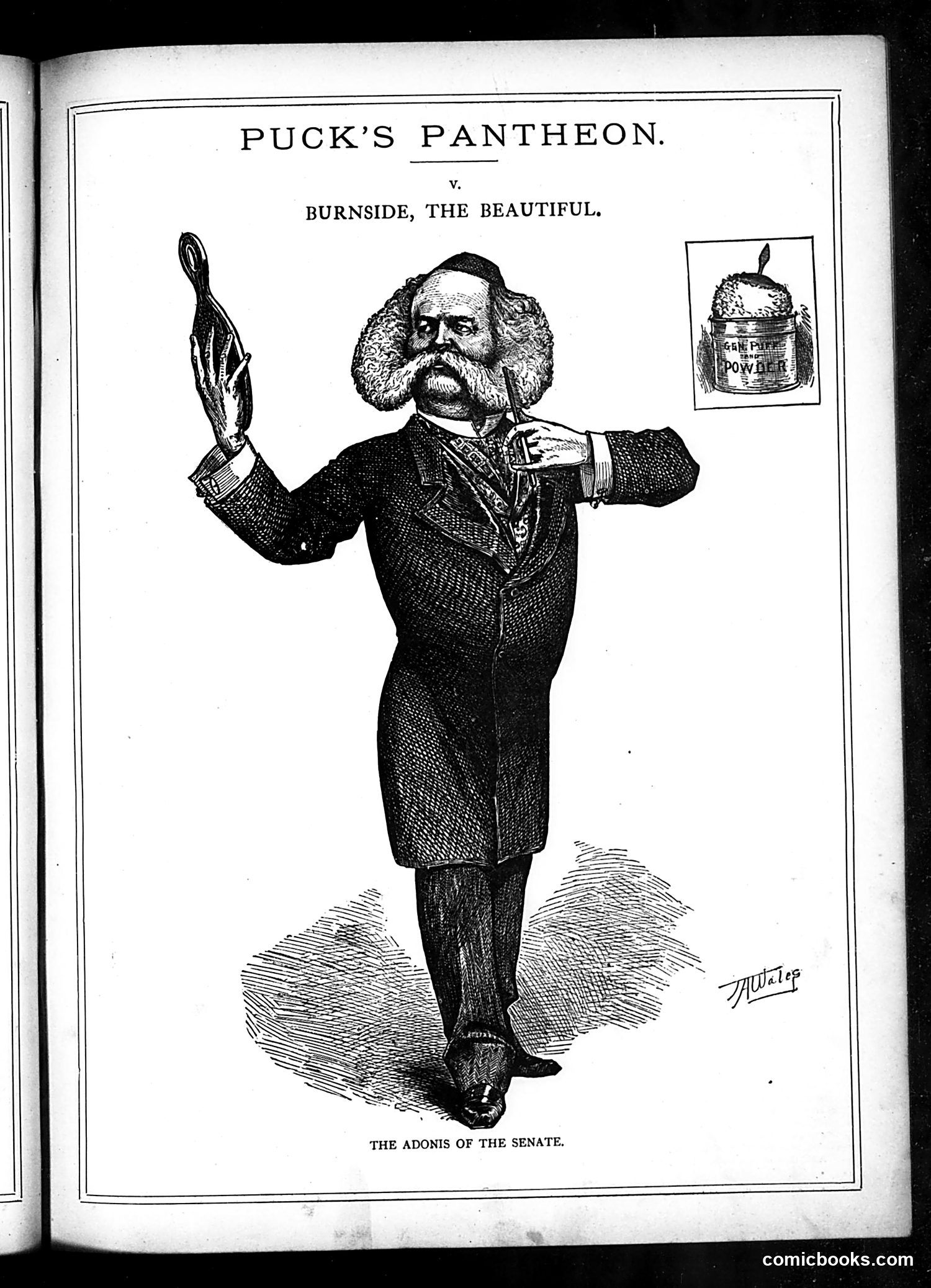
This is a satirical cartoon from Puck magazine depicting a portly man in formal dress labeled "The Adonis of the Senate." The figure holds a feather fan in one hand and appears to be brandishing a powder container in the other, with an inset showing a cosmetics jar. The satire targets a senator (likely from the late 19th century based on style), mocking him as vain and effeminate by associating him with beauty products and feminine grooming. "Burnside, the Beautiful" in the title suggests the subject concerns appearance over substance. The "Adonis" reference ironically compares the figure to classical ideals of masculine beauty, thereby ridiculing him for prioritizing vanity and personal grooming over serious senatorial duties.
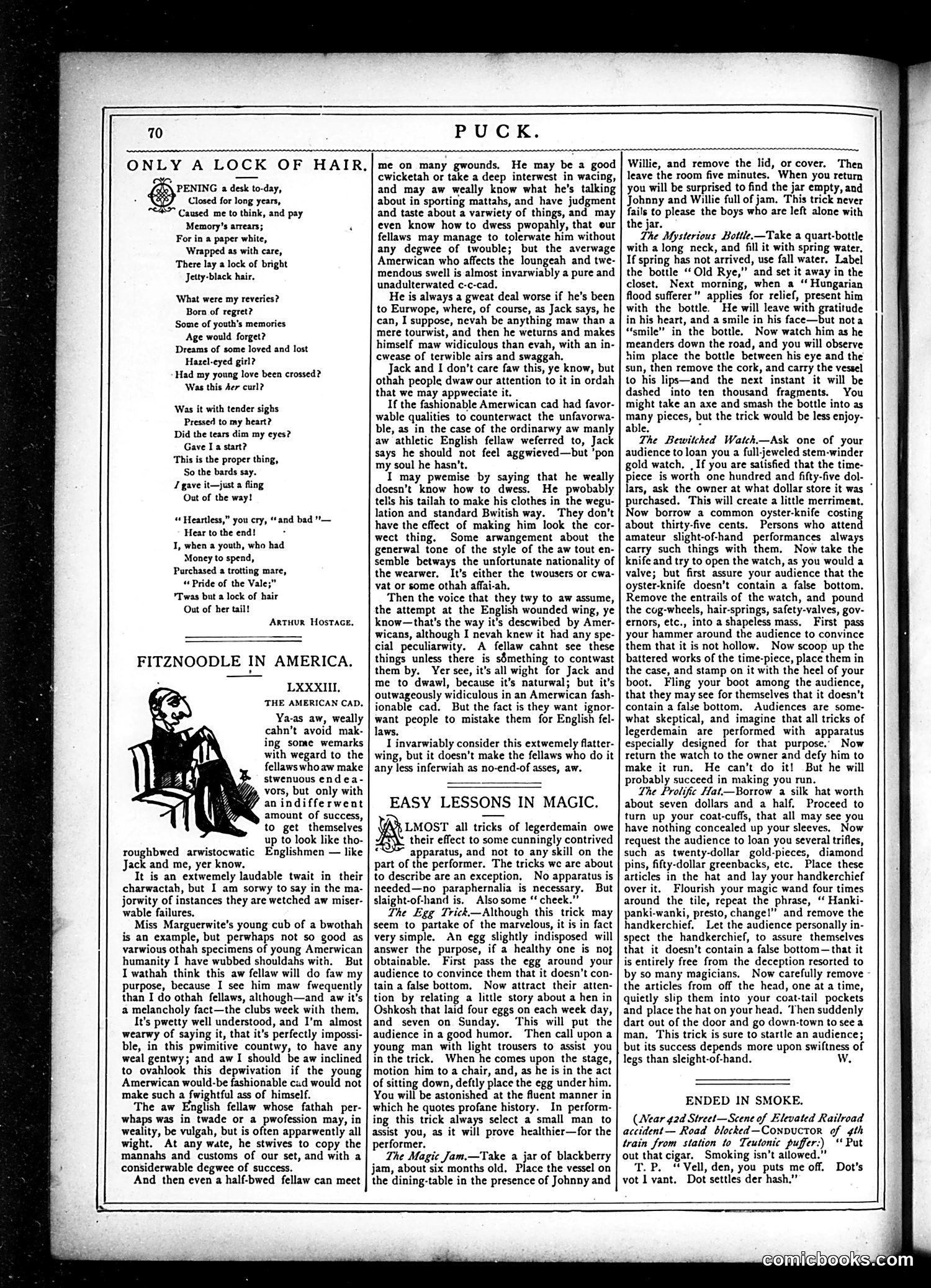
This page contains three distinct articles rather than political cartoons: 1. **"Only a Lock of Hair"** — A sentimental poem about cherished keepsakes and memories. 2. **"Fitznoodle in America"** — A satirical piece mocking the pretensions of an aristocratic English visitor ("The American Cad"). The text ridicules his affected mannerisms, his disdain for American style, and his inability to appreciate American culture. The accompanying caricature shows a pompous, elongated-faced figure embodying these stereotypes. 3. **"Easy Lessons in Magic"** — Instructions for simple parlor tricks and sleight-of-hand performances, including egg tricks and a blackberry jam illusion. The satire targets British snobbery toward American customs and social conventions of the era.
This page features a satirical piece attacking Brooklyn religious and civic institutions. The main cartoon (right column) depicts Brooklyn's churches and charitable organizations as hypocritical—they preach virtue while allegedly enabling moral corruption. The text criticizes prominent Brooklyn figures, particularly targeting those who claim moral superiority while allegedly participating in or tolerating vice and exploitation. References to "Hunter's Point" and specific streets suggest real locations where social problems persisted despite the area's respectable reputation. The satire's core point: Brooklyn's establishment institutions profess righteousness but fail to genuinely address poverty, exploitation, and moral failings within their community. The "Devil's Court" title suggests these institutions unwittingly serve evil through their hypocrisy and inaction rather than their stated charitable missions.
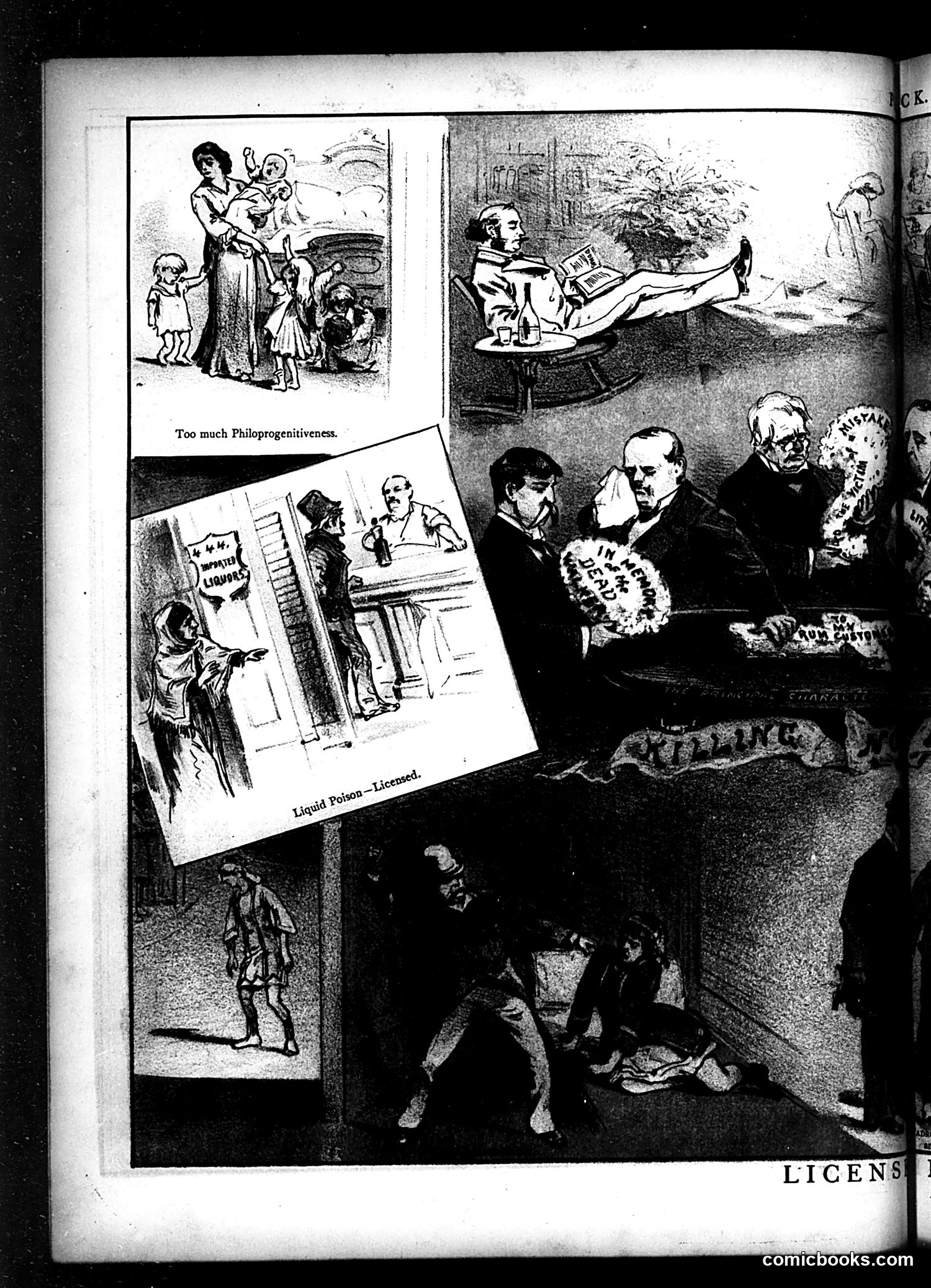
This page contains two distinct satirical cartoons about licensing and regulation. The upper left cartoon, titled "Too much Philoprogenitiveness," depicts a woman with multiple children, satirizing excessive childbearing. The central cartoon, "Liquid Poison—Licensed," shows what appears to be a critique of alcohol regulation. It depicts men examining or distributing bottles, suggesting satire about government licensing of alcohol sales—likely commentary on how official licensing legitimizes a harmful substance the cartoonist considers "poison." The right panel shows well-dressed men (possibly politicians or officials) gathered around, apparently approving or profiting from these licensed products, implying corruption or hypocrisy in the regulatory system. The bottom figure appears separate, possibly an unrelated illustration or advertisement. The overall message critiques how government licensing can legitimize potentially harmful practices or substances through official sanction.
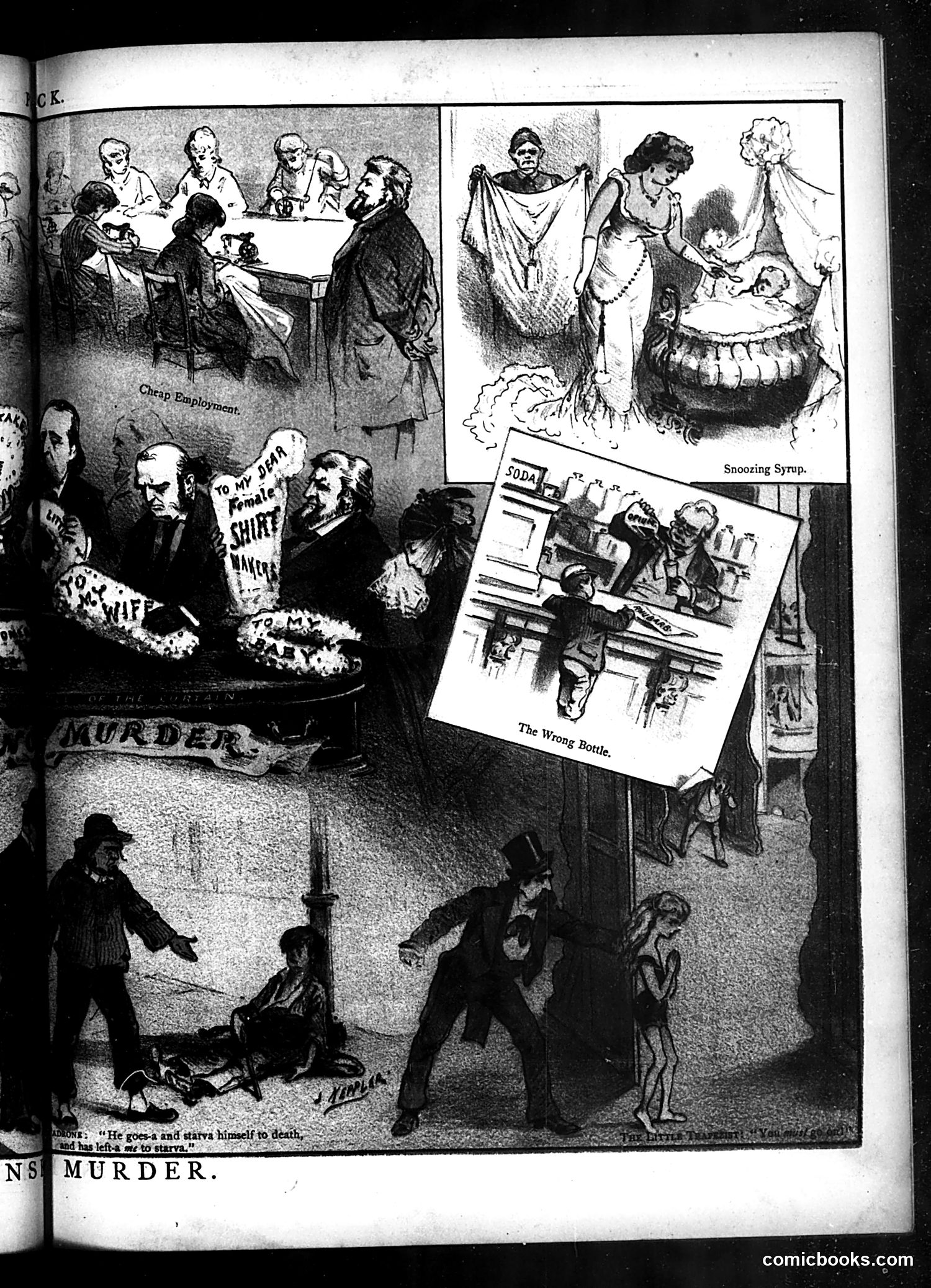
This page contains satirical illustrations addressing **child labor and product safety** in late 19th/early 20th-century America. **"Cheap Employment"** (top left) depicts children working in exploitative conditions—a social reform issue Puck frequently highlighted. **"Snoozing Syrup"** (top right) shows an infant being drugged, likely satirizing patent medicines and syrups marketed to children that contained dangerous substances like opium or laudanum. **"The Wrong Bottle"** (center) appears to reference accidental poisoning—a recurring hazard when toxic substances weren't properly labeled. **"Murder"** (bottom) presents a street scene suggesting neglect or violence toward children. Collectively, these cartoons critique inadequate worker protections, dangerous consumer products, and child welfare failures, using dark humor typical of Puck's muckraking approach to social issues.
This page from *Puck* consists primarily of diplomatic correspondence rather than cartoons. The content focuses on an "alleged affront" to U.S. Minister Welsh by the British government. The dispatches detail a controversy over Welsh not being invited to the wedding breakfast of the Royal Highness (likely a British royal), which the U.S. Minister interpreted as a diplomatic slight. Secretary of State Evarts forwards complaints and requests explanation from British officials. The bottom section shifts to theater reviews, praising productions like "Lord Chumley" and "Fatanitza." This is essentially a satirical news section using mock-serious diplomatic language to mock the fussy etiquette and international protocol disputes of the era—poking fun at how seriously nations took minor social slights.
This page contains the continuation of a serialized story titled "Blood and Thunder" by Richard Downing, set in Belgrasia. The text describes labor organizing activities in London, focusing on a character named Michael Grame and his involvement with workers' associations. The narrative involves domestic drama—Grame's wife anxiously awaits his return during dangerous labor negotiations, while his sister-in-law Helen visits, creating family tension. The story depicts working-class struggles of the period, with references to organizing meetings and discussions of labor rights. This appears to be fictional serialized literature rather than political satire or cartooning. The page showcases Puck's use of long-form narrative fiction alongside its better-known satirical illustrations.
This page contains primarily text articles and verse rather than political cartoons. The main content includes: **"Puck's Brialmess"** — a humorous verse section by C. Zacharie, featuring satirical commentary on American social issues. One piece mocks newspaper editors and their pretensions to wisdom. **Michael Grame narrative** — a lengthy story (appearing to continue from a previous issue) depicting a wealthy industrialist navigating London society, making business decisions, and dealing with domestic tensions. The narrative suggests social commentary on class, labor disputes, and industrial power. The text references labor unrest, police surveillance of activists, and class conflict—typical Progressive Era concerns when Puck published satirical critiques of wealthy industrialists and labor politics. No clear caricatures or identified political figures are visible in the image itself.
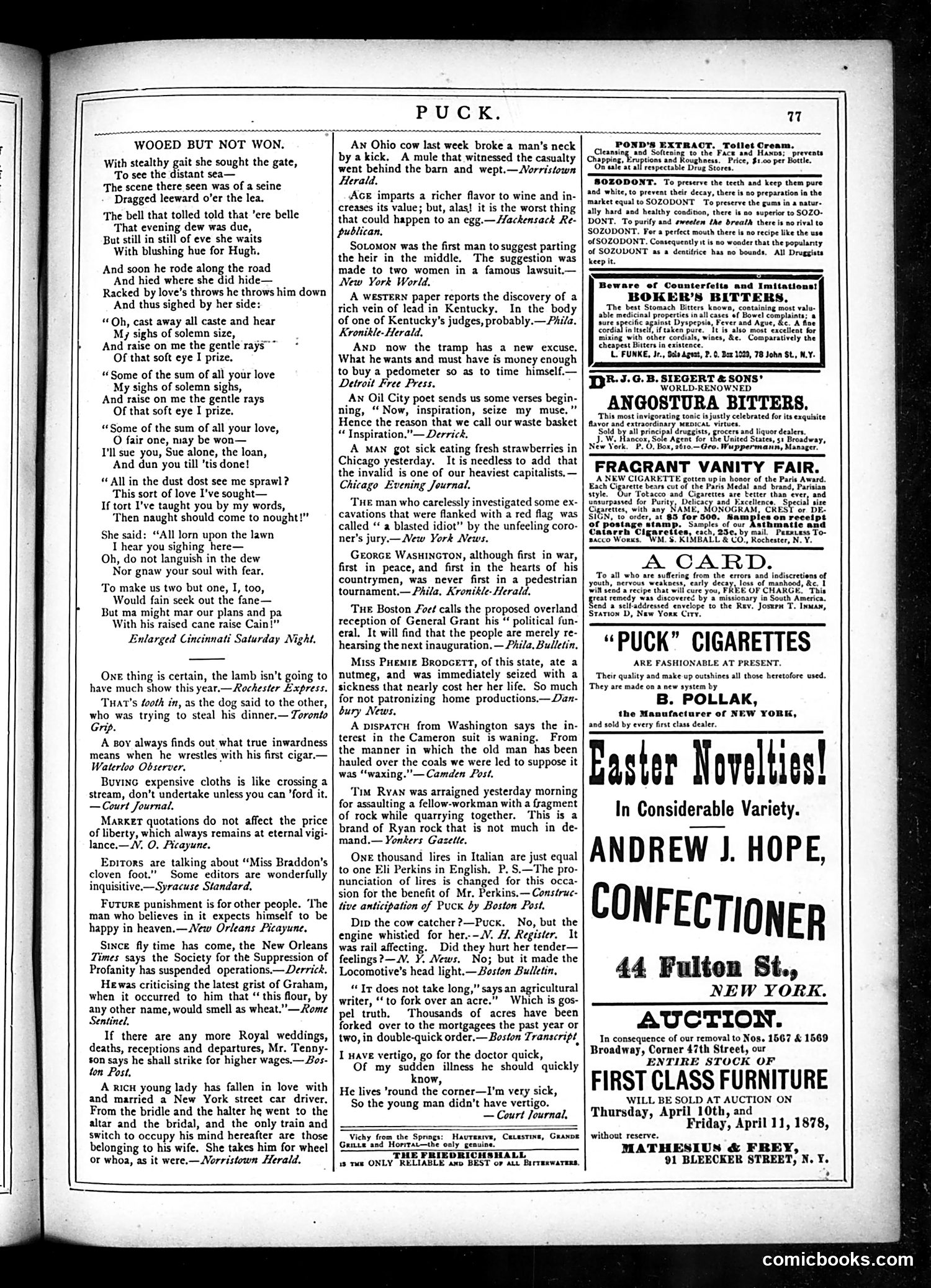
This page is primarily **advertisements and miscellaneous content** rather than political cartoons. The visible text includes: - A poem titled "Wooed But Not Won" - Various brief humorous items sourced from newspapers (about a mule, lead discovery in Kentucky, a tramp's excuse) - Multiple advertisements for products like Sozodont toothpaste, Angostura Bitters, and Puck Cigarettes - An auction notice for furniture - A confectioner's advertisement **No clear political cartoons or caricatures are visible** on this page. It represents a typical late 19th-century magazine layout mixing satirical text snippets with commercial advertisements—the business model that supported publications like Puck.
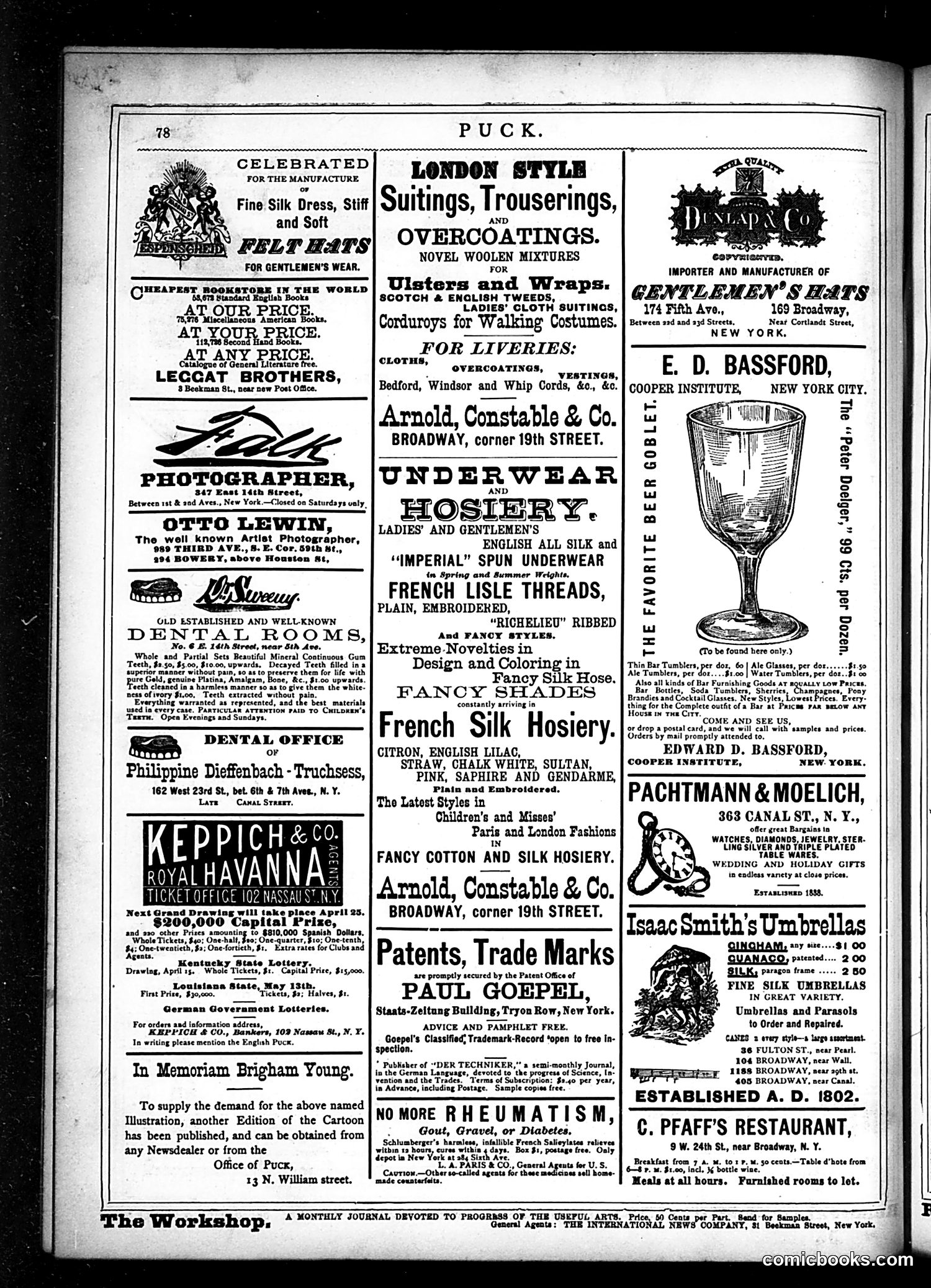
This page is **primarily advertising**, not editorial content or satire. It contains numerous late 19th-century commercial advertisements for: - Clothing manufacturers (Arnold, Constable & Co.; London Style Suitings) - Haberdashery and accessories (Dunlap & Co. hats; hosiery) - Luxury goods (Pachtmann & Moelich silver plate; Isaac Smith's umbrellas) - Services (photographer; dentist; restaurants) - Lottery and gambling services (Kentucky State Lottery; German Government Lotteries) The only non-commercial content is a brief notice about "In Memoriam Brigham Young" and a reference to a cartoon reprinting service, but these occupy minimal space. **No political satire or cartoon commentary is visible on this page**—it functions as Puck's advertising section rather than its editorial or humor content.
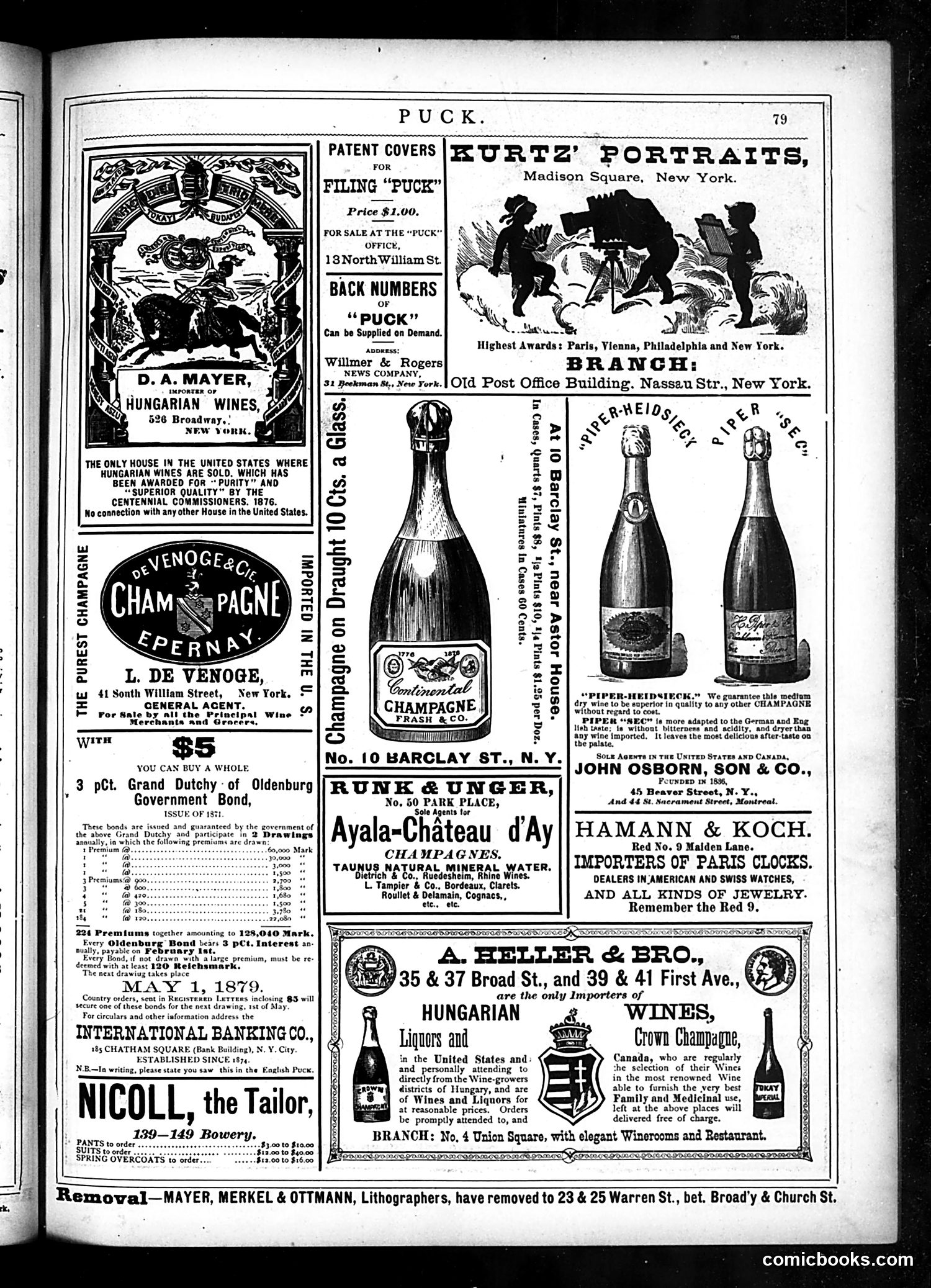
This is primarily an **advertisement page** (page 79) rather than a satirical cartoon. It features various commercial ads from 1879, including: - **Hungarian wines** by D.A. Mayer (Broadway, NY) - **Champagne** brands (Vevenoge, Ayala-Château d'Ay, Runk & Unger) - **Kurtz's Portraits** photography studio in Madison Square - Watches and jewelry from Hamann & Koch - A tailor service (Nicoll) and wine merchant (Heller & Bros.) The only notable satirical element is **Kurtz's Portraits advertisement**, which shows silhouettes of photographers with their equipment, likely poking gentle fun at the photography profession's pretensions. Most content reflects New York's merchant class and upscale consumer goods typical of Puck's affluent readership.
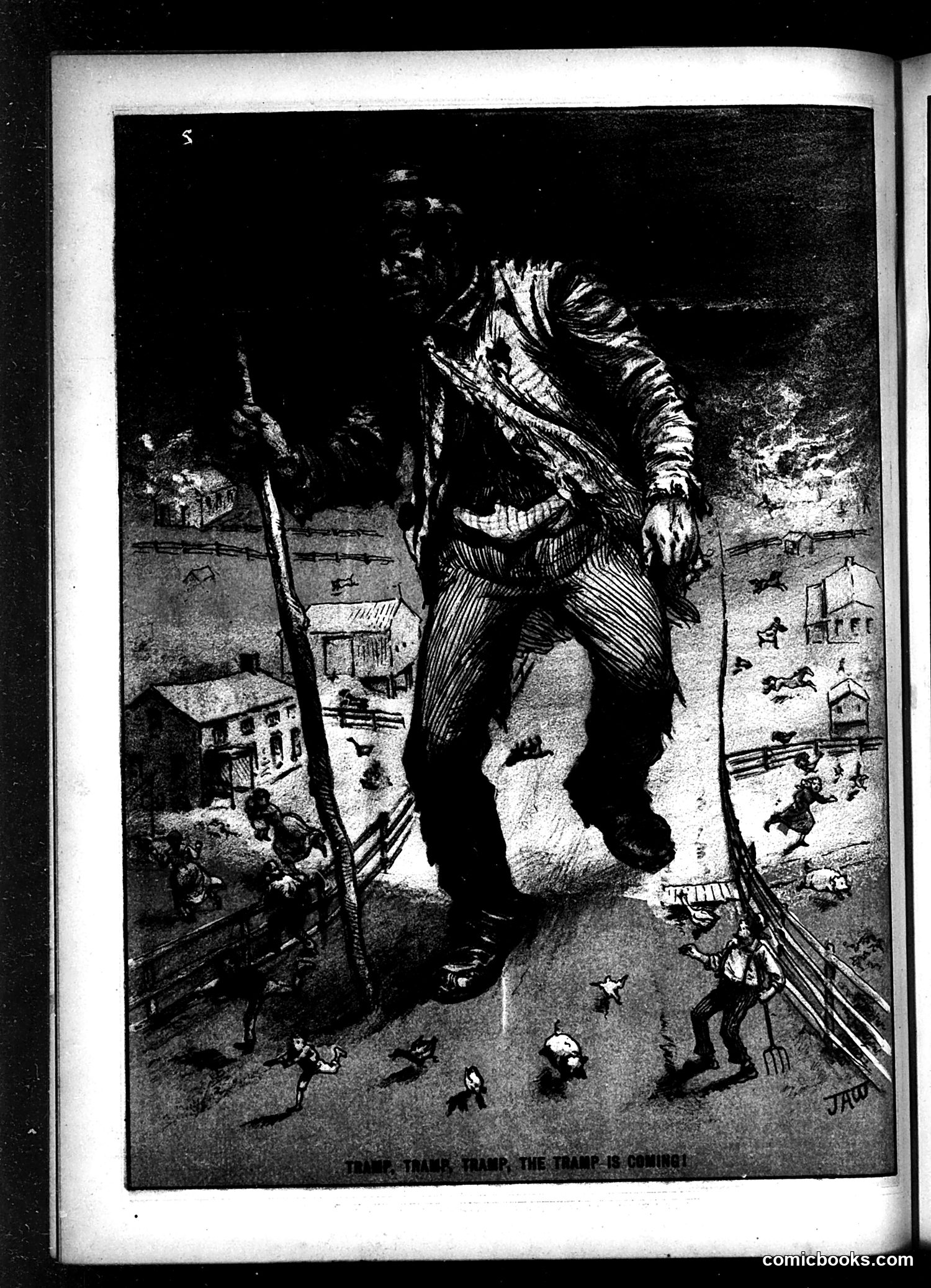
This Puck cartoon depicts a giant figure striding over a rural American landscape, with tiny people fleeing below. The caption reads "THUMP-THUMP-THUMP; THE TRAMP IS COMING!" The imagery suggests a commentary on anxiety about an itinerant or threatening figure—likely referencing fears about "tramps" (homeless wanderers) that were common anxieties in late 19th-century America. The giant's menacing scale and the panicked villagers below suggest the cartoon satirizes exaggerated public fears about vagrancy or social disorder. The rural setting with farms and fences emphasizes the threat to pastoral American life. Without a visible date or clearer identifying details, the specific historical event or person referenced remains unclear, though this reflects period anxieties about economic displacement and social instability.