
Puck, 1879-04-09 · page 3 of 16
Puck — April 9, 1879 — page 3: what you’re looking at
What you’re looking at
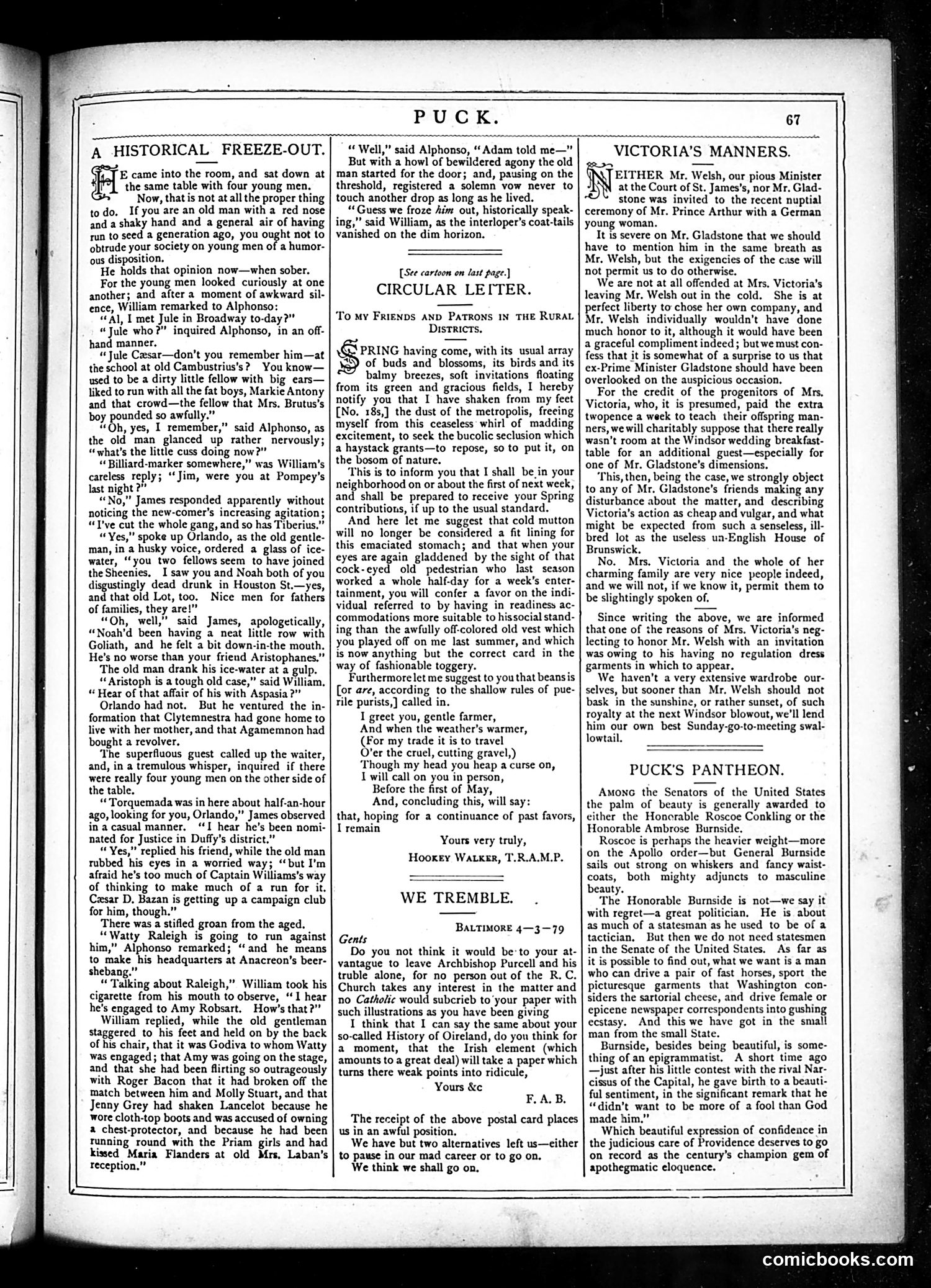
This page contains three distinct sections of satirical commentary rather than illustrated cartoons: 1. **"A Historical Freeze-Out"** mocks social dynamics among young men, using dialogue to satirize pretentious behavior and changing friendships. 2. **"Victoria's Manners"** attacks Mr. Gladstone (the British Prime Minister) and Mrs. Victoria for their allegedly rude treatment of Mr. Welsh, a visiting dignitary. The satire criticizes them for making an uninvited guest uncomfortable—suggesting their behavior was cheap and vulgar rather than befitting their station. 3. **"Puck's Pantheon"** humorously compares Senator Roscoe Conkling to General Burnside, praising Conkling's eloquence while mocking his vanity about his appearance. The page relies on textual satire rather than visual caricature to deliver its political and social commentary.
📄 Transcribed text from this page (OCR, searchable)
Machine-transcribed from the original scan — historical spelling and the odd misread are preserved.
67 A HISTORICAL FREEZE-OUT. E came into the room, and sat down at the same table with four young men. Now, that is not at all the proper thing todo. Ifyou are an old man with a red nose and a shaky hand and a general air of having run to seed a generation ago, you ought not to obtrude your society on young men of a humor- ous disposition. He holds that opinion now—when sober. For the young men looked curiously at one another; and after a moment of awkward sil- ence, William remarked to Alphonso: «Al, I met Jule in Broadway to-day?” “Jule who?” inquired Alphonso, in an off- hand manner. «Jule Cxsar—don't you remember him—at the school at old Cambustrius’s? You know— used to be a dirty little fellow with big ears— liked to run with all the fat boys, Markie Antony and that crowd—the fellow that Mrs. Brutus’s boy pounded so awfully.” “Oh, yes, I remember,” said Alphonso, as the old man glanced up rather nervously; “what's the little cuss doing now?” “Billiard-marker somewhere,” was William's careless reply; ‘‘Jim, were you at Pompey’s last night ?”” “No,” James responded apparently without noticing the new-comer’s increasing agitation; “T’ve cut the whole gang, and so has Tiberius.” “Yes,” spoke up Orlando, as the old gentle- man, ina husky voice, ordered a glass of ice- water, ‘you two fellows seem to have joined theSheenies, I saw you and Noah both of you disgustingly dead drunk in Houston St.—yes, and that old Lot, too. Nice men for fathers of families, they are!” “Oh, well,” said James, apologetically, “Noah'd been having a neat little row with Goliath, and he felt a bit down-in-the mouth, He's no worse than your friend Aristophanes.” The old man drank his ice-water at a gulp. “ Aristoph is a tough old case,” said William, “ Hear of that affair of his with Aspasia ?” Orlando had not. But he ventured the in- formation that Clytemnestra had gone home to live with her mother, and that Agamemnon had bought a revolver. ‘The superfluous guest called up the waiter, and, in a tremulous whisper, inquired if there were really four young men on the other side of the table. “ Torquemada was in here about half-an-hour ago, looking for you, Orlando,” James observed ina casual manner. “I hear he's been nomi- nated for Justice in Duffy's district.” “Yes,” replied his friend, while the old man rubbed his eyes in a worried way; “but I'm afraid he’s too much of Captain Williams's way of thinking to make much of a run for it. Cesar D. Bazan is getting up a campaign club for him, though.” There was a stifled groan from the aged. “Watty Raleigh is going to run against him,” Alphonso remarked; ‘and he means to make his headquarters at Anacreon's beer- shebang.” “ Talking about Raleigh,” William took his cigarette from his mouth to observe, “1 hear he’s engaged to Amy Robsart. How’s that?” William replied, while the old gentleman Staggered to his feet and held on by the back of his chair, that it was Godiva to whom Watty was engaged ; that Amy was going on the stage, and that she had been flirting so outrageously with Roger Bacon that it had broken off the match between him and Molly Stuart, and that Jenny Grey had shaken Lancelot because he wore cloth-top boots and was accused of owning a chest-protector, and because he had been Tunning round with the Priam girls and had kissed Maria Flanders at old Mrs, Laban’s reception,” — “Well,” said Alphonso, ‘Adam told me—” But with a howl of bewildered agony the old man started for the door; and, pausing on the threshold, registered a solemn vow never to touch another drop as long as he lived. “Guess we froze him out, historically speak- ing,” said William, as the interloper’s coat-tails vanished on the dim horizon. [See cartoon on last page. CIRCULAR LEITER. To My FRIENDS AND PATRONS IN THE RURAL Districts. PRING having come, with its usual array of buds and blossoms, its birds and its balmy breezes, soft invitations floating from its green and gracious fields, I hereby notify you that I have shaken from my feet [No. 18s,] the dust of the metropolis, freeing myself from this ceaseless whirl of madding excitement, to seek the bucolic seclusion which a haystack grants—to repose, so to put it, on the bosom of nature, This is to inform you that I shall bein your neighborhood on or about the first of next week, and shall be prepared to receive your Spring contributions, if up to the usual standard. And here let me suggest that cold mutton will no longer be considered a fit lining for this emaciated stomach; and that when your eyes are again gladdened by the sight of that cock-eyed old pedestrian who last season worked a whole half-day for a week's enter- tainment, you will confer a favor on the indi- vidual referred to by having in readiness ac- commodations more suitable to hissocial stand- ing than the awfully off-colored old vest which you played off on me last summer, and which is now anything but the correct card in the way of fashionable toggery. Furthermore let me suggest to you that beansis [or are, according to the shallow rules of pue- rile purists,] called in. I greet you, gentle farmer, And when the weather's warmer, (For my trade it is to travel O’er the cruel, cutting gravel,) ‘Though my head you heap a curse on, I will call on you in person, Before the first of May, And, concluding this, will say: that, hoping for a continuance of past favors, T remain Yours very truly, Hooxey Watker, T.R.A.M.P. WE TREMBLE. BALTIMORE 4—3—79 Gents Do you not think it would be-to your at- vantague to leave Archbishop Purcell and his truble alone, for no person out of the R.C. Church takes any interest in the matter and no Catholic would subcrieb to'your paper with such illustrations as you have been giving I think that I can say the same about your so-called History of Oireland, do you think for a moment, that the Irish element (which amounts to a great deal) will take a paper which turns there weak points into ridicule, Yours &c FLA. B. The receipt of the above postal card places us in an awful position. We have but two alternatives left us—either to pause in our mad career or to go on. We think we shall go on, VICTORIA'S MANNERS. A] EITHER Mr. Welsh, our pious Minister at the Court of St. James’s, nor Mr, Glad- stone was invited to the recent nuptial ceremony of Mr. Prince Arthur with a German young woman. It is severe on Mr, Gladstone that we should have to mention him in the same breath as Mr, Welsh, but the exigencies of the case will not permit us to do otherwise. We are not at all offended at Mrs. Victoria’s leaving Mr. Welsh out in the cold. She is at perfect liberty to chose her own company, and Mr. Welsh individually wouldn't have done much honor to it, although it would have been a graceful compliment indeed ; but we must con- fess that it is somewhat of a surprise to us that ex-Prime Minister Gladstone should have been overlooked on the auspicious occasion, For the credit of the progenitors of Mrs, Victoria, who, it is presumed, paid the extra twopence a week to teach their offspring man- ners, we will charitably suppose that there really wasn’t room at the Windsor wedding breakfast- table for an additional guest—especially for one of Mr. Gladstone's dimensions, ‘This, then, being the case, we strongly object to any of Mr. Gladstone's friends making any disturbance about the matter, and describing Victoria's action as cheap and vulgar, and what might be expected from such a senseless, ill- bred lot as the useless un-English House of Brunswick. No. Mrs. Victoria and the whole of her charming family are very nice people indeed, and we will not, if we know it, permit them to be slightingly spoken of. Since writing the above, we are informed that one of the reasons of Mrs. Victoria’s neg- lecting to honor Mr. Welsh with an invitation was owing to his having no regulation dress garments in which to appear. We haven't a very extensive wardrobe our- selves, but sooner than Mr. Welsh should not bask in the sunshine, or rather sunset, of such royalty at the next Windsor blowout, we'll lend him our own best Sunday-go-to-meeting swal- lowtail. PUCK’S PANTHEON. Amono the Senators of the United States the palm of beauty is generally awarded to either the Honorable Roscoe Conkling or the Honorable Ambrose Burnside. Roscoe is perhaps the heavier weight—more on the Apollo order—but General Burnside sails out strong on whiskers and fancy waist- coats, both mighty adjuncts to masculine beauty. The Honorable Burnside is not—we say it with regret—a great politician, He is about as much of a statesman as he used to be of a tactician, But then we do not need statesmen in the Senate of the United States. As far as it is possible to find out, what we want is a man who can drive a pair of fast horses, sport the picturesque garments that Washington con- siders the sartorial cheese, and drive female or epicene newspaper correspondents into gushing ecstasy. And this we have got in the small man from the small State. Burnside, besides being beautiful, is some- thing of an epigrammatist. A short time ago —just after his little contest with the rival Nar- cissus of the Capital, he gave birth to a beauti- ful sentiment, in the significant remark that he “didn’t want to be more of a fool than God made him.” Which beautiful expression of confidence in the judicious care of Providence deserves to go ‘on record as the century’s champion gem of apothegmatic eloquence. | Se pa RTI IESE comicbooks.com