
Puck, 1879-04-09 · page 4 of 16
Puck — April 9, 1879 — page 4: what you’re looking at
What you’re looking at
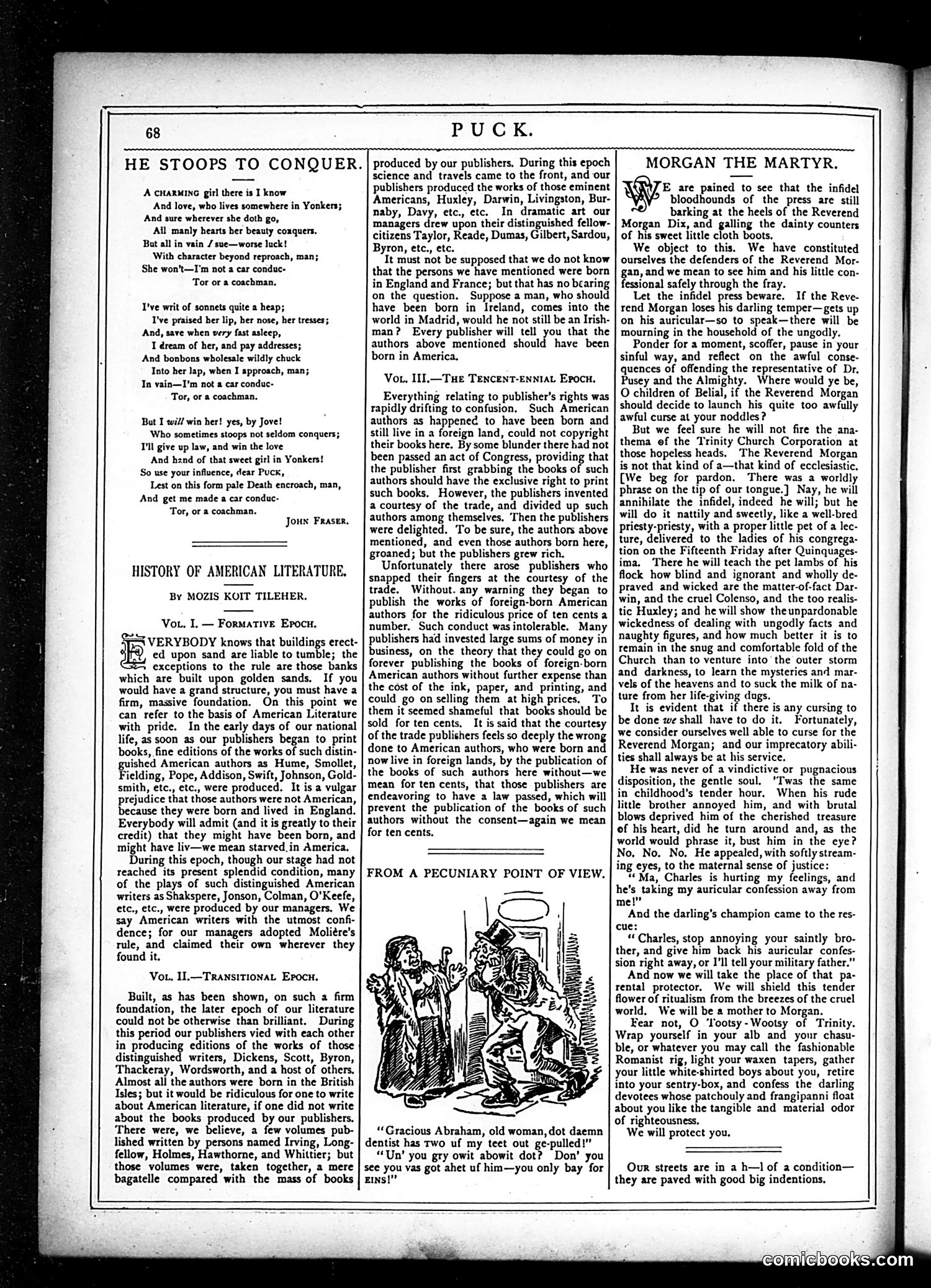
The page contains satirical articles rather than traditional political cartoons. The main content includes: 1. **"He Stoops to Conquer"** — A poem likely mocking someone's descent into compromising behavior, with references to Irish identity ("Yankers," "girl in Yankers"). 2. **"History of American Literature"** — A lengthy essay by Mozis Kott Tilieher critiquing American publishing practices. It discusses how foreign-born authors faced copyright issues and how American publishers exploited these authors' works, reprinting them without compensation. 3. **A small cartoon** shows two figures in what appears to be a confrontational scene, with dialogue about teeth and religious matters ("Gracious Abraham..."), likely satirizing class or religious tensions. The page's primary focus is institutional critique of American publishing's exploitative practices toward foreign writers rather than partisan politics.
📄 Transcribed text from this page (OCR, searchable)
Machine-transcribed from the original scan — historical spelling and the odd misread are preserved.
68 PUCK. HE STOOPS TO CONQUER. A CHARMING girl there is I know And love, who lives somewhere in Yonkers; And sure wherever she doth go, Ail manly hearts her beauty coaquers. But all in vain / sue—worse luck! With character beyond reproach, man; She wont—I'm not a car conduc- Tor or a coachman. D've writ of sonnets quite a heap; I've praised her lip, her nose, her tresses; And, save when very fast asleep, I dream of her, and pay addresses; And bonbons wholesale wildly chuck Into her lap, when I approach, man; In vain—I’m not a car conduc- Tor, or a coachman, But I toil! win her! yes, by Jove! ‘Who sometimes stoops not seldom conquers; Tl give up law, and win the love And hand of that sweet girl in Yonkers! So use your influence, dear Puck, Lest on this form pale Death encroach, man, ‘And get me made a car conduc- Tor, or a coachman. Joux Fraser. HISTORY OF AMERICAN LITERATURE, By MOZIS KOIT TILEHER. Vor. I. — Formative Epocu. eee knows that buildin erect- ed upon sand are liable to tumble; the exceptions to the rule are those banks which are built upon golden sands. If you would have a grand structure, you must have a firm, massive foundation. On this point we can refer to the basis of American Literature with pride. In the early days of our national life, as soon as our publishers began to print books, fine editions of the works of such distin- guished American authors as Hume, Smollet, Fielding, Pope, Addison, Swift, Johnson, Gold- smith, ete., etc., were produced, It is a vulgar prejudice that those authors were not American, because they were born and lived in England. Everybody will admit (and it is greatly to their credit) that they might have been born, and might have liv—we mean starved.in America, During this epoch, though our stage had not reached its present splendid condition, many of the plays of such distinguished American writers as Shakspere, Jonson, Colman, O'Keefe, ete., etc., were produced by our managers, We say American writers with the utmost confi- dence; for our managers adopted Moliére’s tule, and claimed their own wherever they found it. Vot. II.—Transitionat Epocu. Built, as has been shown, on such a firm foundation, the later epoch of our literature could not be otherwise than brilliant. During this period our publishers vied with each other in Producing editions of the works of those distinguished writers, Dickens, Scott, Byron, Thackeray, Wordsworth, and a host of others. Almost all the authors were born in the British Isles; but it would be ridiculous for one to write about American literature, if one did not write about the books produced by our publishers. There were, we believe, a few volumes pub- lished written by persons named Irving, Long- fellow, Holmes, Hawthorne, and Whittier; but those volumes were, taken together, a mere bagatelle compared with the mass of books T produced by our publishers. During this epoch science and travels came to the front, and our publishers produced the works of those eminent Americans, Huxley, Darwin, Livingston, Bur- naby, Davy, etc., etc. In dramatic art our managers drew upon their distingui: citizens Taylor, Reade, Dumas, Gilbert, Sardou, Byron, ete., etc. It must not be supposed that we do not know that the persons we have mentioned were born in England and France; but that has no bearing on the question. Suppose a man, who should have been born in Ireland, comes into the world in Madrid, would he not still be an Irish- man? Every publisher will tell you that the authors above mentioned should have been born in America. Vot, II.—Tue TENCENT-ENNIAL Epocu, Everything relating to publisher’s rights was rapidly drifting to confusion, Such American authors as happened to have been born and still live in a foreign land, could not copyright their books here. By some blunder there had not been passed an act of Congress, providing that the publisher first grabbing the books of such authors should have the exclusive right to print such books. However, the publishers invented a courtesy of the trade, and divided up such authors among themselves, Then the publishers were delighted. To be sure, the authors above mentioned, and even those authors born here, groaned; but the publishers grew rich. Unfortunately there arose publishers who snapped their fingers at the courtesy of the trade. Without. any warning they began to publish the works of foreign-born American authors for the ridiculous price of ten cents a number. Such conduct was intolerable. Many publishers had invested large sums of money in business, on the theory that they could go on forever publishing the books of foreign-born American authors without further expense than the cost of the ink, paper, and printing, and could go on selling them at high prices. To them it seemed shameful that books should be sold for ten cents, It is said that the courtesy of the trade publishers feels so deeply the wrong done to American authors, who were born and now live in foreign lands, by the publication of the books of such authors here without—we mean for ten cents, that those publishers are endeavoring to have a law passed, which will prevent the publication of the books of such authors without the consent—again we mean for ten cents. FROM A PECUNIARY POINT OF VIEW. “Gracious Abraham, old woman, dot daemn dentist has Two uf my teet out ge-pulled!” “Un’ you gry owit abowit dot? Don’ you see you vas got ahet uf him—you only bay for zins!"” MORGAN THE MARTYR. E are pained to see that the infidel bloodhounds of the press are still barking at the heels of the Reverend Morgan Dix, and galling the dainty counters of his sweet little cloth boots, We object to this. We have constituted ourselves the defenders of the Reverend Mor- an, and we mean to see him and his little con- fessional safely through the fray. Let the infidel press beware. If the Reve- rend Morgan loses his darling temper—gets up on his auricular—so to speak—there will be mourning in the household of the ungodly. Ponder for a moment, scoffer, pause in your sinful way, and reflect on the awful conse- quences of offending the representative of Dr. Pusey and the Almighty. Where would ye be, O children of Belial, if the Reverend Morgan should decide to launch his quite too awfully awful curse at your noddles? But we feel sure he will not fire the ana- thema of the Trinity Church Corporation at those hopeless heads, The Reverend Morgan is not that kind of a—that kind of ecclesiastic. [We beg for pardon. There was a worldly phrase on the tip of our tongue.] Nay, he will annihilate the infidel, indeed he will; but he will do it nattily and sweetly, like a well-bred priesty-priesty, with a proper little pet of a lec- ture, delivered to the ladies of his congrega- tion on the Fifteenth Friday after Quinquages- ima, There he will teach the pet lambs of his flock how blind and ignorant and wholly de- praved and wicked are the matter-of-fact Dar- win, and the cruel Colenso, and the too realis- tic Huxley; and he will show theunpardonable wickedness of dealing with ungodly facts and naughty figures, and how much better it is to remain in the snug and comfortable fold of the Church than to venture into the outer storm and darkness, to learn the mysteries and mar- vels of the heavens and to suck the milk of na- ture from her life-giving dogs. It is evident that if there is any cursing to be done we shall have to do it. Fortunately, we consider ourselves well able to curse for the Reverend Morgan; and our imprecatory abili- ties shall always be at his service. He was never of a vindictive or pugnacious disposition, the gentle soul. "Twas the same in childhood’s tender hour. When his rude little brother annoyed him, and with brutal blows deprived him of the cherished treasure of his heart, did he turn around and, as the world would phrase it, bust him in the eye? No, No. No, He appealed, with softly stream- ing eyes, to the maternal sense of justice: “Ma, Charles is hurting my feelings, and he’s taking my auricular confession away from me!” ‘And the darling’s champion came to the res- cue: “Charles, stop annoying your saintly bro- ther, and give him back his auricular confes- sion right away, or I'll tell your military father.” And now we will take the place of that pa- rental protector. We will shield this tender flower of ritualism from the breezes of the cruel world, We will be a mother to Morgan. Fear not, O ‘lootsy-Wootsy of Trinity. Wrap yourself in your alb and your chasu- ble, or whatever you may call the fashionable Romanist rig, light your waxen tapers, gather your little white-shirted boys about you, retire into your sentry-box, and confess the darling devotees whose patchouly and frangipanni float about you like the tangible and material odor of righteousness. We will protect you. Our streets are in a h—I of a condition— they are paved with good big indentions.