
Puck, 1879-04-09 · page 6 of 16
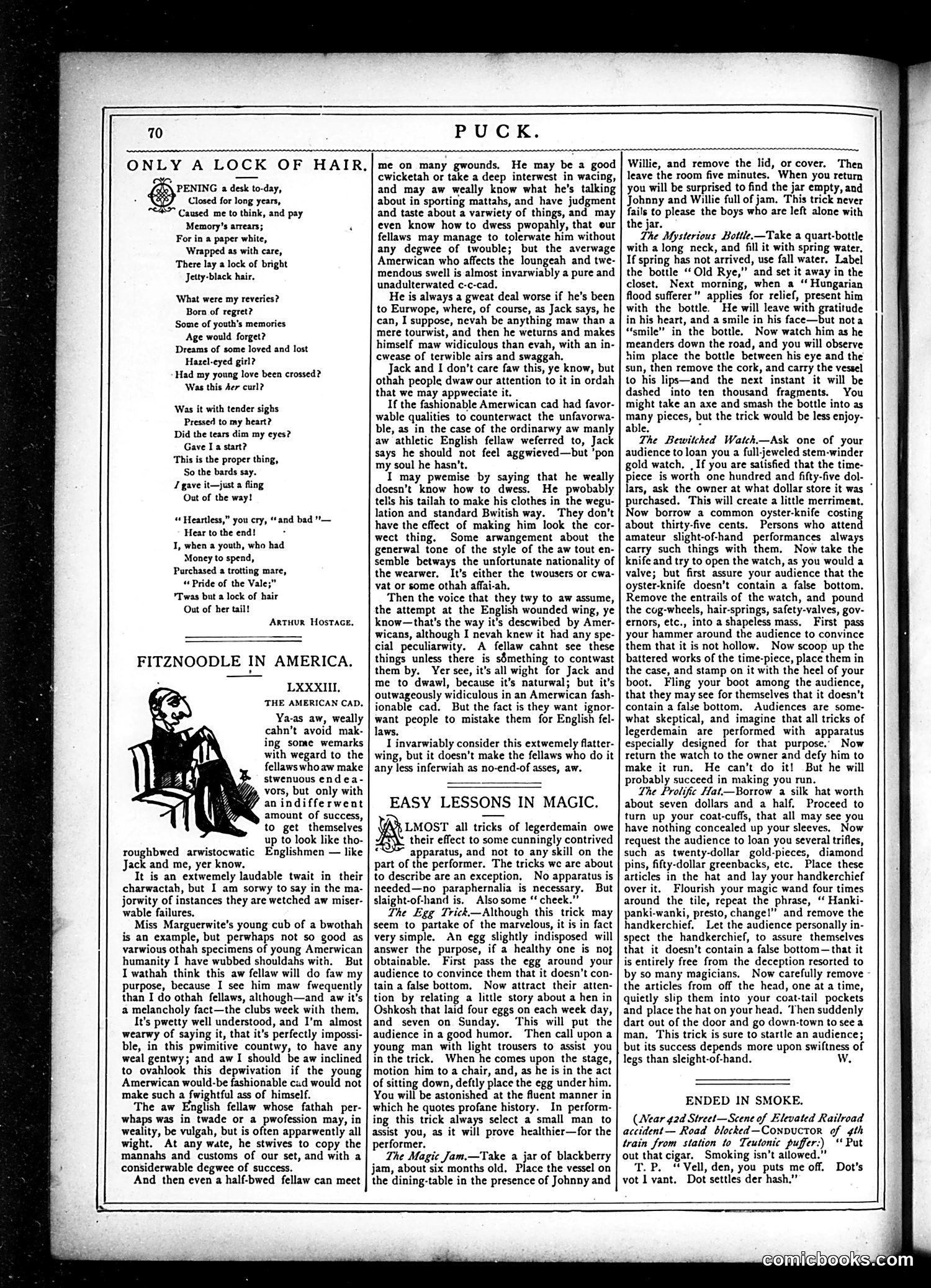
Puck — April 9, 1879 — page 6: what you’re looking at
What you’re looking at
This page contains three distinct articles rather than political cartoons: 1. **"Only a Lock of Hair"** — A sentimental poem about cherished keepsakes and memories. 2. **"Fitznoodle in America"** — A satirical piece mocking the pretensions of an aristocratic English visitor ("The American Cad"). The text ridicules his affected mannerisms, his disdain for American style, and his inability to appreciate American culture. The accompanying caricature shows a pompous, elongated-faced figure embodying these stereotypes. 3. **"Easy Lessons in Magic"** — Instructions for simple parlor tricks and sleight-of-hand performances, including egg tricks and a blackberry jam illusion. The satire targets British snobbery toward American customs and social conventions of the era.
📄 Transcribed text from this page (OCR, searchable)
Machine-transcribed from the original scan — historical spelling and the odd misread are preserved.
10 PUCK. ONLY A LOCK OF HAIR, \ PENING a desk to-day, Closed for long years, Caused me to think, and pay Memory’s arrears; For in a paper white, Wrapped as with care, There lay a lock of bright Jetty-black hair. ‘What were my reveries? Born of regret? Some of youth's memories Age would forget? Dreams of some loved and lost Hazel-eyed girl? Had my young love been crossed? ‘Was this Aer curl? Was it with tender sighs Pressed to my heart? Did the tears dim my eyes? Gave Ia start? ‘This is the proper thing, So the bards say. 7 gave it—just a fing Out of the way! “Heartless,” you ery, “and bad "— Hear to the end! I, when a youth, who had Money to spend, Parchased a trotting mare, «Pride of the Vale;” "Twas but a lock of hair Out of her tail! ArtHuR Hostace. FITZNOODLE IN AMERICA. LXXXIII. THE AMERICAN CAD. Ya-as aw, weally cabn’t avoid mak- ing some wemarks with wegard to the fellaws who aw make stwenuous endea- vors, but only with anindifferwent amount of success, to get themselves up to look like tho- roughbwed arwistocwatic Englishmen — like Jack and me, yer know. It is an extwemely laudable twait in their charwactah, but I am sorwy to say in the ma- jorwity of instances they are wetched aw miser- wable failures, Miss Marguerwite's young cub of a bwothah is an example, but perwhaps not so good as varwious othah specimens of young Amerwican humanity I have wubbed shouldahs with. But Iwathah think this aw fellaw will do faw my purpose, because I see him maw fwequently than I do othah fellaws, although—and aw it’s a melancholy fact—the clubs week with them, It's pwetty well understood, and I'm almost wearwy of saying it, that it’s perfectly impossi- ble, in this pwimitive countwy, to have any weal gentwy; and aw I should be aw inclined to ovahlook this depwivation if the young Amerwican would-be fashionable cud would not make such a fwightful ass of himself. The aw English fellaw whose fathah per- whaps was in twade or a pwofession may, in weality, be vulgah, but is often apparwently all wight. At any wate, he stwives to copy the mannahs and customs of our set, and with a considerwable degwee of success. me on many gwounds. He may be a good cwicketah or take a deep interwest in wacing, and may aw weally know what he’s talking about in sporting mattahs, and have judgment and taste about a varwiety of things, and may even know how to dwess pwopahly, that our fellaws may manage to tolerwate him without any degwee of twouble; but the averwage Amerwican who affects the loungeah and twe- mendous swell is almost invarwiably a pure and unadulterwated c-c-cad. He is always a gweat deal worse if he's been to Eurwope, where, of course, as Jack says, he can, I suppose, nevah be anything maw than a mere tourwist, and then he weturns and makes himself maw widiculoys than evah, with an in- cwease of terwible airs and swaggah. Jack and I don’t care faw this, ye know, but othah people dwaw our attention to it in ordah that we may appweciate it. If the fashionable Amerwican cad had favor- wable qualities to counterwact the unfavorwa- ble, as in the case of the ordinarwy aw manly aw athletic English fellaw weferred to, Jack says he should not feel aggwieved—but ’pon my soul he hasn't. I may pwemise by saying that he weally doesn’t know how to dwess. He pwobably telis his tailah to make his clothes in the wegu- lation and standard Bwitish way. They don’t have the effect of making him look the cor- wect thing, Some arwangement about the generwal tone of the style of the aw tout en- semble betways the unfortunate nationality of the wearwer, It’s either the twousers or cwa- vat or some othah affai-ah. Then the voice that they twy to aw assume, the attempt at the English wounded wing, ye know—that’s the way it’s descwibed by Amer- wicans, although I nevah knew it had any spe- cial peculiarwity. A fellaw cahnt see these things unless there is sémething to contwast them by. Yer see, it’s all wight for Jack and me to dwawl, because it’s naturwal; but it's outwageously widiculous in an Amerwican fash- ionable cad. But the fact is they want ignor- want people to mistake them for English fel- laws. I invarwiably consider this extwemely flatter- wing, but it doesn’t make the fellaws who do it any less inferwiah as no-end-of asses, aw. EASY LESSONS IN MAGIC. LMOST all tricks of legerdemain owe their effect to some cunningly contrived apparatus, and not to any skill on the part of the performer. The tricks we are about to describe are an exception, No apparatus is needed—no paraphernalia is necessary. But slaight-of-hand is. Also some ‘ cheek.” The Egg Trick—Although this trick may seem to partake of the marvelous, it is in fact very simple. An egg slightly indisposed will answer the purpose, if a healthy one is not obtainable. First pass the egg around your audience to convince them that it doesn’t con- tain a false bottom. Now attract their atten- tion by relating a little story about a hen in Oshkosh that laid four eggs on each week day, and seven on Sunday, This will put the audience in a good humor. Then call upon a young man with light trousers to assist you in the trick. When he comes upon the stage, motion him to a chair, and, as he is in the act of sitting down, deftly place the egg under him. You will be astonished at the fluent manner in which he quotes profane history. In perform- ing this trick always select a small man to assist you, as it will prove healthier—for the performer. The Magic Jam.—Take a jar of blackberry about six months old. Place the vessel on Willie, and remove the lid, or cover. Then leave the room five minutes, When you return you will be surprised to find the jar empty, and Johnny and Willie full of jam. This trick never fails to please the boys who are left alone with the jar. The Mysterious Bottle,—Take a quart-bottle with a long neck, and fill it with spring water, If spring has not arrived, use fall water. Label the bottle “Old Rye,” and set it away in the closet. Next morning, when a “ Hungarian flood sufferer” applies for relief, present him with the bottle. He will leave with gratitude in his heart, and a smile in his face—but not a “smile” in the bottle. Now watch him as he meanders down the road, and you will observe him place the bottle between his eye and the sun, then remove the cork, and carry the vessel to his lips—and the next instant it will be dashed into ten thousand fragments. You might take an axe and smash the bottle into as many pieces, but the trick would be less enjoy- able. The Bewitched Watch—Ask one of your audience to loan you a full-jeweled stem-winder gold watch. , If you are satisfied that the time- piece is worth one hundred and fifty-five dol- lars, ask the owner at what dollar store it was * purchased. This will create a little merriment. Now borrow a common oyster-knife costing about thirty-five cents. Persons who attend amateur slight-of-hand performances always carry such things with them. Now take the knife and try to open the watch, as you would a valve; but first assure your audience that the oyster-knife doesn’t contain a false bottom. Remove the entrails of the watch, and pound the cog-wheels, hair-springs, safety-valves, gov- ernors, etc., into a shapeless mass, First pass your hammer around the audience to convince them that it is not hollow. Now scoop up the battered works of the time-piece, place them in the case, and stamp on it with the heel of your boot. Fling your boot among the audience, that they may see for themselves that it doesn’t contain a false bottom. Audiences are some- what skeptical, and imagine that all tricks of legerdemain are performed with apparatus especially designed for that purpose.” Now return the watch to the owner and defy him to make it run. He can’t do it! But he will probably succeed in making you run. The Prolific Hat—Borrow a silk hat worth about seven dollars and a half, Proceed to turn up your coat-cuffs, that all may see you have nothing concealed up your sleeves. Now request the audience to loan you several trifles, such as twenty-dollar gold-pieces, diamond pins, fifty-dollar greenbacks, etc. Place these articles in the hat and lay your handkerchief over it. Flourish your magic wand four times around the tile, repeat the phrase, ‘ Hanki- panki-wanki, presto, change!” and remove the handkerchief, Let the audience personally in- spect the handkerchief, to assure themselves that it doesn’t contain a false bottom—that it is entirely free from the deception resorted to by so many magicians, Now carefully remove the articles from off the head, one at a time, quietly slip them into your coat-tail pockets and place the hat on your head, ‘Then suddenly dart out of the door and go down-town to see a man, This trick is sure to startle an audience; but its success depends more upon swiftness of legs than sleight-of-hand. w. ENDED IN SMOKE. (Near gad Street—Scene of Elevated Railroad accident— Road blocked—Conpuctor of gth train from station to Teutonic puffer:) “Put out that cigar. Smoking isn’t allowed.” T. P. “Vell, den, you puts me off. Dot's And then even a half-bwed fellaw can meet ig-table in the presence of Johnny and | vot 1 vant. Dot settles der hasl