
Puck, 1879-04-09 · page 11 of 16
Puck — April 9, 1879 — page 11: what you’re looking at
What you’re looking at
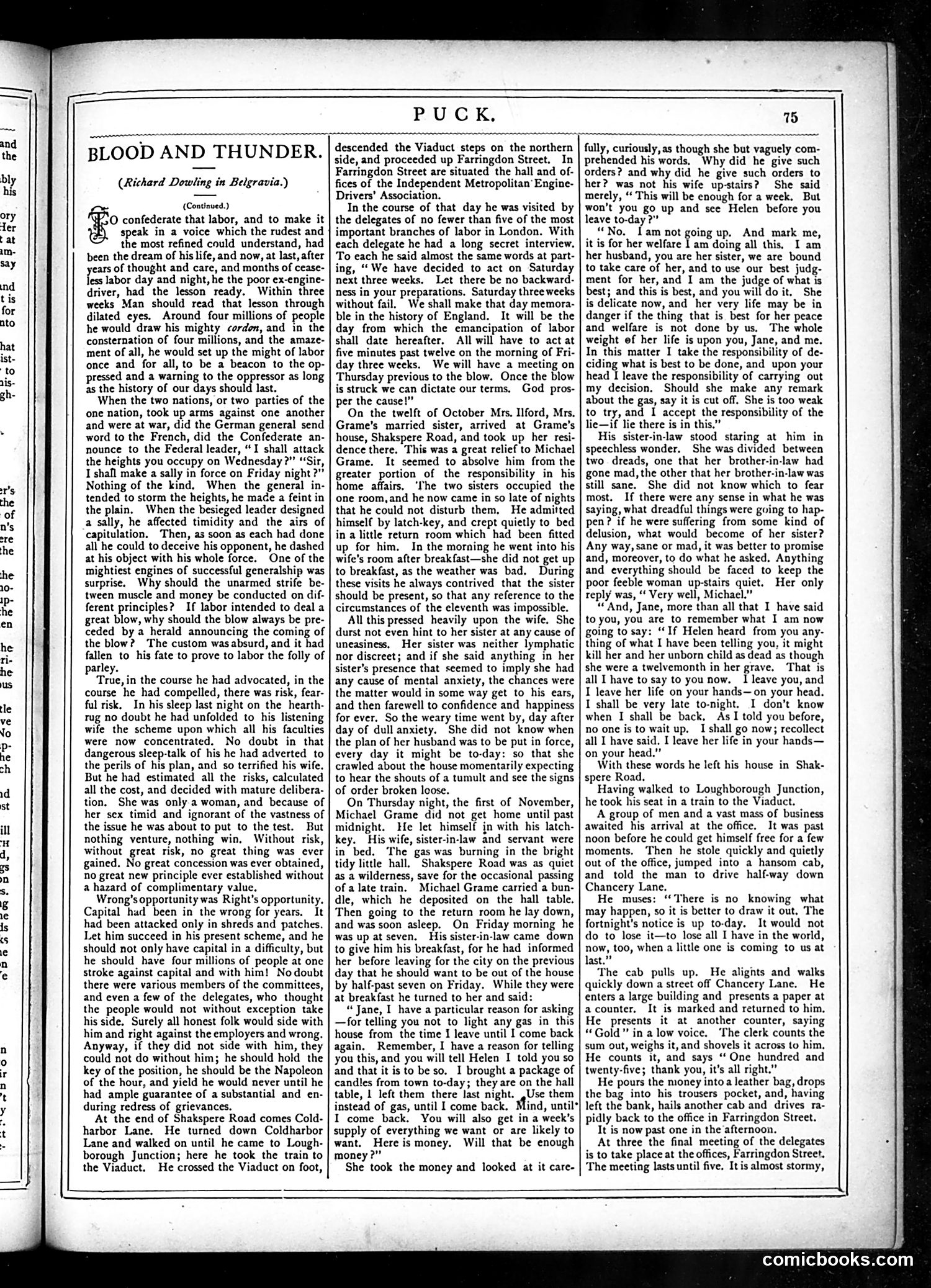
This page contains the continuation of a serialized story titled "Blood and Thunder" by Richard Downing, set in Belgrasia. The text describes labor organizing activities in London, focusing on a character named Michael Grame and his involvement with workers' associations. The narrative involves domestic drama—Grame's wife anxiously awaits his return during dangerous labor negotiations, while his sister-in-law Helen visits, creating family tension. The story depicts working-class struggles of the period, with references to organizing meetings and discussions of labor rights. This appears to be fictional serialized literature rather than political satire or cartooning. The page showcases Puck's use of long-form narrative fiction alongside its better-known satirical illustrations.
📄 Transcribed text from this page (OCR, searchable)
Machine-transcribed from the original scan — historical spelling and the odd misread are preserved.
PUCK. 5 BLOOD AND THUNDER. (Richard Dowling in Belgravia.) (Continued. 'O confederate that labor, and to make it speak in a voice which the rudest and the most refined could understand, had been the dream of his life, and now, at last, after ears of thought and care, and months of cease- less labor day and night, he the poor ex-engine- driver, had the lesson ready. Within three weeks Man should read that lesson through dilated eyes. Around four millions of people he would draw his mighty cordon, and in the consternation of four millions, and the amaze- ment of all, he would set up the might of labor once and for all, to be a beacon to the op- pressed and a warning to the oppressor as long as the history of our days should last. When the two nations, or two parties of the one nation, took up arms against one another and were at war, did the German general send word to the French, did the Confederate an- nounce to the Federal leader, “I shall attack the heights you occupy on Wednesday ?” “Sir, I shall make a sally in force on Friday night?” Nothing of the kind. When the general in- tended to storm the heights, he made a feint in the plain. When the besieged leader designed a sally, he affected timidity and the airs of capitulation. Then, as soon as each had done all he could to deceive his opponent, he dashed at his object with his whole force. One of the mightiest engines of successful generalship was surprise. Why should the unarmed strife be- tween muscle and money be conducted on dif- ferent principles? If labor intended to deal a great blow, why should the blow always be pre- ceded bya herald announcing the coming of the blow? The custom was absurd, and it had fallen to his fate to prove to labor the folly of parley. True, in the course he had advocated, in the course he had compelled, there was risk, fear- ful risk, In his sleep last night on the hearth- rug no doubt he had unfolded to his listening wife the scheme upon which all his faculties were now concentrated. No doubt in that dangerous sleep-talk of his he had adverted to the perils of his plan, and so terrified his wife. But he had estimated all the risks, calculated all the cost, and decided with mature delibera- tion, She was only. a woman, and because of her sex timid and ignorant of the vastness of the issue he was about to put to the test. But nothing venture, nothing win, Without risk, without great risk, no great thing was ever gained. No great concession was ever obtained, no great new principle ever established without a hazard of complimentary value. Wrong’s opportunity was Right’s opportunity. Capital had been in the wrong for years, It had been attacked only in shreds and patches. Let him succeed in his present scheme, and he should not only have capital in a difficulty, but he should have four millions of people at one stroke against capital and with him! No doubt there were various members of the committees, and even a few of the delegates, who thought the people would not without exception take his side. Surely all honest folk would side with him and right against the employers and wrong. Anyway, if they did not side with him, they could not do without him; he should hold the key of the position, he should be the Napoleon of the hour, and yield he would never until he had ample guarantee of a substantial and en- during redress of grievances. At the end of Shakspere Road comes Cold- harbor Lane. He turned down Coldharbor Lane and walked on until he came to Lough- borough Junction; here he took the train to the Viaduct. He crossed the Viaduct on foot, descended the Viaduct steps on the northern side, and proceeded up Farringdon Street. In Farringdon Street are situated the hall and of- fices of the Independent Metropolitan’ Engine- Drivers’ Association. In the course of that day he was visited by the delegates of no fewer than five of the most important branches of labor in London. With each delegate he had a long secret interview. To each he said almost the same words at part- ing, “We have decided to act on Saturday next three weeks. Let there be no backward- ness in your preparations. Saturday three weeks without fail. We shall make that day memora- ble in the history of England. It will be the day from which the emancipation of labor shall date hereafter. All will have to act at five minutes past twelve on the morning of Fri- day three weeks. We will have a meeting on ‘Thursday previous to the blow. Once the blow is struck we can dictate our terms, God pros- per the cause!”” On the twelft of October Mrs. Ilford, Mrs. Grame’s married sister, arrived at Grame’s house, Shakspere Road, and took up her resi- dence there. This was a great relief to Michael Grame. It seemed to absolve him from the greater portion of the responsibility in his home affairs. ‘I'he two sisters occupied the one room, and he now came in so late of nights that he could not disturb them, He admitted himself by latch-key, and crept quietly to bed in a little return room which had been fitted up for him, In the morning he went into his wife's room after breakfast—she did not get up to breakfast, as the weather was bad, During these visits he always contrived that the sister should be present, so that any reference to the circumstances of the eleventh was impossible. All this pressed heavily upon the wife. She durst not even hint to her sister at any cause of uneasiness, Her sister was neither lymphatic nor discreet; and if she said anything in her sister's presence that seemed to imply she had any cause of mental anxiety, the chances were the matter would in some way get to his ears, and then farewell to confidence and happiness for ever. So the weary time went by, day after day of dull anxiety. She did not know when the plan of her husband was to be put in force, every day it might be to-day: so that she crawled about the house momentarily expecting to hear the shouts of a tumult and see the signs of order broken loose. On Thursday night, the first of November, Michael Grame did not get home until past midnight. He let himself jn with his latch- key. His wife, sister-in-law and servant were in bed. ‘The gas was burning in the bright tidy little hall, Shakspere Road was as quiet as a wilderness, save for the occasional passing of a late train. Michael Grame carried a bun- dle, which he deposited on the hall table. Then going to the return room he lay down, and was soon asleep. On Friday morning he was up at seven. His sister-in-law came down to give him his breakfast, for he had informed her before leaving for the city on the previous day that he should want to be out of the house by half-past seven on Friday. While they were at breakfast he turned to her and said: “Jane, I have a particular reason for asking —for telling you not to light any gas in this house from the time I leave until I come back again. Remember, I have a reason for telling you this, and you will tell Helen I told you so and that it is to be so. I brought a package of candles from town to-day; they are on the hall table, 1 left them there last night. .Use them instead of gas, until I come back. Mind, until* I come back. You will also get in a week's supply of everything we want or are likely to want. Here is money. Will that be enough money ?” She took the money and looked at it care- fully, curiously, as though she but vaguely com- prehended his words, Why did he give such orders? and why did he give such orders to her? was not his wife up-stairs? She said merely, “ This will be enough for a week, But won't you go up and see Helen before you leave to-day?” “No. Iam not going up. And mark me, it is for her welfare 1 am doing all this. I am her husband, you are her sister, we are bound. to take care of her, and to use our best judg- ment for her, and I am the judge of what is best; and this is best, and you will do it. She is delicate now, and her very life may be in danger if the thing that is best for her peace and welfare is not done by us. The whole weight ef her life is upon you, Jane, and me. In this matter I take the responsibility of de- ciding what is best to be done, and upon your head I leave the responsibility of carrying out my decision, Should she make any remark about the gas, say it is cut off. She is too weak to try, and I accept the responsibility of the lie—if lie there is in this.” His sister-in-law stood staring at him in speechless wonder. She was divided between two dreads, one that her brother-in-law had gone mad, the other that her brother-in-law was still sane. She did not know which to fear most. If there were any sense in what he was saying, what dreadful things were going to hap- pen? if he were suffering from some kind of delusion, what would become of her sister? Any way, sane or mad, it was better to promise and, moreover, to do what he asked, Anything and everything should be faced to keep the poor feeble woman up-stairs quiet. Her only reply was, “ Very well, Michael.” “And, Jane, more than all that I have said to you, you are to remember what I am now going to say: “If Helen heard from you any- thing of what I have been telling you, it might kill her and her unborn child as dead as though she were a twelvemonth in her grave. That is all I have to say to you now. I leave you, and I leave her life on your hands—on your head. I shall be very late to-night. I don’t know when I shall be back, As I told you before, no one is to wait up, I shall go now; recollect all I have said. I leave her life in your hands— on your head.” With these words he left his house in Shak- spere Road. Having walked to Loughborough Junction, he took his seat in a train to the Viaduct. A group of men and a vast mass of business awaited his arrival at the office. It was past noon before he could get himself free for a few moments. Then he stole quickly and quietly out of the office, jumped into a hansom cab, and told the man to drive half-way down Chancery Lan He muses: “There is no knowing what may happen, so it is better to draw it out. The fortnight’s notice is up to-day. It would not do to lose it—to lose all I have in the world, now, too, when a little one is coming to us at last.” The cab pulls up. He alignts and walks quickly down a street off Chancery Lane. He enters a large building and presents a paper at acounter, It is marked and returned to him. He presents it at another counter, saying “Gold” in a low voice. ‘The clerk counts the sum out, weighs it, and shovels it across to him. He counts it, and says “One hundred and twenty-five; thank you, it’s all right.” He pours the money intoa leather bag, drops the bag into his trousers pocket, and, having left the bank, hails another cab and drives ra- pidly back to the office in Farringdon Street. It is now past one in the afternoon, At three the final meeting of the delegates is to take place at the offices, Farringdon Street, The meeting lasts until five. It is almost storm: comicbooks.com