
A complete issue · 16 pages · 1879
Puck — March 26, 1879
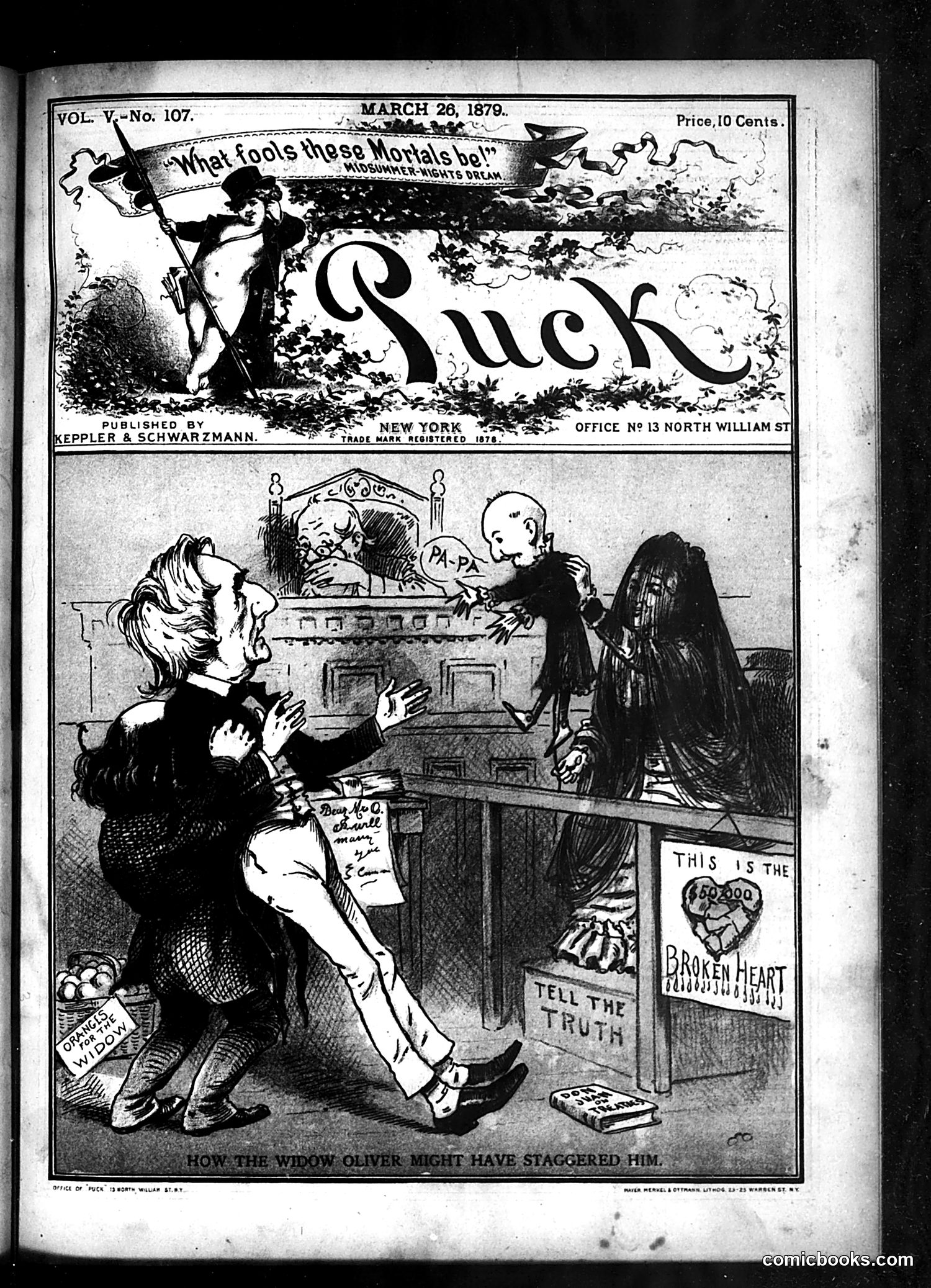
**Main Cartoon: "How the Widow Oliver Might Have Staggered Him"** This cartoon satirizes a legal or romantic scandal involving "Widow Oliver." The scene depicts a woman at a counter labeled "Tell the Truth" and "This is the Broken Heart Brokerage" confronting what appears to be a fortune teller or charlatan behind a desk. The satire targets fraudulent spiritualists or con artists who exploited vulnerable people—particularly widows seeking contact with deceased relatives. The woman's confident stance suggests she's exposing the charlatan's deception. Period newspapers frequently mocked spiritualism and mediums as elaborate scams preying on grieving clients. The reference to "Widow Oliver" likely alludes to a specific contemporary scandal, though the specific identity remains unclear from the image alone.
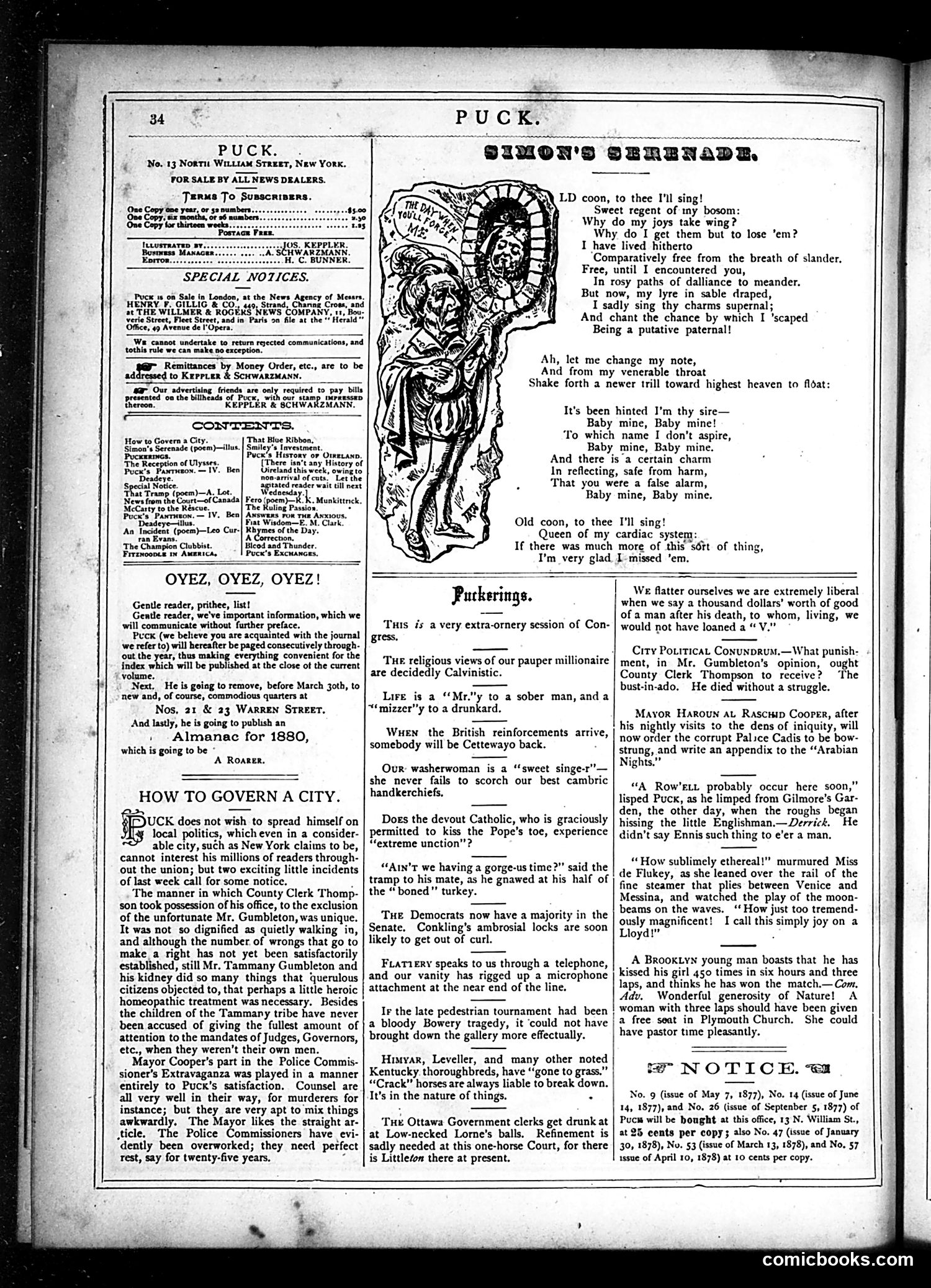
The main cartoon depicts an elderly man playing bagpipes while singing to a woman. Based on the accompanying poem "Simon's Serenade," this appears to be satirizing romantic pursuit—specifically an older man's awkward courtship attempt. The poem's lyrics mock his efforts ("Baby mine, Baby mine") and suggest he's pursuing someone despite being a "false alarm" romantically. The satire targets the absurdity of age-inappropriate romantic gestures and the persistence of unwanted advances. The bagpipes themselves—traditionally associated with Scotland—may add to the comedic exaggeration of his performance. The page also contains various brief satirical notices about contemporary political and social issues, though these are difficult to parse without additional historical context about 1880s events and figures referenced.
This page contains two distinct pieces of political satire: **"The Reception of Ulysses"** (left) is a theatrical piece mocking President Ulysses S. Grant's third-term aspirations. The dialogue satirizes Grant's candidacy through classical allusion—comparing him to Homer's Ulysses—while characters debate his fitness for continued office. The repeated chorus "We can't do much worse than you" suggests public skepticism of his presidency. **"Puck's Pantheon: Ben Deadeye"** (right) is a biographical character assassination of General Benjamin Butler, describing him as a "triangular" politician, incompetent administrator, and self-serving opportunist. It dismisses Butler as a disreputable figure unworthy of public trust. Both pieces employ ridicule and wordplay typical of Puck's irreverent approach to political figures of the Reconstruction era.
This page contains several satirical pieces rather than a single cartoon. "That Tramp: A Double Ender" appears to be a humorous poem about encountering a vagrant at the kitchen door. The main content is "News From the Court of Canada," a satirical letter from Ottawa dated March 26, 1879, mocking Canadian social and political life. It describes balls, dancing, and society events, ridiculing what the writer sees as pretentious aristocratic behavior among Canadian officials and their families. References to "Uncle" (likely Governor General connections) and commentary on "democratic tastes" suggest criticism of colonial affectation. The remaining pieces—"McCarthy to the Rescue," "The Ball Room," and others—appear to be social commentary and humorous anecdotes about Canadian society, focusing on the gap between colonial pretense and frontier reality.
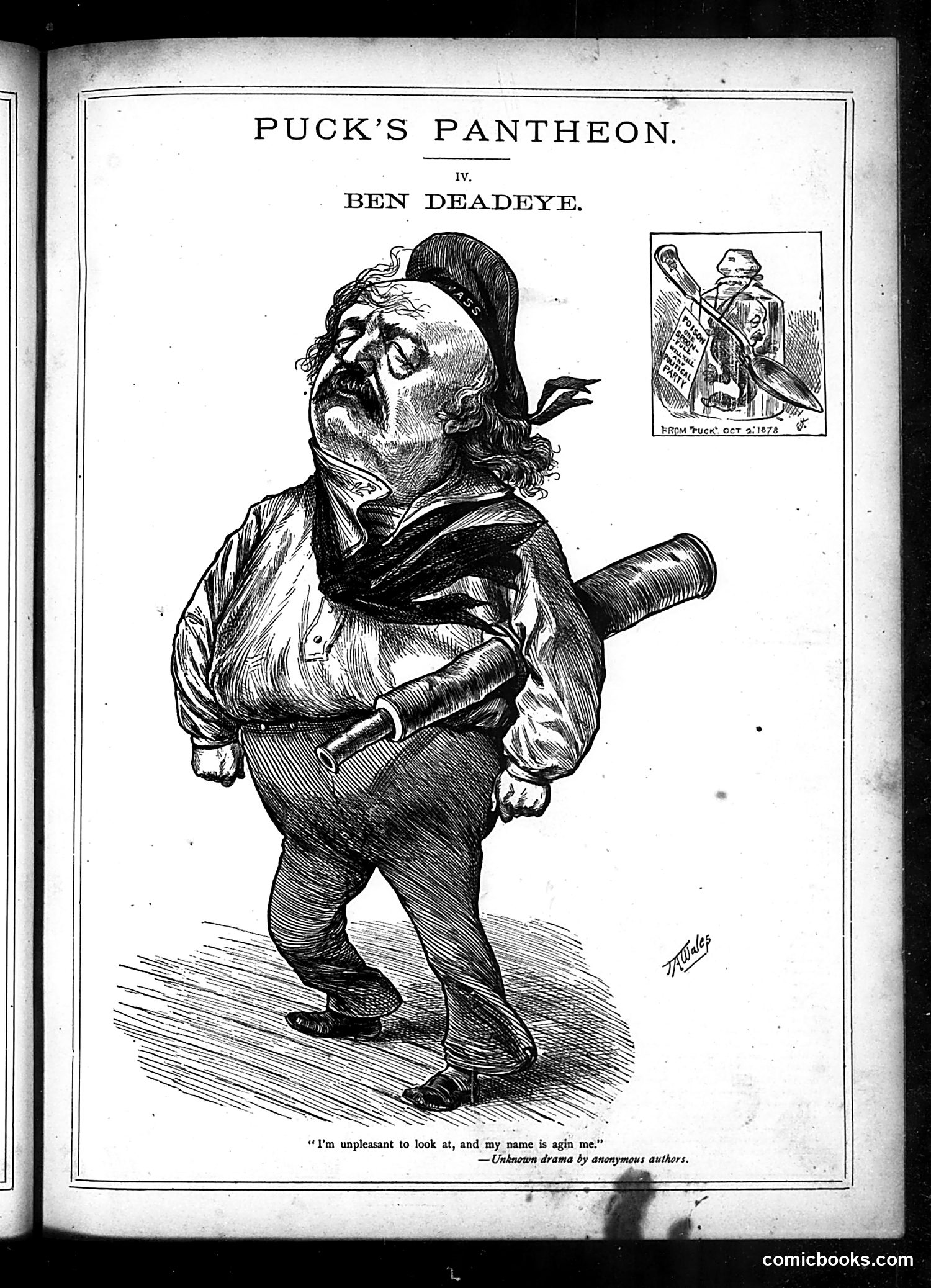
This is a caricature of a figure labeled "Ben Deadeye," though the identity isn't entirely clear from the image alone. The character is depicted as a disheveled man with a prominent mustache, wearing period clothing and carrying what appears to be a rifle or long gun. The exaggerated facial features and unflattering portrayal suggest this is satirical political commentary. The quote beneath—"I'm unpleasant to look at, and my name is acne me"—appears to be self-deprecating dialogue, though the OCR may contain errors. The small inset image in the upper right appears to reference another Puck cartoon from October 1874. Without additional historical context, the specific political or social target remains unclear, though the grotesque caricature style was typical of Puck's satirical approach.
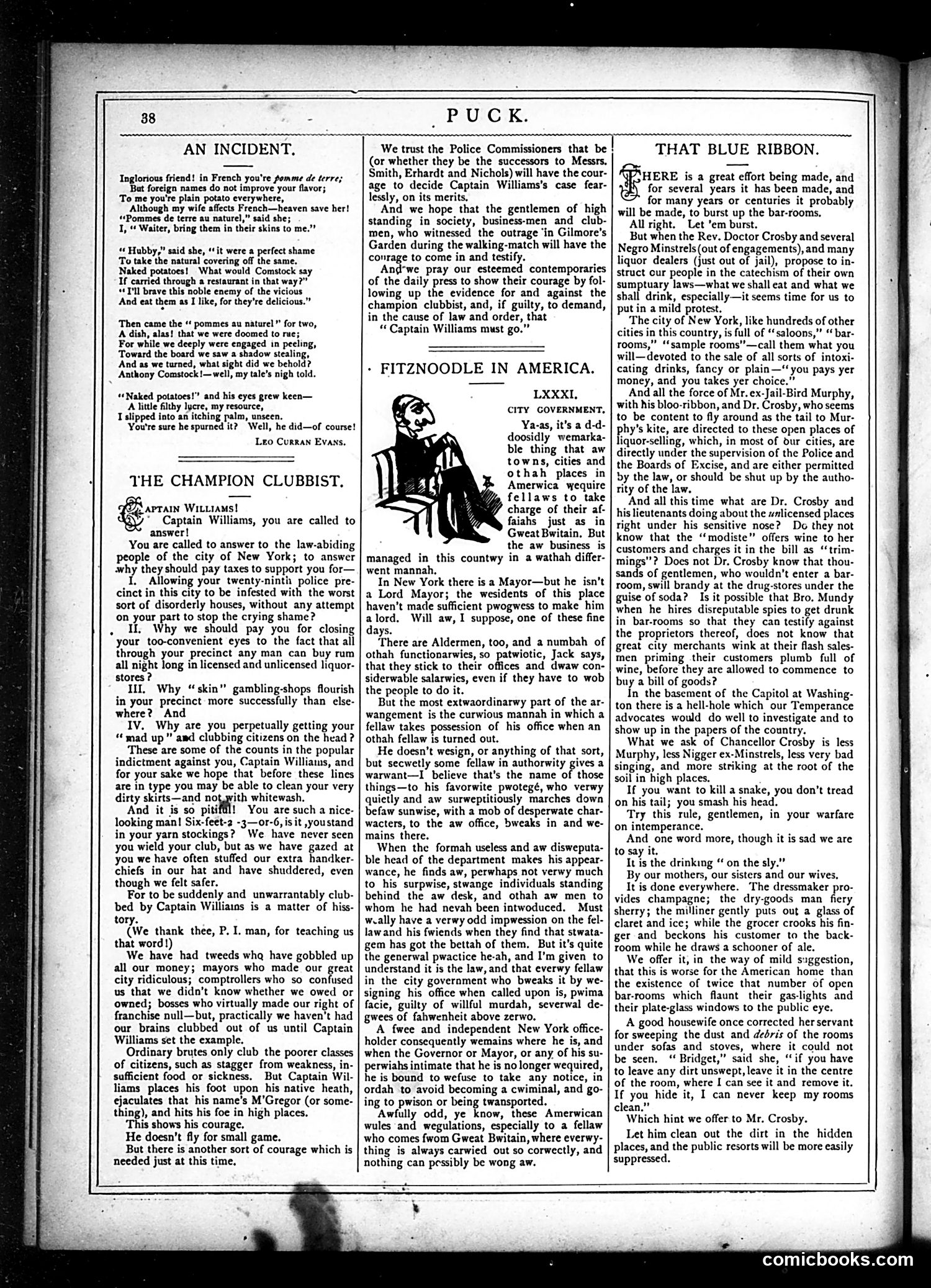
This section satirizes American city government's inefficiency compared to British administration. The cartoon depicts a figure (likely representing American municipal authority) slouching incompetently. The text critiques how American cities supposedly require "fellows to take charge of their affairs" like Britain does with colonial governors, suggesting American municipal leaders lack competence. It mocks the paradox: American cities claim independence yet perform worse than British-administered territories. The piece particularly targets corruption in New York City governance—specifically the Mayor's office and police commissioners. It argues that unlike Britain's orderly system, American cities tolerate widespread bribery, gambling dens, and liquor sales operating openly under official supervision, with police complicity rather than enforcement. The satire suggests American democracy produces worse governance than British hierarchy.
This page contains "Smiley's Investment," a prose story with no visible cartoon. The narrative satirizes a naïve investor named Smiley who is swindled by a smooth-talking broker named Sharpe. The satire targets **stock market fraud and manipulation** common in the Gilded Age. Smiley, representing the gullible small investor, is seduced by promises of quick wealth and exclusive inside information. Sharpe exploits him with worthless mining stocks and dubious real estate schemes. The story mocks both the victim's greed and credulity, and the predatory practices of brokers who exploited ordinary people. The dramatic arc—from initial enthusiasm to eventual financial ruin—illustrates how easily ordinary citizens could be defrauded during this period of largely unregulated financial markets.
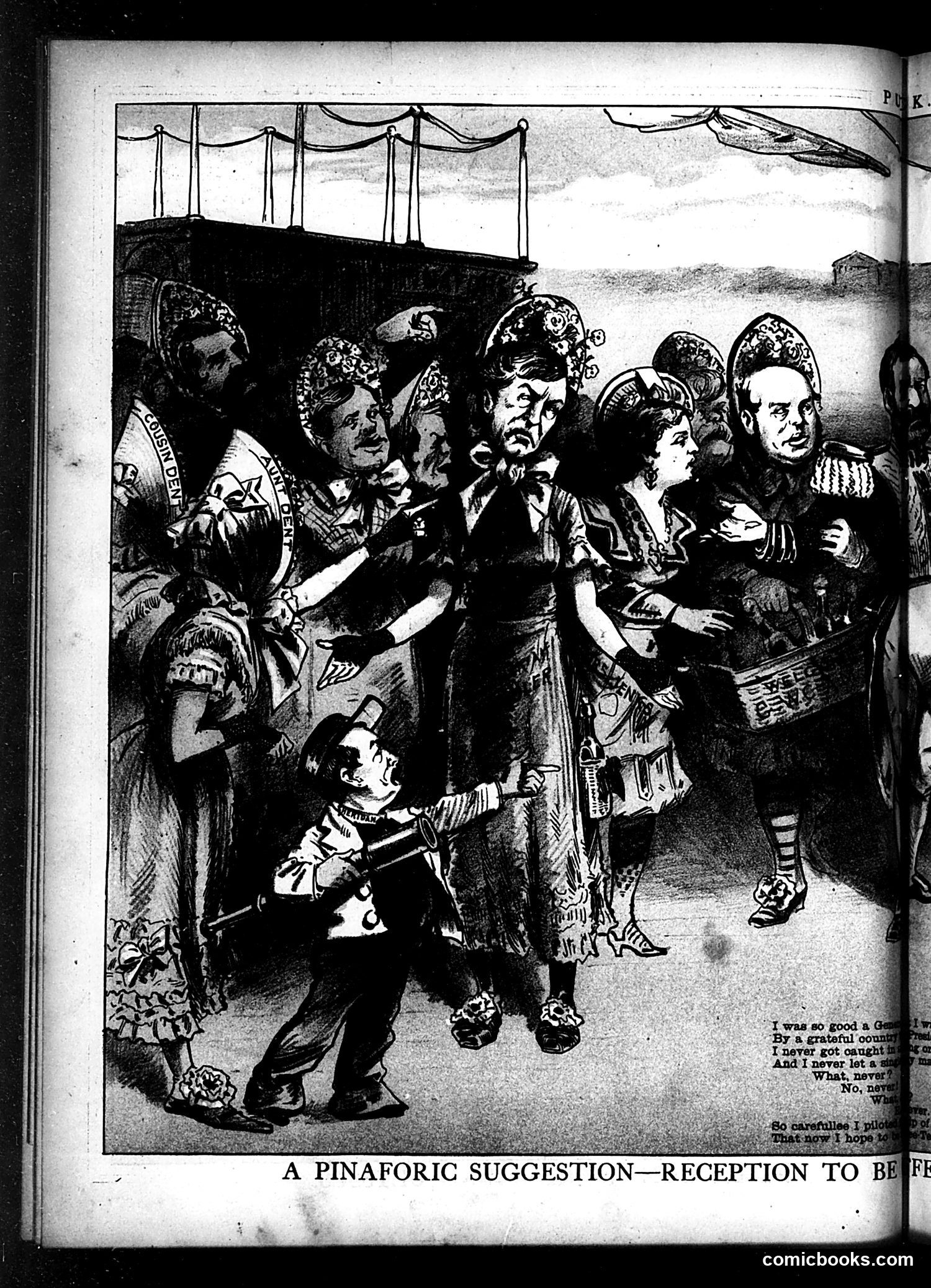
This political cartoon satirizes a proposed diplomatic reception. The title "Pinaforic Suggestion" references Gilbert and Sullivan's opera *H.M.S. Pinafore* (1878), suggesting the scene is absurdly theatrical or farcical. The image depicts elegantly dressed dignitaries and military figures receiving a small child in formal attire. The satire appears to mock an official state reception or formal ceremony that Puck finds ridiculous—the juxtaposition of the tiny child among grand, formally-dressed adults emphasizes the absurdity. Without clearer text or additional context visible on the page, the specific political figures or event referenced remain unclear. The cartoon's point seems to be criticizing the formality or pretension of some contemporary diplomatic proceeding that Puck deemed worthy of mockery.
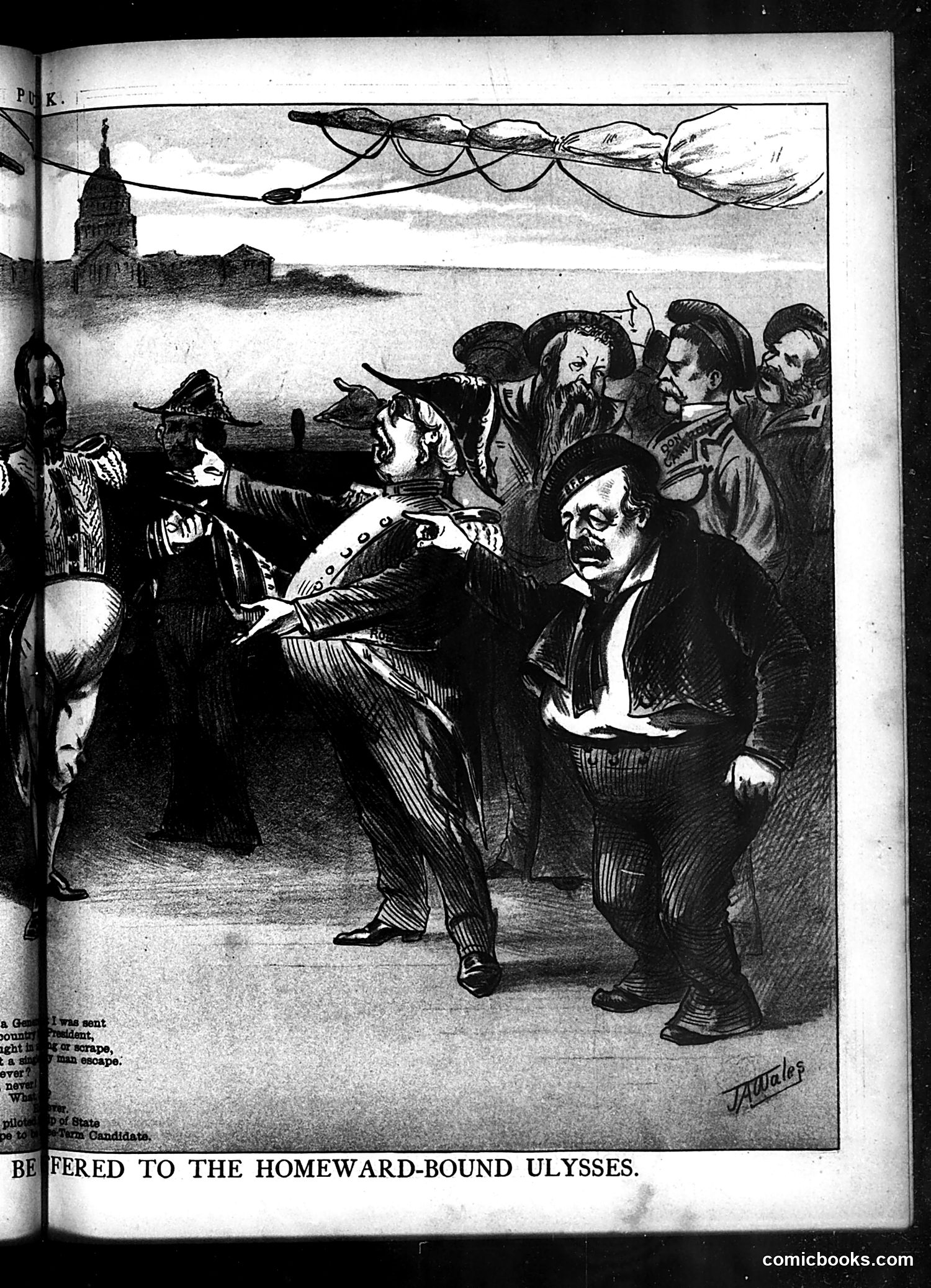
This political cartoon satirizes American politicians or diplomats being sent abroad on missions, then returning home without accomplishing their goals—hence the classical reference to Ulysses (Odysseus), whose journey home took years of struggle. The scene depicts several figures in formal 19th-century dress gathered around a central character who appears to be a dignitary or official. The caricatured faces suggest these represent specific political figures, though the OCR'd caption and visible text don't clearly identify them by name. The "homeward-bound" reference implies these officials were deferred or postponed in their missions, returning empty-handed. Without clearer identification of the specific figures or historical context from the page, the precise political conflict remains unclear, but the cartoon mocks diplomatic failure or political ineffectiveness.
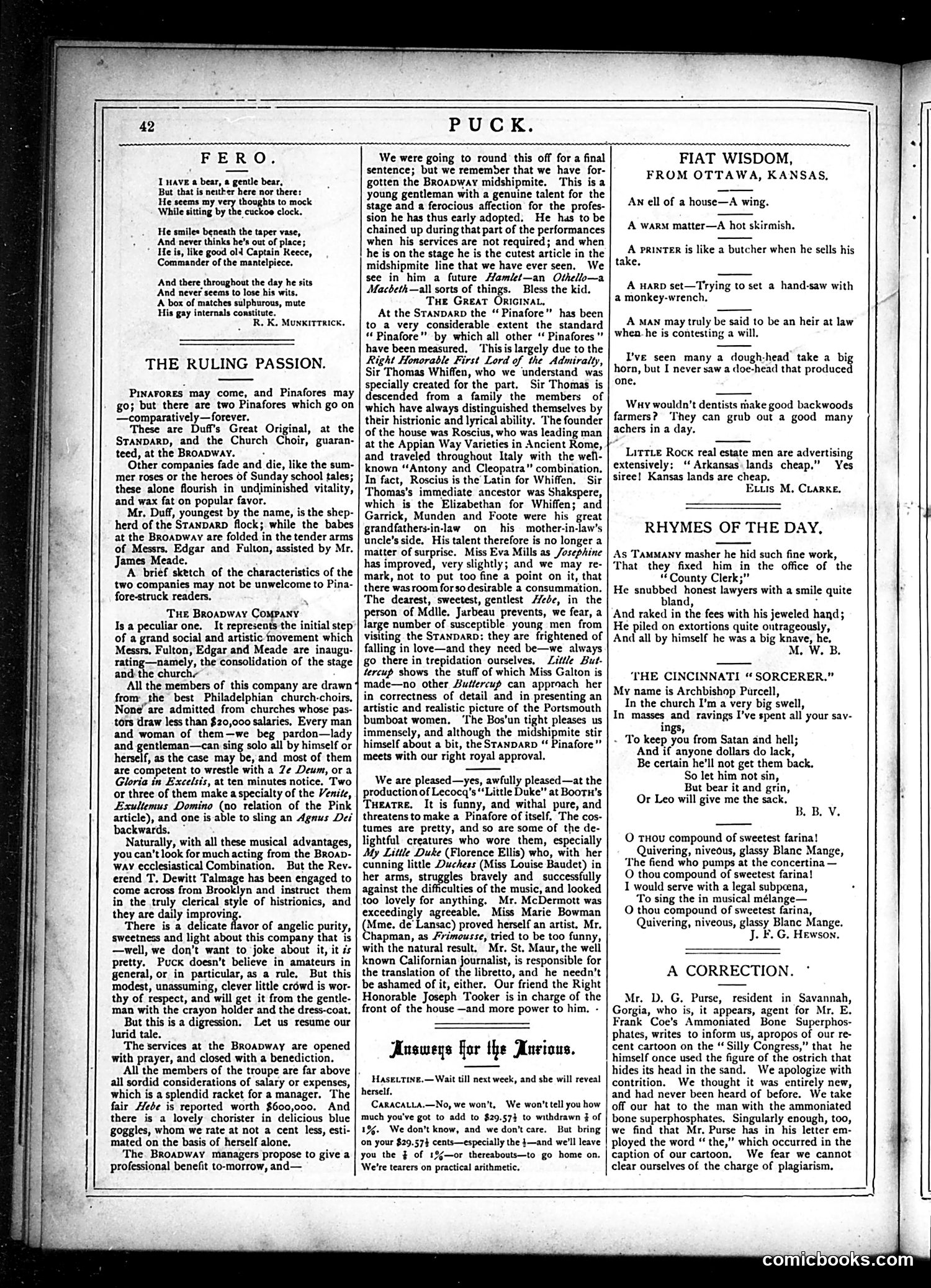
This page contains primarily text-based satirical commentary rather than illustrated cartoons. The main sections include: **"Fero"** - A poem about a bear, likely satirizing a person or public figure through animal metaphor. **"The Ruling Passion"** - Extended commentary critiquing theatrical productions on Broadway, particularly discussing Pinafores (likely Gilbert & Sullivan's "H.M.S. Pinafore"). The text mocks both the performances and the audiences' susceptibility to mediocre entertainment. **"Rhymes of Day"** and **"The Cincinnati 'Sorcerer'"** - Brief satirical verses about various subjects. **"Answers for the Inquisitive"** - A humor column with Q&A format addressing reader questions. The page demonstrates Puck's characteristic approach: using wordplay and cultural criticism to satirize contemporary theater, social pretensions, and public gullibility, without relying primarily on visual caricature.
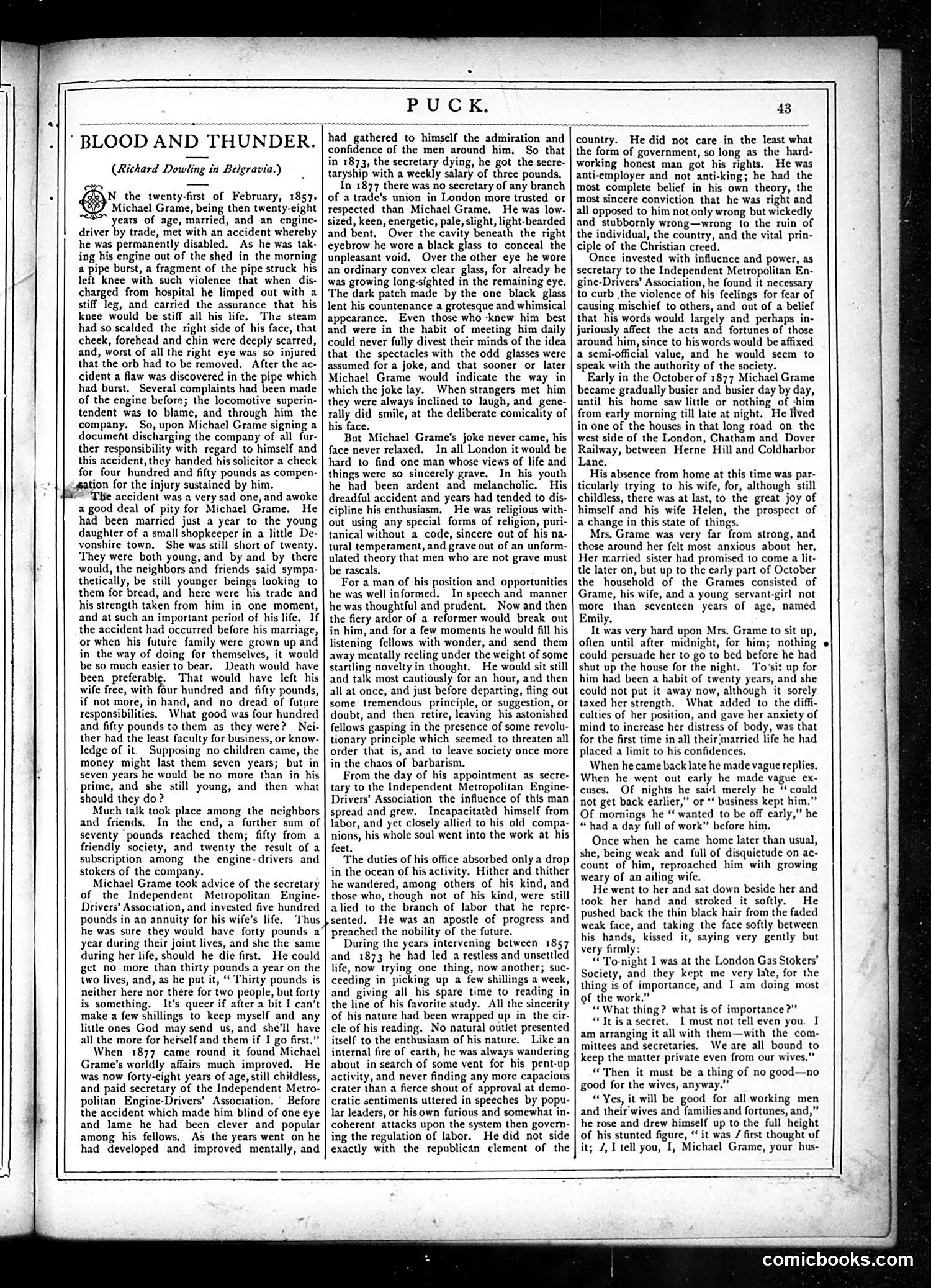
This page is primarily text—a biographical article titled "BLOOD AND THUNDER" about Michael Grame, an engine driver. The piece satirizes Grame's life trajectory from a working-class laborer who suffered a serious industrial accident in 1857 to his later involvement with the Independent Metropolitan Engine-Drivers' Association. The satire mocks Grame's transformation: once a victim of workplace injury, he became a labor activist and union organizer, though the article suggests his idealism was somewhat self-righteous and his principles inconsistently applied. The piece critiques both his personal contradictions and the broader labor movement's rhetoric about workers' rights and social reform. It's social commentary rather than visual satire.
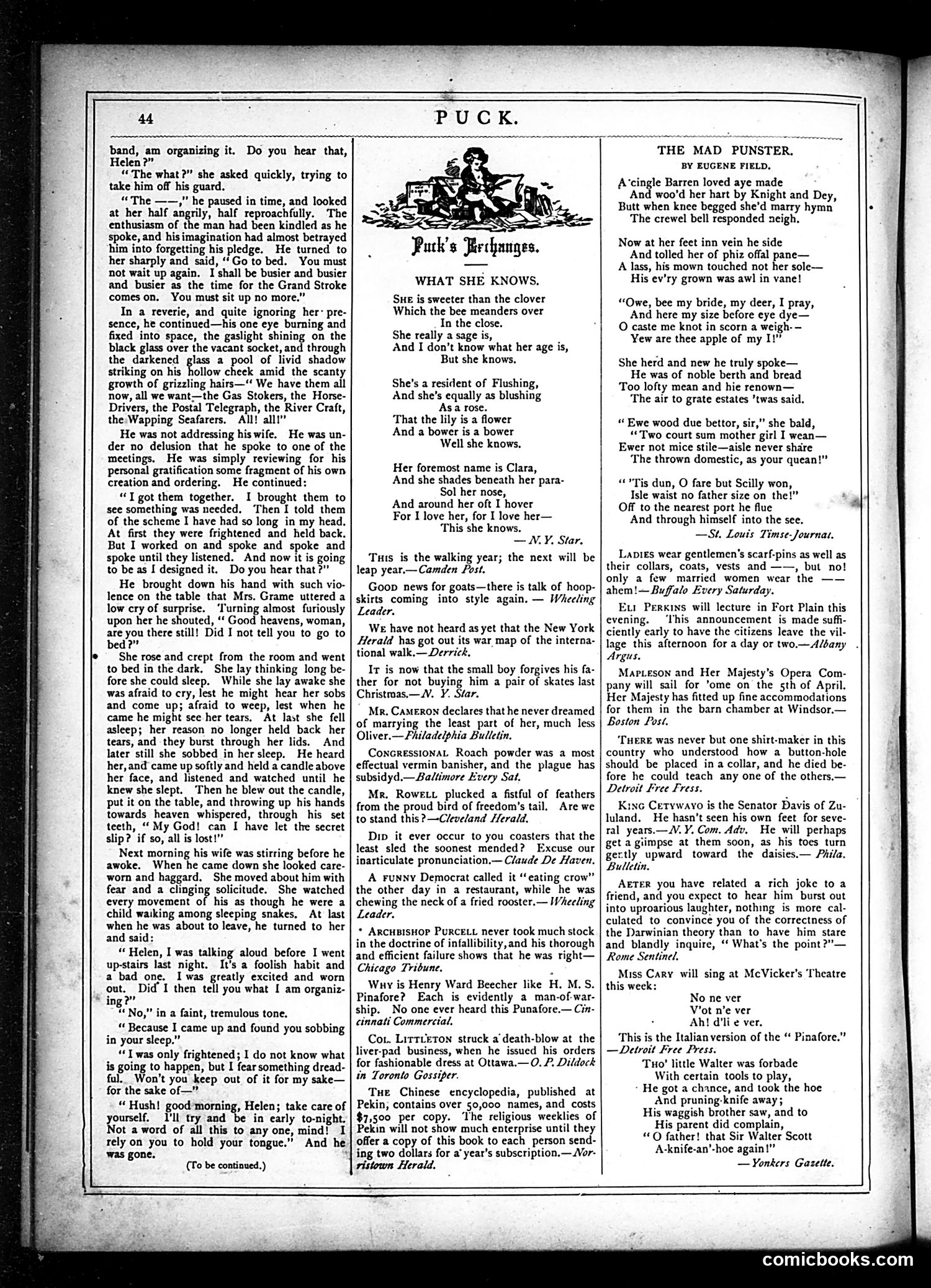
This page features a humorous poem titled "The Mad Punster" by Eugene Field, accompanied by various brief satirical notices and jokes typical of Puck's format. The main illustration shows a man in period dress, likely representing a stereotypical punster or joker. The accompanying poem mocks someone obsessively making puns and wordplay, with the punster appearing annoying to those around him. The surrounding column contains gossip-style items poking fun at contemporary figures and social trends—including commentary on fashion, opera, and notable personalities. References to "the New York social season" and specific individuals suggest these target recognizable public figures of the era, though specific identities aren't always clear from the OCR text alone. The overall tone is lighthearted mockery of social pretension and human foibles typical of Puck's satirical approach.
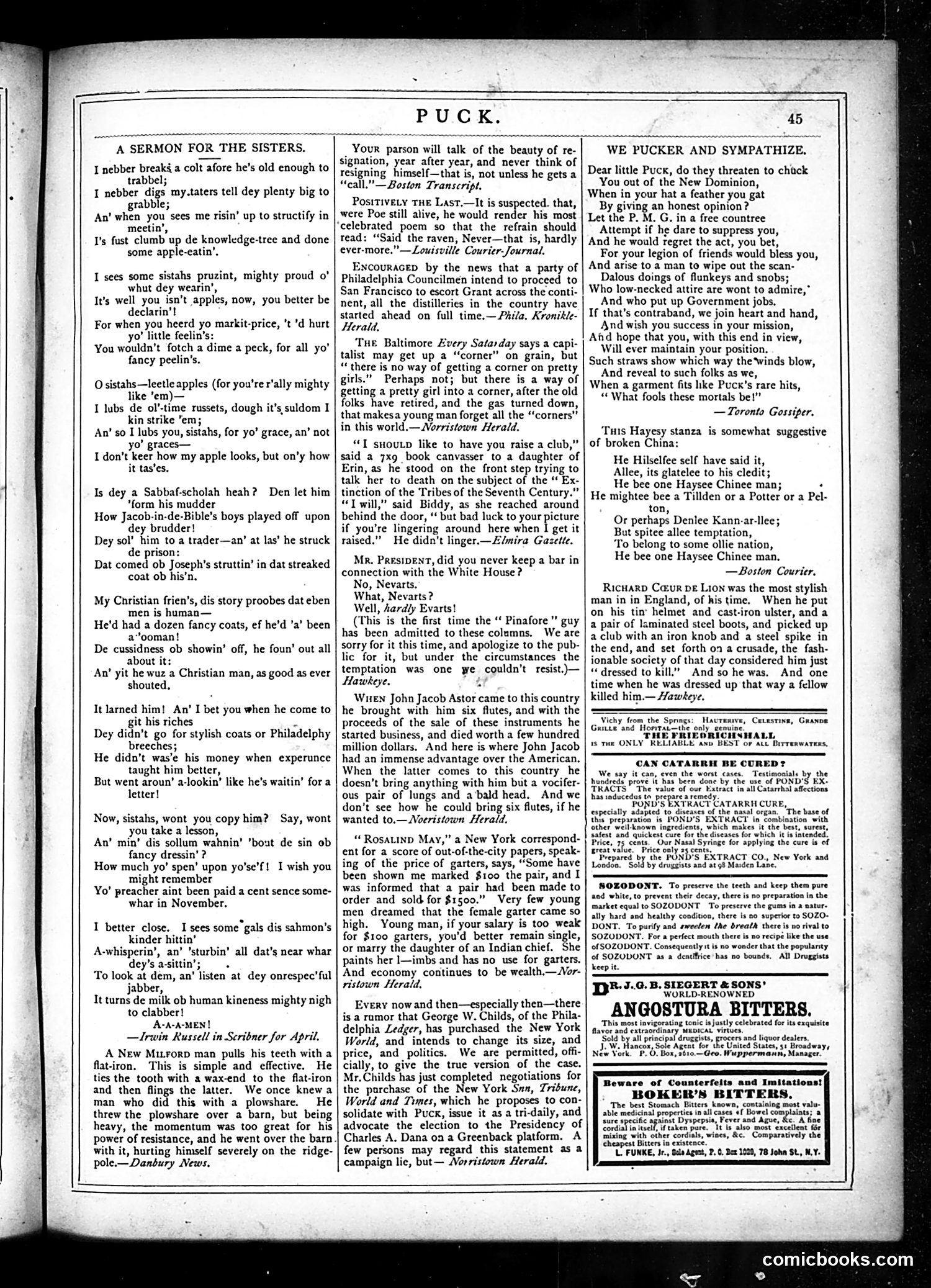
This page contains primarily **text-based satirical commentary** rather than illustrated cartoons. The content includes: 1. **"A Sermon for the Sisters"** — A dialect poem mocking working-class women, using exaggerated speech patterns for comic effect. 2. **Multiple news item parodies** — Short satirical pieces commenting on contemporary events, including references to: - A "Pinaface" character (unclear who this references) - George W. Childs of the Philadelphia Ledger purchasing the New York World - Charles A. Dana and presidential politics 3. **Advertisements** for patent medicines (Pond's Extract, Sozodont toothpaste, Angostura Bitters) and products claiming medical benefits The humor relies on **contemporary political gossip, social commentary on class and dialect**, and the popular 19th-century format of satirizing current events through fake news items. Without illustrations, the satire depends entirely on reader familiarity with named figures and recent news.
This page is **primarily advertisements**, not editorial content or cartoons. It's page 46 from Puck magazine and contains commercial notices for late 19th-century businesses including: - Puck Cigarettes - Arnold, Constable & Co. (Spring woolens and clothing) - Dunlap & Co. (gentlemen's hats) - E.D. Bassford (beer glasses) - Various other retailers (photographers, hatmakers, jewelers, dental services, umbrellas) The ads feature period-appropriate typography and imagery—woodcuts of products like hats and glassware. There is **no visible political satire or cartoon content** on this page. It represents typical magazine monetization of the era, with advertisers filling space between editorial material elsewhere in the publication.
This page is primarily **advertising**, not political satire. It contains numerous commercial advertisements from late 19th-century New York businesses, including: - Champagne and wine merchants (Piper-Heidsieck, A. Heller & Bro.) - Furniture makers (Mathesius & Frey) - Lottery promotions (Royal Havana Lottery) - Portrait studios (Kurtz's Portraits) - Tailors and jewelers (Nicoll the Tailor, Hamann & Koch) - Financial services (International Banking Co.) The only non-commercial content is **Kurtz's Portraits** illustration at top right, showing silhouettes of people viewing portraits—a straightforward advertisement for their Madison Square studio. This represents Puck's revenue model: satirical content subsidized by classified and display advertising targeting wealthy New York readers.
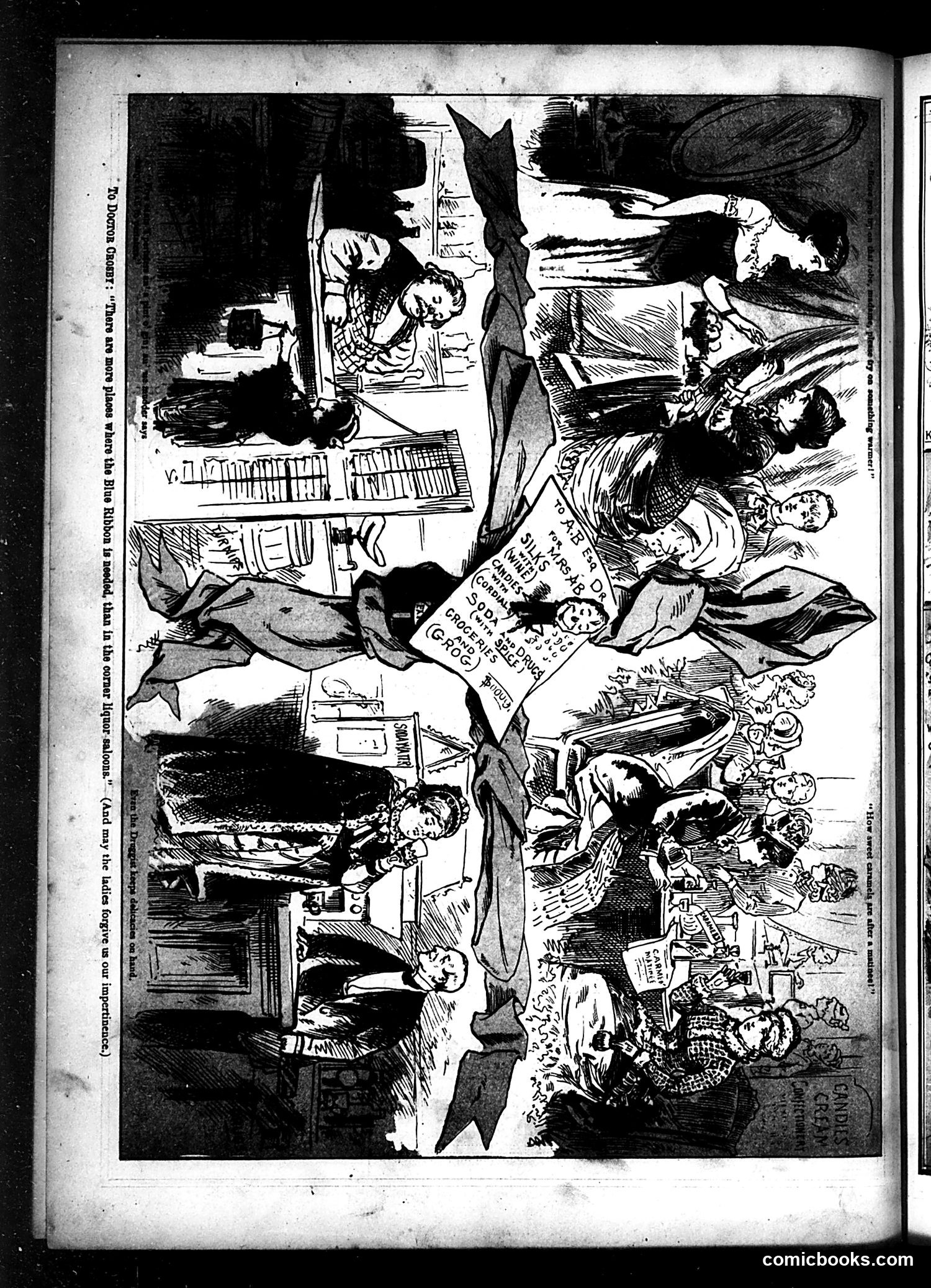
I can see this is a Puck magazine page with an illustration that appears to be oriented sideways or upside-down on the page, making it difficult to read with certainty. The image contains multiple figures in what appears to be a chaotic scene with various characters and objects scattered throughout in a satirical composition typical of Puck's style. However, the OCR text provided is blank or illegible, and the orientation of the illustration makes it challenging to identify specific figures, captions, or the exact political/social references with confidence. Without being able to read the accompanying text clearly or orient the image properly, I cannot reliably explain what specific people, events, or issues this cartoon satirizes. To provide accurate interpretation, I would need clearer text or a properly-oriented image.