
Puck, 1879-03-26 · page 4 of 16
Puck — March 26, 1879 — page 4: what you’re looking at
What you’re looking at
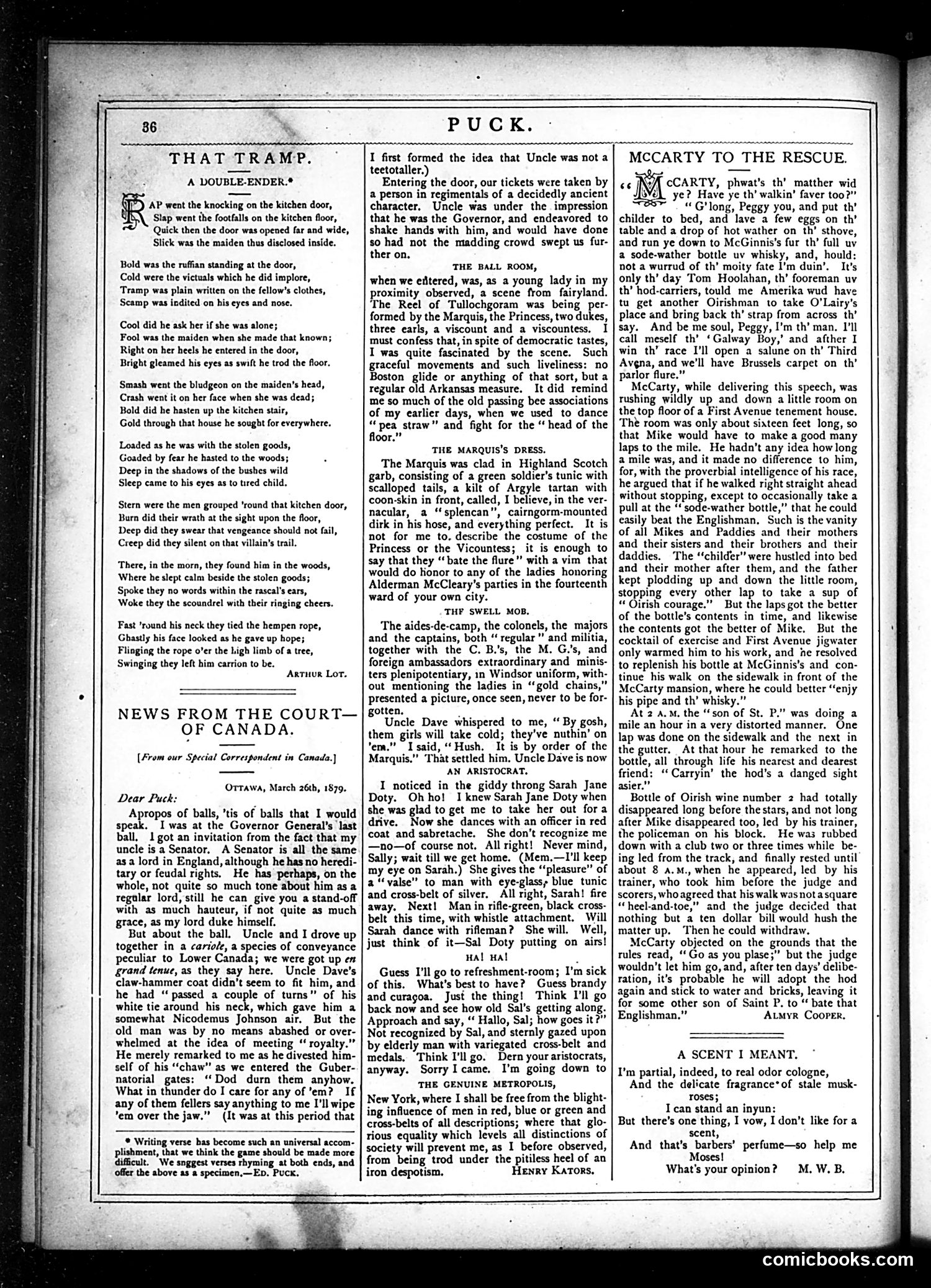
This page contains several satirical pieces rather than a single cartoon. "That Tramp: A Double Ender" appears to be a humorous poem about encountering a vagrant at the kitchen door. The main content is "News From the Court of Canada," a satirical letter from Ottawa dated March 26, 1879, mocking Canadian social and political life. It describes balls, dancing, and society events, ridiculing what the writer sees as pretentious aristocratic behavior among Canadian officials and their families. References to "Uncle" (likely Governor General connections) and commentary on "democratic tastes" suggest criticism of colonial affectation. The remaining pieces—"McCarthy to the Rescue," "The Ball Room," and others—appear to be social commentary and humorous anecdotes about Canadian society, focusing on the gap between colonial pretense and frontier reality.
📄 Transcribed text from this page (OCR, searchable)
Machine-transcribed from the original scan — historical spelling and the odd misread are preserved.
PUCK. THAT TRAMP. A DOUBLE-ENDER.* ‘AP went the knocking on the kitchen door, Slap went the footfalls on the kitchen floor, Quick then the door was opened far and wide, Slick was the maiden thus disclosed inside. Bold was the ruffian standing at the door, Cold were the victuals which he did implore, ‘Tramp was plain written on the fellow’s clothes, Scamp was indited on his eyes and nose. Cool did he ask her if she was alone; Fool was the maiden when she made that known; Right on her heels he entered in the door, Bright gleamed his eyes as swift he trod the floor. ‘Smash went the bludgeon on the maiden’s head, Crash went it on her face when she was dead; Bold did he hasten up the kitchen stair, Gold through that house he sought for everywhere. Loaded as he was with the stolen goods, Goaded by fear he hasted to the woods; Deep in the shadows of the bushes wild Sleep came to his eyes as to tired child, Stern were the men grouped ‘round that kitchen door, Burn did their wrath at the sight upon the floor, Deep did they swear that vengeance should not fail, Creep did they silent on that villain’s trail, There, in the morn, they found him in the woods, Where he slept calm beside the stolen goods; Spoke they no words within the rascal’s ears, ‘Woke they the scoundrel with their ringing cheers. Fast ‘round his neck they tied the hempen rope, Ghastly his face looked as he gave up hope; Flinging the rope o'er the high limb of a tree, Swinging they left him carrion to be. Artur Lor. NEWS FROM THE COURT— OF CANADA, [From our Special Correspondent in Canada.) Ortawa, March 26th, 1879. Dear Puck: Apropos of balls, ’tis of balls that I would speak. I was at the Governor General’s last ball, 1 got an invitation from the fact that my uncle is a Senator. A Senator is all the same asa lord in England, although he has no heredi- tary or feudal rights. He has perhaps, on the whole, not quite so much tone about him as a regolar lord, still he can give you a stand-off with as much hauteur, if not quite as much grace, as my lord duke himself. But about the ball. Uncle and I drove up together in a cariole, a species of conveyance peculiar to Lower Canada; we were got up en grand tenue, as they say here. Uncle Dave's claw-hammer coat didn’t seem to fit him, and he had “passed a couple of turns” of his white tie around his neck, which gave him a somewhat Nicodemus Johnson air. But the old man was by no means abashed or over- whelmed at the idea of meeting “ royalty.” He merely remarked to me as he divested him- self of his “‘chaw” as we entered the Guber- natorial gates: ‘‘Dod durn them anyhow. What in thunder do I care for any of em? If any of them fellers say anything to me I'll wipe tem over the jaw.” (It was at this period that © Writing verse bas become such an universal accom- plishment, that we think the game should be made more difficult. We snggest verses rhyming at both ends, and offer the above as a specimen.—Ep. PUCK. I first formed the idea that Uncle was not a teetotaller.) Entering the door, our tickets were taken by a person in regimentals of a decidedly ancient character. Uncle was under the impression that he was the Governor, and endeavored to shake hands with him, and would have done so had not the madding crowd swept us fur- ther on, THE BALL ROOM, when we eiitered, was, as a young lady in my proximity observed, a scene from fairyland. The Reel of Tullochgoram was being per- formed by the Marquis, the Princess, two dukes, three earls, a viscount and a viscountess. I must confess that, in spite of democratic tastes, I was quite fascinated by the scene. Such graceful movements and such liveliness: no Boston glide or anything of that sort, but a regular old Arkansas measure. It did remind me so much of the old passing bee associations of my earlier days, when we used to dance “pea straw” and fight for the “head of the floor.” THE MARQUIS'S DRESS. The Marquis was clad in Highland Scotch garb, consisting of a green soldier's tunic with scalloped tails, a kilt of Argyle tartan with coon-skin in front, called, I believe, in the ver- nacular, a ‘“splencan”, cairngorm-mounted dirk in his hose, and everything perfect. It is not for me to. describe the costume of the Princess or the Vicountess; it is enough to say that they “bate the flure”’ with a vim that would do Konor to any of the ladies honoring Alderman McCleary’s parties in the fourteenth ward of your own city. THF SWELL MOB. The aides-de-camp, the colonels, the majors and the captains, both “ regular” and militia, together with the C. B.'s, the M. G.’s, and foreign ambassadors extraordinary and minis- ters plenipotentiary, in Windsor uniform, with- out mentioning the ladies in “gold chains,” presented a picture, once seen, never to be for- gotten, . Uncle Dave whispered to me, “ By gosh, them girls will take cold; they've nuthin’ on tem.” I said, “Hush. It is by order of the Marquis.” That settled him. Uncle Dave is now AN ARISTOCRAT. I noticed in the giddy throng Sarah Jane Doty. Ohho! 1 knew Sarah Jane Doty when she was glad to get me to take her out fora drive. Now she dances with an officer in red coat and sabretache. She don’t recognize me —no—of course not. All right! Never mind, Sally; wait till we get home. (Mem.—I'll keep my eye on Sarah.) She gives the “pleasure” of a “‘valse” to man with eye-glassp blue tunic and cross-belt of silver. All right, Sarah! fire away, Next! Man in rifle-green, black cross- belt this time, with whistle attachment. Will Sarah dance with rifleman? She will. Well, just think of it—Sal Doty putting on airs! ual Hal Guess I'll go to refreshment-room; I'm sick of this. What's best to have? Guess brandy and curagoa. Just the thing! Think I'll go back now and see how old Sal's getting along. Approach and say, “ Hallo, Sal; how goes it?” Not recognized by Sal, and sternly gazed upon by elderly man with variegated cross-belt and medals. ‘Think I'll go. Dern your aristocrats, anyway. Sorry came. I'm going down to THE GENUINE METROPOLIS, New York, where I shall be free from the blight- ing influence of men in red, blue or green and cross-belts of all descriptions; where that glo- rious equality which levels all distinctions of society will prevent me, as I before observed, from being trod under the pitiless heel of an iron despotism. Henry Kators. MCCARTY TO THE RESCUE. ce NV cCARTY, phwat's th’ matther wid el ye? Have ye th’ walkin’ faver too?” “G'long, Peggy you, and put th’ childer to bed, and lave a few eggs on th’ table and a drop of hot wather on th’ sthove, and run ye down to McGinnis’s fur th’ full uv a sode-wather bottle uv whisky, and, hould: not a wurrud of th’ moity fate I'm duin’. It’s only th’ day Tom Hoolahan, th’ fooreman uv th’ hod-carriers, tould me Amerika wud have tu get another Oirishman to take O'Lairy’s place and bring back th’ strap from across th’ say. And be me soul, Peggy, I’m th’ man. I'll call meself th’ ‘Galway Boy,’ and afther I win th’ race I'll open a salune on th’ Third Avgna, and we'll have Brussels carpet on th’ parlor flure.” McCarty, while delivering this speech, was rushing wildly up and down a little room on the top floor of a First Avenue tenement house, The room was only about siateen feet long, so that Mike would have to make a good many laps to the mile. He hadn't any idea how long a mile was, and it made no difference to him, for, with the proverbial intelligence of his race, he argued that if he walked right straight ahead without stopping, except to occasionally take a pull at the ‘ sode-wather bottle,” that he could easily beat the Englishman, Such is the vanity of all Mikes and Paddies and their mothers and their sisters and their brothers and their daddies. The ‘‘childer” were hustled into bed and their mother after them, and the father kept plodding up and down the little room, stopping every other lap to take a sup of “ Oirish courage.” But the laps got the better of the bottle’s contents in time, and likewise the contents got the better of Mike. But the cocktail of exercise and First Avenue jigwater only warmed him to his work, and he resolved to replenish his bottle at McGinnis’s and con- tinue his walk on the sidewalk in front of the McCarty mansion, where he could better “enjy his pipe and th’ whisky.” At 2 A.M, the “son of St. P.” was doing a mile an hour in a very distorted manner, One lap was done on the sidewalk and the next in the gutter, At that hour he remarked to the bottle, all through life his nearest and dearest friend: ‘“Carryin’ the hod’s a danged sight asier.”” Bottle of Oirish wine number 2 had totally disappeared long before the stars, and not long after Mike disappeared too, led_ by his trainer, the policeman on his block. He was rubbed down with a club two or three times while be- ing led from the track, and finally rested until about 8 a.s., when he appeared, led by his trainer, who took him before the judge and scorers, who agreed that his walk was nota square “‘heel-and-toe,” and the judge deciced that nothing but a ten dollar bill would hush the matter up. Then he could withdraw. McCarty objected on the grounds that the rules read, ‘Go as you plase;” but the judge wouldn't let him go, and, after ten days’ delibe- ration, it’s probable he will adopt the hod again and stick to water and bricks, leaving it for some other son of Saint P. to “ bate that Englishman.” AtMyR Cooper. A SCENT I MEANT. I'm partial, indeed, to real odor cologne, And the delicate fragrance*of stale musk- roses; I can stand an inyun: But there’s one thing, I vow, I don’t like for a scent, And that's barbers’ perfume—so help me Moses! M. W. B. What's your opinion? comicbooks.com