
Puck, 1879-03-26 · page 6 of 16
Puck — March 26, 1879 — page 6: what you’re looking at
What you’re looking at
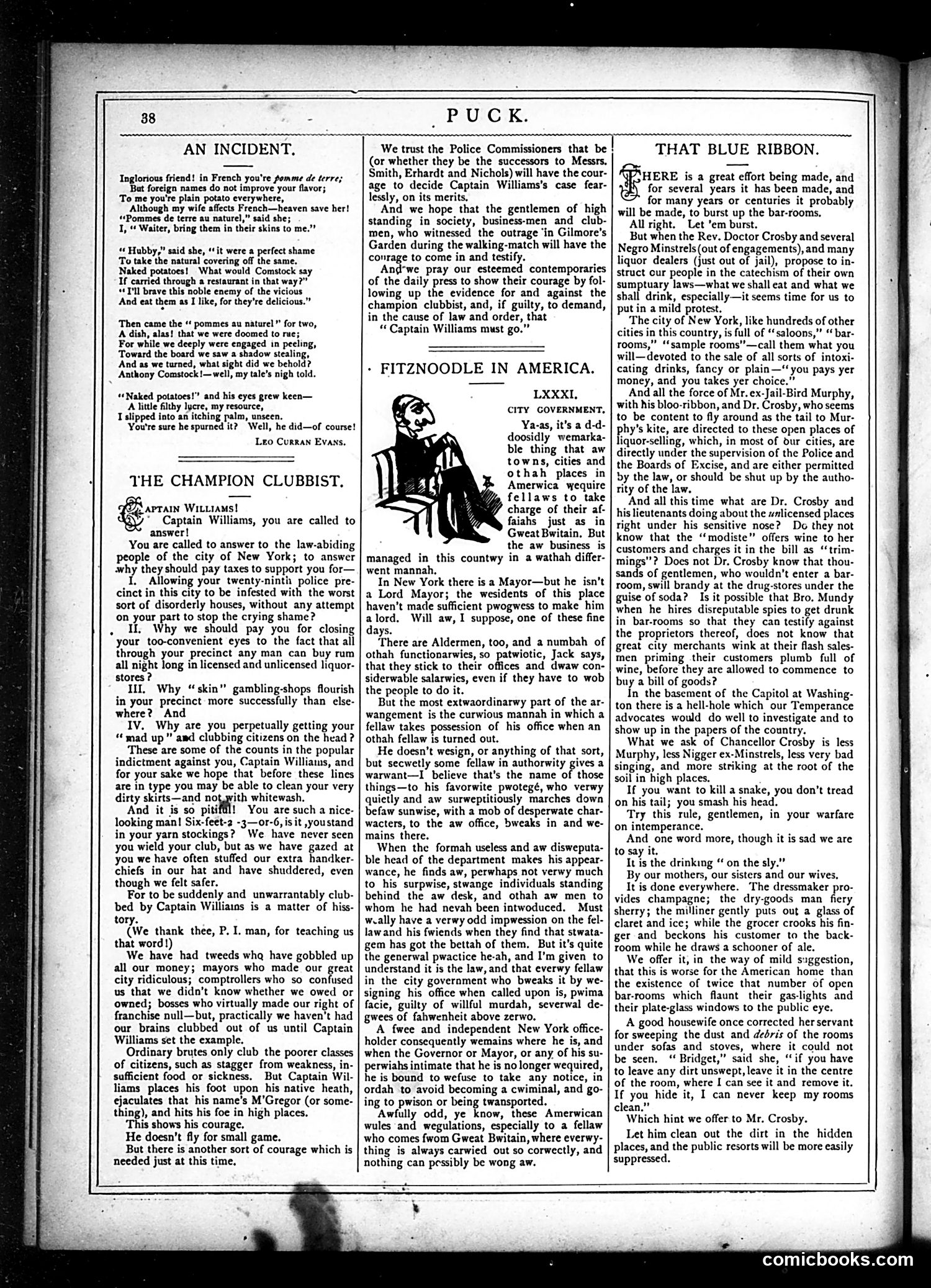
This section satirizes American city government's inefficiency compared to British administration. The cartoon depicts a figure (likely representing American municipal authority) slouching incompetently. The text critiques how American cities supposedly require "fellows to take charge of their affairs" like Britain does with colonial governors, suggesting American municipal leaders lack competence. It mocks the paradox: American cities claim independence yet perform worse than British-administered territories. The piece particularly targets corruption in New York City governance—specifically the Mayor's office and police commissioners. It argues that unlike Britain's orderly system, American cities tolerate widespread bribery, gambling dens, and liquor sales operating openly under official supervision, with police complicity rather than enforcement. The satire suggests American democracy produces worse governance than British hierarchy.
📄 Transcribed text from this page (OCR, searchable)
Machine-transcribed from the original scan — historical spelling and the odd misread are preserved.
_PUCK. AN INCIDENT, Inglorious friend! in French you're pomme de terre; Bat foreign names do not improve your flavor; To me you're plain potato everywhere, ‘Although my wife affects French—heaven save her! «“Pommes de terre au naturel,” said she; I, Waiter, bring them in their skins to me.”” «« Hubby,” said she, “it were a perfect shame To take the natural covering off the same. Naked potatoes! What would Comstock say If carried through restaurant in that way?” “Tl brave this noble enemy of the vicious And eat them as I like, for they're delicious.” Then came the “ pommes au naturel” for two, A dish, alas! that we were doomed to rue; For while we deeply were engaged in peeling, Toward the board we saw a shadow stealing, And as we turned, what sight did we behold? ‘Anthony Comstock !—well, my tale’s nigh told. “Naked 1 and his eyes grew keen— A little filthy Iycre, my resource, I slipped into an itching palm, unseen. You're sure he spurned it? ‘Well, he did—of course! Leo Curran Evans. THE CHAMPION CLUBBIST. EQ. APTAIN Wituams! Captain Williams, you are called to answer! You are called to answer to the law-abiding people of the city of New York; to answer why they should pay taxes to support you for— I. Allowing your twenty-ninth police pre- cinct in this city to be infested with the worst sort of disorderly houses, without any attempt on your part to stop the crying shame? Il. Why we should pay you for closing your too-convenient eyes to the fact that all through your precinct any man can buy rum all night long in licensed and unlicensed liquor- stores ? II, Why “skin” gambling-shops flourish in your precinct more successfully than else- where? And IV. Why are you perpetually getting your “mad up” and clubbing citizens on the head? These are some of the counts in the popular indictment against you, Captain Williams, and for your sake we hope that before these lines are in type you may be able to clean your very dirty skirts—and notywith whitewash. And it is so pitifal! You are such a nice- looking man! Six-feet-2 -3—or-6, is it youstand in your yarn stockings? We have never seen you wield your club, but as we have gazed at you we have often stuffed our extra handker- chiefs in our hat and have shuddered, even though we felt safer. For to be suddenly and unwarrantably club- bed by Captain Williains is a matter of hiss- tory. (We thank thee, P, I. man, for teaching us that word!) We have had tweeds whq have gobbled up all our money; mayors who made our great city ridiculous; comptrollers who so confused us that we didn’t know whether we owed or owned; bosses who virtually made our right of franchise null—but, practically we haven’t had our brains clubbed out of us until Captain Williams set the example, Ordinary brutes only club the poorer classes of citizens, such as stagger from weakness, in- sufficient food or sickness. But Captain Wil- liams places his foot upon his native heath, ejaculates that his name's M’Gregor (or some- thing), and hits his foe in high places. This shows his courage. He doesn't fly for small game. But there is another sort of courage which is needed just at this time. We trust the Police Commissioners that be (or whether they be the successors to Messrs. Smith, Erhardt and Nichols) will have the cour- age to decide Captain Williams's case fear- lessly, on its merits, And we hope that the gentlemen of high standing in society, business-men and club- men, who witnessed the outrage ‘in Gilmore's Garden during the walking-match will have the conrage to come in and testify. And*we pray our esteemed contemporaries of the daily press to show their courage by fol- lowing up the evidence for and against the champion clubbist, and, if guilty, to demand, in the cause of law and order, that “Captain Williams must go.” + FITZNOODLE IN AMERICA. LXXXI, CITY GOVERNMENT, Ya-as, it's a d-d- doosidly, wemarka- ble thing that aw towns, cities and othah places in Amerwica wequire fellaws to take charge of their af- faiahs just as in Gweat Bwitain. But the aw business is managed in this countwy in a wathah differ- went mannah, In New York there is a Mayor—but he isn’t a Lord Mayor; the wesidents of this place haven’t made sufficient pwogwess to make him alord. Will aw, I suppose, one of these fine days. There are Aldermen, too, and a numbah of othah functionarwies, so patwiotic, Jack says, that they stick to their offices and dwaw con- siderwable salarwies, even if they have to wob the people to do it. But the most extwaordinarwy part of the ar- wangement is the curwious mannah in which a fellaw takes possession of his office when an othah fellaw is turned out. He doesn’t wesign, or anything of that sort, but secwetly some fellaw in authorwity gives a warwant—I believe that's the name of those things—to his favorwite pwotegé, who verwy quietly and aw surweptitiously marches down befaw sunwise, with a mob of desperwate char- wacters, to the aw office, bweaks in and we- mains there. When the formah useless and aw disweputa- ble head of the department makes his appear- wance, he finds aw, perwhaps not verwy much to his surpwise, stwange individuals standing behind the aw desk, and othah aw men to whom he had nevah been intwoduced, Must wally have a verwy odd impwession on the fel- lawand his fwiends when they find that stwata- gem has got the bettah of them. But it’s quite the generwal pwactice he-ah, and I’m given to understand it is the law, and that everwy fellaw in the city government who bweaks it by we- signing his office when called upon is, pwima facie, guilty of willful murdah, severwal de- gwees of fahwenheit above zerwo. A fwee and independent New York office- holder consequently wemains where he is, and when the Governor or Mayor, or any of his su- perwiahs intimate that he is no longer wequired, he is bound to wefuse to take any notice, in ordah to avoid becoming a cwiminal, and go- ing to pwison or being twansported. ‘Awfully odd, ye know, these Amerwican wules and wegulations, especially to a fellaw who comes fwom Gweat Bwitain, where everwy- thing is always carwied out so corwectly, and nothing can pessibly be wong aw. THAT BLUE RIBBON. HERE is a great effort being made, and for several years it has been made, and for many years or centuries it probably will be made, to burst up the bar-rooms, All right. "Let ‘em burst. But when the Rev. Doctor Crosby and several Negro Minstrels (out of engagements), and many liquor dealers (just out of jail), propose to in- struct cur people in the catechism of their own sumpuaty. laws—what we shall eat and what we shall drink, especially—it seems time for us to put in a mild protest, The city of New York, like hundreds of other cities in this country, is full of “saloons,” “ bar- rooms,” sample rooms"—call them what you will—devoted to the sale of all sorts of intoxi- cating drinks, fancy or plain— you pays yer money, and you takes yer choice.” And all the force of Mr.ex-Jail-Bird Murphy, with his bloo-ribbon, and Dr. Crosby, who seems to be content to fly around as the tail to Mur- phy’s kite, are directed to these open places of iquor-selling, which, in most of dur cities, are directly under the supervision of the Police and the Boards of Excise, and are either permitted by the law, or should be shut up by the autho- rity of the law. And all this time what are Dr. Crosby and his lieutenants doing about the unlicensed places right under his sensitive nose? Do they not know that the ‘‘modiste” offers wine to her customers and charges it in the bill as ‘trim- mings’? Does not Dr. Crosby know that thou- sands of gentlemen, who wouldn’t enter a bar- room, swill brandy at the drug-stores under the guise of soda? Is it possible that Bro. Mundy when he hires disreputable spies to get drunk in bar-rooms so that they can testify against the proprietors thereof, does not know that great city merchants wink at their flash sales- men priming their customers plumb full of wine, vefore they are allowed to commence to buy a bill of goods? In the basement of the Capitol at Washing- ton there is a hell-hole which our Temperance advocates would do well to investigate and to show up in the papers of the country, What we ask of Chancellor Crosby is less Murphy, less Nigger ex-Minstrels, less very bad singing, and more striking at the root of the soil in high places. If you want to kill a snake, you don’t tread on his tail; you smash his head. Try this rule, gentlemen, in your warfare on intemperance. And one word more, though it is sad we are to say it. It is the drinking “ on the sly.” By our mothers, our sisters and our wives, It is done everywhere. The dressmaker pro- vides champagne; the dry-goods man fiery sherry; the milliner gently puts out a glass of claret and ice; while the grocer crooks his fin- ger and beckons his customer to the back- room while he draws a schooner of ale. We offer it, in the way of mild suggestion, that this is worse for the American home than the existence of twice that number of open bar-rooms which flaunt their gas-lights and their plate-glass windows to the public eye. A good housewife once corrected her servant for sweeping the dust and debris of the rooms under sofas and stoves, where it could not be seen. ‘ Bridget,” said she, “if you have to leave any dirt unswept, leave it in the centre of the room, where I can see it and remove it. If you hide it, I can never keep my rooms clean.” Which hint we offer to Mr. Crosby. Let him clean out the dirt in the hidden places, and the public resorts will be more easily suppressed. comicbooks.com