
A complete issue · 16 pages · 1879
Puck — February 12, 1879
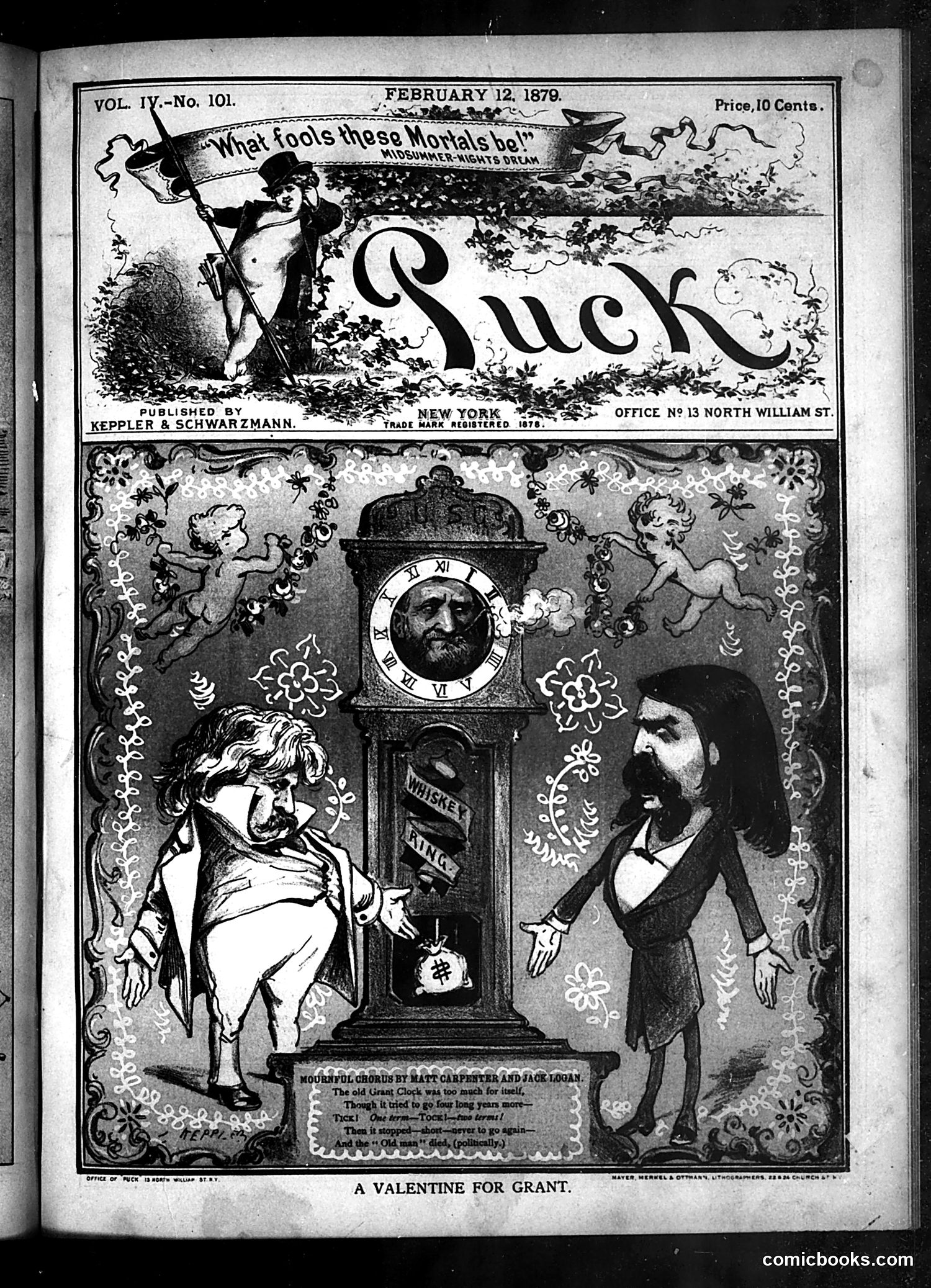
This February 1879 *Puck* cartoon satirizes President Ulysses S. Grant through an ornate clock mechanism. The image shows two figures flanking a grandfather clock: on the left, a rotund man appears distressed, while on the right stands a man with a distinctive mustache. The clock face displays Grant's bearded face at its center. The caption references "Mourning Chords by Matt Carpenter and Iago Logan," suggesting commentary on Grant's administration or legacy. The overall composition appears to mock Grant's presidency, possibly his financial mismanagement or political controversies, by reducing him to a mechanical timepiece—suggesting his era has passed or his influence is mechanical/artificial rather than substantive.
This page contains political commentary titled "After the Battle," satirizing President Grant's administration. The text mocks Grant for exhibiting a "dead-give-away" expression when presenting his Cabinet to Congress—suggesting his opponents controlled the political spectacle despite his party's opposition. The satire criticizes Republican leadership, particularly comparing Hayes unfavorably to Grant and suggesting Democratic political maneuvering. References to "Conkling," "Sherman," and other Cabinet figures indicate this targets specific Grant-era officials and factional disputes. The "Puckerings" column offers lighter social commentary on manners and naval matters. A separate piece titled "A Valentine for Grant" praises Grant's preventing Puck magazine from bankruptcy, suggesting this is partisan Republican advocacy dressed as satire. The page appears to date from the Grant presidency era (1869-1877), focusing on intra-Republican conflicts.
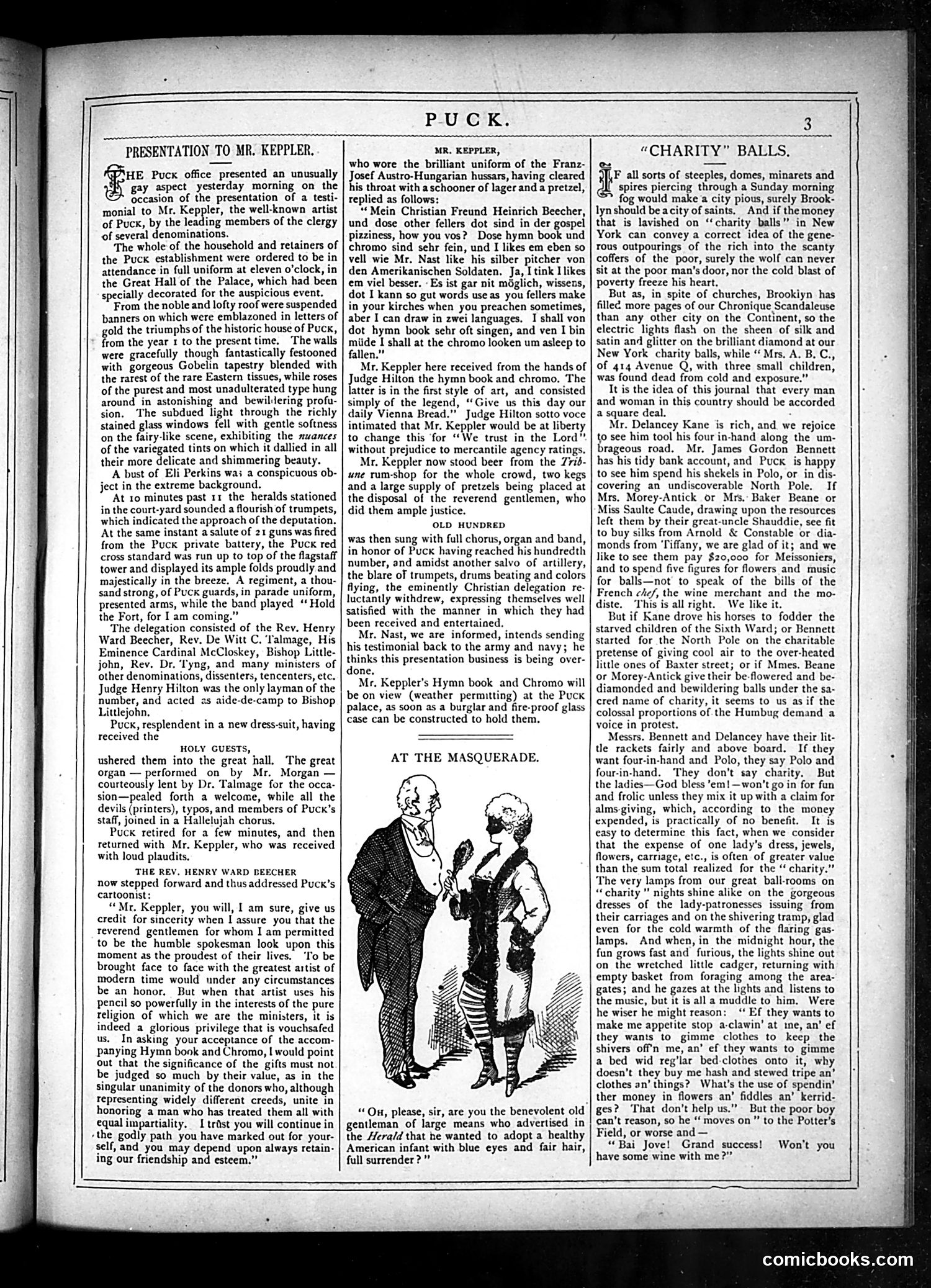
This page contains two distinct pieces: **"Presentation to Mr. Keppler"** describes a ceremonial gift to Puck's founder/editor. The text details decorations and entertainment at what appears to be a formal event honoring him, with references to clergy members and various dignitaries attending. **"Charity Balls"** (right column) critiques wealthy society women's charity fundraising. The satire argues that lavish ball expenses—dresses, jewelry, carriages—often exceed funds actually donated to the poor. It mocks the pretense of charitable intent when the real purpose appears to be displaying wealth and social status. **"At the Masquerade"** (bottom) shows an illustrated dialogue between two figures. The caption suggests satire about adoption schemes or fraudulent charitable solicitations, likely mocking either con artists exploiting charitable impulses or the gullibility of wealthy donors. The page collectively satirizes both institutional charity and wealthy patronage as performative rather than genuinely philanthropic.
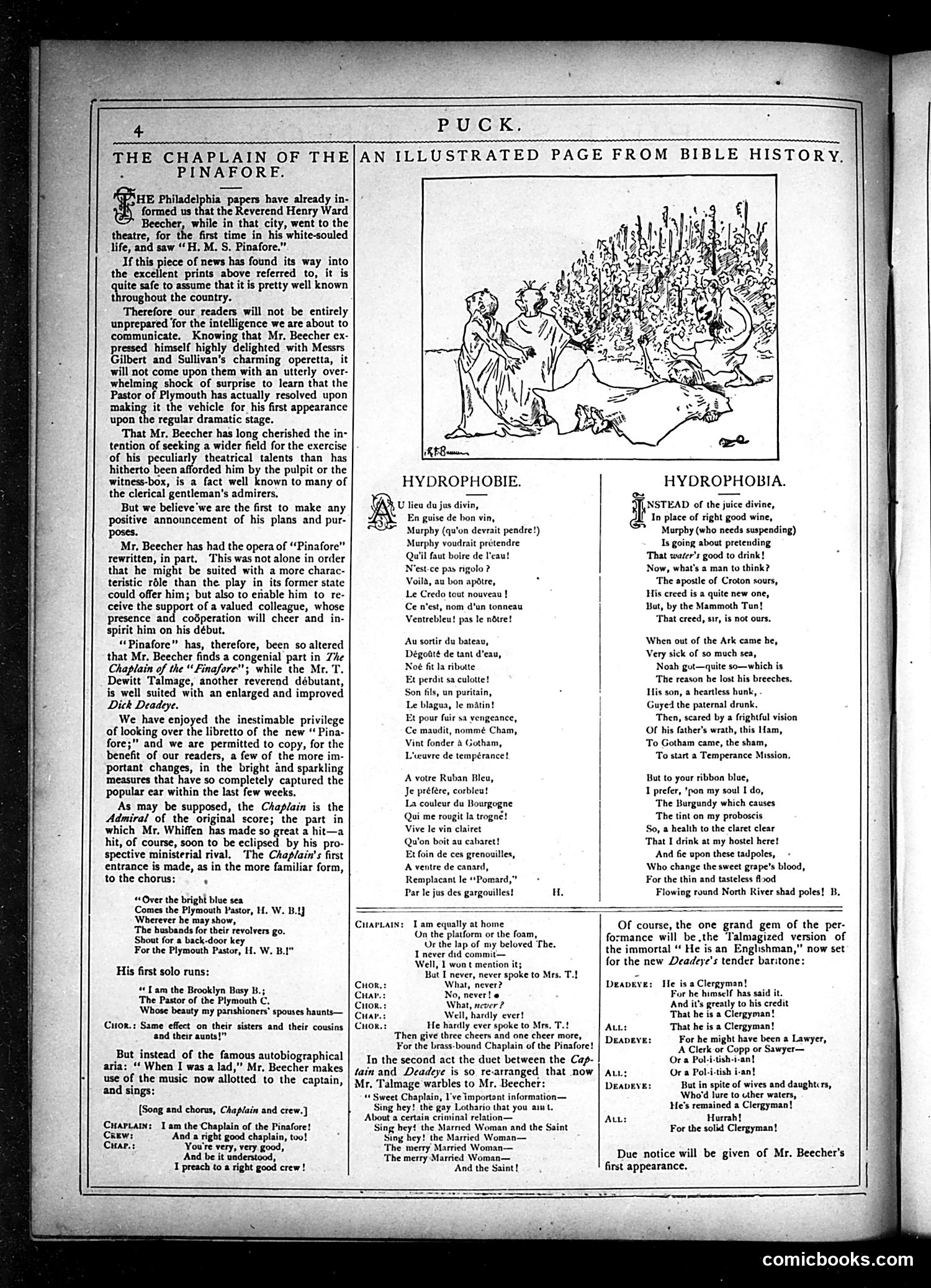
This page primarily contains theatrical commentary rather than political satire. The left column discusses Reverend Henry Ward Beecher's attendance at a theater production of "Pinafore" (Gilbert & Sullivan's *HMS Pinafore*), noting this was his first theater visit. The text humorously suggests this event warrants announcement despite Beecher's prominence. The center illustration appears to depict a biblical scene with multiple figures, labeled "An Illustrated Page from Bible History." The right side contains extensive theatrical material—two poems titled "Hydrophobia" and "Hydrophobia" (possibly contrasting perspectives), followed by dialogue and song lyrics from *Pinafore*, including character exchanges between a Chaplain, Crew, and other roles. The page is primarily cultural/entertainment commentary rather than political satire.
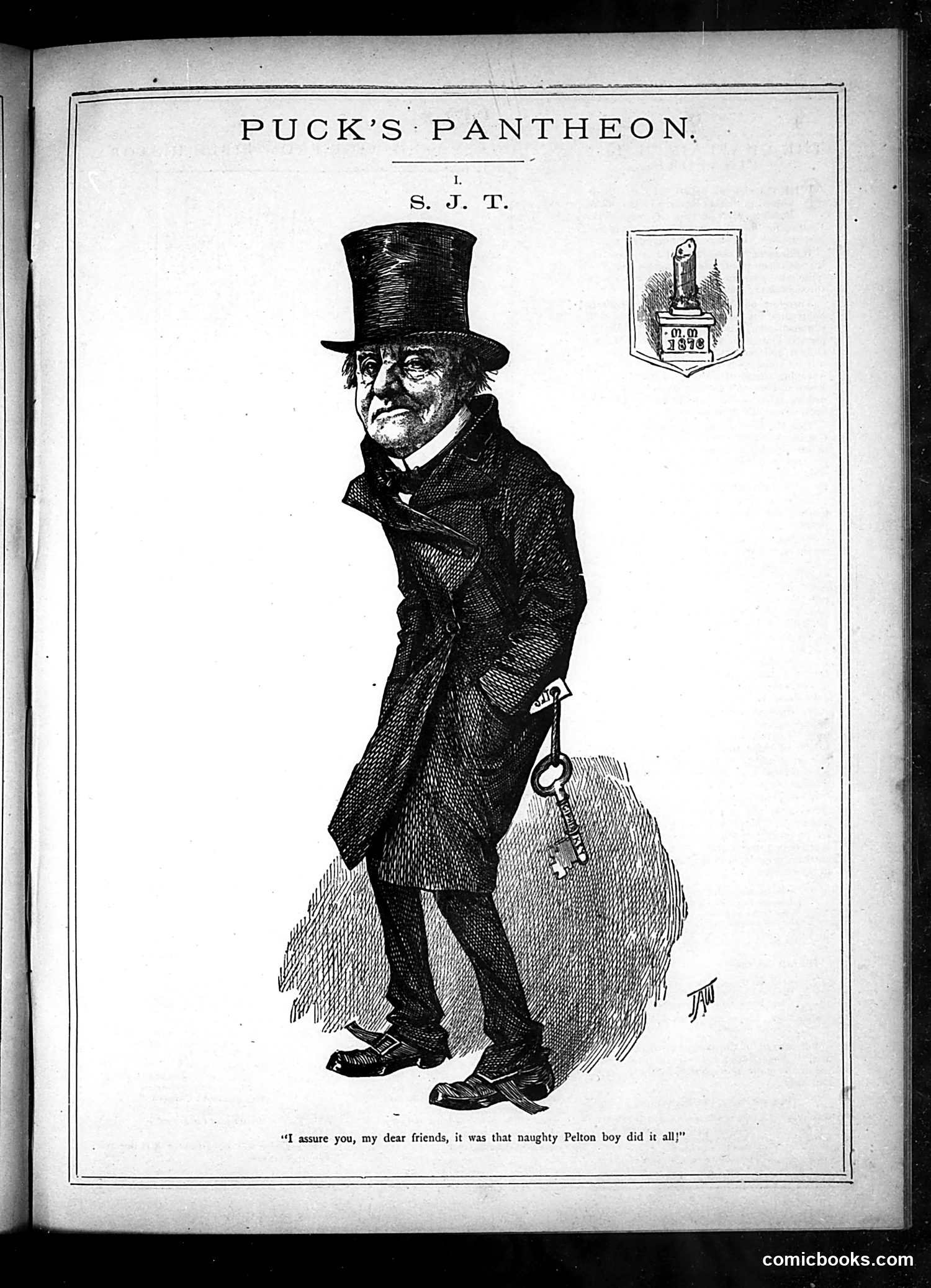
This is a caricature from Puck's "Pantheon" series, section I, depicting a figure identified by initials "S.J.T." The man wears formal Victorian attire—top hat, tailcoat, and carries a monocle on a chain—presenting himself as a gentleman of means or influence. The caption reads: "I assure you, my dear friends, it was that naughty Pelton boy did it all!" The satire suggests this dignified figure is deflecting blame onto someone named Pelton. Without additional context, the specific political or social scandal referenced remains unclear, though the cartoon mocks how powerful or prominent individuals might scapegoat others to preserve their reputation. The elaborate formal dress emphasizes his pretension to respectability while attempting to evade accountability.
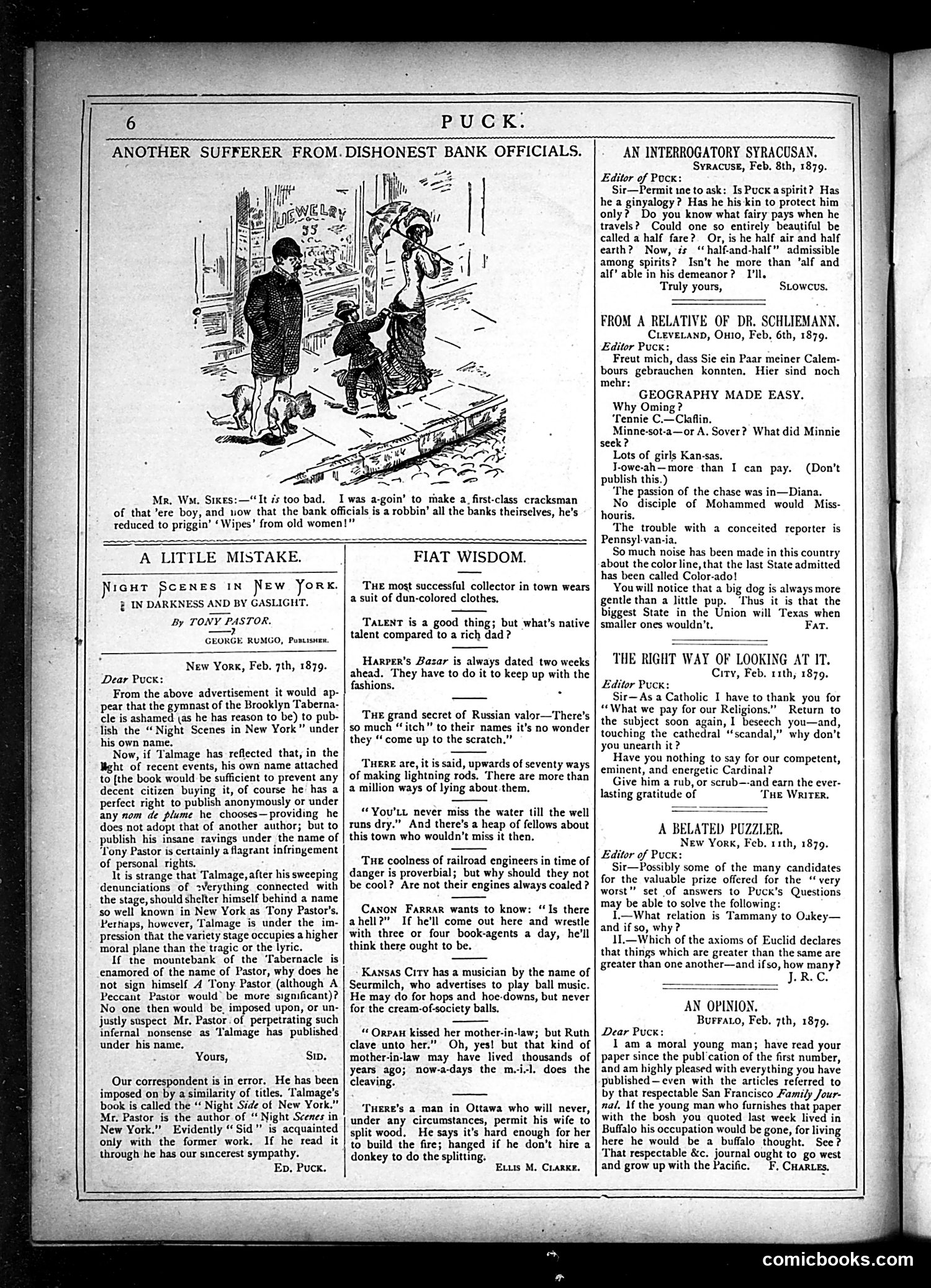
The main cartoon, "Another Sufferer from Dishonest Bank Officials," depicts a man confronting what appears to be a bank employee at a window, with a child present. The caption quotes the man saying the bank officials are "robbin' all the banks themselves," suggesting he's been defrauded—possibly in connection with the broader banking scandals of the 1870s post-Civil War era. The page contains primarily reader letters and editorial commentary rather than political cartoons. Topics include humorous questions about fairy tales and Irish geography, discussions of Russian naming conventions, and railroad engineer safety concerns. The overall tone is light satirical commentary on contemporary social and cultural matters rather than pointed political critique.
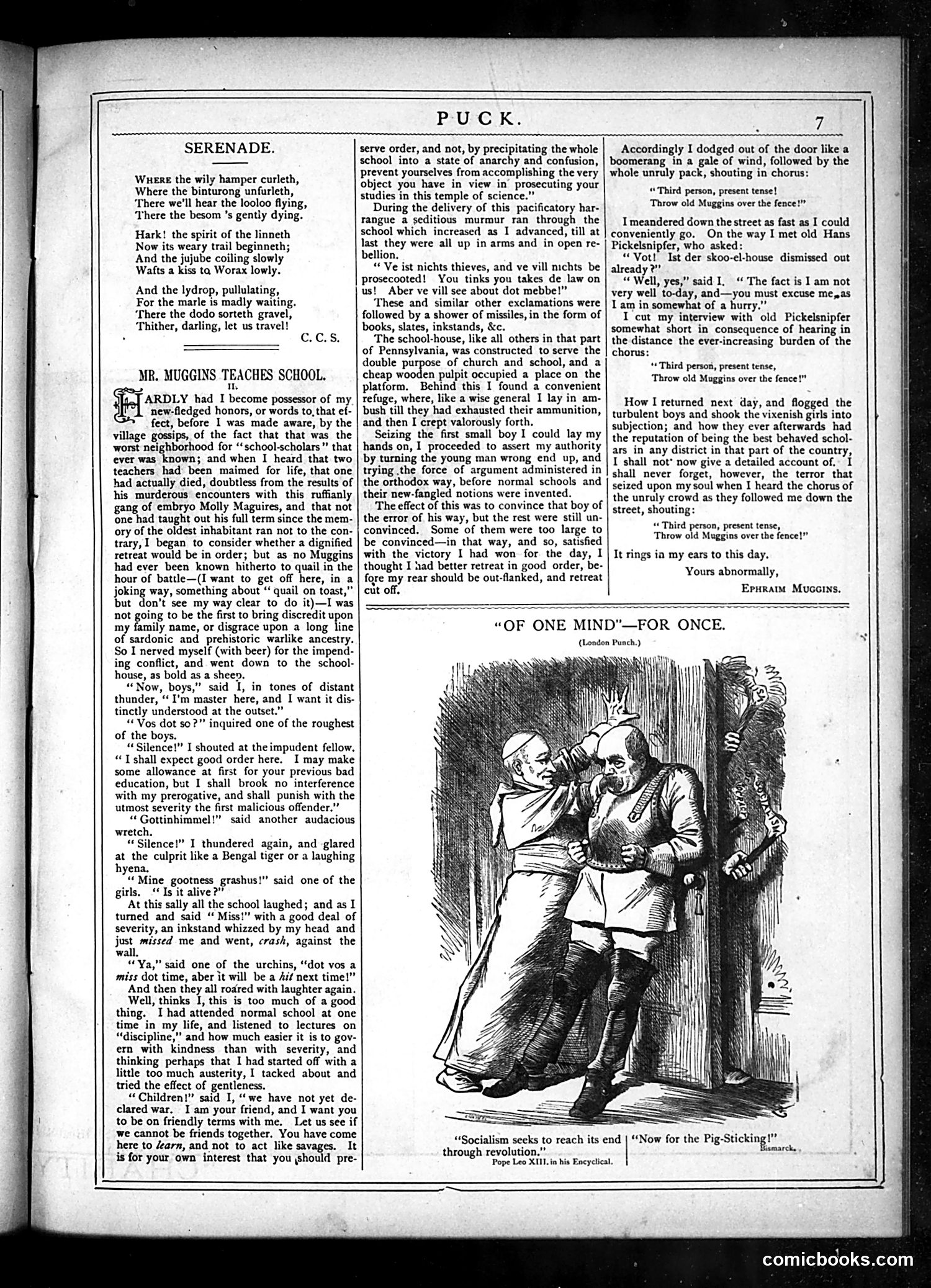
The main cartoon titled **"Of One Mind—For Once"** (credited to Cesare) depicts a figure labeled as representing **Socialism** attempting to reach a goal through violent revolution. The caption below reads: "Socialism seeks to reach its end / 'Now for the Pig-Sticking!'" with a reference to Pope Leo XIII's encyclical. The satire mocks socialist movements by suggesting they use violent, crude methods ("pig-sticking") rather than legitimate reform. The figure's aggressive posture and the phrase's brutality imply socialists are dangerous radicals. This reflects late-19th-century anxieties about revolutionary socialism in America, portraying it as primitive and destructive rather than reasoned political change. The surrounding text discusses a schoolmaster's disciplinary experiences, unrelated to the political cartoon.
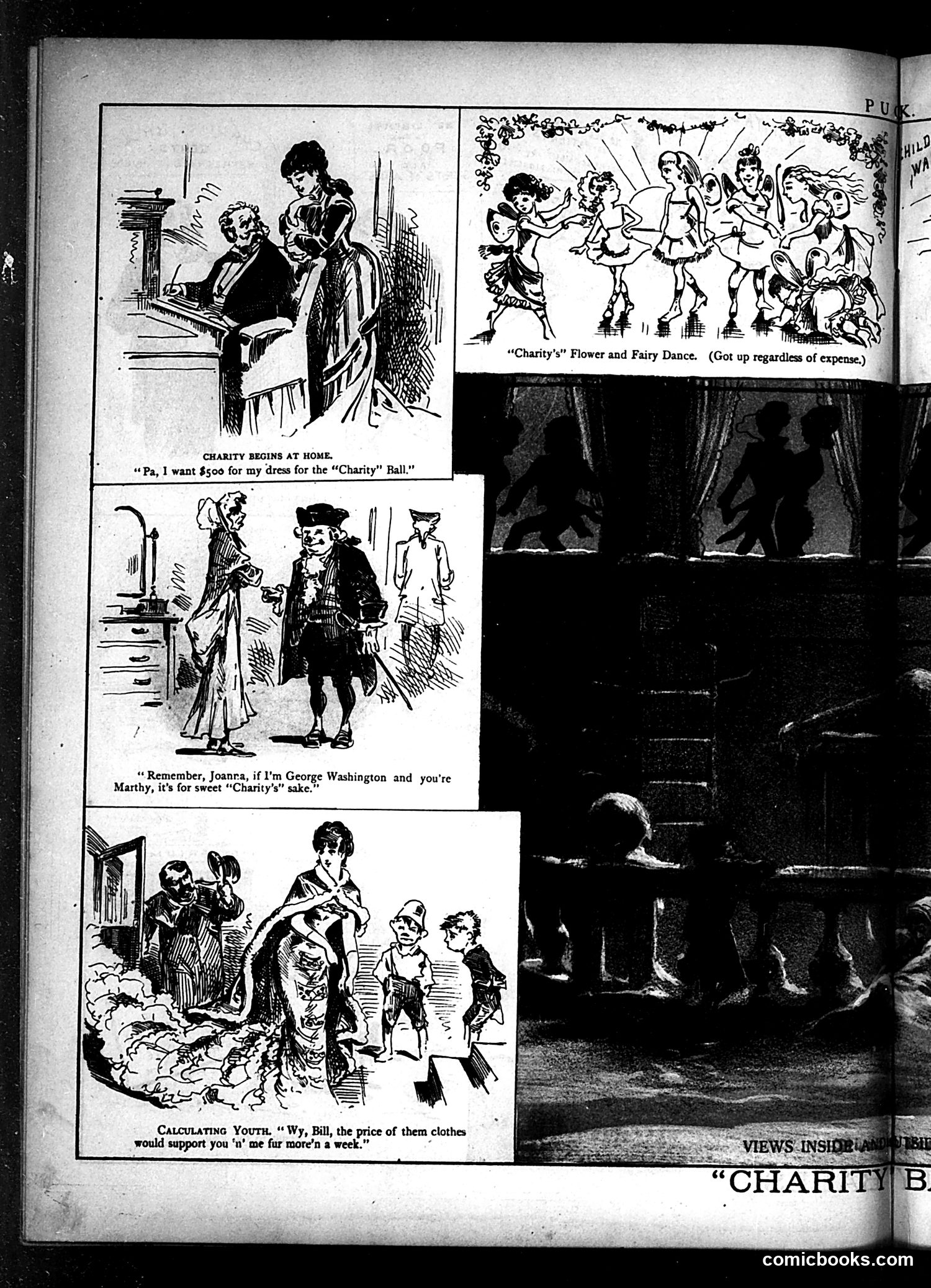
This page satirizes "charity" through multiple scenes showing hypocrisy. **Top left**: A woman asks her husband for $500 for a "Charity Ball"—a wealthy social event. **Top right**: The caption "Charity's Flower and Fairy Dance" depicts elaborately dressed children, mocking how charity events prioritize spectacle over actual aid. **Middle**: A man references George Washington to convince "Joanna" to contribute "for sweet Charity's sake"—using patriotic manipulation for donations. **Bottom**: "Calculating Youth" shows a man reasoning that children's expensive clothes could support families for weeks, questioning whether charity truly helps the poor or merely enables wealthy people's social performances. The cartoon criticizes how the wealthy use charity events for entertainment and social status rather than genuine concern for the needy.
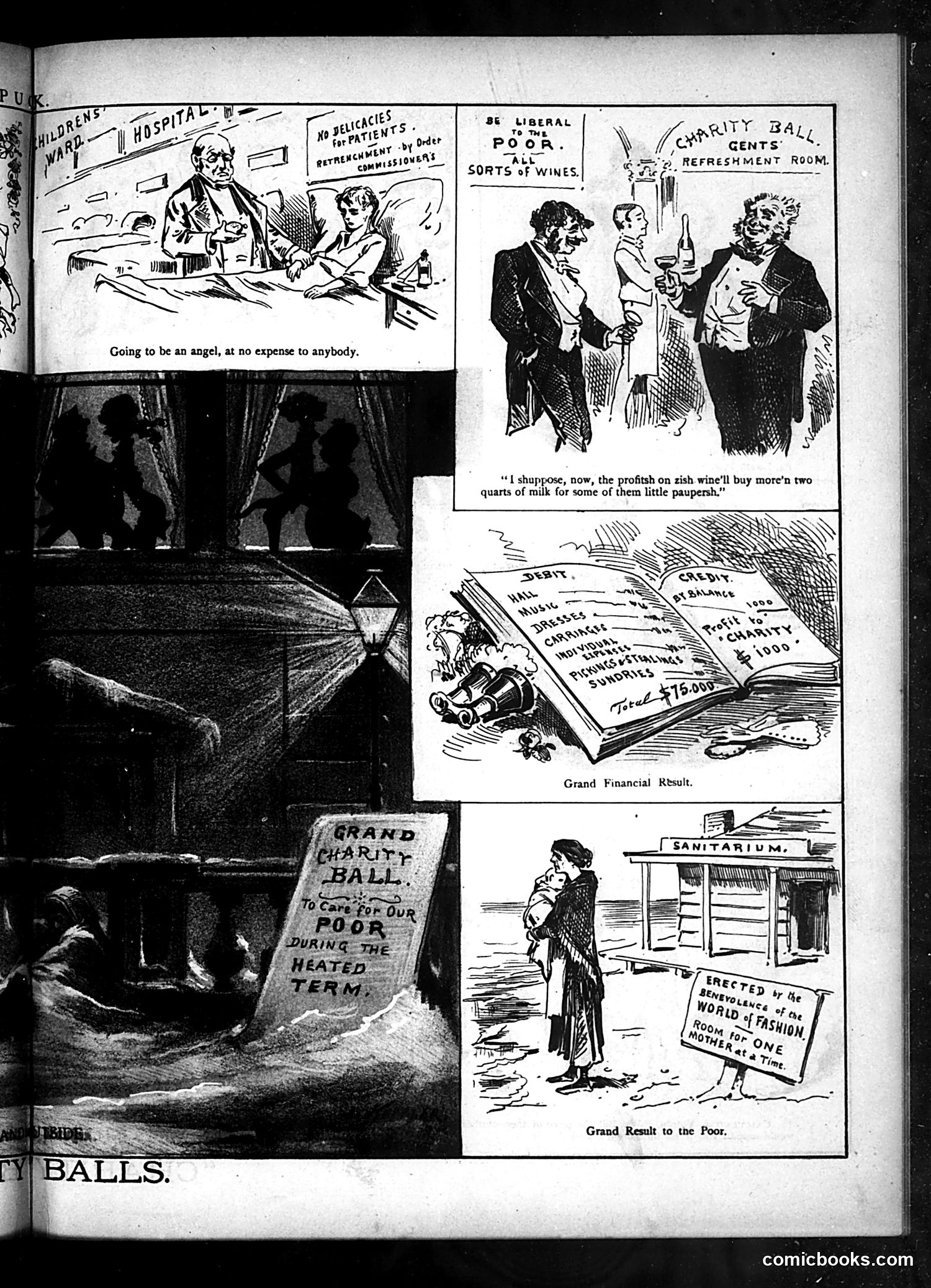
This page satirizes the hypocrisy of charity galas. The top panel shows a hospital ward where a dying child receives "no delicacies" under "retrenchment by order of commissioners," while the right panels depict wealthy attendees at a "Charity Ball" indulging in wine and fine dining—the "Grand Financial Result" showing £15,000 raised but little reaching the poor. The bottom panel titled "Grand Result to the Poor" shows a destitute mother and child outside a sanitarium, highlighting the disconnect between charitable fundraising and actual aid to the needy. The satire critiques how Victorian charitable institutions served more as social venues for the wealthy than as effective relief mechanisms, with most funds apparently absorbed by overhead rather than helping the suffering poor the galas ostensibly served.
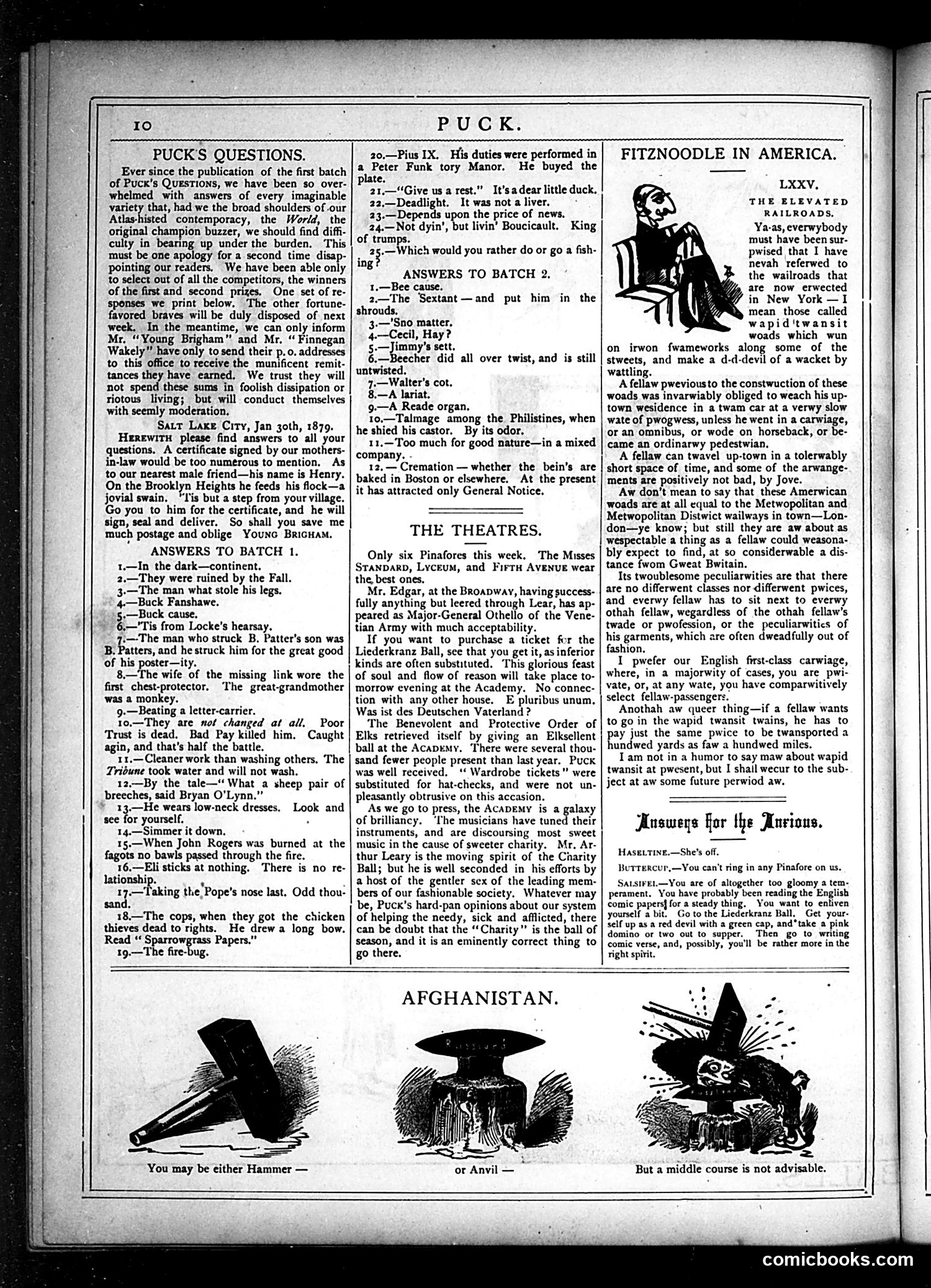
This political cartoon appears in Puck's satirical section and comments on the British military situation in Afghanistan (likely the Second Anglo-Afghan War, 1879-1880, based on the magazine's date). The cartoon presents three options using blacksmith imagery: "Hammer," "Anvil," and "a middle course is not advisable." This suggests the British faced a binary choice in Afghanistan—aggressive military action or defensive posturing—with compromise being impossible. The hammer and anvil metaphor implies that Afghanistan would either be the hammer (aggressor) or anvil (victim) in military conflict, with Britain caught between extremes. The satire critiques what Puck viewed as the impractical middle-ground approach to colonial military strategy, advocating instead for decisive action one way or another.
This page from *Puck* magazine contains a serialized story titled "The Body of a Bankrupt" by R.E. Francillon, set in Belgavia. The narrative is a melodramatic tale centered on a widow named Marie and her financial struggles following her husband's death. The story involves Marie's attempts to secure her late husband's necklace (allegedly his property, not hers), conflicts with creditors and a banker, and emotional pleas from a monsieur attempting to purchase her love and devotion in exchange for financial relief. The satire targets how poverty and desperation can render women vulnerable to exploitation and moral compromise. This appears to be **serialized fiction rather than a political cartoon**, using social commentary to critique class dynamics and gender vulnerability in financial crises.
This page contains **no political cartoon**—it's primarily text and a decorative header. The main content is a serialized story titled "Pascal Fénis" (continuing from previous issues), which appears to be a melodrama about a goldsmith and jeweler's romantic entanglements and financial troubles. The right column features **"Puck's Persiflages"**—brief satirical commentary on contemporary issues, including references to politics (presidential elections), religion (Mormon polygamy), journalism, and social customs. These are witty one-liners mocking various public figures and current events, rather than illustrated cartoons. The page demonstrates Puck's dual nature: serialized fiction alongside short-form satirical commentary on topical issues.
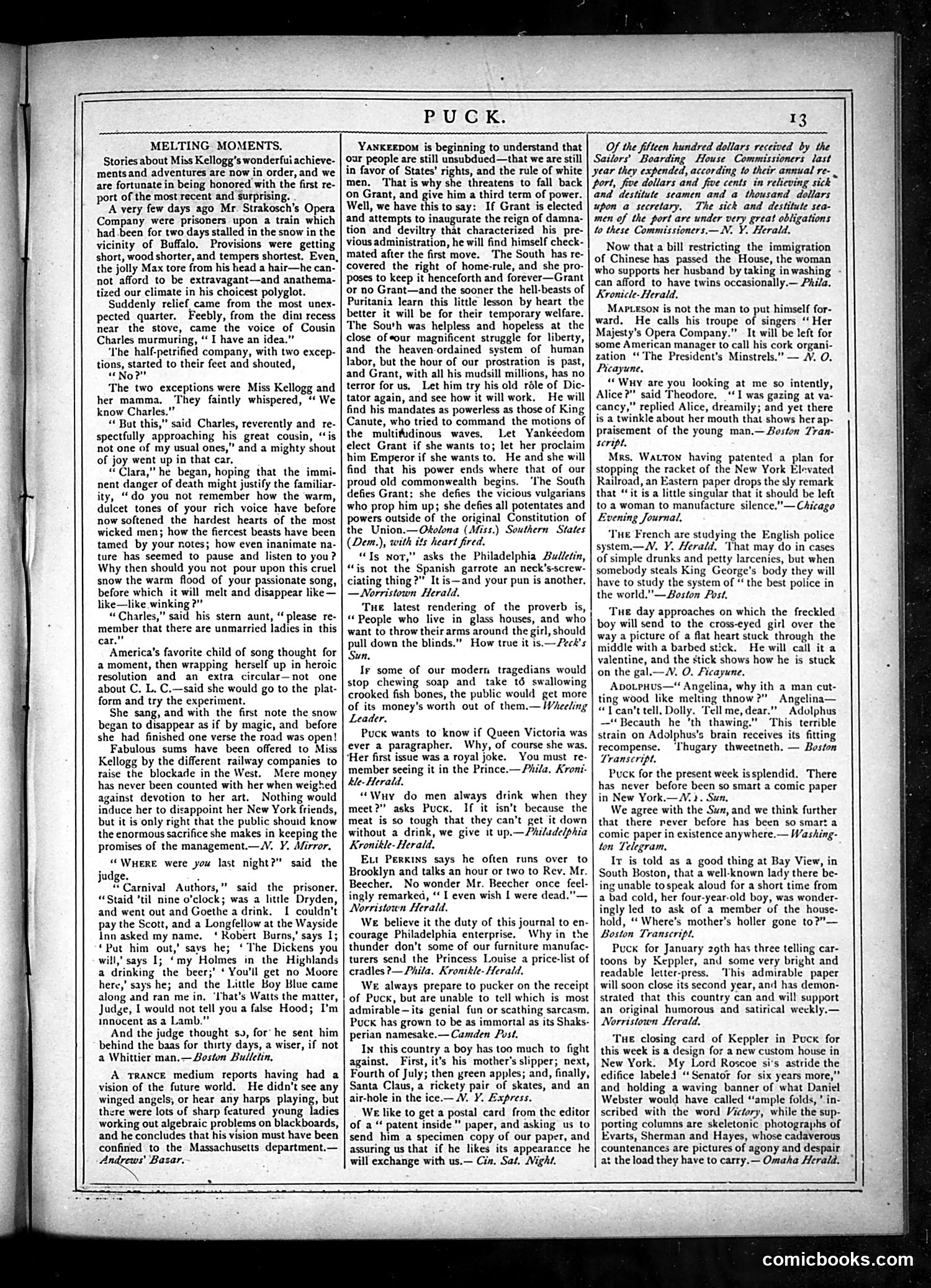
This page contains satirical commentary rather than cartoons. The "Melting Moments" section mocks contemporary political and social figures through brief witty observations. Key references include: - **Grant's administration**: Criticism of President Ulysses S. Grant's policies and associates regarding states' rights and racial issues - **Miss Kellogg**: A famous opera singer whose extravagant lifestyle is satirized - **Charles**: Appears to be a character in domestic humor - **Various social commentary**: Jokes about immigration ("Chinese bill"), railroad corruption, and public morality The satire targets wealthy industrialists, political hypocrisy, and contemporary scandals through gossip-style commentary. Most specific references are unclear without additional historical context, though the overall tone ridicules the powerful and fashionable of the era.
This page is predominantly **advertising and notices** rather than political cartoons. The visible content includes: **Main Elements:** - Spring cotton dress materials advertisement (Arnold, Constable & Co.) - German Liederkranz Masquerade Ball announcement (February 1879) - Arion Masquerade Ball notice - Various New York business advertisements (photographer, dentist, tailor, restaurant) - A small satirical piece titled "CAN CATARRH BE CURED?" promoting Pond's Extract as a cure **Satirical Content:** The catarrh cure piece appears to mock exaggerated medical claims popular in the era, using humorous testimonials to suggest Pond's Extract could remedy what seems an incurable condition—typical of Puck's consumer skepticism. The masquerade ball announcements reflect 1870s New York's active social scene. Overall, this is a commercial page with minimal political satire.
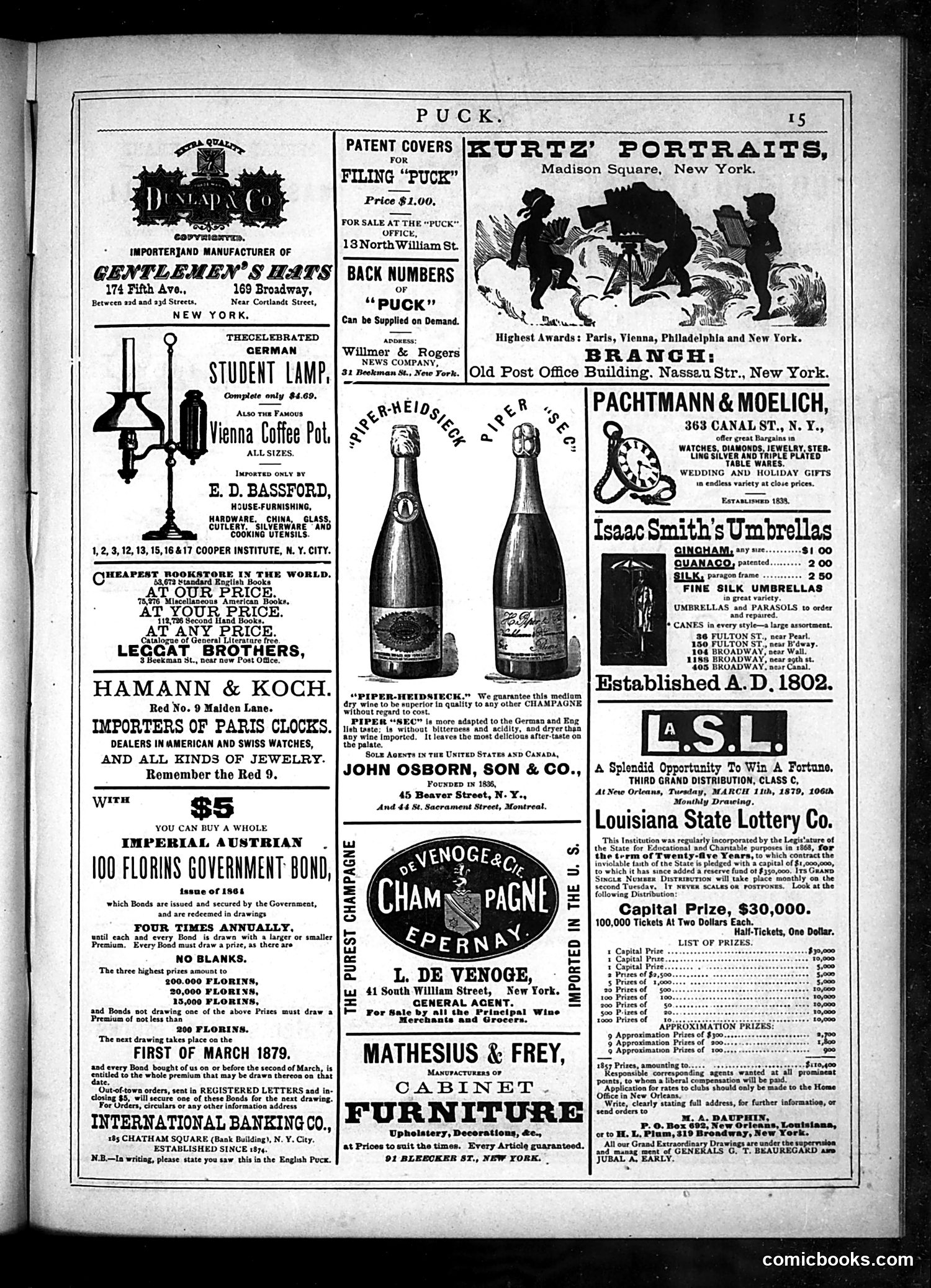
This page is primarily **advertising**, not political satire. It contains numerous commercial notices from late 19th-century New York businesses, including: - Wine and champagne merchants (Piper-Heidsieck, J. De Venoge) - Furniture manufacturers (Mathesius & Frey) - Jewelry importers (Hamann & Koch) - Book retailers and bond dealers - The Louisiana State Lottery The only illustration with potential satirical content appears in the upper right: **Kurtz's Portraits** featuring silhouettes of figures, though the specific political or social commentary is unclear from the image alone. The page also advertises Puck's own products: patent covers for filing issues and back numbers of the magazine. This appears to be a revenue-generating advertising section rather than editorial content.
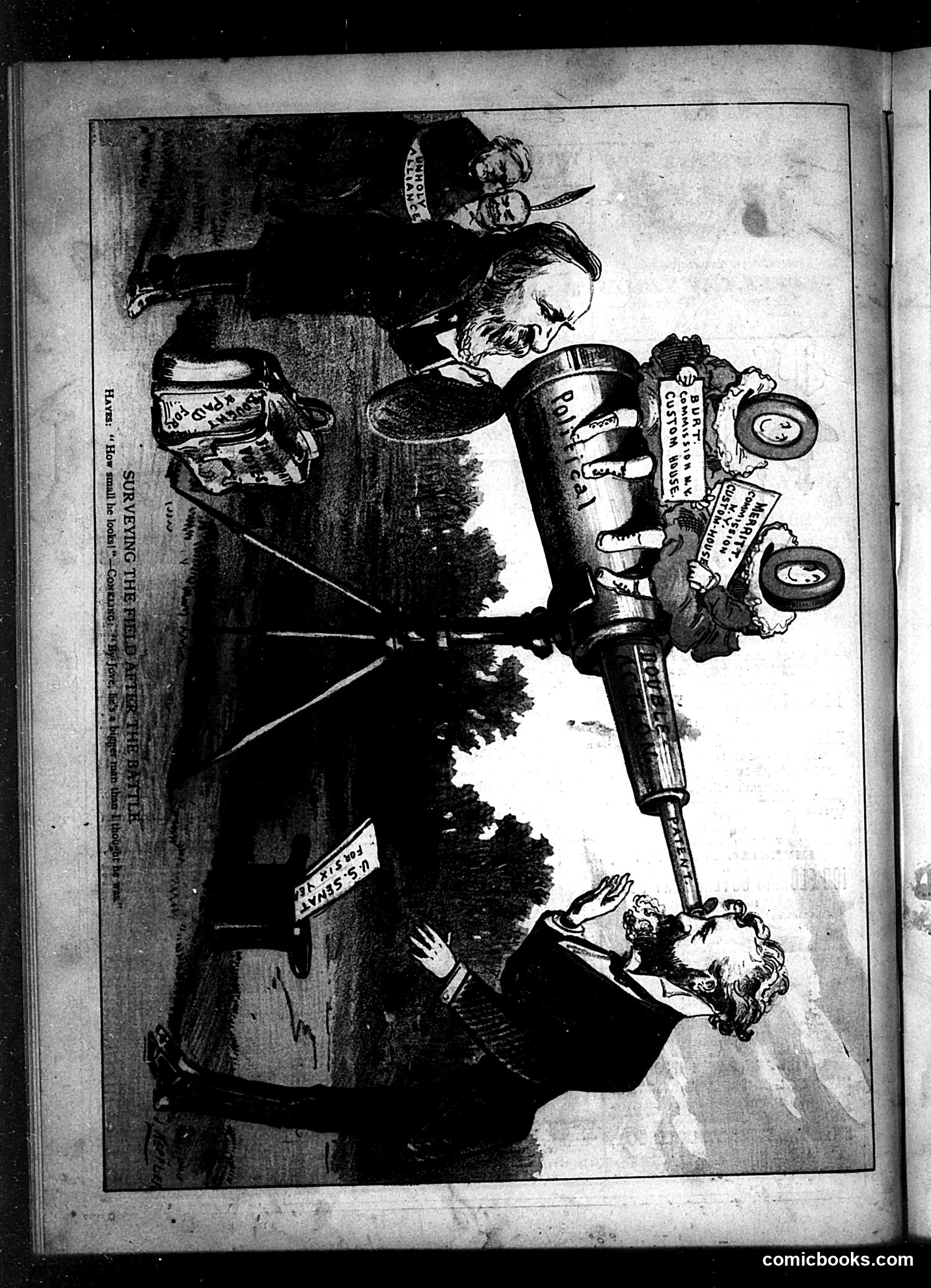
This appears to be a Puck magazine satirical cartoon (rotated 90 degrees) depicting a large syringe or medical injector being wielded by a mustachioed man in formal dress. A smaller figure at top and another below appear to be receiving or reacting to its contents. The visible text references "SWINDLER THE FEED" and mentions "CARBOLIC ACID" or similar chemical substances on the syringe barrel. The satire likely criticizes fraudulent medical practices or quack medicine—a common Puck target. The "swindler" figure represents a charlatan doctor or con artist using dubious chemical treatments on gullible patients. The exaggerated scale and grotesque imagery emphasize the absurdity and danger of such deception. Without clearer OCR text or date confirmation, the specific political scandal or medical fraud being referenced remains unclear, though it reflects late 19th/early 20th-century concerns about unregulated medical practitioners.