
Puck, 1879-02-12 · page 3 of 16
Puck — February 12, 1879 — page 3: what you’re looking at
What you’re looking at
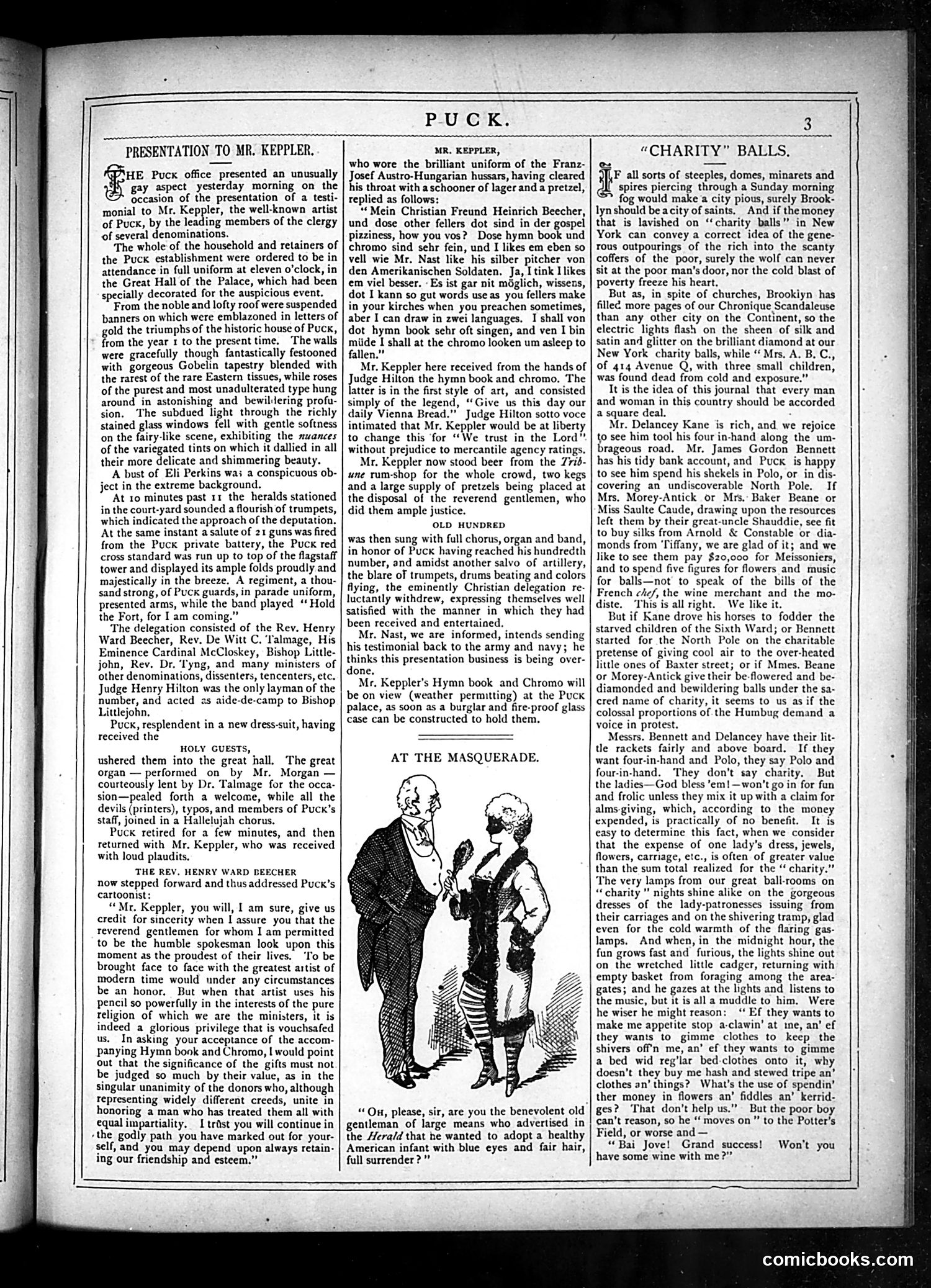
This page contains two distinct pieces: **"Presentation to Mr. Keppler"** describes a ceremonial gift to Puck's founder/editor. The text details decorations and entertainment at what appears to be a formal event honoring him, with references to clergy members and various dignitaries attending. **"Charity Balls"** (right column) critiques wealthy society women's charity fundraising. The satire argues that lavish ball expenses—dresses, jewelry, carriages—often exceed funds actually donated to the poor. It mocks the pretense of charitable intent when the real purpose appears to be displaying wealth and social status. **"At the Masquerade"** (bottom) shows an illustrated dialogue between two figures. The caption suggests satire about adoption schemes or fraudulent charitable solicitations, likely mocking either con artists exploiting charitable impulses or the gullibility of wealthy donors. The page collectively satirizes both institutional charity and wealthy patronage as performative rather than genuinely philanthropic.
📄 Transcribed text from this page (OCR, searchable)
Machine-transcribed from the original scan — historical spelling and the odd misread are preserved.
PRESENTATION TO MR. KEPPLER. HE Puck office presented an unusually gay aspect yesterday morning on the occasion of the presentation of a testi- monial to Mr. Keppler, the well-knawn artist of Puck, by the leading members of the clergy ‘of several denominations. The whole of the household and retainers of the Puck establishment were ordered to be in attendance in full uniform at eleven o'clock, in the Great Hall of the Palace, which had been specially decorated for the auspicious event. From the noble and lofty roof were suspended banners on which were emblazoned in letters of old the triumphs of the historic house of Puck, from the year 1 to the present time, The walls were gracefully though fantastically festooned with gorgeous Gobelin tapestry blended with the rarest of the rare Eastern tissues, while roses of the purest and most unadulterated type hung around in astonishing and bewiliering profu- sion, The subdued light through the richly stained glass windows fell with gentle softness on the fairy-like scene, exhibiting the nuances of the variegated tints on which it dallied in all their more delicate and shimmering beauty. A bust of Eli Perkins was a conspicuous ob- ject in the extreme background. P At 10 minutes past 11 the heralds stationed in the court-yard sounded a flourish of trumpets, which indicated the approach of the deputation. At the same instant a salute of 21 guns was fired from the Puck private battery, the Puck red cross standard was run up to top of the flagstaff tower and displayed its ample folds proudly and majestically in the breeze. A regiment, a thou- sand strong, of Puck guards, in parade uniform, presented arms, while the band played ‘ Hold the Fort, for I am coming.” The delegation consisted of the Rev. Henry Ward Beecher, Rev. De Witt C. ‘Talmage, His Eminence Cardinal McCloskey, Bishop Little- john, Rev. Dr. ‘l'yng, and many ministers of other denominations, dissenters, tencenters, etc, Judge Henry Hilton was the only layman of the number, and acted 2s aide-de-camp to Bishop Littlejohn, Puck, resplendent in a new dress-suit, having received the HOLY GUESTS, ushered them into the great hall. The great organ — performed on by Mr. Morgan — courteously lent by Dr. Talmage for the occa- sion—pealed forth a welcome, while all the devils (printers), typos, and members of Puck’s staff, joined in a Hallelujah chorus. Puck retired for a few minutes, and then returned with Mr. Keppler, who was received with loud plaudits, THE REV, HENRY WARD BEECHER now stepped forward and thus addressed Puck’s cartoonist: “Mr. Keppler, you will, | am sure, give us credit for sincerity when I assure you that the reverend gentlemen for whom I am permitted to be the humble spokesman look upon this moment as the proudest of their lives. ‘Io be brought face to face with the greatest artist of modern time would under any circumstances be an honor. But when that artist uses his pencil so powerfully in the interests of the pure religion of which we are the ministers, it is indeed a glorious privilege that is vouchsafed us. In asking your acceptance of the accom- panying Hymn book and Chromo, | would point out that the significance of the gifts must not. be judged so much by their value, as in the singular unanimity of the donors who, although representing widely different creeds, unite in honoring a man who has treated them all with equal impartiality. I tritst you will continue in -the godly path you have marked out for your- self, and you may depend upon always retain- ing our friendship and esteem.” MR. KEPPLER, who wore the brilliant uniform of the Franz- Josef Austro-Hungarian hussars, having cleared his throat with a schooner of lager and a pretzel, replied as follows: “Mein Christian Freund Heinrich Beecher, und dose other fellers dot sind in der gospel pizziness, how you vos? Dose hymn book und chromo sind sehr fein, und I likes em eben so vell wie Mr. Nast like his silber pitcher von den Amerikanischen Soldaten. Ja, I tink I likes em viel besser. Es ist gar nit maglich, wissens, dot I kann so gut words use as you fellers make in your kirches when you preachen sometimes, aber I can draw in zwei languages. I shall von dot hymn book sehr oft singen, and ven I bin miide I shall at the chromo looken um asleep to fallen.” Mr. Keppler here received from the hands of Judge Hilton the hymn book and chromo. The latter is in the first style of art, and consisted simply of the legend, “Give us this day our daily Vienna Bread.” Judge Hilton sotto voce intimated that Mr. Keppler would be at liberty to change this ‘for “We trust in the Lord” without prejudice to mercantile agency ratings. Mr. Keppler now stood beer from the Z7ib- une rum-shop for the whole crowd, two kegs and a large supply of pretzels being placed at the disposal of the reverend gentlemen, who did them ample justice. OLD HUNDRED was then sung with full chorus, organ and band, in honor of Puck having reached his hundredth number, and amidst another salvo of artillery, the blare of trumpets, drums beating and colors flying, the eminently Christian delegation re- luctantly withdrew, expressing themselves well satisfied with the manner in which they had been received and entertained. Mr. Nast, we are informed, intends sending his testimonial back to the army and navy; he thinks this presentation business is being over- done. Mr. Keppler’s Hymn book and Chromo will be on view (weather permitting) at the Puck palace, as soon as a burglar and fire-proof glass case can be constructed to hold them. AT THE MASQUERADE, “ Ou, please, sir, are you the benevolent old gentleman of large means who advertised in the Hera/d that he wanted to adopt a healthy American infant with blue eyes and fair hair, full surrender?” “CHARITY” BALLS. ir all sorts of steeples, domes, minarets and a spires piercing through a Sunday morning fog would make'a city pious, surely Brook- lyn should be acity of saints. And if the money that is lavished on ‘charity balls” in New York can convey a correct idea of the gene- Tous outpourings of the rich into the scanty coffers of the poor, surely the wolf can never sit at the poor man’s door, nor the cold blast of poverty freeze his heart. But as, in spite of churches, Brookiyn has fillec more pages of our Chronique Scandaleuse than any other city on the Continent, so the electric lights flash on the sheen of silk and satin and glitter on the brilliant diamond at our New York charity balls, while “ Mrs. A. B. C., of 414 Avenue Q, with three small children, was found dead from cold and exposure.” It is the idea of this journal that every man and woman in this country should be accorded a square deal. S Mr. Delancey Kane is rich, and we rejoice to see him tool his four in-hand along the um- brageous road. Mr. James Gordon Bennett has his tidy bank account, and Puck is happy to see him spend his shekels in Polo, or in dis- covering an undiscoverable North Pole. If Mrs. Morey-Antick or Mrs. Baker Beane or Miss Saulte Caude, drawing upon the resources left them by their great-uncle Shauddie, see fit to buy silks from Arnold & Constable or dia- monds from ‘Tiffany, we are glad of it; and we like to see them pay $20,000 for Meissoniers, and to spend five figures for flowers and music for balls—not to speak of the bills of the French ccf, the wine merchant and the mo- diste. This is all right. We like it. But if Kane drove his horses to fodder the starved children of the Sixth Ward; or Bennett started for the North Pole on the charitable pretense of giving cool air to the over-heated little ones of Baxter street; or if Mmes. Beane or Morey-Antick give their be-flowered and be- diamonded and bewildering balls under the sa- cred name of charity, it seems to us as if the colossal proportions of the Humbug demand a voice in protest. Messrs. Bennett and Delancey have their lit- tle rackets fairly and above board. If they want four-in-hand and Polo, they say Polo and four-in-hand. They don't say charity, But the ladies—God bless ’em!—won’t go in for fun and frolic unless they mix it up with a claim for alms-giving, which, according to the money expended, is practically of no benefit. It is easy to determine this fact, when we consider that the expense of one lady’s dress, jewels, flowers, carriage, etc., is often of greater value than the sum total realized for the “ charity.” ‘The very lamps from our great bali-rooms on “charity " nights shine alike on the gorgeous dresses of the lady-patronesses issuing from their carriages and on the shivering tramp, glad even for the cold warmth of the flaring gas- lamps. And when, in the midnight hour, the fun grows fast and furious, the lights shine out on the wretched little cadger, returning with empty basket from foraging among the area- gates; and he gazes at the lights and listens to the music, but it is all a muddle to him. Were he wiser he might reason: ‘‘ Ef they wants to make me appetite stop a-clawin’ at ine, an’ ef they wants to gimme clothes to keep the shivers off'n me, an’ ef they wants to gimme a bed wid reg’lar bed-clothes onto it, why doesn’t they buy me hash and stewed tripe an’ clothes an’ things? What's the use of spendin’ ther money in flowers an’ fiddles an’ kerrid- ges? That don’t help us.” But the poor boy can’t reason, so he ‘‘ moves on” to the Potter’s Field, or worse and — “Bai Jove! Grand success! Won't you have some wine with me?” comicbooks.com