
Puck, 1879-02-12 · page 13 of 16
Puck — February 12, 1879 — page 13: what you’re looking at
What you’re looking at
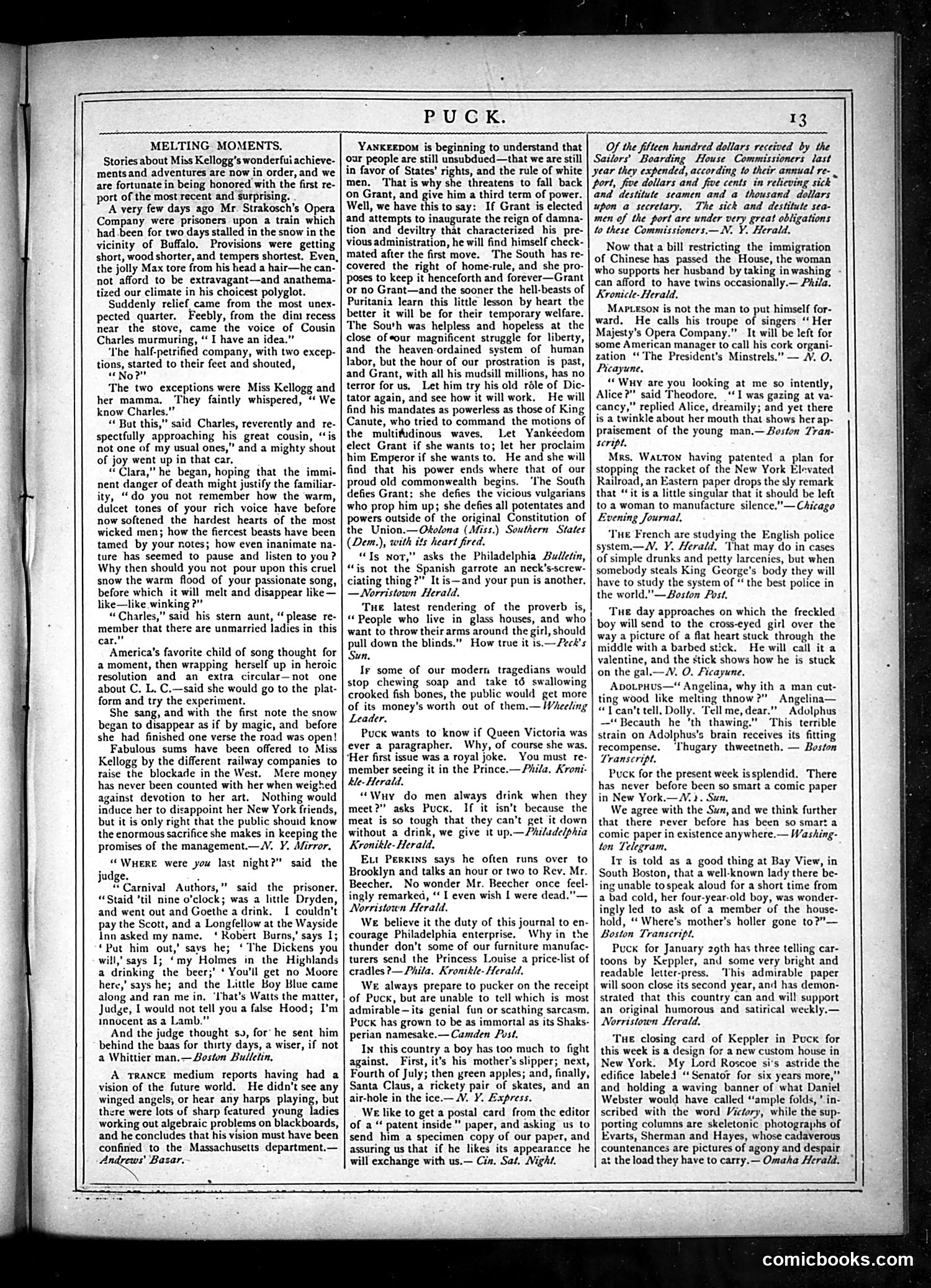
This page contains satirical commentary rather than cartoons. The "Melting Moments" section mocks contemporary political and social figures through brief witty observations. Key references include: - **Grant's administration**: Criticism of President Ulysses S. Grant's policies and associates regarding states' rights and racial issues - **Miss Kellogg**: A famous opera singer whose extravagant lifestyle is satirized - **Charles**: Appears to be a character in domestic humor - **Various social commentary**: Jokes about immigration ("Chinese bill"), railroad corruption, and public morality The satire targets wealthy industrialists, political hypocrisy, and contemporary scandals through gossip-style commentary. Most specific references are unclear without additional historical context, though the overall tone ridicules the powerful and fashionable of the era.
📄 Transcribed text from this page (OCR, searchable)
Machine-transcribed from the original scan — historical spelling and the odd misread are preserved.
PUCK. x3) MELTING MOMENTS. Stories about Miss Kellogg’s wonderfui achieve- ments and adventures are now in order, and we are fortunate in being honored with the first re- port of the most recent and surprising. A very few days ago Mr. Strakosch’s Opera Company were prisoners upon a train which had been for two days stalled in the snow in the vicinity of Buffalo. Provisions were getting short, wood shorter, and tempers shortest. Even, the jolly Max tore from his head a hair—he can- not afford to be extravagant—and anathema- tized our climate in his choicest polyglot. Suddenly relief. came from the most unex- pected quarter. Feebly, from the dint recess near the stove, came the voice of Cousin Charles murmuring, “I have an idea.” ‘The half-petrified company, with two excep- tions, started to their feet and shouted, “No?” The two exceptions were Miss Kellogg and They faintly whispered, “ We her mamma, know Charles.” «But this,” said Charles, reverently and re- spectfully approaching his great cousin, ‘is not one of my usual ones,” and a mighty shout of joy went up in that car, “Clara,” he began, hoping that the immi- nent danger of death might justify the familiar- ity, ‘do you not remember how the warm, dulcet tones of your rich voice have before now softened the hardest hearts of the most wicked men; how the fiercest beasts have been tamed by your notes; how even inanimate na- ture has seemed to pause and listen to you? Why then should you not pour upon this cruel snow the warm flood of your passionate song, before which it will melt and disappear like— like—like winking ?” “Charles,” said his stern aunt, “ please re- member that there are unmarried ladies in this car.” America’s favorite child of song thought for a moment, then wrapping herself up in heroic resolution and an extra circular—not one about C. L, C.—said she would go to the plat- form and try the experiment. She sang, and with the first note the snow began to disappear as if by magic, and before she had finished one verse the road was open! Fabulous sums have been offered to Miss Kellogg by the different railway companies to raise the blockade in the West. Mere money has never been counted with her when weighed against devotion to her art. Nothing would induce her to disappoint her New York friends, but it is only right that the public should know the enormous sacrifice she makes in keeping the promises of the management.—M. Y. Mirror. “Wuere were you last night?” said the judge. * “Carnival Authors,” said the prisoner. “Staid 'til nine o’clock; was a little Dryden, and went out and Goethe a drink. 1 couldn't pay the Scott, and a Longfellow at the Wayside Inn asked my name. ‘ Robert Burns,’ says 1; *Put him out,’ says he; ‘The Dickens you will,’ says 1; ‘my Holmes in the Highlands a drinking the beer;’ ‘ You'll get no Moore here,’ says he; and the Little Boy Blue came along and ran me in, ‘Ihat’s Watts the matter, Judge, I would not tell you a false Hood; I'm innocent as a Lamb.” And the judge thought so, for’ he sent him behind the baas for thirty days, a wiser, if not a Whittier man.— Boston Bulletin, A TRANCE medium reports having had a vision of the future world. He didn’t see any winged angels, or hear any harps playing, but there were lots of sharp featured young ladies working out algebraic problems on blackboards, and he concludes that his vision must have been confined to the Massachusetts department.— oe ‘Basar, YANKEEDOM is beginning to understand that our people are still unsubdued—that we are still in favor of States’ rights, and the rule of white men. That is why she threatens to fall back on Grant, and give him a third term of power. Well, we have this to say: If Grant is elected and attempts to inaugurate the reign of damna- tion and deviltry that characterized his pre- vious administration, he will find himself check- mated after the first move. The South has re- covered the right of home-rule, and she pro- poses to keep it henceforth and forever—Grant or no Grant—and the sooner the hell-beasts of Puritania learn this little lesson by heart the better it will be for their temporary welfare. The South was helpless and hopeless at the close ofsour magnificent struggle for liberty, and the heaven-ordained system of human labor, but the hour of our prostration is past, and Grant, with all his mudsill millions, has no terror for us, Let him try his old réle of Dic- tator again, and see how it will work. He will find his mandates as powerless as those of King Canute, who tried to command the motions of the multitudinous waves, Let Yankeedom elect Grant if she wants to; let her proclaim him Emperor if she wants to, He and she will find that his power ends where that of our proud old commonwealth begins. ‘rhe South defies Grant: she defies the vicious vulgarians who prop him up; she defies all potentates and powers outside of the original Constitution of the Union.—Okolona (Miss.) Southern States (Dem.), with its heart fred. “Ts not,” asks the Philadelphia Bud/etin, “is not the Spanish garrote an neck's-screw- ciating thing?” It is—and your pun is another, —Norristown Herald, Tue latest rendering of the proverb is, “People who live in glass houses, and who want to throw their arms around the girl, should pull down the blinds.” How true it is.—/%ch's Sun, Ir some of our modern tragedians would stop chewing soap and take té swallowing crooked fish bones, the public would get more of its money's worth out of them.— Wheeling Leader. Puck wants to know if Queen Victoria was ever a paragrapher. Why, of course she was, ‘Her first issue was a royal joke. You must re- member seeing it in the Prince.— Phila, Kroni- kle- Herald. “Wuy do men always drink when they meet?” asks Puck. If it isn’t because the meat is so tough that they can’t get it down without a drink, we give it up.—Philadelphia Kronikle- Herald. Ext Perkins says he often runs over to Brooklyn and talks an hour or two to Rev. Mr. Beecher. No wonder Mr. Beecher once feel- ingly remarked, ‘I even wish I were dead.” — Norristown Herald. We believe it the duty of this journal to en- courage Philadelphia enterprise. Why in the thunder don’t some of our furniture manufac- turers send the Princess Louise a price-list of cradles ?—Phila, Krontkle- Herald, We always prepare to pucker on the receipt of Puck, but are unable to tell which is most admirable—its genial fun or scathing sarcasm, Puck has grown to be as immortal as its Shaks- perian namesake.—Camden Post. In this country a boy has too much to fight against. First, it’s his mother's slipper; next, Fourth of July; then green apples; and, finally, Santa Claus, a rickety pair of skates, and an air-hole in the ice.— 4. Y. Express. We like to get a postal card from the editor of a “ patent inside” paper, and asking us to send him a specimen copy of our paper, and assuring us that if he likes its appearance he will exchange with us.— Cin. Sat, Night. Of the fifteen hundred dollars received by the Sailors’ “Boarding House Commissioners last year they expended, according to their annual re- port, five dollars and five cents in relieving sick ‘and’ destitute seamen and a thousand dollars upon a secretary. The sick and destitute sea- men of the port are under very great obligations to these Commissioners,—N. Y. Herald. Now that a bill restricting the immigration of Chinese has d the House, the woman who supports her husband by taking inwashing - can afford to have twins occasionally.— Phila. Kronicle-Herald, Mapteson is not the man to put himself for- ward, He calls his troupe of singers ‘‘ Her Majesty's Opera Company.” It will be left for some American manager to call his cork organi- zation “The President’s Minstrels.” — WV. O. Picayune. ““Wuy are you looking at me so intently, Alice?” said Theodore. ‘I was gazing at va- cancy,” replied Alice, dreamily; and yet there is a twinkle about her mouth that shows her ap- praisement of the young man.— Boston Zran- script. Mrs. Watton having patented a plan for stopping the racket of the New York Elevated Railroad, an Eastern paper drops the sly remark that “it is a little singular that it should be left to a woman to manufacture silence.”— Chicago Evening Journal. ‘Tue French are studying the English police system.—W. ¥. Herald. ‘That may do in cases of simple drunks and petty larcenies, but when somebody steals King George's body they will have to study the system of “ the best police in the world.” — Boston Post. ‘Tue day approaches on which the freckled boy will send to the cross-eyed girl over the way a picture of a flat heart stuck through the middle with a barbed stick. He will call it a valentine, and the stick shows how he is stuck on the gal.—J. O. Ficayune. Apopnus— Angelina, why ith a man cut- ting wood like melting thnow ?” Angelina— “Tcan'’t tell, Dolly. Tell me, dear.” Adolphus —‘*Becauth he ’th thawing.” This terrible strain on Adolphus’s brain receives its fitting recompense. ‘Ihugary thweetneth. — Boston Transcript. Puck for the present week issplendid. There has never before been so smart a comic paper in New York.—. 2. Sun, We agree with the Sun, and we think further that there never before has been so smart a comic paper in existence anywhere.— Washing- ton Telegram. Ir is told as a good thing at Bay View, in South Boston, that a well-known lady there be- ing unable tospeak aloud for a short time from a bad cold, her four-year-old boy, was wonder- ingly led to ask of a member of the house- hold, ‘ Where’s mother’s holler gone to?”— Boston Transcript. Puck for January 29th has three telling car- toons by Keppler, and some very bright and readable letter-press. ‘This admirable paper will soon close its second year, and has demon- strated that this country can and will support an original humorous and satirical weekly Norristown Herald, ‘Tue closing card of Keppler in Puck for this week is a design for a new custom house in New York. My Lord Roscoe si's astride the edifice labeled “Senator for six years more,” and holding a waving banner of what Daniel Webster would have called ‘‘ample folds, ’ in- scribed with the word Victory, while the sup- porting columns are skeletonic photographs of Evarts, Sherman and Hayes, whose cadaverous countenances are pictures of agony and despair at the load they have to carry.— Omaha Herald. comicbooks.com