
Puck, 1879-02-12 · page 11 of 16
Puck — February 12, 1879 — page 11: what you’re looking at
What you’re looking at
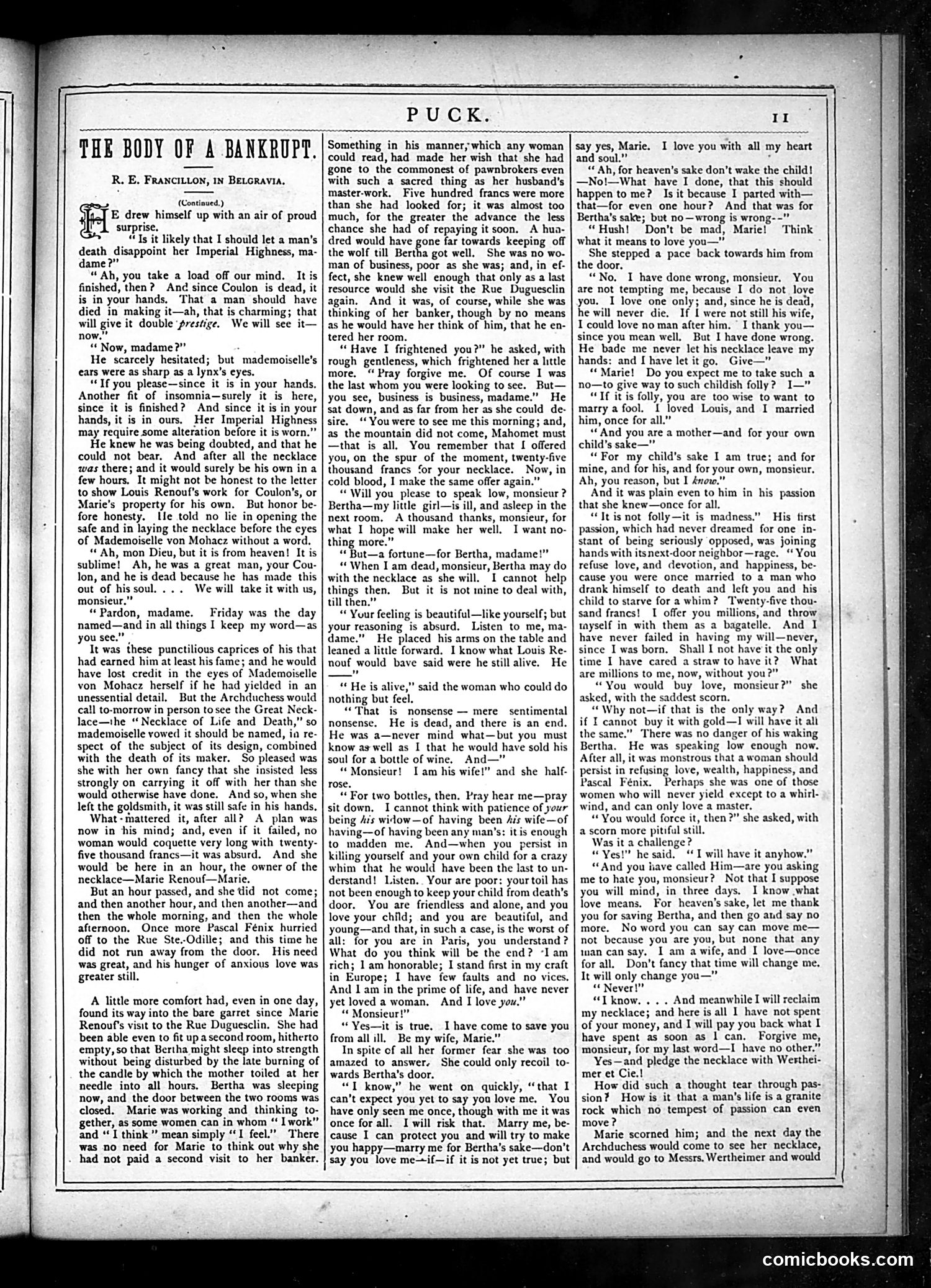
This page from *Puck* magazine contains a serialized story titled "The Body of a Bankrupt" by R.E. Francillon, set in Belgavia. The narrative is a melodramatic tale centered on a widow named Marie and her financial struggles following her husband's death. The story involves Marie's attempts to secure her late husband's necklace (allegedly his property, not hers), conflicts with creditors and a banker, and emotional pleas from a monsieur attempting to purchase her love and devotion in exchange for financial relief. The satire targets how poverty and desperation can render women vulnerable to exploitation and moral compromise. This appears to be **serialized fiction rather than a political cartoon**, using social commentary to critique class dynamics and gender vulnerability in financial crises.
📄 Transcribed text from this page (OCR, searchable)
Machine-transcribed from the original scan — historical spelling and the odd misread are preserved.
PUCK. Il THE BODY OF A BANKRUPT. R. E. FRANCILLON, IN BELGRAVIA. (Continued. E drew himself up with an air of proud surprise, “Ts it likely that I should let a man’s death disappoint her Imperial Highness, ma- dame?” “ Ah, you take a load off our mind. It is finished, then? And since Coulon is dead, it is in your hands, That a man should have died in making it—ah, that is charming; that will give it double ‘prestige. We will see it— now.” “ Now, madame?” : He scarcely hesitated; but mademoiselle’s ears were as sharp as a lynx’s eyes, “If you please—since it is in your hands. Another fit of insomnia—surely it is here, since it is finished? And since it is in your hands, it is in ours. Her Imperial Highness may require some alteration before it is worn.” He knew he was being doubted, and that he could not bear, And after all the necklace was there; and it would surely be his own in a few hours. It might not be honest to the letter to show Louis Renouf’s work for Coulon’s, or Marie's property for his own, But honor be- fore honesty. Le told no lie in opening the safe and in laying the necklace before the eyes of Mademoiselle von Mohacz without a word. “ Ah, mon Dieu, but it is from heaven! It is sublime! Ah, he was a great man, your Cou- lon, and he is dead because he has made this out of his soul. ... We will take it with us, monsieur.”” “Pardon, madame. Friday was the day named—and in all things I keep my word—as you sec,” It was these punctilious caprices of his that had earned him at least his fame; and he would have lost credit in the eyes of Mademoiselle von Mohacz herself if he had yielded in an unessential detail, But the Archduchess would call to-morrow in person tosee the Great Neck- lace—the “Necklace of Life and Death,” so mademoiselle vowed it should be named, ia re- spect of the subject of its design, combined with the death of its maker. So pleased was she with her own fancy that she insisted less strongly on carrying it off with her than she would otherwise have done. And so, when she left the goldsmith, it was still safe in his hands, What-mattered it, after all? A plan was now in ‘his mind; and, even if it failed, no woman would coquette very long with twenty- five thousand francs—it was absurd. And she would be here in an hour, the owner of the necklace—Marie Renouf—Marie. But an hour passed, and she did not come; and then another hour, and then another—and then the whole morning, and then the whole afternoon. Once more Pascal Fénix hurried off to the Rue Ste.-Odille; and this time he did not run away from the door. His need was great, and his hunger of anxious love was greater still. A little more comfort had, even in one day, found its way into the bare garret since Marie Renouf's visit to the Rue Duguesclin. She had been able even to fit upasecond room, hitherto empty, so that Bertha might sleep into strength without being disturbed by the late burning of the candle by which the mother toiled at her needle into all hours. Bertha was sleeping now, and the door between the two rooms was closed. Marie was working and thinking to- gether, as some women can in whom “ I work” and ‘I think” mean simply ‘I feel.” There was no need for Marie to think out why she - had not paid a second visit to her banker. Something in his manner, which any woman could read, had made her wish that she had gone to the commonest of pawnbrokers even with such a sacred thing as her husband's master-work, Five hundred francs were more than she had looked for; it was almost too much, for the greater the advance the less chance she had of repaying it soon. A hua- dred would have gone far towards keeping off the wolf till Bertha got well, She was no wo- man of business, poor as she was; and, in ef- fect, she knew well enough that only as a last resource would she visit the Rue Duguesclin again. And it was, of course, while she was thinking of her banker, though by no means as he would have her think of him, that he en- tered her room. “Have I frightened you?” he asked, with rough gentleness, which frightened her a little more. “Pray forgive me. Of course I was the last whom you were looking to see. But— you see, business is business, madame.” He sat down, and as far from her as she could de- sire. ‘You were to see me this morning; and, as the mountain did not come, Mahomet must —that is all, You remember that [ offered you, on the spur of the moment, twenty-five thousand francs for your necklace. Now, in cold blood, I make the same offer again.” “Will you please to speak low, monsicur ? Bertha—my little girl—is ill, and asleep in the next room. A thousand thanks, monsieur, for what I hope will make her well. I want no- thing more.” « But—a fortune—for Bertha, madame!”” “When I am dead, monsicur, Bertha may do with the necklace as she will. I cannot help things then, But it is not mine to deal with, till then.” “ Your feeling is beautiful—like yourself; but your reasoning is absurd. Listen to me, ma- dame.” He placed his arms on the table and leaned a little forward. 1 know what Louis Re- nouf would bave said were he still alive. He ‘ He is alive,” said the woman who could do nothing but feel. “That is nonsense — mere sentimental nonsense. He is dead, and there is an end. He was a—never mind what—but you must know aswell as I that he would have sold his soul for a bottle of wine. And—” “ Monsieur! I am his wife!” and she half- rose. “ For two bottles, then, Pray hear me—pray sit down, I cannot think with patience of your being Ais widow—of having been Ais wife—of having—of having been any man’s: it is enough to madden me. And—when you persist in killing yourself and your own child for a crazy whim that he would have been the last to un- derstand! Listen. Your are poor: your toil has not been enough to keep your child from death’s door. You are friendless and alone, and you love your child; and you are beautiful, and young—and that, in such a case, is the worst of all: for you are in Paris, you understand ? What do you think will be the end? ‘Iam rich; 1 am honorable; I stand first in my craft in Europe; I have few faults and no vices. And | am in the prime of life, and have never yet loved a woman, And I love you.” “ Monsieur!” “Yes—it is true. I have come to save you from all ill. Be my wife, Marie.” In spite of all her former fear she was too amazed to answer. She could only recoil to- wards Bertha’s door. “1 know,” he went on quickly, ‘that I can’t expect you yet to say you love me, You have only seen me once, though with me it was once for all. I will risk that. Marry me, be- cause I can protect you and will try to make you happy—marry me for Bertha’s sake—don't say you love me—if—if it is not yet true; but I love you with all my heart say yes, Marie. and soul.” Ah, for heaven’s sake don’t wake the child! 'No!—What have I done, that this should happen to me? Is it because I parted with— that—for even one hour? And that was for Bertha’s sake; but no—wrong is wrong- “Hush! Don’t be mad, Marie! what it means to love you—"”” She stepped a pace back towards him from the door, “No, I have done wrong, monsieur. You are not tempting me, because I do not love you. I love one only; and, since he is dead, he will never die. If I were not still his wife, I could love no man after him. © I thank you— since you mean well, But I have done wrong. He bade me never let his necklace leave my hands: and [ have let it go. Give—” “Marie! Do you expect me to take such a no—to give way to such childish folly? I—” “Tf it is folly, you are too wise to want to marry a fool. I loved Louis, and I married him, once for all.” ‘And you are a mother—and for your own child’s sake—"” “For my child’s sake I am true; and for mine, and for his, and for your own, monsieur, Ah, you reason, but I drow." And it was plain even to him in his passion that she knew—once for all. “Tris not folly—it is madness.” His first passion, which had never dreamed for one in- stant of being seriously opposed, was joining hands with itsnext-door neighbor—rage. “ You refuse love, and devotion, and happiness, be- cause you were once married to a man who drank himself to death and left you and his child to starve fora whim? Twenty-five thou- sand francs! I offer you millions, and throw tayself in with them as a bagatelle. And I have never failed in having my will—never, since I was born. Shall I not have it the only time I have cared a straw to have it? What are millions to me, now, without you?” “You would buy love, monsieur?” she asked, with the saddest scorn. “Why not—if that is the only way? And if I cannot buy it with gold—I will have it all the same.” There was no danger of his waking Bertha. He was speaking low enough now. After all, it was monstrous that a woman should persist in refysing love, wealth, happiness, and Pascal Fénix. Perhaps she was one of those women who will never yield except to a whirl- wind, and can only love a master, “You would force it, then ?” she asked, with a scorn more pitiful still. Was it a challenge? “Yes!” he said, ‘I will have it anyhow.” “And you have called Him—are you asking me to hate you, monsieur? Not that I suppose you will mind, in three days. I know what love means. For heaven's sake, let me thank you for saving Bertha, and then go and say no more. No word you can say can move me— not because you are you, but none that any ian can say. I am a wife, and I love—once for all. Don't fancy that time will change me. It will only change you—” “ Never!” “T know, . . . And meanwhile I will reclaim my necklace; and here is all I have not spent of your money, and I will pay you back what I have spent as soon as 1 can. Forgive me, monsieur, for my last word—I_ have no other.” Yes—and pledge the necklace with Werthei- mer et Cie.! How did such a thought tear through pas- sion? How is it that a man’s life is a granite rock which no tempest of passion can even move ? Marie scorned him; and the next day the Archduchess would come to see her necklace, and would go to Messrs. Wertheimer and would ink comicbooks.com