
A complete issue · 17 pages · 1878
Puck — December 18, 1878
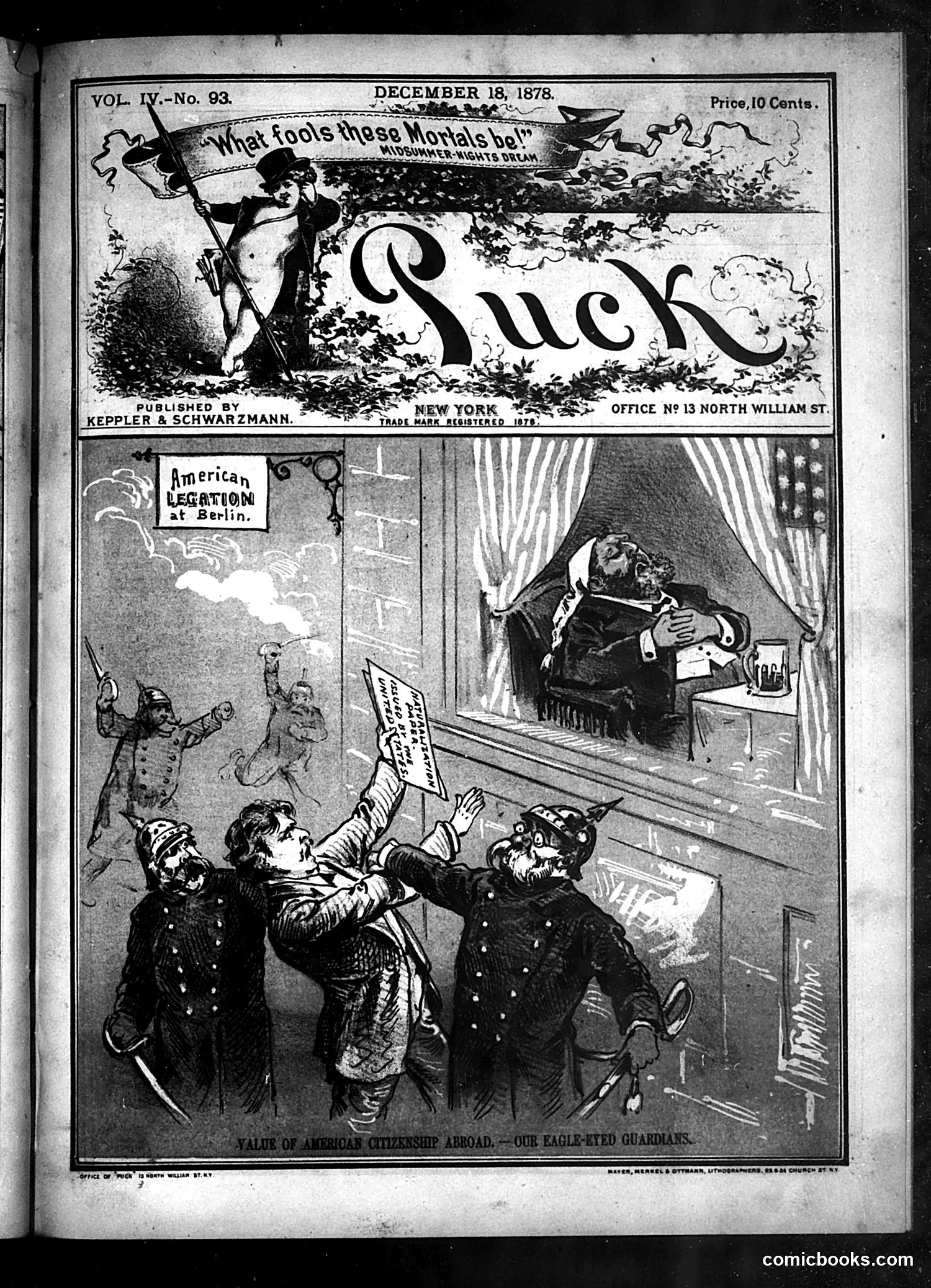
The main cartoon is titled "Value of American Citizenship Abroad—Our Eagle-Eyed Guardians." It depicts American diplomatic or consular officials (represented as stern, uniformed guards) protecting an American citizen at what appears to be a legation in Berlin (noted in the inset). The satire criticizes American diplomatic representation abroad. The "eagle-eyed guardians" appear ineffectual or indifferent—standing passively while the American citizen gestures frantically for help. The joke suggests that American consular officials provided inadequate protection or assistance to citizens abroad, particularly in Europe. This reflects late-19th-century anxieties about American representation and the government's responsibility to safeguard citizens' interests internationally.
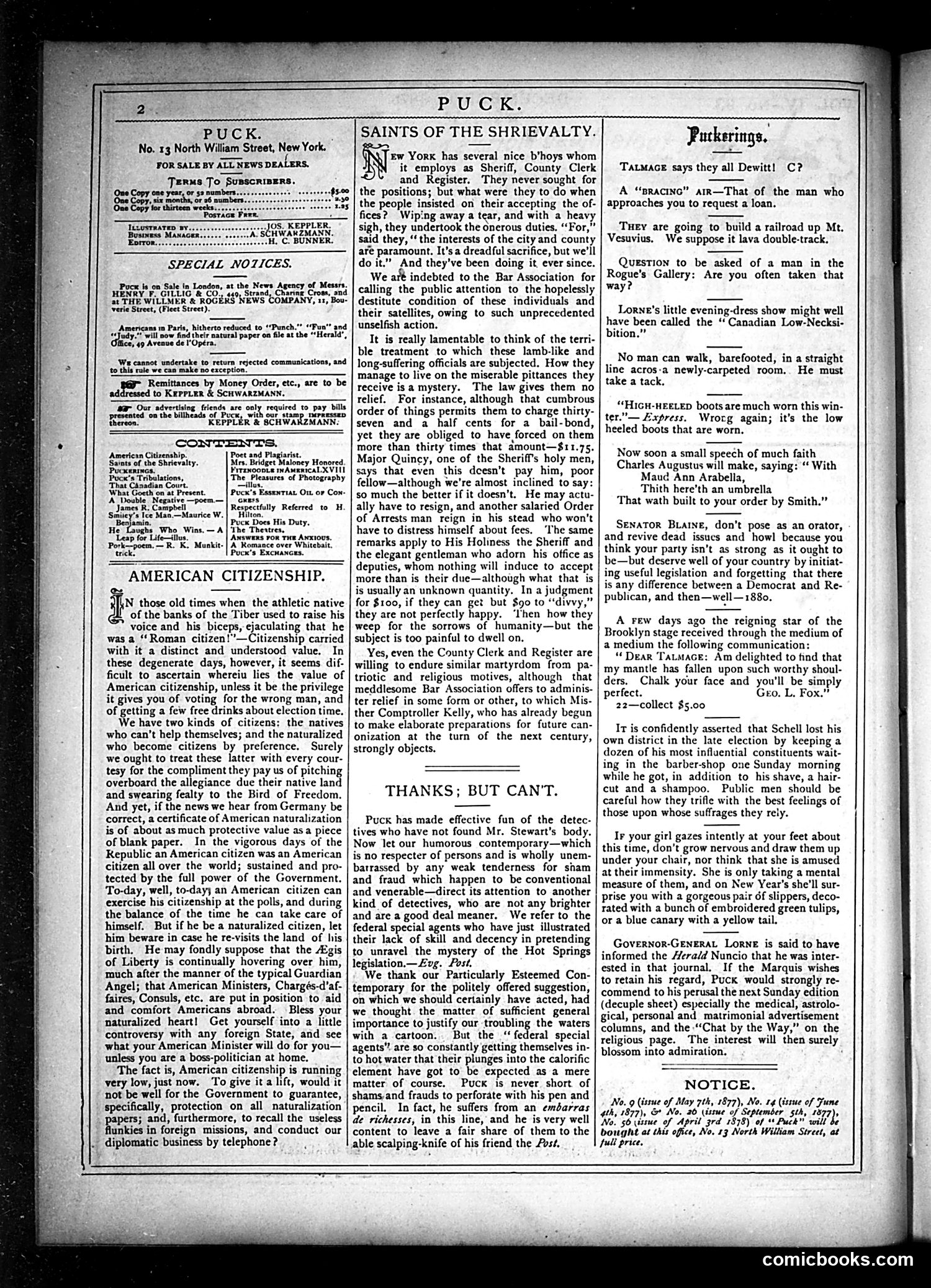
This page consists primarily of **editorial content rather than cartoons**. The main sections include: 1. **"Saints of the Shrievalty"** - A satirical article criticizing New York's Sheriff and County Clerk, who apparently resisted public pressure to accept positions. The satire attacks their reluctance and self-importance. 2. **"American Citizenship"** - A lengthy editorial defending naturalized citizenship rights against nativist skepticism, arguing that naturalized citizens deserve equal respect and voting rights as native-born Americans. 3. **"Thanks; But Can't"** - Commentary on Puck's earlier satire of detective fraud, criticizing federal agents' incompetence. The page contains **no visible political cartoons**—it's primarily opinion journalism typical of Puck's satirical approach to contemporary civic issues of the 1870s-80s era.
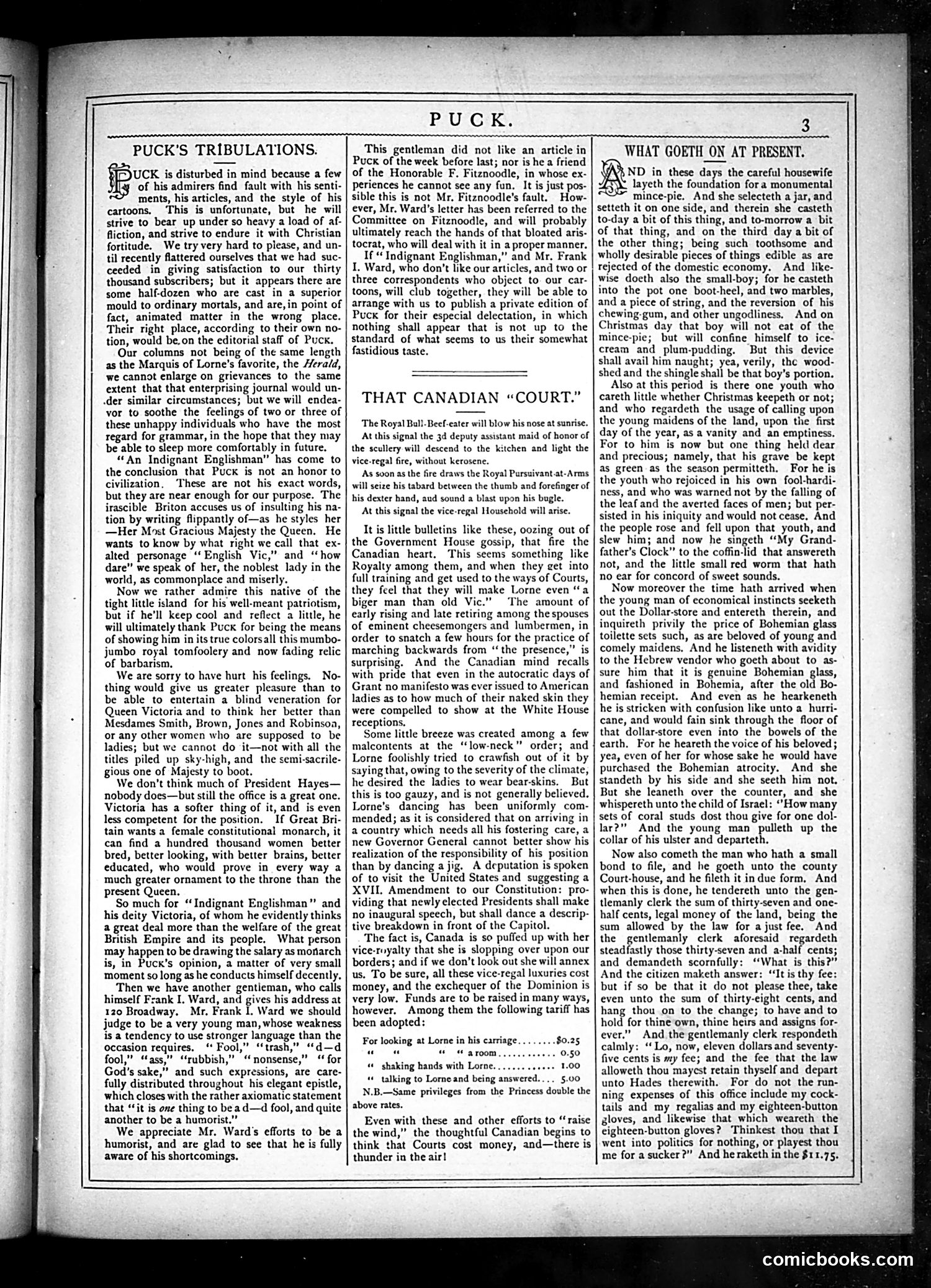
This page contains editorial commentary and satirical pieces rather than illustrated cartoons. The main sections critique: 1. **"Puck's Tribulations"** — defends the magazine against criticism from readers and F. Fitzzoone, arguing Puck uses "Christian fortitude" in satire while critics lack humor. 2. **"That Canadian 'Court'"** — satirizes Canadian government pretension, mocking their attempt to emulate British aristocratic customs and ceremony. The piece ridicules Canadians for adopting "vice-regal" household formality while lacking genuine nobility. 3. **"What Goeth On At Present"** — humorous observations on Christmas preparations and household economics, poking fun at middle-class domestic life and frivolous spending. The satire targets institutional pomposity and social pretension through witty commentary rather than visual caricature.
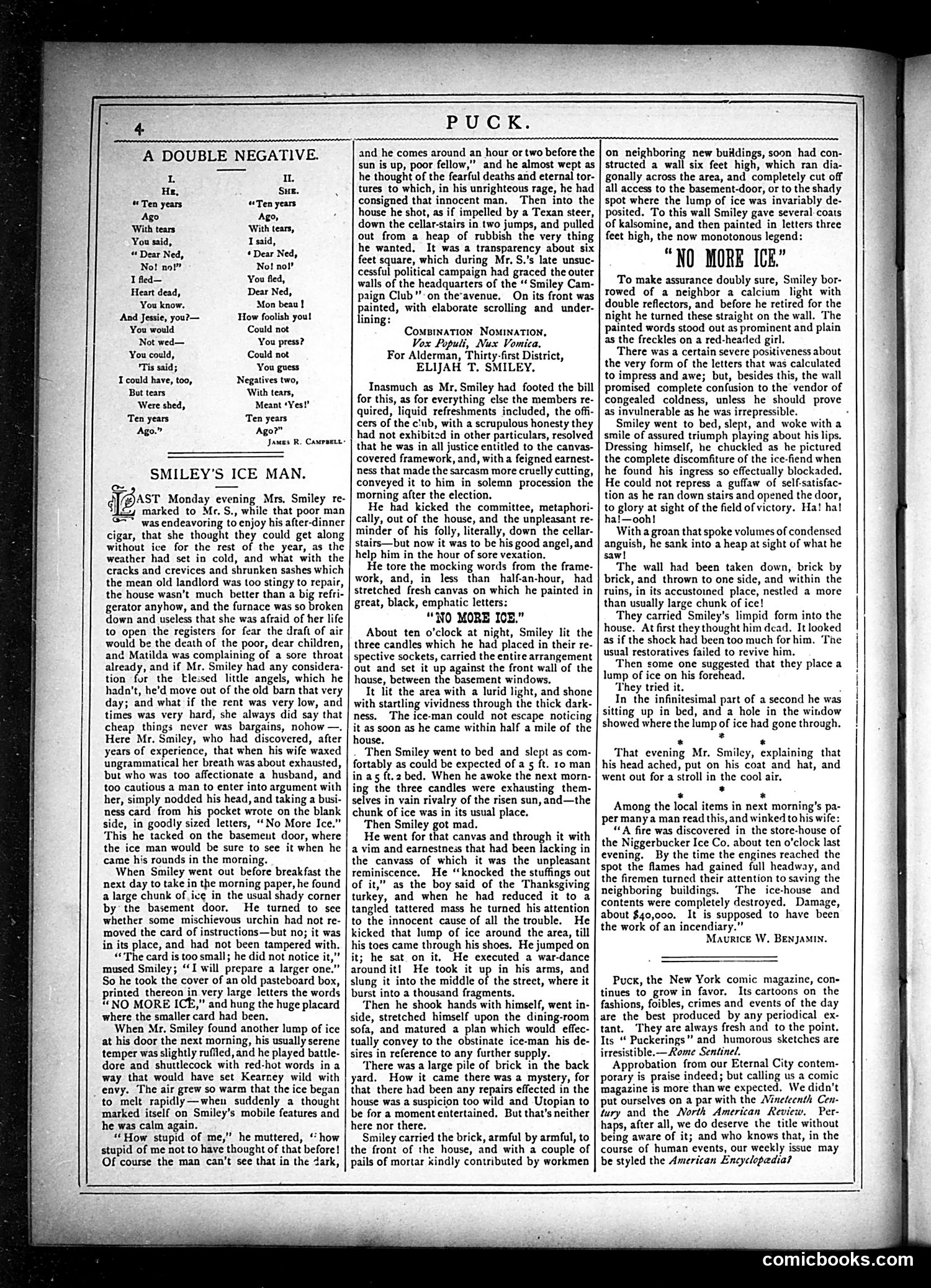
This story satirizes **Elijah T. Smiley**, a political figure (appears to be from Texas, given references to "a Texan steer"). The piece mocks Smiley's failed attempt to curry favor by placing ice in neighbors' windows during hot weather—a seemingly generous gesture that backfires spectacularly. The satire targets Smiley's transparent political opportunism: his ice delivery is exposed as calculated self-promotion rather than genuine kindness. The joke escalates when his blocks of ice become weapons of chaos, spreading destruction throughout the neighborhood and ultimately destroying his own house. The piece critiques politicians who perform artificial charity for votes while lacking authentic compassion. "No More Ice" captures public exhaustion with such performative gestures.
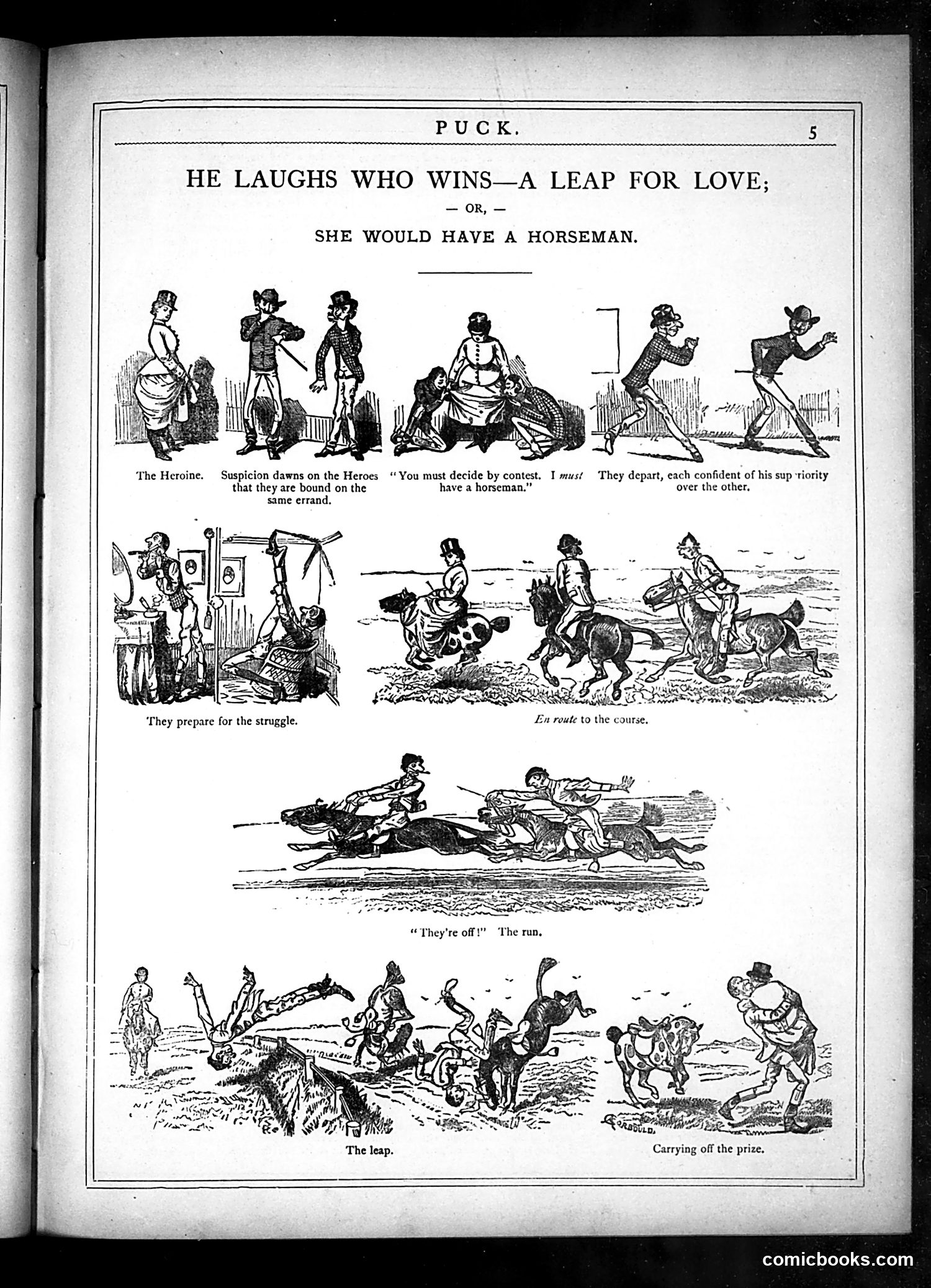
This Puck cartoon depicts a romantic competition presented as a steeplechase contest. A woman ("The Heroine") must choose between suitors by having them compete in an equestrian race—a satirical commentary on courtship as physical competition rather than romantic merit. The narrative follows two male competitors preparing, racing, and ultimately leaping obstacles to prove their worthiness. The final panels show "the leap" and "carrying off the prize"—the woman as literal spoils of victory. The satire mocks both the absurdity of reducing romance to athletic prowess and the era's treatment of women as passive objects to be won. The title's phrase "she would have a horseman" suggests ironic commentary on women's limited agency in choosing husbands based solely on a man's physical abilities or social status.
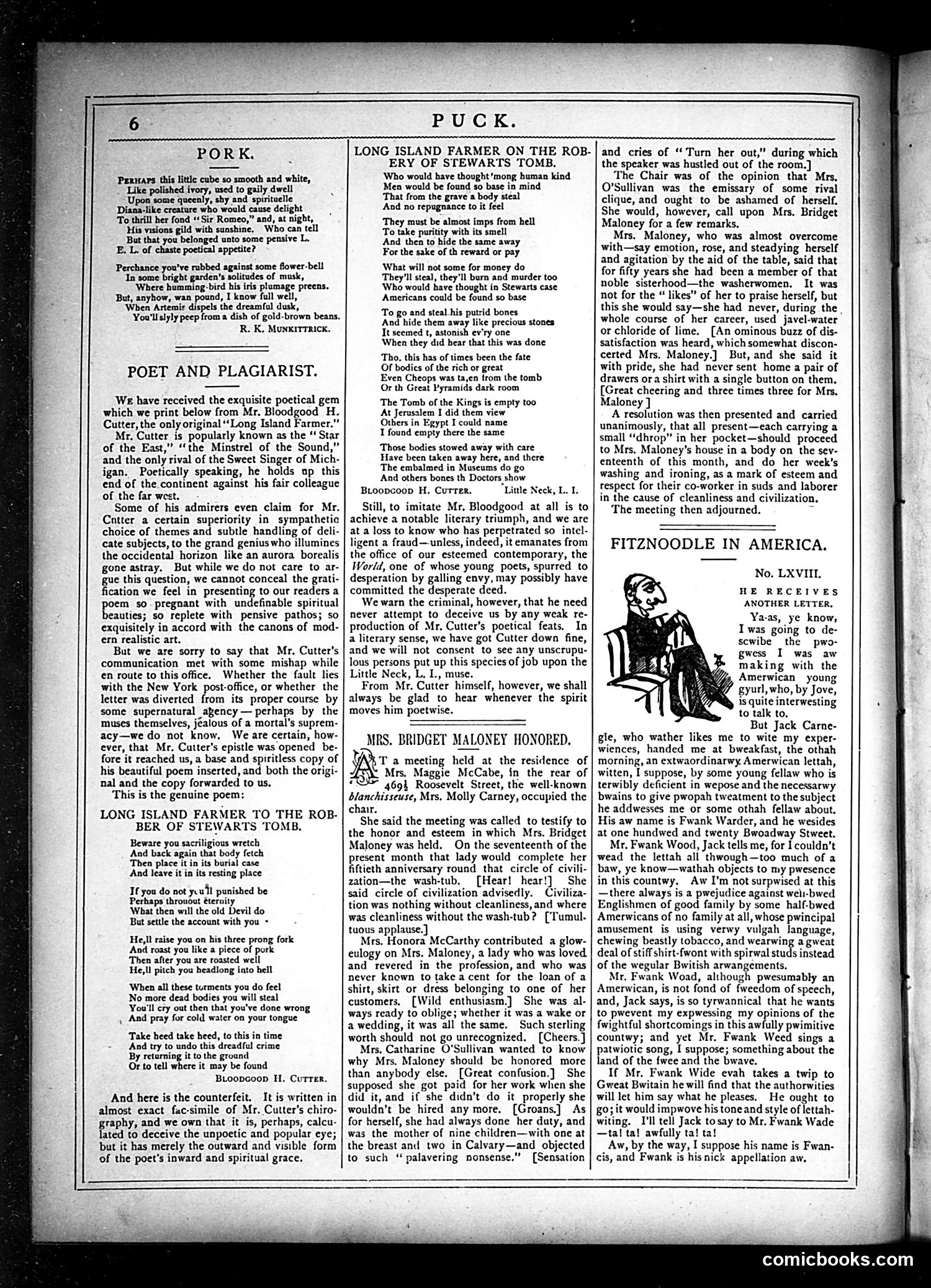
This page contains three separate pieces of satirical content: 1. **"Pork"** and **"Poet and Plagiarist"**: Two poems critiquing what appears to be a literary scandal involving a poet named Mr. Cutter who allegedly plagiarized a poem called "Long Island Farmer" from another source. The text accuses Cutter of passing off stolen work as original, though his admirers defend him. The satire mocks both the plagiarist and those who defend obvious fraud. 2. **"Mrs. Bridget Maloney Honored"**: A humorous account of a testimonial dinner honoring an Irish immigrant domestic worker. The piece celebrates her decades of service while gently satirizing the formal Victorian-era practice of honoring working-class women, with some comedic confusion during the proceedings. 3. **"Fitznoodle in America"**: A small illustrated section beginning a series about an Irish character's observations of American life and manners.
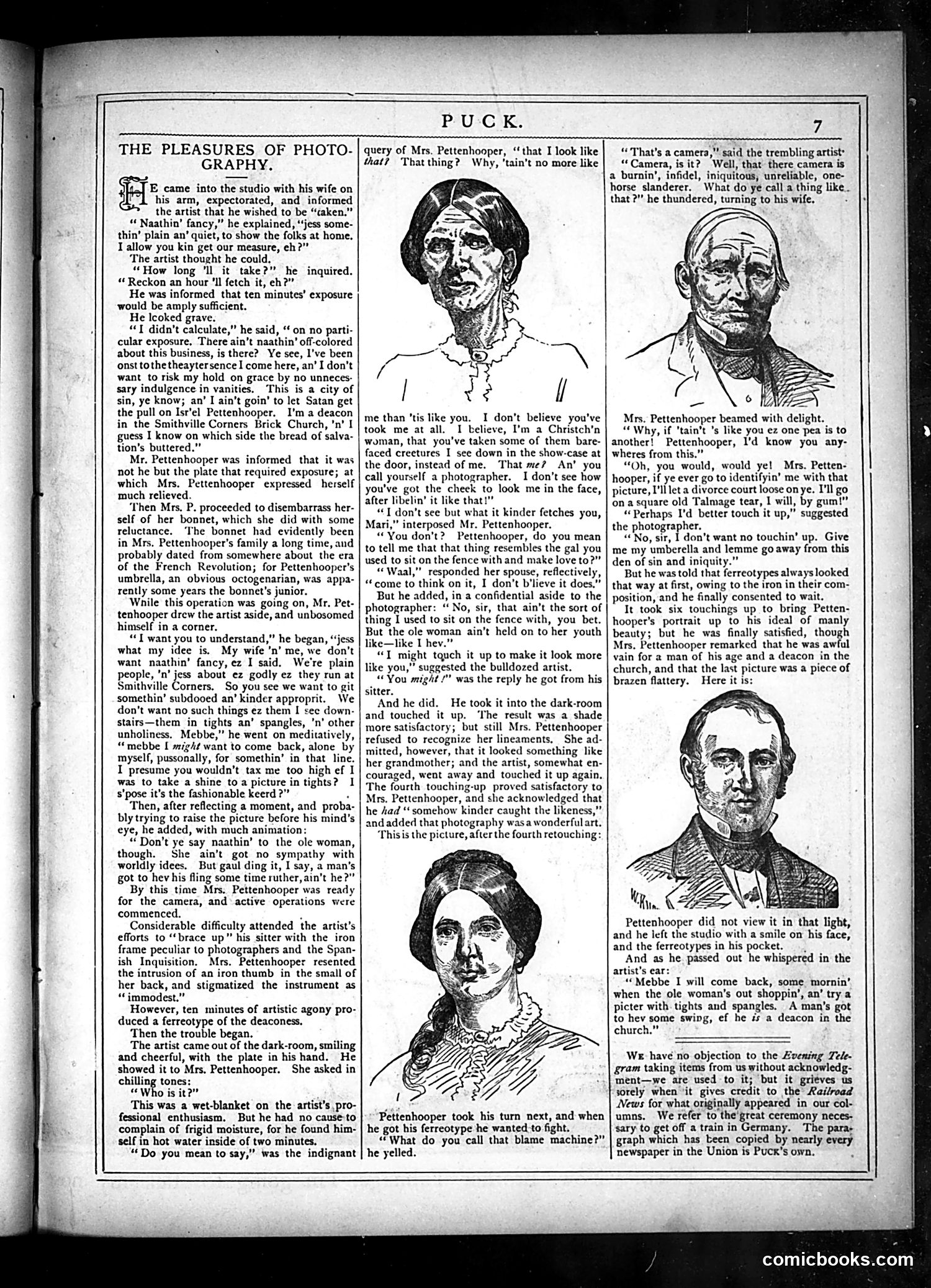
This satirical piece mocks the emerging photography craze of the late 19th century. The story follows Mr. and Mrs. Pettenshooper as they attempt to create a photographic portrait, but encounter repeated technical failures and frustrations. The satire targets: - **Photography's complexity**: The lengthy exposure times and technical requirements made amateur photography difficult and often unsuccessful - **Vanity and perfectionism**: Mrs. Pettenshooper's obsession with achieving an idealized likeness - **The artist's resentment**: Professional portrait painters viewed photography as a threatening, inferior technology The accompanying sketches show various failed attempts at capturing acceptable portraits, emphasizing how the new photographic process produced unpredictable, often unflattering results. The humor lies in mocking both the technology's limitations and people's unrealistic expectations of it.
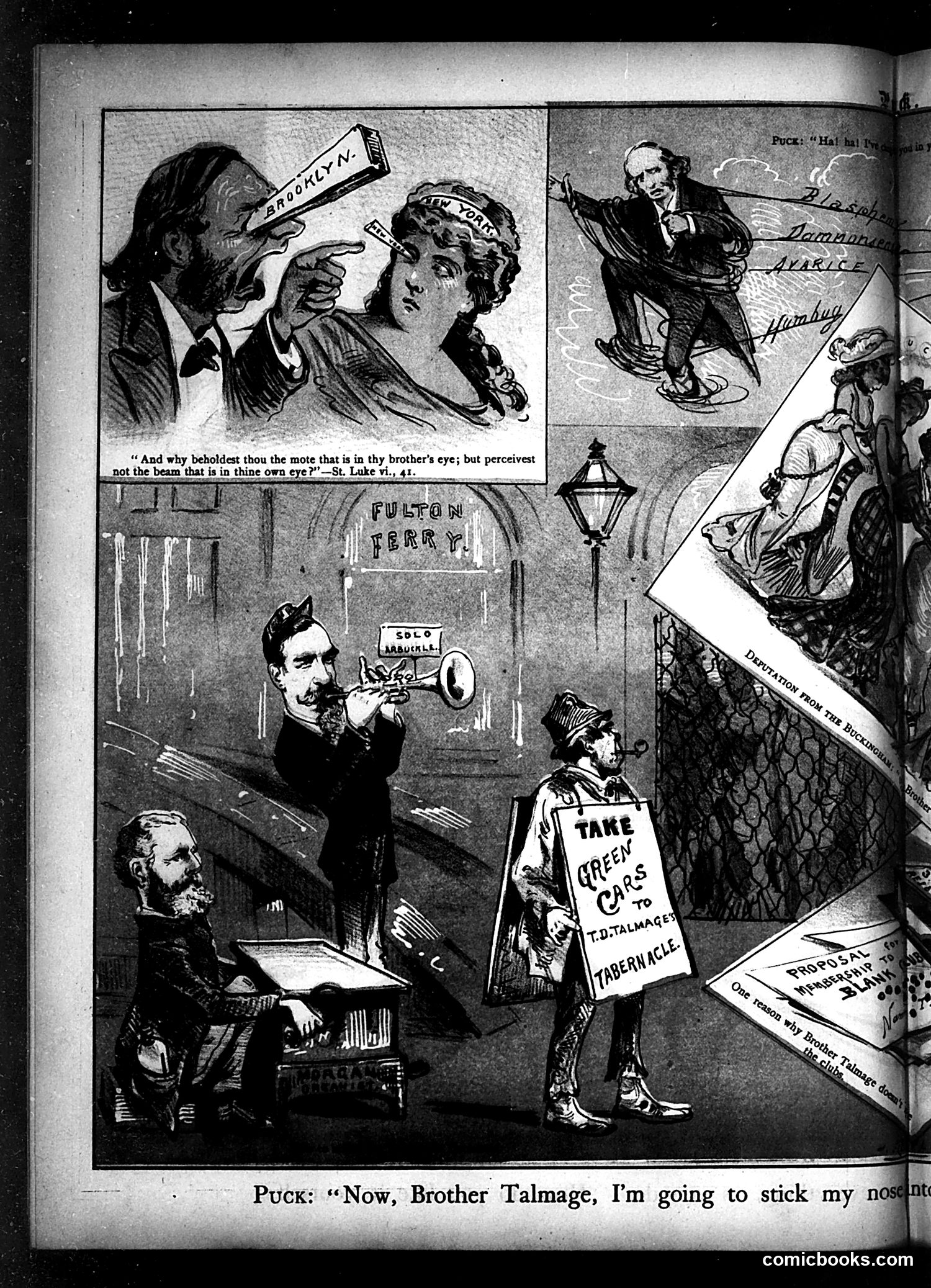
This page contains political satire targeting figures associated with corruption or moral hypocrisy. The top panel quotes St. Luke 6:41 about perceiving specks in others' eyes while missing beams in one's own—suggesting accusations of selective judgment or hypocrisy. The lower cartoon depicts "Brother Talmage" (likely a clergyman or public figure) being mocked by "Puck" (the magazine's satirical persona). References to "Fulton Terry," "Solo Jarguille," and a sign advertising "Take Green Cars to T.D. Talmage's Tabernacle" suggest this targets a specific religious or civic leader involved in transit-related or moral scandals. The satire appears to ridicule a public figure's credibility gap—perhaps lecturing morality while involved in dubious business dealings. The architectural/street setting suggests urban corruption themes common in Gilded Age political cartoons.
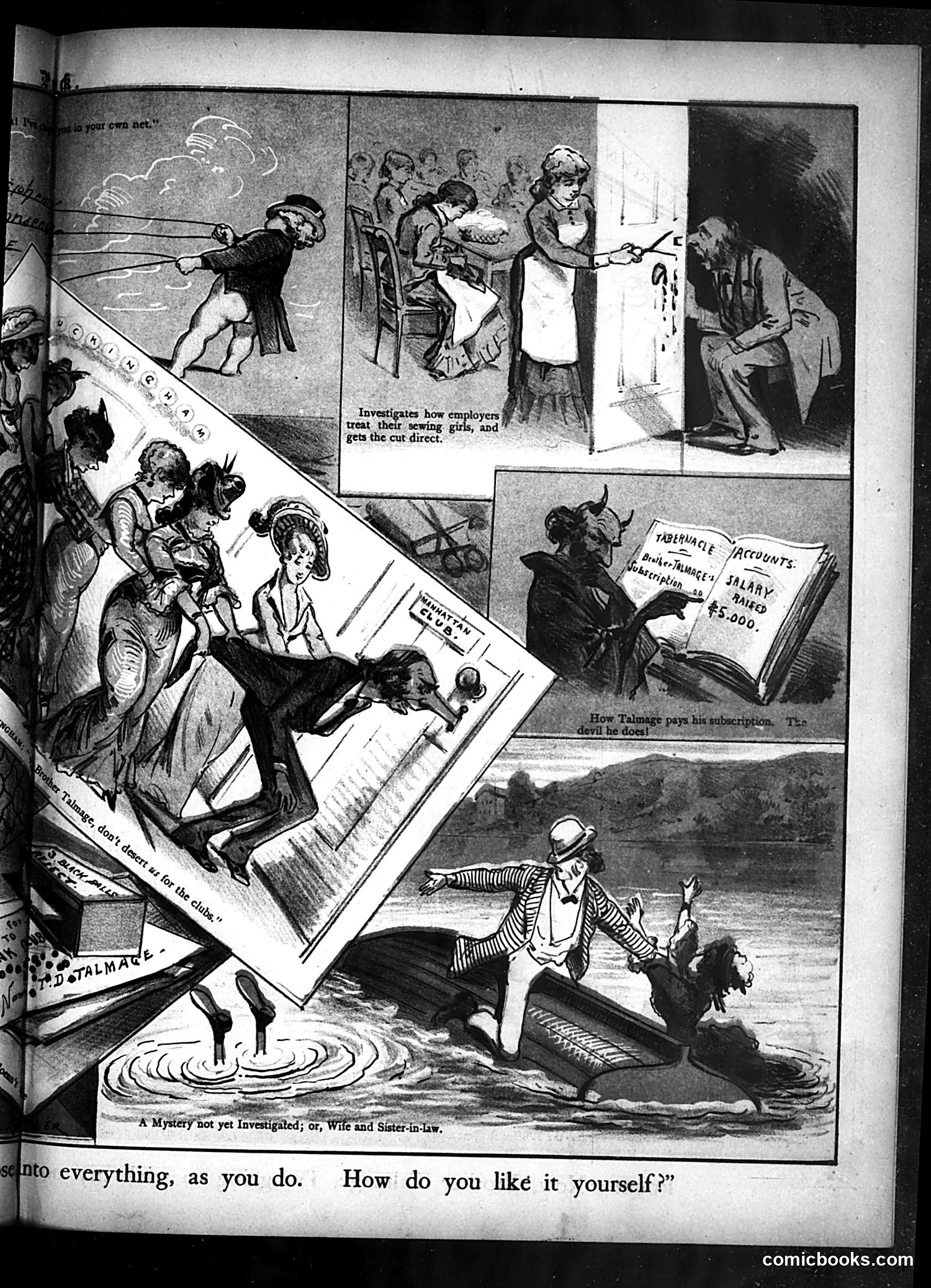
This page contains a multi-panel satirical narrative about labor exploitation and corruption. The top panels show an investigator examining poor working conditions for "sewing girls" and uncovering embezzlement by an employer named Talmage (visible on ledgers showing "$5,000" in fraudulent accounts). The final panel depicts "A Mystery bot yet Investigated; or, Wife and Sister-in-law"—showing a man in water being pulled by what appears to be a woman, suggesting domestic scandal or mysterious drowning circumstances. The overall satire critiques industrial labor abuses, financial fraud by employers, and possibly connects workplace corruption to personal moral failures. The "wife and sister-in-law" subtitle hints at sexual impropriety or family scandal accompanying the financial crimes, suggesting hypocrisy among the wealthy and powerful.
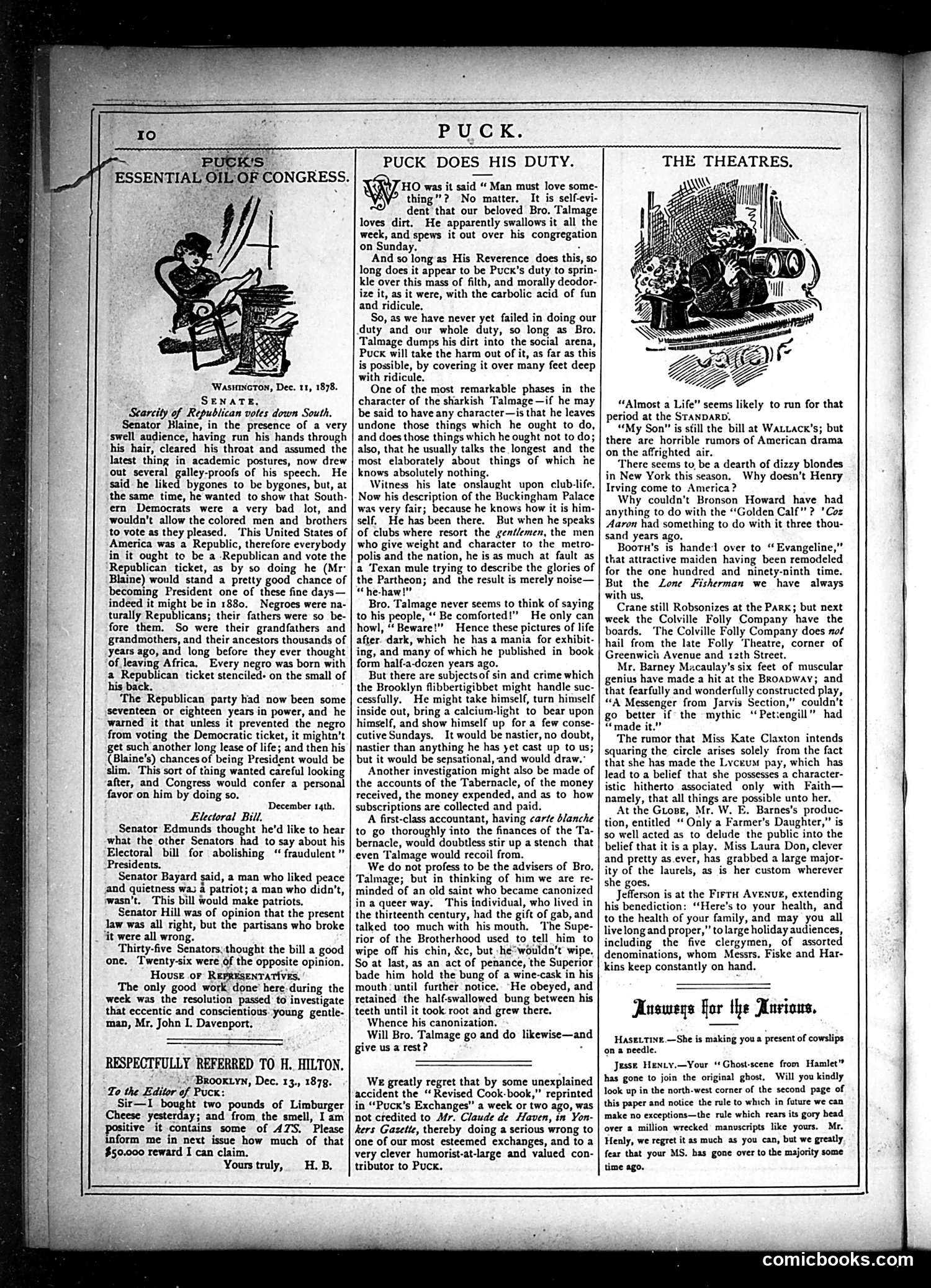
This page contains three sections satirizing American politics and culture circa 1898: **"Puck's Essential Oil of Congress"** (left): A caricatured figure, likely representing a congressman, is depicted as a bottle of concentrated political essence—visual mockery of congressional rhetoric and behavior. **"Puck Does His Duty"** (center): The main article criticizes Brother Talmage (a prominent preacher) for dumping moral filth into society while condemning it. The piece argues Talmage enjoys describing social scandals in detail despite claiming moral authority, making him hypocritical. **"The Theatres"** (right): Brief reviews of current theatrical productions, including commentary on "Almost a Life" and other shows. The page exemplifies Puck's satirical approach: attacking public figures for moral inconsistency while entertaining readers with sharp, pointed critique.
This page contains a serialized story titled "A Romance Over Whitebait" by Mrs. Adolphe Smith, appearing in Puck's "Tinsley's Magazine" section. The narrative follows characters named Clyde, Dudley, Glyde, and Miss Tata discussing marriage and social matters at what appears to be a fashionable London dinner party in Bond Street. The story satirizes Victorian courtship customs and male attitudes toward matrimony. Dudley expresses reluctance about marriage while his friends encourage him to pursue Miss Tata romantically. The dialogue mocks both the pretensions of high society dining and the era's conventional romantic conventions. This is literary satire rather than a political cartoon—it uses humor to critique social expectations around courtship and class status among London's upper classes.
This page contains no visible political cartoon. Instead, it's primarily a serialized story titled "You See in Young Dudley" that appears to be fiction rather than satire. The text presents dialogue between characters—Miss Lovel, young Dudley, and Glyde—discussing romantic entanglements and financial matters (references to twenty thousand pounds, creditors, and marriage prospects). The bottom of the page includes brief news items, including a mention of "The South" and Washington Weather Bureau observations. Without visible caricatures, political figures, or satirical illustrations on this particular page, I cannot identify specific political or social satire. This appears to be a content page mixing serialized fiction with miscellaneous notes rather than editorial cartooning.
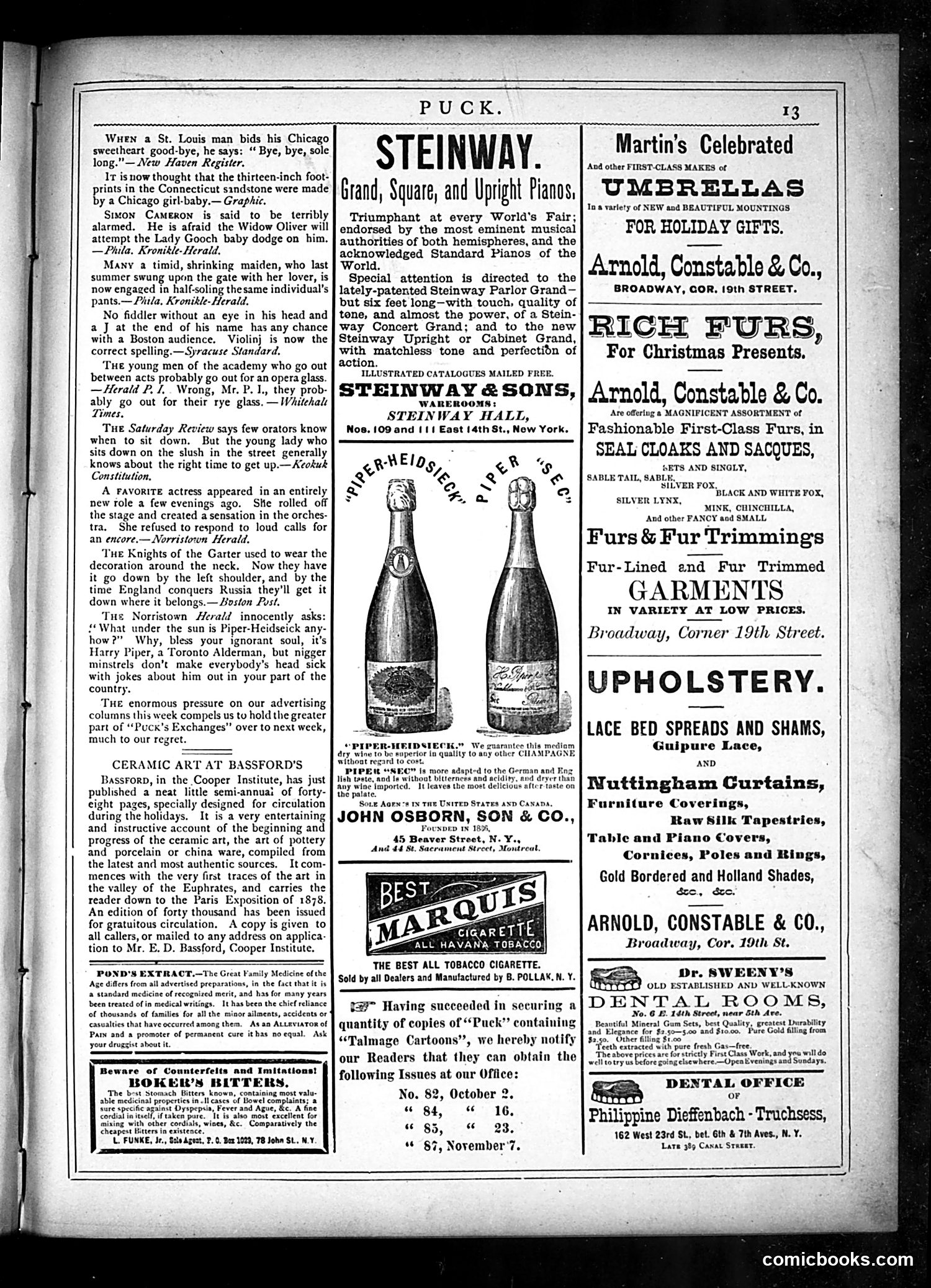
This is primarily an **advertising page** from Puck magazine (page 13), not a satirical cartoon section. The advertisements feature luxury goods typical of the 1880s-90s era: Steinway pianos, furs and fur-trimmed garments from Arnold, Constable & Co., upholstery and home furnishings, and other high-end merchandise. The only substantive editorial content consists of brief **society gossip items** in the upper left—anecdotes about Chicago socialites, theatrical performers, and fashion trends. These snippets mock minor social figures and current fads in a light, humorous tone typical of Puck's satirical voice. The page demonstrates how Puck monetized its readership through advertising while maintaining its satirical brand through gossip commentary.
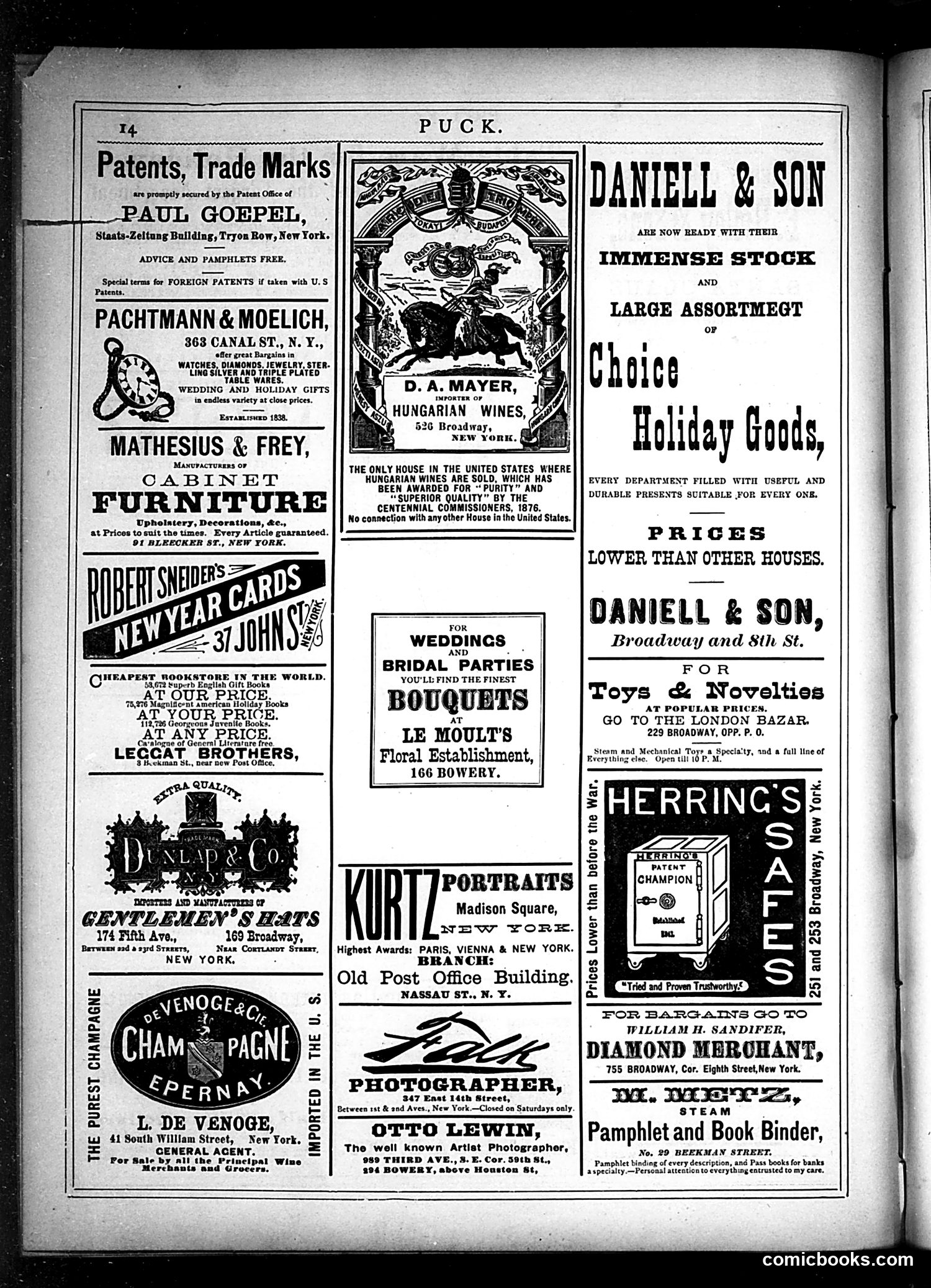
This is primarily an **advertising page** from Puck magazine, not a satirical cartoon. The page contains commercial advertisements for various New York businesses from the late 19th century, including: - Patents and trademarks (Paul Gohbel) - Furniture (Mathesius & Frey) - New Year cards (Robert Shonders) - Books (Legget Brothers) - Champagne (De Venoge) - Hungarian wines (D.A. Mayer) - Holiday goods (Daniell & Son) - Photography (Kurtz, Otto Lewin) - Various other retail establishments The page shows how Puck supported itself financially through advertising rather than solely satirical content. These ads reflect consumer culture and businesses available to wealthy New Yorkers of the period.
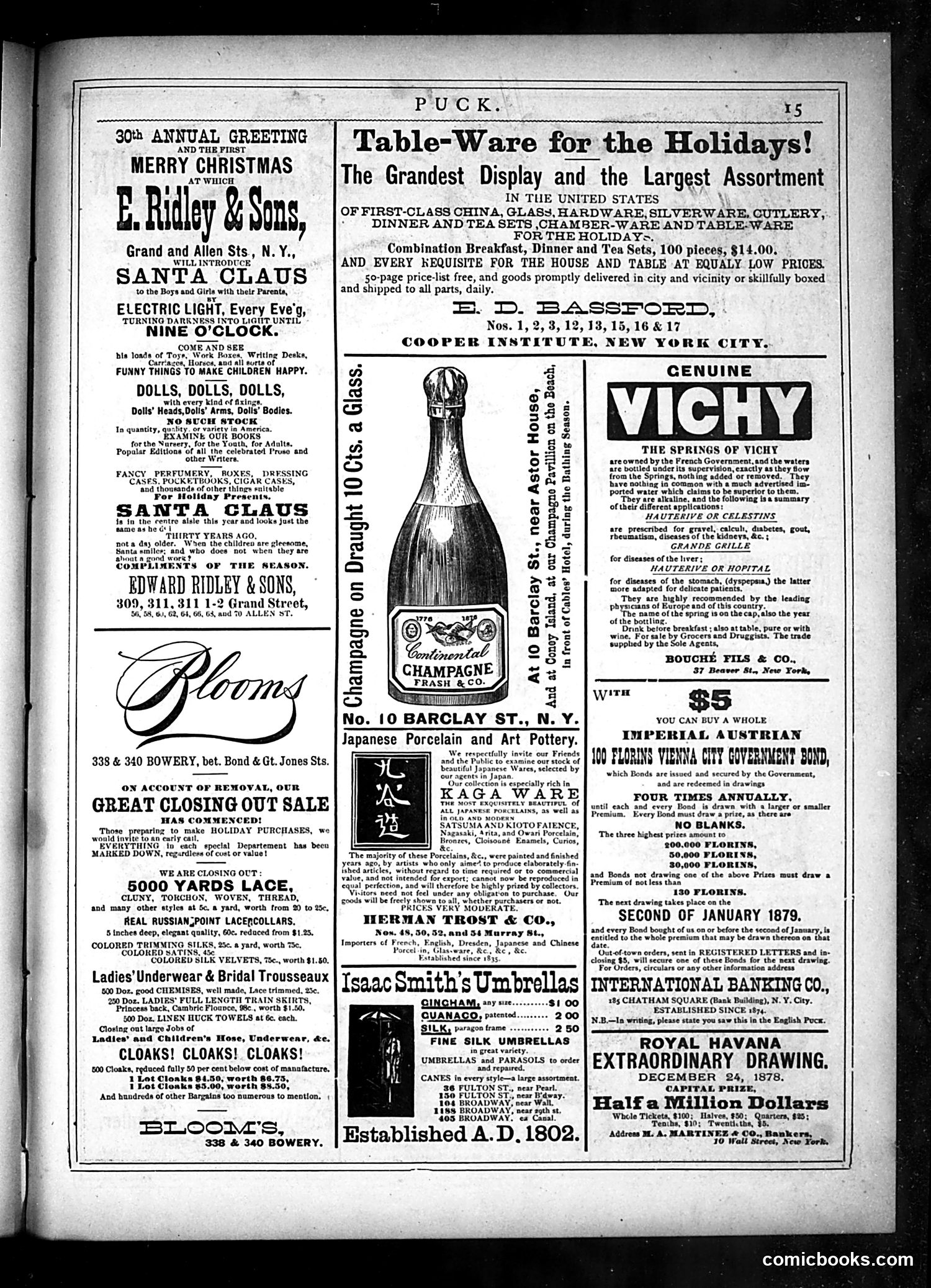
This page is primarily **advertising**, not satirical content. It contains commercial advertisements for holiday merchandise and services typical of a late 19th-century publication, including: - E. Ridley & Sons (toys, dolls, Christmas goods) - Blooms (flowers) - D.D. Bassford (table-ware) - Vichy mineral water - Japanese porcelain and pottery - Isaac Smith's umbrellas - A Royal Havana lottery drawing advertisement The page reflects the magazine's dual purpose as both satire and commercial vehicle. The advertisements target affluent readers with luxury goods appropriate for holiday gift-giving. No political cartoons or satirical commentary are visible on this particular page—it serves primarily as a revenue-generating advertising section rather than editorial content.
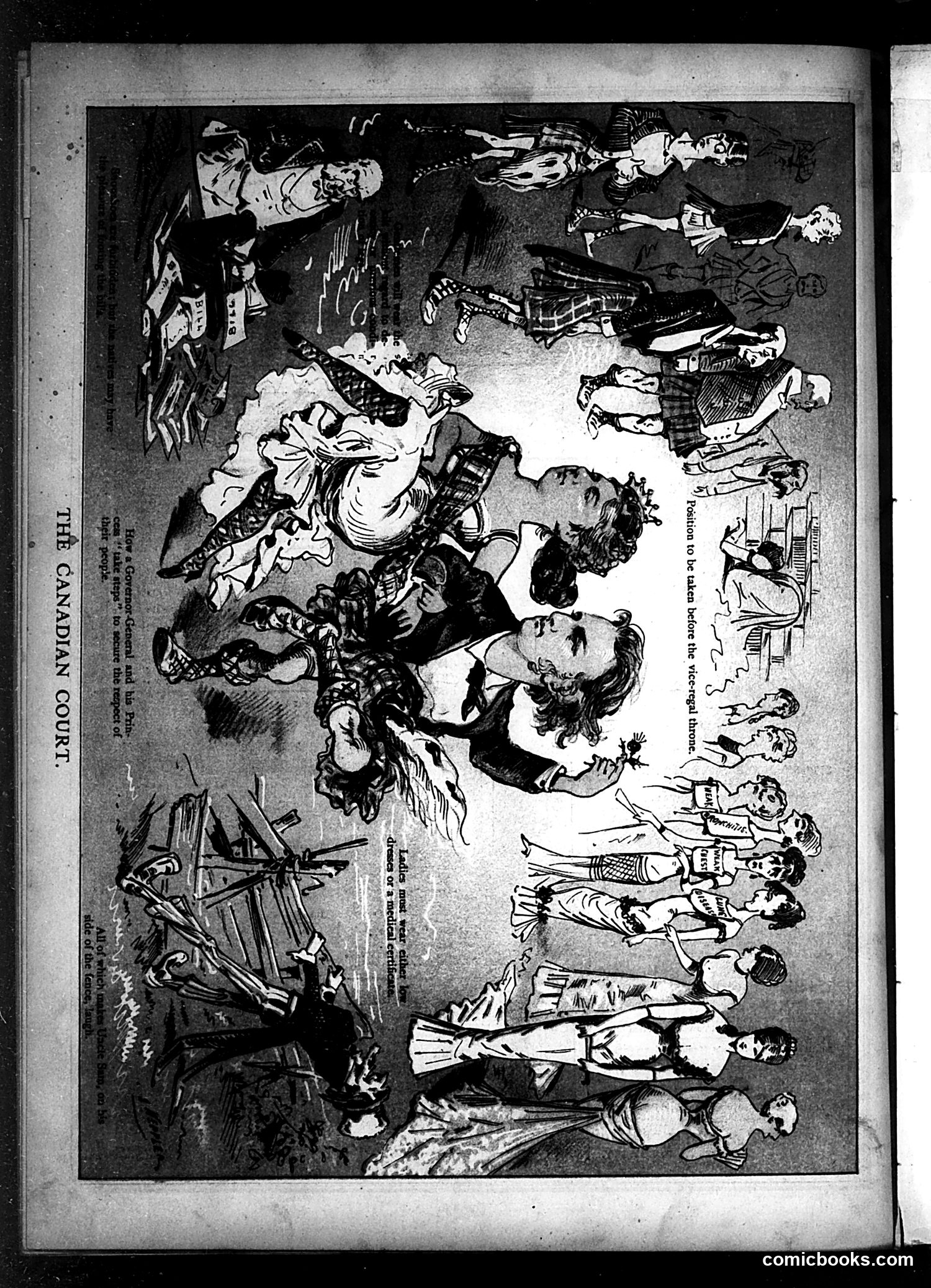
This page depicts a satirical scene titled "The Canadian Court" showing what appears to be a grotesque central figure (likely representing Canadian political authority or leadership) surrounded by various figures in formal dress. The caricature employs exaggeration typical of Puck's style—distorted facial features and body proportions to mock the subject. Without clearer identification of specific individuals or readable dates, the exact political context remains unclear, though the composition suggests commentary on Canadian governance or a particular scandal involving court proceedings. The surrounding figures appear to represent various political or social actors responding to or participating in this "court" scenario. The overall tone is derisive, treating Canadian affairs as ridiculous theater. More specific context about the publication date would clarify which political events this references.
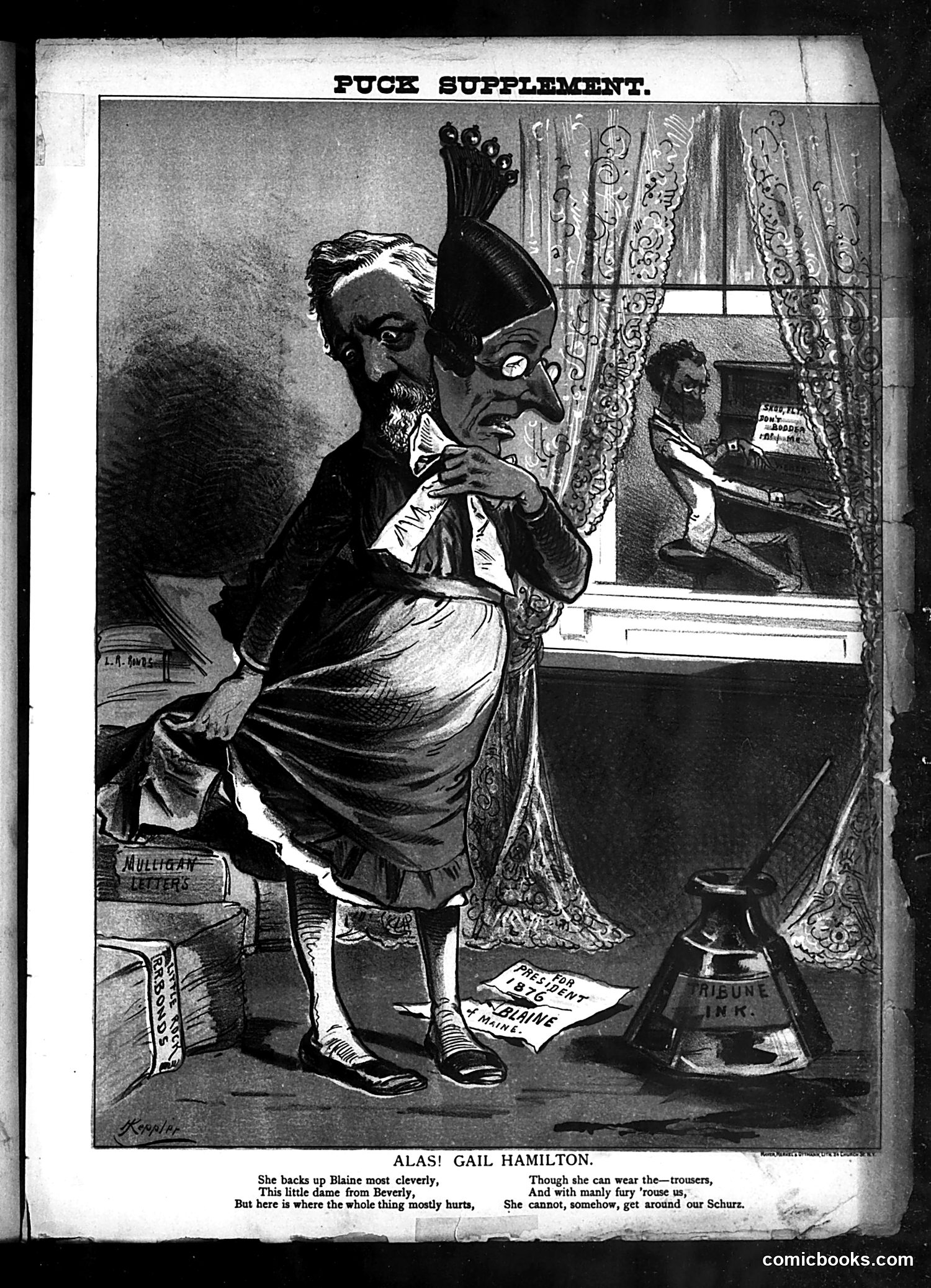
This Puck supplement satirizes **Gail Hamilton**, a 19th-century American writer and social commentator. The cartoon depicts her in masculine dress (wearing trousers and a crown-like headdress), wielding a pen and ink bottle labeled "Tribune Ink." The accompanying verse mocks her literary talent and her unconventional gender presentation. The poem suggests she skillfully "backs up Blaine" (likely James G. Blaine, a political figure) and "this little dame from Beverly" succeeds at political writing, but "cannot, somehow, get around our Schurz"—apparently unable to out-argue another commentator. The satire ridicules Hamilton for both her intellectual ambitions and her adoption of masculine appearance/authority, treating these as inherently laughable transgressions against Victorian gender norms.