
Puck, 1878-12-18 · page 7 of 17
Puck — December 18, 1878 — page 7: what you’re looking at
What you’re looking at
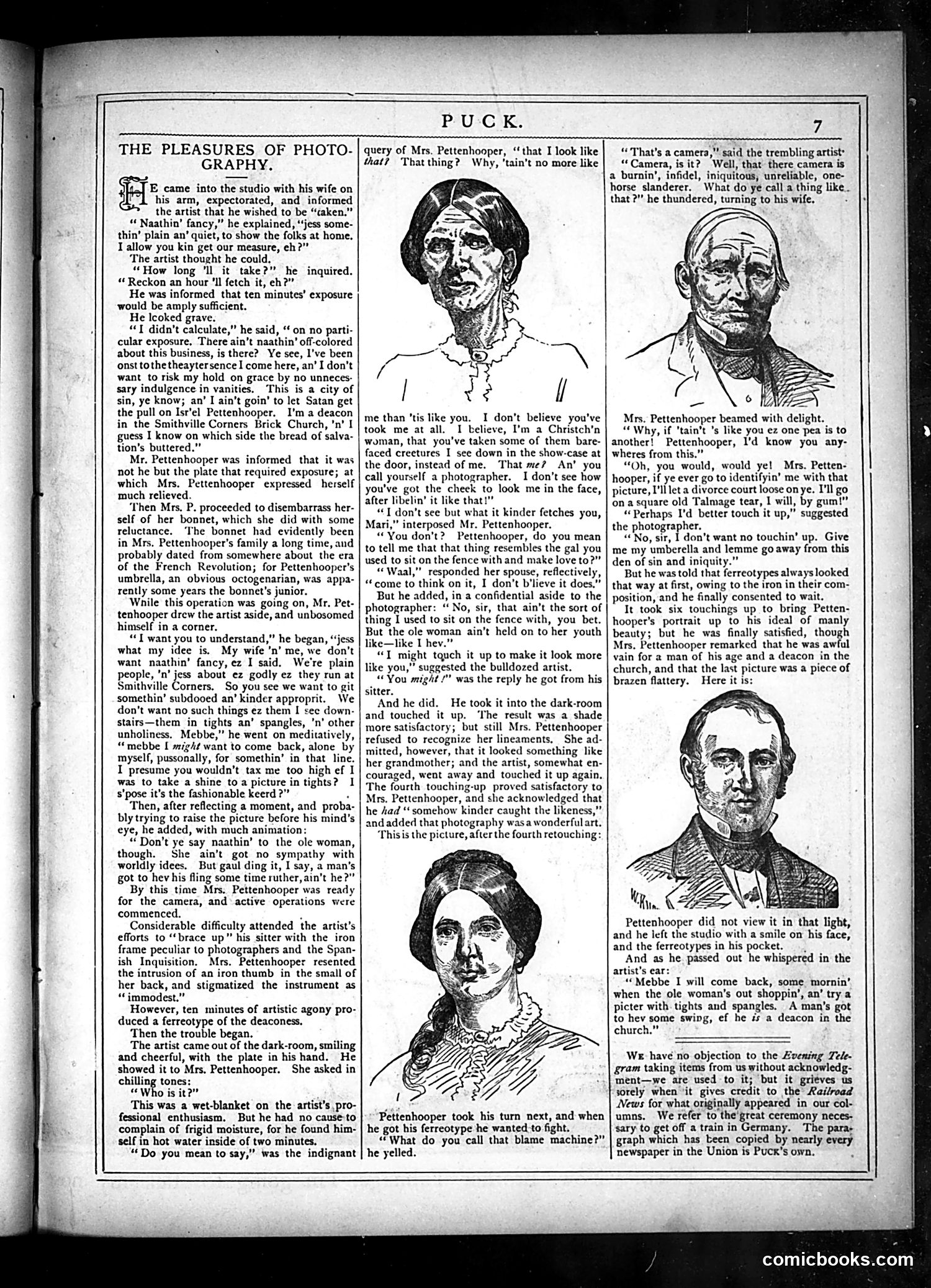
This satirical piece mocks the emerging photography craze of the late 19th century. The story follows Mr. and Mrs. Pettenshooper as they attempt to create a photographic portrait, but encounter repeated technical failures and frustrations. The satire targets: - **Photography's complexity**: The lengthy exposure times and technical requirements made amateur photography difficult and often unsuccessful - **Vanity and perfectionism**: Mrs. Pettenshooper's obsession with achieving an idealized likeness - **The artist's resentment**: Professional portrait painters viewed photography as a threatening, inferior technology The accompanying sketches show various failed attempts at capturing acceptable portraits, emphasizing how the new photographic process produced unpredictable, often unflattering results. The humor lies in mocking both the technology's limitations and people's unrealistic expectations of it.
📄 Transcribed text from this page (OCR, searchable)
Machine-transcribed from the original scan — historical spelling and the odd misread are preserved.
7 THE PLEASURES OF PHOTO- GRAPHY. E came into the studio with his wife on his arm, expectorated, and informed the artist that he wished to be “caken.”” “ Naathin’ fancy,” he explained, ‘jess some- thin’ plain an’ quiet, to show the folks at home, I allow you kin get our measure, eh?” The artist thought he could. “How long ‘ll it take?” he inquired. “ Reckon an hour 'Il fetch it, eh?” He was informed that ten minutes’ exposure would be amply sufficient. He Icoked grave. “I didn’t calculate,” he said, ‘on no parti- cular exposure, There ain’t naathin’ off-colored about this business, is there? Ye see, I’ve been onst tothe theaytersence 1 come here, an’ I don’t want to risk my hold on grace by no unneces- sary indulgence in vanities. This is a city of sin, ye know; an’ I ain’t goin’ to let Satan get the pull on Isr’el Pettenhooper. I’m a deacon in the Smithville Corners Brick Church, 'n’ I guess I know on which side the bread of salva- tion's buttered.”” Mr. Pettenhooper was informed that it was not he but the plate that required exposure; at which Mrs. Pettenhooper expressed herself much relieved. ‘Then Mrs. P. proceeded to disembarrass her- self of her bonnet, which she did with some reluctance. ‘The bonnet had evidently been in Mrs. Pettenhooper’s family a long time, and probably dated from somewhere about the era of the French Revolution; for Pettenhooper’s umbrella, an obvious octogenarian, was appa- rently some years the bonnet’s junior. While this operation was going on, Mr. Pet- tenhooper drew the artist aside, and unbosomed himself in a corner. “I want you to understand,” he began, ‘‘jess what my idee is. My wife ’n’ me, we don't hin’ fancy, ez I said. We're plain jess about ez godly ez they run at Smithville Goraers So you see we want to git somethin’ subdooed an’ kinder approprit. We don't want no such things ez them I sec down- stairs—them in tights an’ spangles, 'n’ other unholiness. Mebbe,” he went on meditatively, mebbe I might want to come back, alone by myself, pussonally, for somethin’ in that line. I presume you wouldn’t tax me too high ef 1 was to take a shine toa picture in tights? 1 s'pose it’s the fashionable keerd ?” f Then, after reflecting a moment, and proba- bly trying to raise the picture before his mind's eye, he added, with much animation: “Don’t ye say naathin’ to the ole woman, though. She ain’t got no sympathy with worldly idees. But gaul ding it, I say, a man’s got to hev his fling some time ruther, ain't he?” By this time Mrs. Pettenhooper was ready for the camera, and active operations were commenced. ‘ Considerable difficulty attended the artist’s efforts to “brace up” his sitter with the iron frame peculiar to photographers and the Span- ish Inquisition. Mrs. Pettenhooper resented the intrusion of an iron thumb in the small of her back, and stigmatized the instrument as “immodest.” However, ten minutes of artistic agony pro- duced a ferreotype of the deaconess, ‘Then the trouble began. The artist came out of the dark-room, smiling and cheerful, with the plate in his hand. He showed it to Mrs. Pettenhooper. She asked in chilling toni “Who is This was a wet-blanket on the artist's pro- fessional enthusiasm. But he had no cause-to complain of frigid moisture, for he found him- self in hot water inside of two minutes. “Do you mean to say,” was the indignant query of Mrs. Pettenhooper, ‘that I look like that? Thatthing? Why, ‘tain’t no more like me than 'tis like you. I don't believe you've took me at all. I believe, I'm a Christch’n woman, that you've taken some of them bare- faced creetures I see down in the show-case at the door, instead of me. That me? An’ you call yourself a photographer. I don’t see how you've got the check to look me in the face, after libelin’ it like that!” “I don’t see but what it kinder fetches you, Mari,” interposed Mr. Pettenhooper. “You don’t? Pettenhooper, do you mean. to tell me that that thing resembles the gal you used to sit on the fence with and make love to?” “Waal,” responded her spouse, reflectively, “come to think on it, I don’t b'lieve it does,” But he added, in a confidential aside to the photographer: “ No, sir, that ain't the sort of thing I used to sit on the fence with, you bet. But the ole woman ain’t held on to her youth like—like I hev.”” “I might tquch it up to make it look more like you,” suggested the bulldozed artist. “You might /” was the reply he got from his sitter. And he did. He took it into the dark-room and touched it up. ‘The result was a shade more satisfactory; but still Mrs. Pettenhooper refused to recognize her lineaments, She ad- mitted, however, that it looked something like her grandmother; and the artist, somewhat en- couraged, went away and touched it up again, The fourth touching-up proved satisfactory to Mrs. Pettenhooper, and she acknowledged that he Aad ‘somehow kinder caught the likeness,” and added that photography wasa wonderful art. ‘Thisis the picture, after the fourth retouching: Pettenhooper took his turn next, and when he got his ferreotype he wanted-to fight. “What do you call that blame machine?” he yelled. “ That's a camera,” said the trembling artist» “Camera, is it? Well, that there camera is a burnin’, infidel, iniquitous, unreliable, one- horse slanderer. What do ye call a thing like. that ?” he thundered, turning to his wife. : Mn. Pettenhooper beamed with delight. “Why, if 'tain’t ’s like you ez one pea is to another! Pettenhooper, I'd know you any- wheres from this.” “Oh, you would, would ye! Mrs. Petten- hooper, if ye ever go to identifyin’ me with that picture, I'll let. a divorce court loose on ye. I'll go ona square old Talmage tear, I will, by gum!” “Perhaps I'd better touch it up,” suggested the photographer. “No, sir, I don’t want no touchin’ up. Give me my umberella and lemme go away from this den of sin and iniquity.” But he was told that ferreotypes always looked that way at first, owing to the iron in their com- position, and he finally consented to wait. It took six touchings up to bring Petten- hooper’s portrait up to his ideal of manly beauty; but he was finally satisfied, though Mrs. Pettenhooper remarked that he was awful vain for a man of his age and a deacon in the church, and that the last picture was a piece of brazen flattery. Here it is: Pettenhooper did not view it in that light, and he left the studio with a smile on his face, and the ferreotypes in his pocket. And as he. passed out he whispered in the artist’s ear: ““Mebbe I will come back, some mornin’ when the ole woman’s out shoppin’, an’ try a picter with tights and spangles. A man’s got to hev some swing, ef he is a deacon in the church.” We have no objection to the Lvening Tele- gram taking items from us without acknowledg- ment—we are used to it; but it gri¢ves us sorely when ‘it gives credit to the Railroad News for what originally appeared in our col- umns. We refer to the'great ceremony neces- sary to get off a train in Germany. The para- graph which has been copied by nearly every newspaper in the Union is Puck's own. : comicbooks.com