
Puck, 1878-12-18 · page 6 of 17
Puck — December 18, 1878 — page 6: what you’re looking at
What you’re looking at
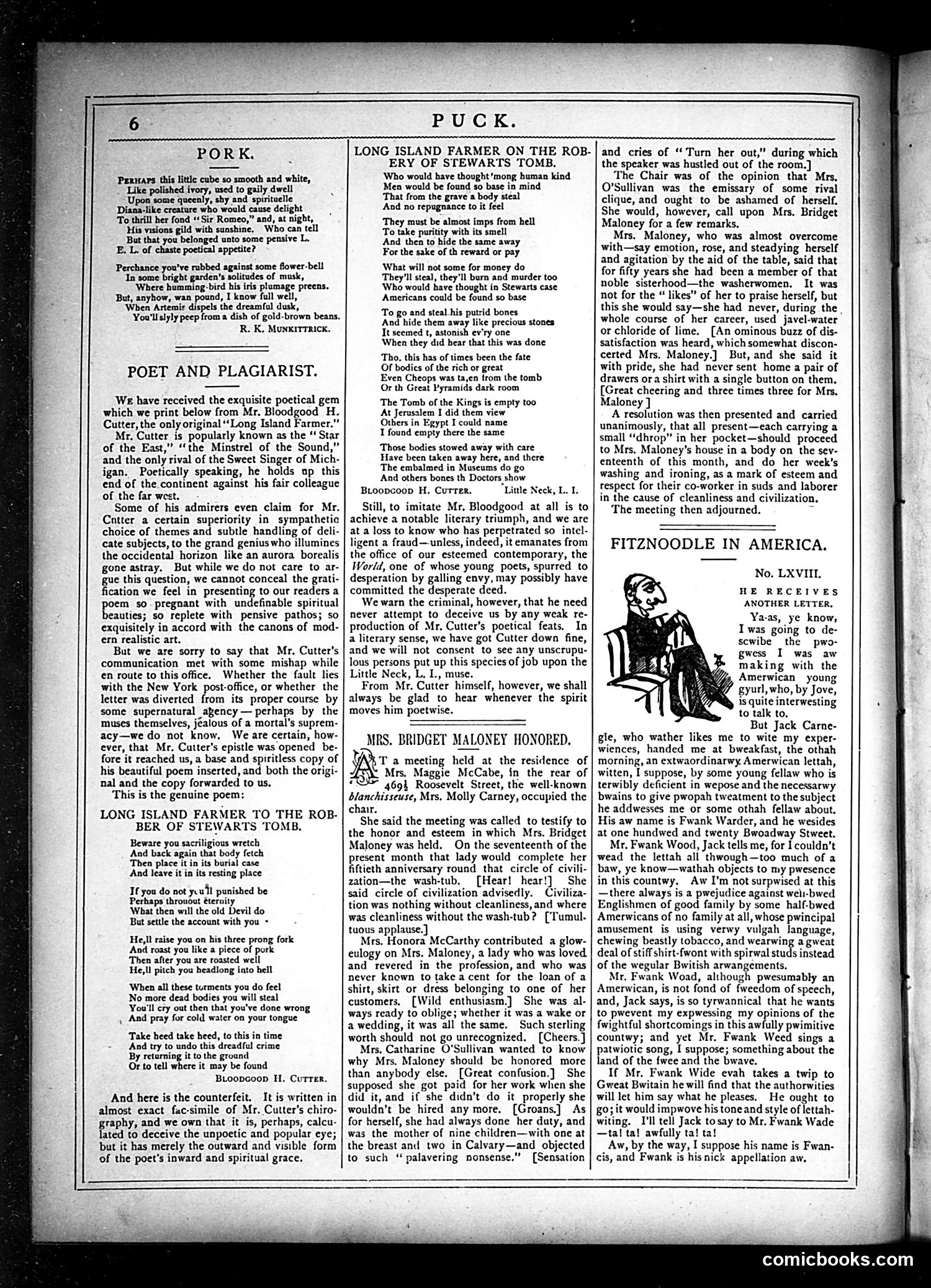
This page contains three separate pieces of satirical content: 1. **"Pork"** and **"Poet and Plagiarist"**: Two poems critiquing what appears to be a literary scandal involving a poet named Mr. Cutter who allegedly plagiarized a poem called "Long Island Farmer" from another source. The text accuses Cutter of passing off stolen work as original, though his admirers defend him. The satire mocks both the plagiarist and those who defend obvious fraud. 2. **"Mrs. Bridget Maloney Honored"**: A humorous account of a testimonial dinner honoring an Irish immigrant domestic worker. The piece celebrates her decades of service while gently satirizing the formal Victorian-era practice of honoring working-class women, with some comedic confusion during the proceedings. 3. **"Fitznoodle in America"**: A small illustrated section beginning a series about an Irish character's observations of American life and manners.
📄 Transcribed text from this page (OCR, searchable)
Machine-transcribed from the original scan — historical spelling and the odd misread are preserved.
PUCK. PORK. Panitars this little cube so smooth and white, Like polished ivory, used to gaily dwell Upon some queenly, shy and spirituelle Diana-like creature who would cause delight To thrill her fond «Sir Romeo,” and, at night, His visions gild with sunshine. Who can tell But that you belonged unto some pensive L. E, L. of chaste poetical appetite? Perchance you've rubbed against some flower-bell In some bright garden's solitudes of musk, ‘Where humming-bird his iris plumage preens. But, anyhow, wan pound, I know full well, When Artemis dispels the dreamful dusk, ‘You'll slyly peep from a dish of gold-brown beans. R. K. MUNKITTRICK. POET AND PLAGIARIST. We have received the exquisite poctical gem which we print below from Mr. Bloodgood H. Cutter, the only original “Long Island Farmer.” Mr. Cutter is popularly known as the ‘Star of the East,” “the Minstrel of the Sound,” and the only rival of the Sweet Singer of Mich- igan. Poetically speaking, he holds ap this end of the continent against his fair colleague of the far west. Some of his admirers even claim for Mr. Cntter a certain superiority in sympathetic choice of themes and subtle handling of deli- cate subjects, to the grand genius who illumines the occidental horizon like an aurora borealis gone astray. But while we do not care to ar- gue this question, we cannot conceal the grati- fication we feel in presenting to our readers a oem so pregnant with undefinable spiritual auties; so replete with pensive pathos; so exquisitely in accord with the canons of mod- ern realistic art. But we are sorry to say that Mr. Cutter’s communication met with some mishap while en route to this office. Whether the fault lies with the New York post-office, or whether the letter was diverted from its proper course by some supernatural agency — perhaps by the muses themselves, jéalous of a mortal’s suprem- acy—we do not know, We are certain, how- ever, that Mr. Cutter’s epistle was opened be- fore it reached us, a base and spiritless copy of his beautiful poem inserted, and both the origi- nal and the copy forwarded to us. This is the genuine poem: LONG ISLAND FARMER TO THE ROB- BER OF STEWARTS TOMB. Beware you sacriligious wretch And back again that body fetch ‘Then place it in its burial case And leave it in its resting place Tf you do not y.u il punished be Perhaps throuout étervity What then will the old Devil do But settle the account with you - Hell raise you on his three prong fork ‘And roast you like a piece of pork Then after you are roasted well He,ll pitch you headlong into hell ‘When all these torments you do feel No more dead bodies you will steal You'll cry out then that you've done wrong And pray for cold water on your tongue Take heed take heed, to this in time And try to undo this dreadful crime By returning it to the ground Or to tell where it may be found Bioopcoop H. Currer. And here is the counterfeit. It is written in almost exact fac-simile of Mr. Cutter’s chiro- raphy, and we own that it is, perhaps, calcu- lated to deceive the unpoetic and popular eye; but it has merely the outward and visible form of the poet’s inward and spiritual grace. LONG ISLAND FARMER ON THE ROB- ERY OF STEWARTS TOMB. Who would have thought’mong human kind Men would be found so base in mind ‘That from the grave a body steal And no repugnance to it feel ‘They must be almost imps from hell To take puritity with its smell ‘And then to hide the same away For the sake of th reward or pay ‘What will not some for money do They'll steal, they'll burn and murder too Who would have thought in Stewarts case Americans could be found so base To go and steal his putrid bones And hide them away like precious stones It seemed t, astonish ev'ry one ‘When they did hear that this was done Tho. this has of times been the fate Of bodies of the rich or great Even Cheops was ta,en from the tomb Or th Great Pyramids dark room The Tomb of the Kings is empty too At Jerusalem I did them view Others in Egypt I could name T found empty there the same ‘Those bodies stowed away with care Have been taken away here, and there The embalmed in Museums do go And others bones th Doctors show Buoopcoop H. Currer. Little Neck, L. I. Still, to imitate Mr. Bloodgood at all is to achieve a notable literary triumph, and we are at a loss to know who has perpetrated so intel- ligent a fraud—unless, indeed, it emanates from the office of our esteemed contemporary, the World, one of whose young poets, spurred to desperation by galling envy, may possibly have committed the desperate deed. We warn the criminal, however, that he need never attempt to deceive us by any weak re- production of Mr. Cutter’s poetical feats. In a literary sense, we have got Cutter down fine, and we will not consent to see any unscrupu- lous persons put up this species of job upon the Little Neck, L, I., muse. From Mr. Cutter himself, however, we shall always be glad to hear whenever the spirit moves him poetwise. MRS. BRIDGET MALONEY HONORED. a meeting held at the residence of \* Mrs, Maggie McCabe, in the rear of ki 4694 Roosevelt Street, the well-known blanchisseuse, Mrs. Molly Carney, occupied the chair. She said the meeting was called to testify to the honor and esteem in which Mrs. Bridget Maloney was held. On the seventeenth of the present month that lady would complete her fiftieth anniversary round that circle of civili- zation—the wash-tub, [Hear! hear!] She said circle of civilization advisedly. Civiliza- tion was nothing without cleanliness, and where was cleanliness without the wash-tub? [‘Tumul- tuous applause.) Mrs. Honora McCarthy contributed a glow- eulogy on Mrs. Maloney, a lady who was loved. and revered in the profession, and who was never known to take a cent for the loan of a shirt, skirt or dress belonging to one of her customers. [Wild enthusiasm.] She was al- ways ready to oblige; whether it was a wake or a wedding, it was all the same. Such sterling worth should not go unrecognized. [Cheers.] Mrs. Catharine O'Sullivan wanted to know why Mrs. Maloney should be honored more than anybody else, [Great confusion.] She supposed she got paid for her work when she did it, and if she didn’t do it properly she wouldn’t be hired any more. [Groans] As for herself, she had always done her duty, and was the mother of nine children—with one at the breast and two in Calvary—and objected to such “palavering nonsense.” (Sensation and cries of ‘Turn her out,” during which the speaker was hustled out of the room.] The Chair was of the opinion that Mrs, O'Sullivan was the emissary of some rival clique, and ought to be ashamed of herself. She would, however, call upon Mrs. Bridget Maloney for a few remarks. Mrs, Maloney, who was almost overcome with—say emotion, rose, and steadying herself and agitation by the aid of the table, said that for fifty years she had been a member of that noble sisterhood—the washerwomen. It was not for the “ likes” of her to praise herself, but this she would say—she had never, during the whole course of her career, used’ javel-water or chloride of lime. [An ominous buzz of dis- satisfaction was heard, which somewhat discon- certed Mrs. Maloney.] But, and she said it with pride, she had never sent home a pair of drawers ora shirt with a single button on them, (Great cheering and three times three for Mrs. Maloney ] A resolution was then presented and carried unanimously, that all present—each carrying a small “dhrop” in her pocket—should proceed to Mrs. Maloney’s house in a body on the sev- enteenth of this month, and do her week's washing and ironing, as a mark of esteem and respect for their co-worker in suds and laborer in the cause of cleanliness and civilization, The meeting then adjourned. FITZNOODLE IN AMERICA. No, LXVIII. HE RECEIVES ANOTHER LETTER, Ya-as, ye know, Iwas going to de- sewibe the pwo- gwess I was aw making with the Amerwican young gyurl,who, by Jove, is quite interwesting to talk to, But Jack Carne- gie, who wather likes me to wite my exper- wiences, handed me at bweakfast, the othah morning, an extwaordinarwy Amerwican lettah, witten, I suppose, by some young fellaw who is terwibly deficient in wepose and the necessarwy bwains to give pwopah tweatment to the subject he addwesses me or some othah fellaw about. His aw name is Fwank Warder, and he wesides at one hundwed and twenty Bwoadway Stweet. Mr. Fwank Wood, Jack tells me, for I couldn't wead the lettah all thwough—too much of a baw, ye know—wathah objects to my pwesence in this countwy, Aw I’m not surpwised at this —there always is a pwejudice against weli-bwed Englishmen of good family by some half-bwed Amerwicans of no family at all, whose pwincipal amusement is using verwy vulgah language, chewing beastly tobacco, and wearwing a gweat deal of stiff shirt-fwont with spirwal studs instead of the wegular Bwitish arwangements, Mr. Fwank Woad, although pwesumably an Amerwican, is not fond of fweedom of speech, and, Jack says, is so tyrwannical that he wants to pwevent my expwessing my opinions of the fwightful shortcomings in this awfully pwimitive countwy; and yet Mr. Fwank Weed sings a patwiotic song, I suppose; something about the land of the fwee and the bwave. If Mr. Fwank Wide evah takes a twip to Gweat Bwitain he will find that the authorwities will let him say what he pleases. He ought to go; it would impwove his toneand style of lettah- witing. I'll tell Jack tosay to Mr. Fwank Wade —tal ta! awfully ta! ta! Aw, by the way, I suppose his name is Fwan- cis, and Fwank is his nick appellation aw. comicbooks.com