
Puck, 1878-12-18 · page 4 of 17
Puck — December 18, 1878 — page 4: what you’re looking at
What you’re looking at
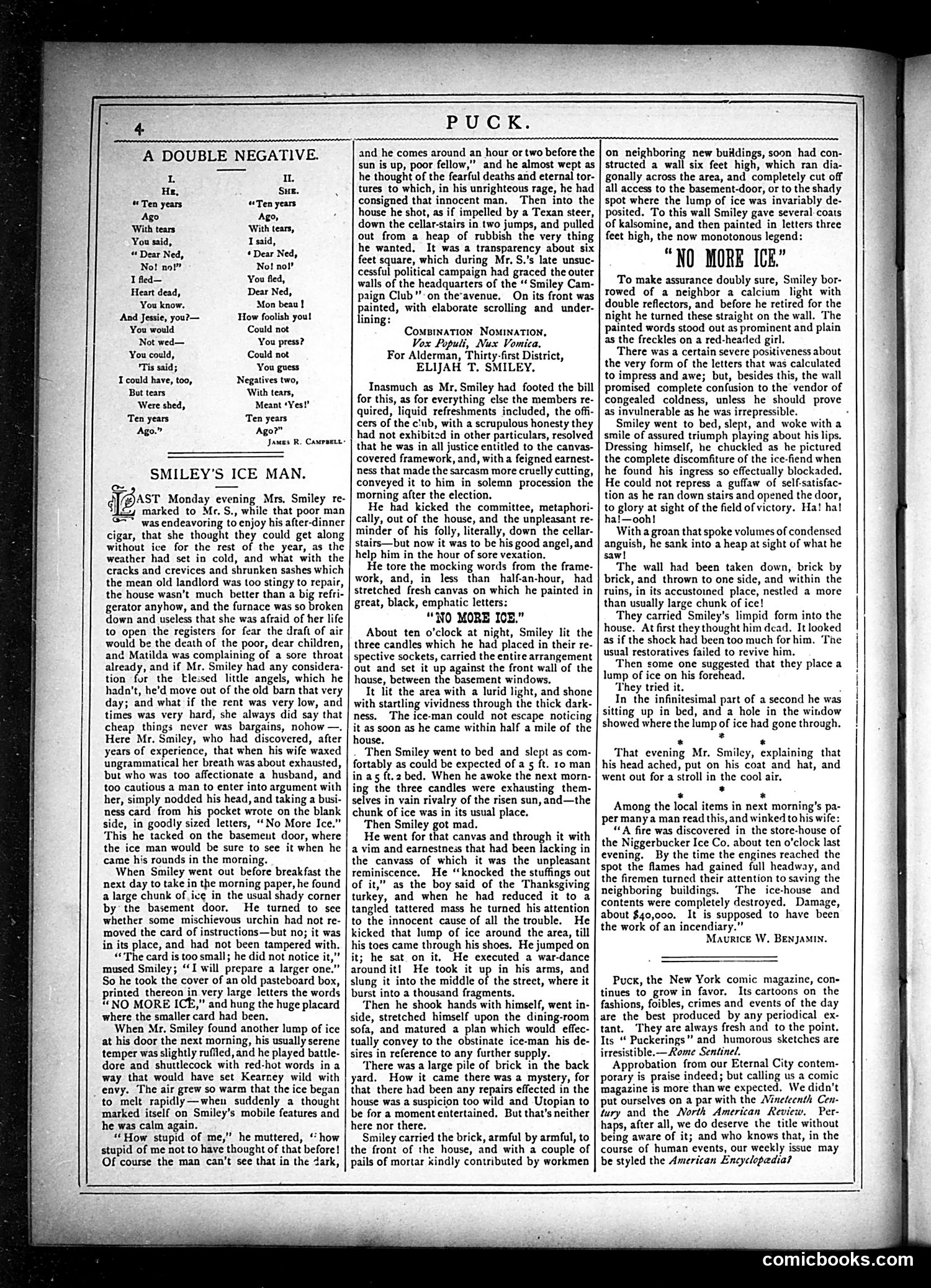
This story satirizes **Elijah T. Smiley**, a political figure (appears to be from Texas, given references to "a Texan steer"). The piece mocks Smiley's failed attempt to curry favor by placing ice in neighbors' windows during hot weather—a seemingly generous gesture that backfires spectacularly. The satire targets Smiley's transparent political opportunism: his ice delivery is exposed as calculated self-promotion rather than genuine kindness. The joke escalates when his blocks of ice become weapons of chaos, spreading destruction throughout the neighborhood and ultimately destroying his own house. The piece critiques politicians who perform artificial charity for votes while lacking authentic compassion. "No More Ice" captures public exhaustion with such performative gestures.
📄 Transcribed text from this page (OCR, searchable)
Machine-transcribed from the original scan — historical spelling and the odd misread are preserved.
PUCK. A DOUBLE NEGATIVE. I. Sur. “Ten years Ago, With tears, I said, «Dear Ned, No! nol’ You fled, Dear Ned, Mon beau How foolish you! Could not You press? Could not You guess Negatives two, With tears, Meant ‘Yes!’ Ten years Ago?” ‘Jaues R. Cantrastt No! no!” I fled— Heart dead, You know, ‘And Jessie, you?— You would Not wed— You could, Tis said; T could have, too, Bot tears Were shed, Ten years Ago.” SMILEY’S ICE MAN. oe as east Monday evening Mrs, Smiley re- 2 marked to Mr. S., while that poor man =" was endeavoring to enjoy his after-dinner cigar, that she thought they could get along without ice for the rest of the year, as the weather had set in cold, and what with the cracks and crevices and shrunken sashes which the mean old landlord was too stingy to repair, the house wasn’t much better than a big refri- gerator anyhow, and the furnace was so broken down and useless that she was afraid of her life to open the registers for fear the draft of air would be the death of the poor, dear children, and Matilda was complaining of a sore throat already, and if Mr. Smiley had any considera- tion fur the Elessed little angels, which he hadn't, he’d move out of the old barn that very day; and what if the rent was very low, and times was very hard, she always did say that cheap things never was bargains, nohow —. Here Mr. Smiley, who had discovered, after years of experience, that when his wife waxed ungrammatical her breath was about exhausted, but who was too affectionate a husband, and too cautious a man to enter into argument with her, simply nodded his head, and taking a busi- ness card from his pocket wrote on the blank side, in goodly sized letters, ‘‘No More Ice.” This he tacked on the basement door, where the ice man would be sure to see it when he came his rounds in the morning. When Smiley went out before breakfast the next day to take in the morning paper, he found a large chunk of ice in the usual shady corner by the basement door. He turned to see whether some mischievous urchin had not re- moved the card of instructions—but no; it was in its place, and had not been tampered with. “The card is too small; he did not notice it,”” mused Smiley; “I will prepare a larger one.” So he took the cover of an old pasteboard box, printed thereon in very large letters the words “NO MORE ICE,” and hung the huge placard where the smaller card had been. When Mr. Smiley found another lump of ice at his door the next morning, his usually serene temper was slightly ruffled, and he played battle- dore and shuttlecock with red-hot words ina way that would have set Kearney wild with envy. The air grew so warm that the ice began to melt rapidly—when suddenly a thought marked itself on Smiley’s mobile features and he was calm again. “«How stupid of me,” he muttered, ‘how stupid of me not to have thought of that before! Of course the man can’t see that in the dark, and he comes around an hour or two before the sun is up, poor fellow,” and he almost wept as he thought of the fearful deaths and eternal tor- tures to which, in his unrighteous rage, he had consigned that innocent man. Then into the house he shot, as if impelled by a Texan steer, down the cellar-stairs in two jumps, and pulled out from a heap of rubbish the very thing he wanted, It was a transparency about six feet square, which during Mr. S.'s late unsuc- cessful political campaign had graced the outer walls of the headquarters of the ‘‘ Smiley Cam- paign Club”’-on the‘avenue, On its front was painted, with elaborate scrolling and under- lining: Compination Nomination, Vox Populi, Nux Vomica. For Alderman, Thirty-first District, ELIJAH T. SMILEY, Inasmuch as Mr, Smiley had footed the bill for this, as for everything else the members re- quired, liquid refreshments included, the offi- cers of the c'ub, with a scrupulous honesty they had not exhibited in other particulars, resolved that he was in all justice entitled to the canvas- covered framework, and, with a feigned earnest- ness that made the sarcasm more cruelly cutting, conveyed it to him in solemn procession the morning after the election. He had kicked the committee, metaphori- cally, out of the house, and the unpleasant re- minder of his folly, literally, down the cellar- stairs—but now it was to be his good angel, and help him in the hour of sore vexation. He tore the mocking words from the frame- work, and, in less than half-an-hour, had stretched fresh canvas on which he painted in great, black, emphatic letters: “NO MORE ICE.” About ten o’clock at night, Smiley lit the three candles which he had placed in their re- spective sockets, carried the entire arrangement out and set it up against the front wall of the hause, between the basement windows, It lit the area with a lurid light, and shone with startling vividness through the thick dark- ness. The ice-man could not escape noticing it as soon as he came within half a mile of the house. Then Smiley went to bed and slept as com- fortably as could be expected of a 5 ft. ro man in as ft.2 bed. When he awoke the next morn- ing the three candles were exhausting them- selves in vain rivalry of the risen sun, and—the chunk of ice was in its usual place. Then Smiley got mad. He went for that canvas and through it with a vim and earnestness that had been lacking in the canvass of which it was the unpleasant reminiscence. He “knocked the stuffings out of it,” as the boy said of the Thanksgiving turkey, and when he had reduced it to a tangled tattered mass he turned his attention to the innocent cause of all the trouble. He kicked that lump of ice around the area, till his toes came through his shoes. He jumped on it; he sat on it, He executed a war-dance around it! He took it up in his arms, and slung it into the middle of the street, where it burst into a thousand fragments. Then he shook hands with himself, went in- side, stretched himself upon the dining-room sofa, and matured a plan which would effec- tually convey to the obstinate ice-man his de- sires in reference to any further supply. ‘There was a large pile of brick in the back yard. How it came there was a mystery, for that there had been any repairs effected in the house was a suspicion too wild and Utopian to be for a momententertained, But that’s neither here nor there. Smiley carried the brick, armful by armful, to the front of the house, and with a couple of pails of mortar kindly contributed by workmen on neighboring new buildings, soon had con- structed a wall six feet high, which ran dia- gonally across the area, and completely cut off all access to the basement-door, or to the shady spot where the lump of ice was invariably de- posited. To this wall Smiley gave several-coats of kalsomine, and then painted in letters three feet high, the now monotonous legend: “NO MORE Ich” To make assurance doubly sure, Smiley bor- rowed of a neighbor a calcium light with double reflectors, and before he retired for the night he turned these straight on the wall. The painted words stood out as prominent and plain as the freckles on a red-headed girl. There was a certain severe positiveness about the very form of the letters that was calculated to impress and awe; but, besides this, the wall promised complete confusion to the vendor of congealed coldness, unless he should prove as invulnerable as he was irrepressible. . Smiley went to bed, slept, and woke with a smile of assured triumph playing about his lips. Dressing himself, he chuckled as he pictured the complete discomfiture of the ice-fiend when he found his ingress so effectually blockaded, He could not repress a guffaw of self-satisfac- tion as he ran down stairs and opened the door, to glory at sight of the field of victory. Ha! ha! ha!—ooh! With a groan that spoke volumes of condensed anguish, he sank into a heap at sight of what he saw! The wall had been taken down, brick by brick, and thrown to one side, and within the ruins, in its accustomed place, nestled a more than usually large chunk of ice! They carried Smiley's limpid form into the house. At first they thought him dead. It looked as if the shock had been too much for him. The usual restoratives failed to revive him, Then some one suggested that they place a lump of ice on his forehead. They tried it. 3 In the infinitesimal part of a second he was sitting up in bed, and a hole in the window showed where the lump of ice had gone through. Ps * * That evening Mr. Smiley, explaining that his head ached, put on his coat and hat, and went out for a stroll in the cool air, * * * Among the local items in next morning’s pa- per many a man read this, and winked tohis wife: “A fire was discovered in the store-house of the Niggerbucker Ice Co, about ten o'clock last evening. By the time the engines reached the spot the flames had gained full headway, and the firemen turned their attention to saving the neighboring buildings. ‘The ice-house and contents were completely destroyed. Damage, about $40,000. It is supposed to have been the work of an incendiary.” Maurice W. Benjamin. Puck, the New York comic magazine, con- tinues to grow in favor. Its cartoons on the fashions, foibles, crimes and events of the day are the best produced by any periodical ex- tant. They are always fresh and to the point. Its “ Puckerings” and humorous sketches are irresistible.—Rome Sentinel. Approbation from our Eternal City contem- porary is praise indeed; but calling us a comic magazine is more than we expected. We didn’t put ourselves on a par with the Wineteenth Cen- tury and the North American Review. Per- haps, after all, we do deserve the title without being aware of it; and who knows that, in the course of human events, our weekly issue may be styled the American Encyclopedia? comicbooks.com