
A complete issue · 16 pages · 1878
Puck — November 27, 1878
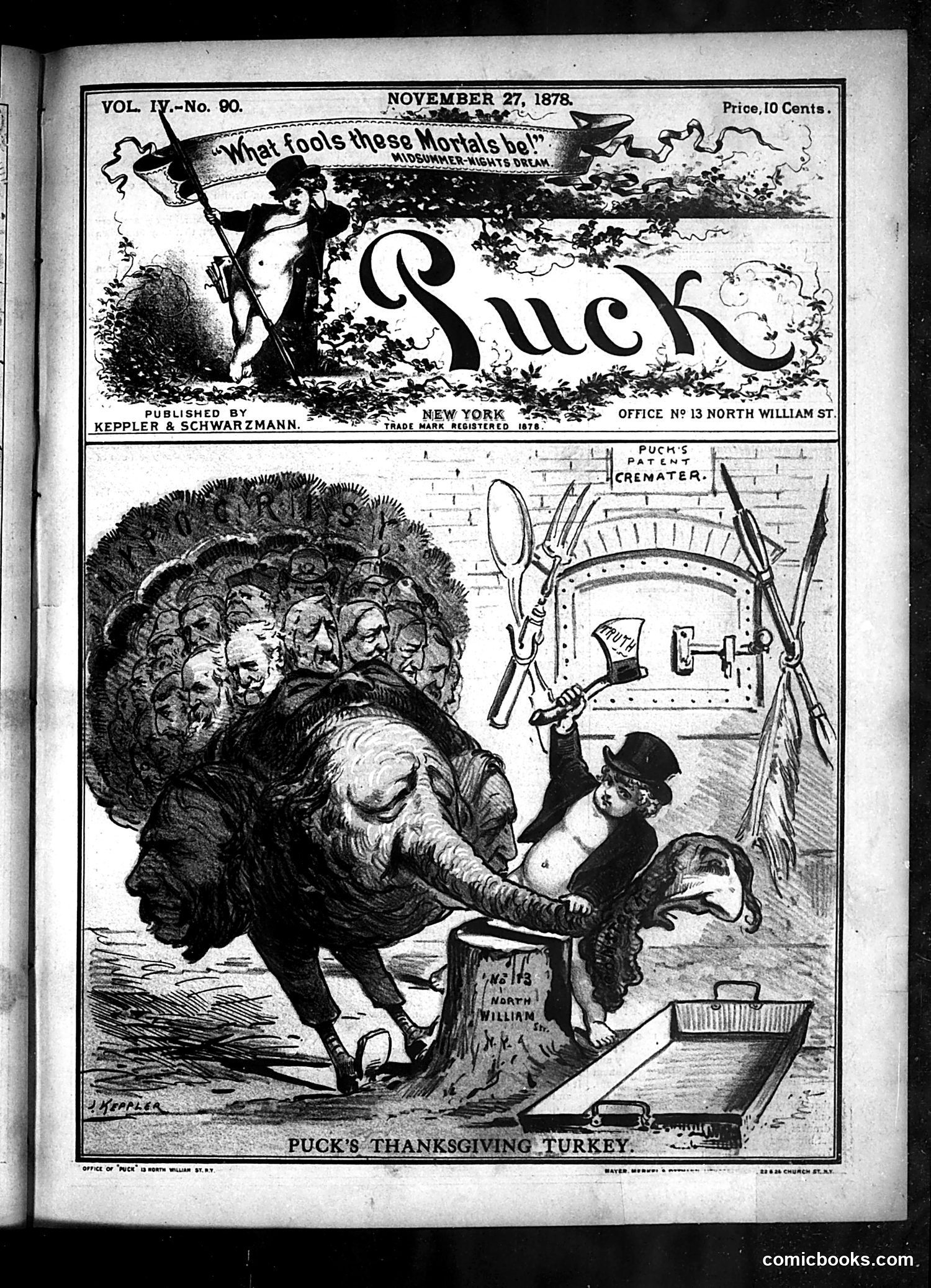
This cartoon satirizes corrupt political patronage and embezzlement. A grotesque turkey—its body composed of multiple faces representing politicians or bureaucrats—is being presented for "Thanksgiving." One figure operates "Puch's Patent Cremater" (a furnace), while another stands near a coffin labeled "The Late Wm. H. H. Murray," suggesting disposal of evidence or bodies. The turkey's monstrous multi-faced form represents collective political corruption. The cremator symbolizes attempts to destroy evidence of wrongdoing. The overall message condemns how corrupt officials—literally embodied in this grotesque creature—are "roasted" (exposed) during holiday season, yet the system's machinery exists to conceal their crimes.
This page consists primarily of **text articles and letters** rather than political cartoons. The main content includes: 1. **"Brother Murphy's Work"** — A satirical piece defending a Catholic priest (Brother Murphy) who helped reform a drunk named Francis Murphy, mocking critics who claim saving drunkards is pointless charity. 2. **"Puck's Thanksgiving Turkey"** — A humorous essay personifying a turkey facing slaughter, with commentary on hypocrisy and holiday traditions. 3. **"Of Corset Is"** — A letter correcting a previous cartoon about women's corsets, addressing anatomical accuracy in fashion depiction. The satirical targets are social hypocrisy, religious reform efforts, and fashion criticism rather than specific political figures. This reflects Puck's tendency toward social commentary over partisan politics during this period.
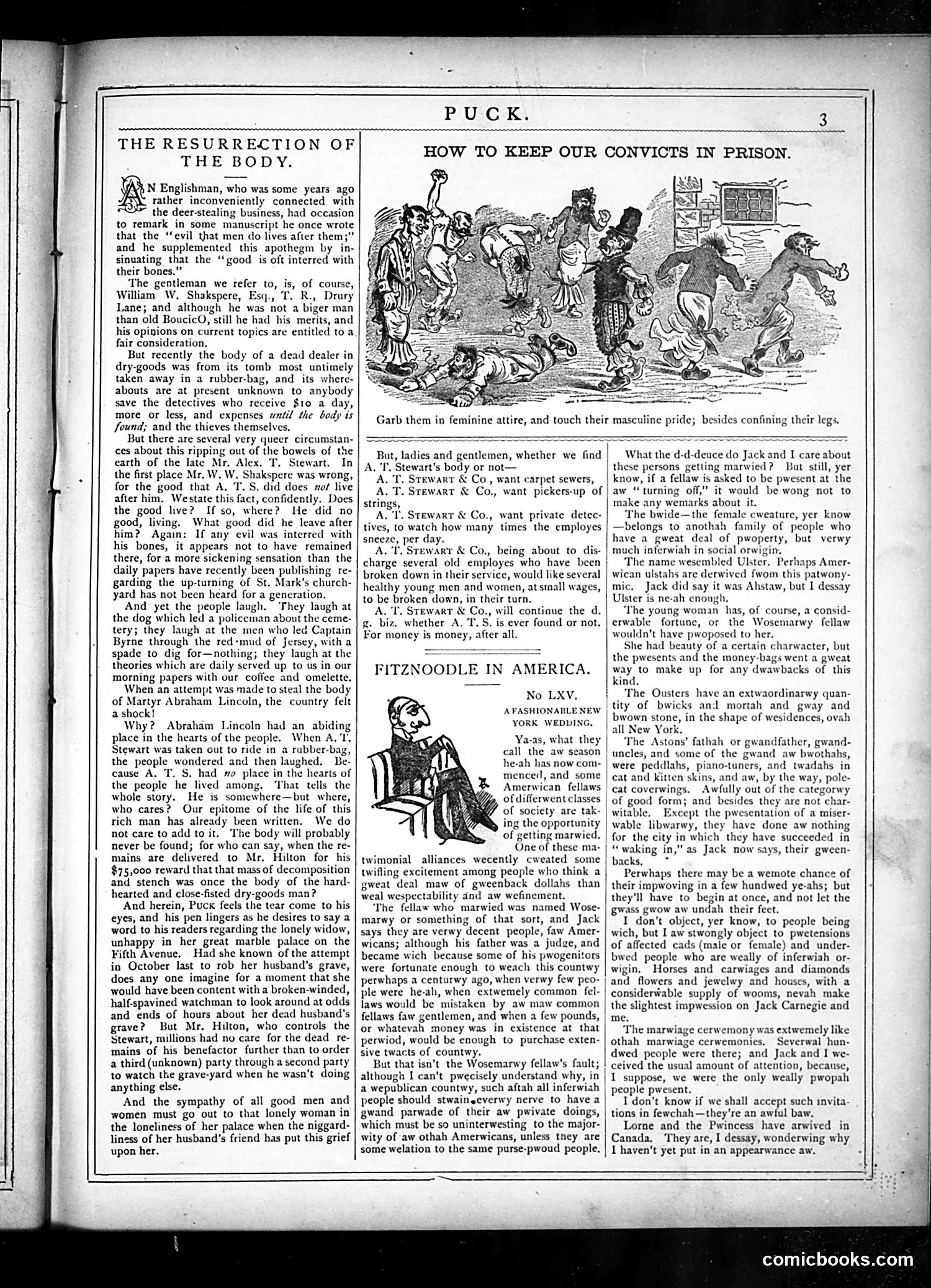
**"How to Keep Our Convicts in Prison"** presents a satirical cartoon showing guards restraining prisoners. The accompanying text mocks the apparent ease with which convicts escape, suggesting institutional incompetence. References to carpet sewers and private detectives imply that wealthy businesses (A. T. Stewart & Co.) hire their own security rather than trusting public systems—a critique of privatized law enforcement. **"Fitznoodle in America"** satirizes a fashionable Englishman navigating American social aspirations. The text ridicules newly wealthy Americans aping European aristocracy through marriages, acquisitions of old European art, and ostentatious consumption. The satire targets the nouveau riche's insecurity and their attempts to purchase social legitimacy through material goods and foreign connections. Both pieces mock institutional failure and social pretension characteristic of Gilded Age America.
This Puck page satirizes the **mysterious disappearance of the Tribune Building** in New York City—apparently a real incident causing public sensation around the time of publication. The article mocks the **incompetence of police and city officials** who cannot locate an entire building, despite various theories: that it was stolen and smuggled out by river, hidden in New Jersey, or involved in insurance fraud schemes. The satire targets how **sensational the press coverage became**, with wild rumors spreading while authorities bungled the investigation. The police claimed they'd arrest the perpetrators but produced no real evidence or progress. This reflects Puck's typical role: **mocking official incompetence and public gullibility** regarding urban mysteries, while critiquing how newspapers amplified absurd speculation into major scandals.
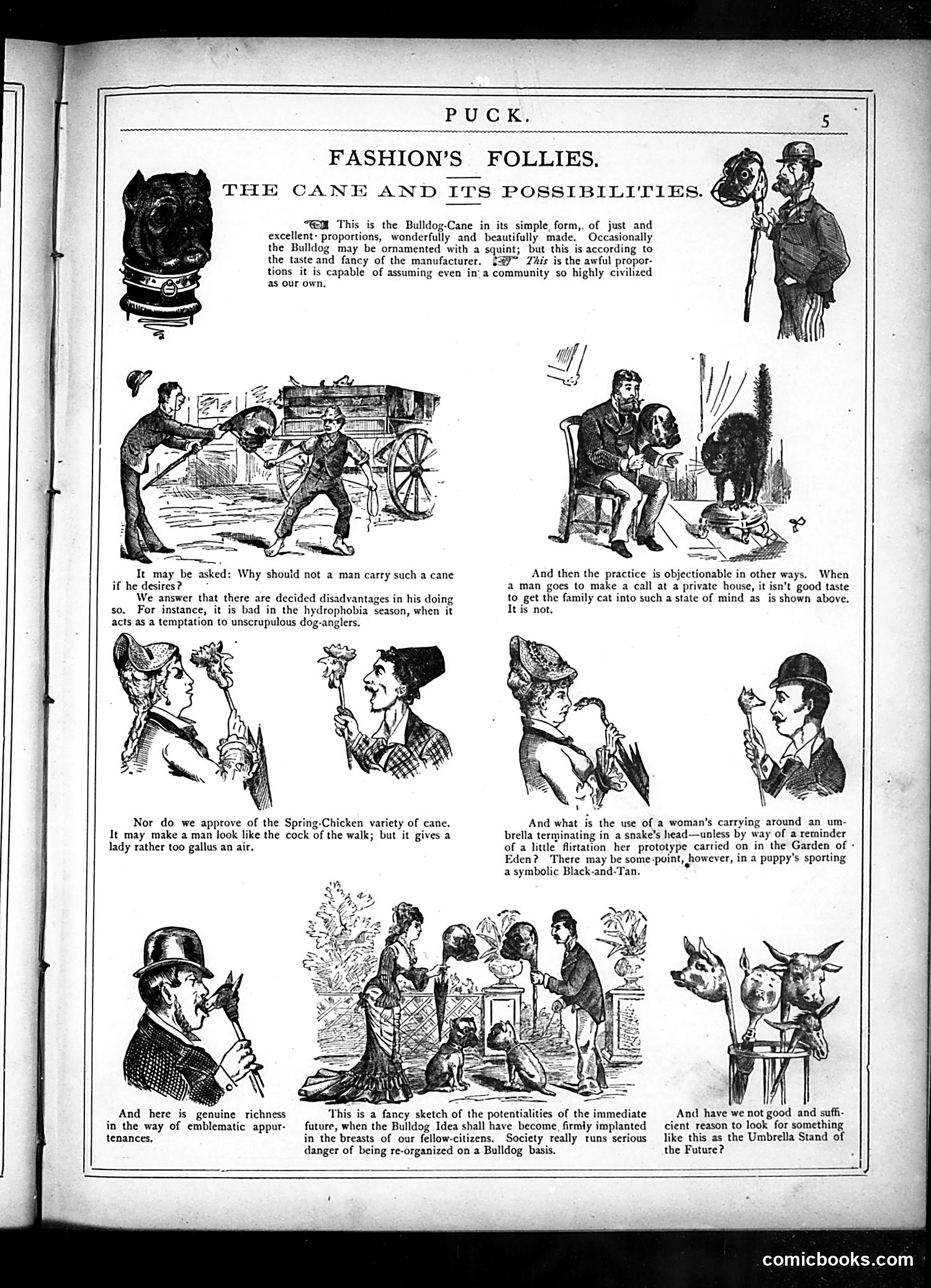
This Puck satirical piece mocks the fashionable trend of men carrying ornamental canes in late 19th-century society. The article ridicules several cane styles—the "Bulldog-Cane," "Spring-Chicken variety," and elaborate decorative versions—as pretentious affectations that attract "unscrupulous dangle-rs" (con artists). The cartoons depict absurd scenarios: men using canes to menace others, women carrying umbrellas with animal heads, and fantasies of dogs and cattle organized around a "Bulldog basis," suggesting that adopting this fashion trend could dangerously transform society. The satire critiques how fashion-obsessed elites blindly adopt status symbols, warning that such frivolous trends could destabilize the social order—a common Puck theme mocking upper-class vanity and herd mentality.
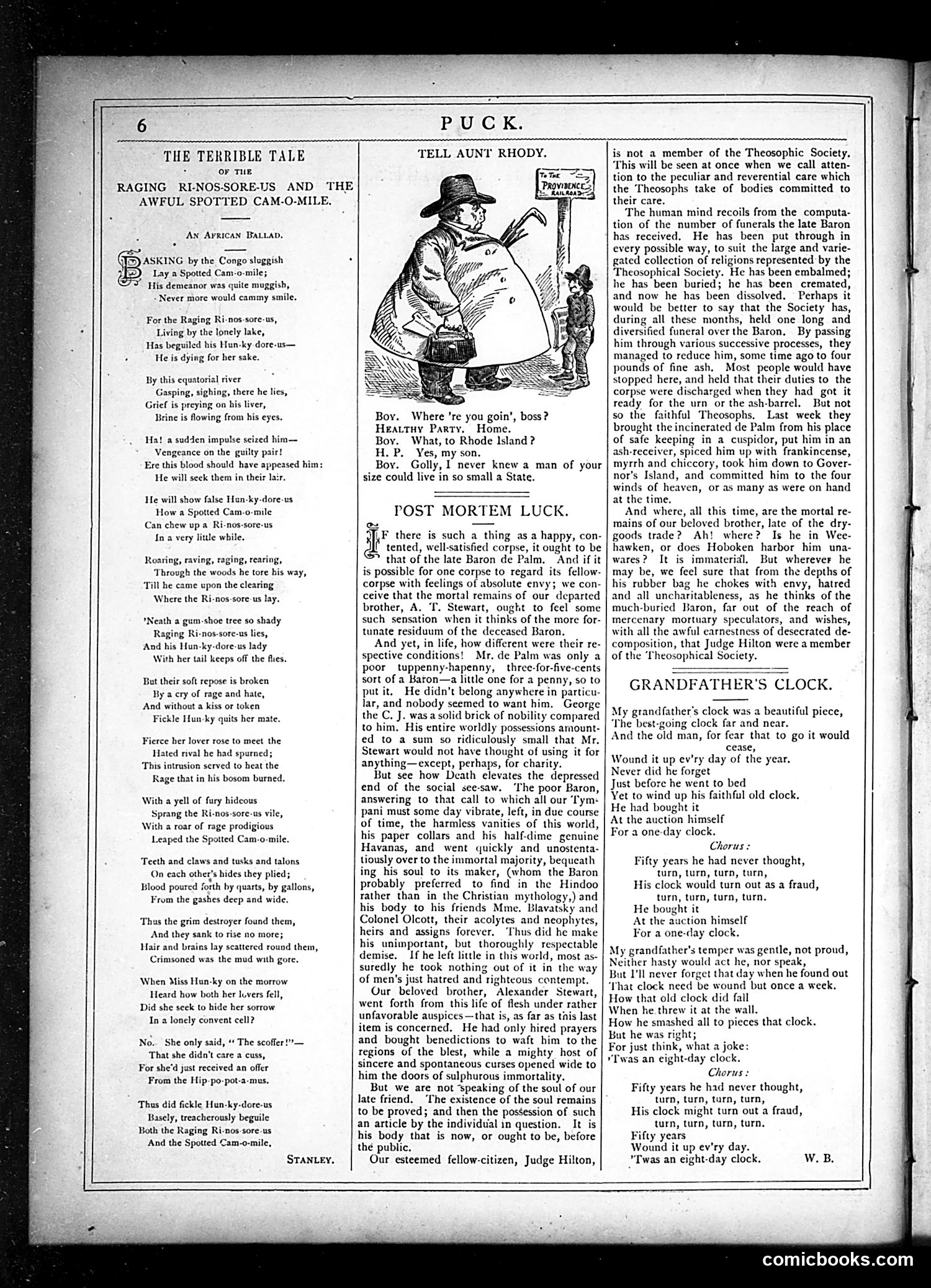
This cartoon depicts a man reading a newspaper to a small boy, illustrating the folk song "Tell Aunt Rhody" (visible on the sign). The humor appears to be visual rather than politically pointed—it simply captures a domestic scene of an adult sharing news with a child. The page also contains poetry and prose pieces including "Post Mortem Luck" (discussing the Theosophic Society and Baron de Palm's remains) and "Grandfather's Clock" (verses about an heirloom timepiece). These are satirical pieces on contemporary social topics, though without identifying the specific publication date, the precise political references remain unclear. The content emphasizes Puck's mix of humor, social commentary, and literary content typical of 19th-century American satirical magazines.
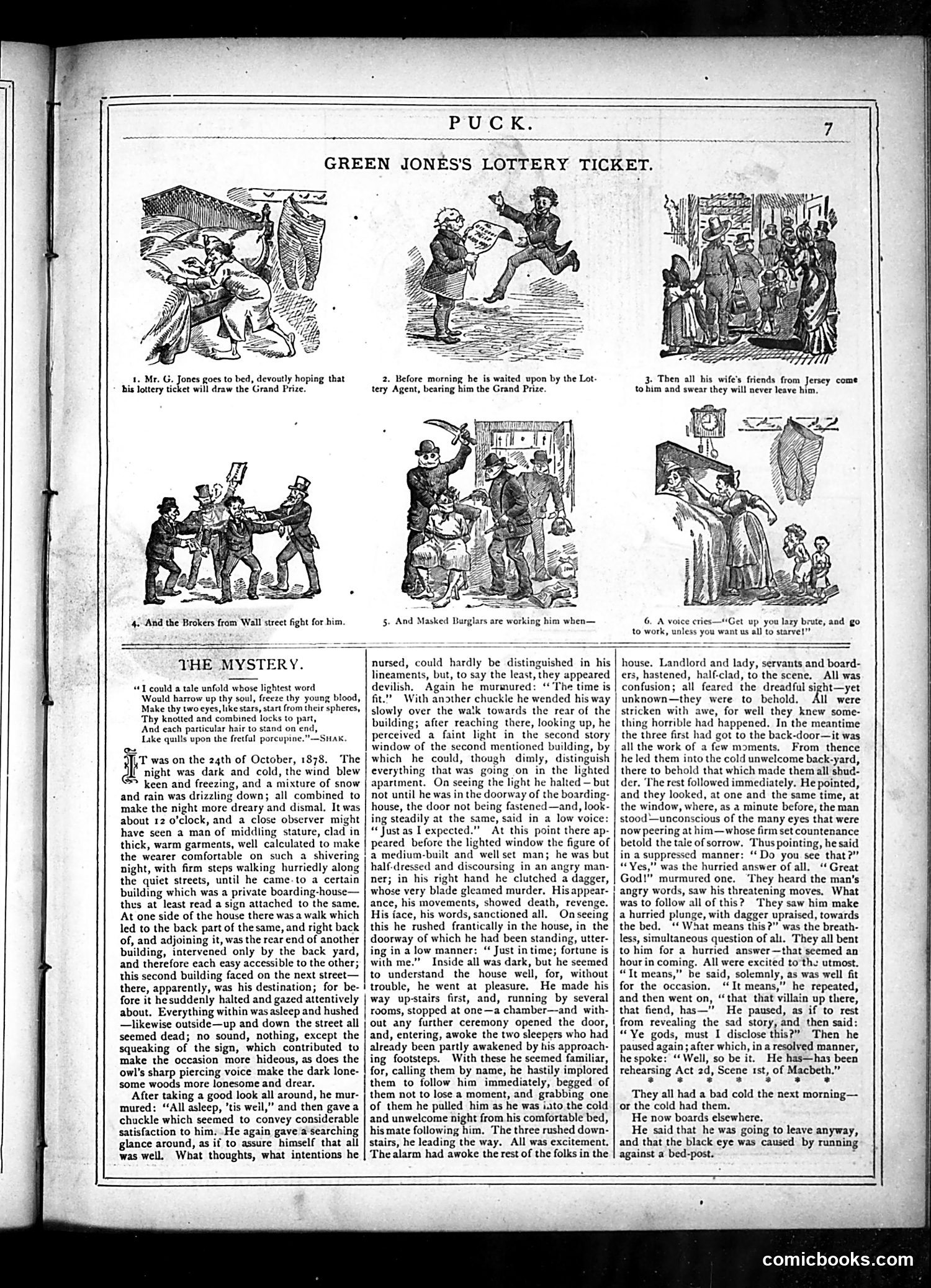
This six-panel comic strip satirizes lottery gambling and its consequences. Mr. G. Jones foolishly hopes his lottery ticket will win the "Grand Prize" (panel 1). A lottery agent visits him with news (panel 2), leading Jones to celebrate with his wife's Jersey friends (panel 3). The story then darkens: brokers from Wall Street fight over him (panel 4), masked burglars rob him (panel 5), and a voice warns him to "get on yer hay bode, and go to work" (panel 6). The satire targets lottery schemes as snares for the gullible poor. Winning supposedly brings not fortune but exploitation—by financial schemers and criminals who recognize an easy mark. The moral: honest labor ("hay bode"/hay bale) beats gambling's false promises.
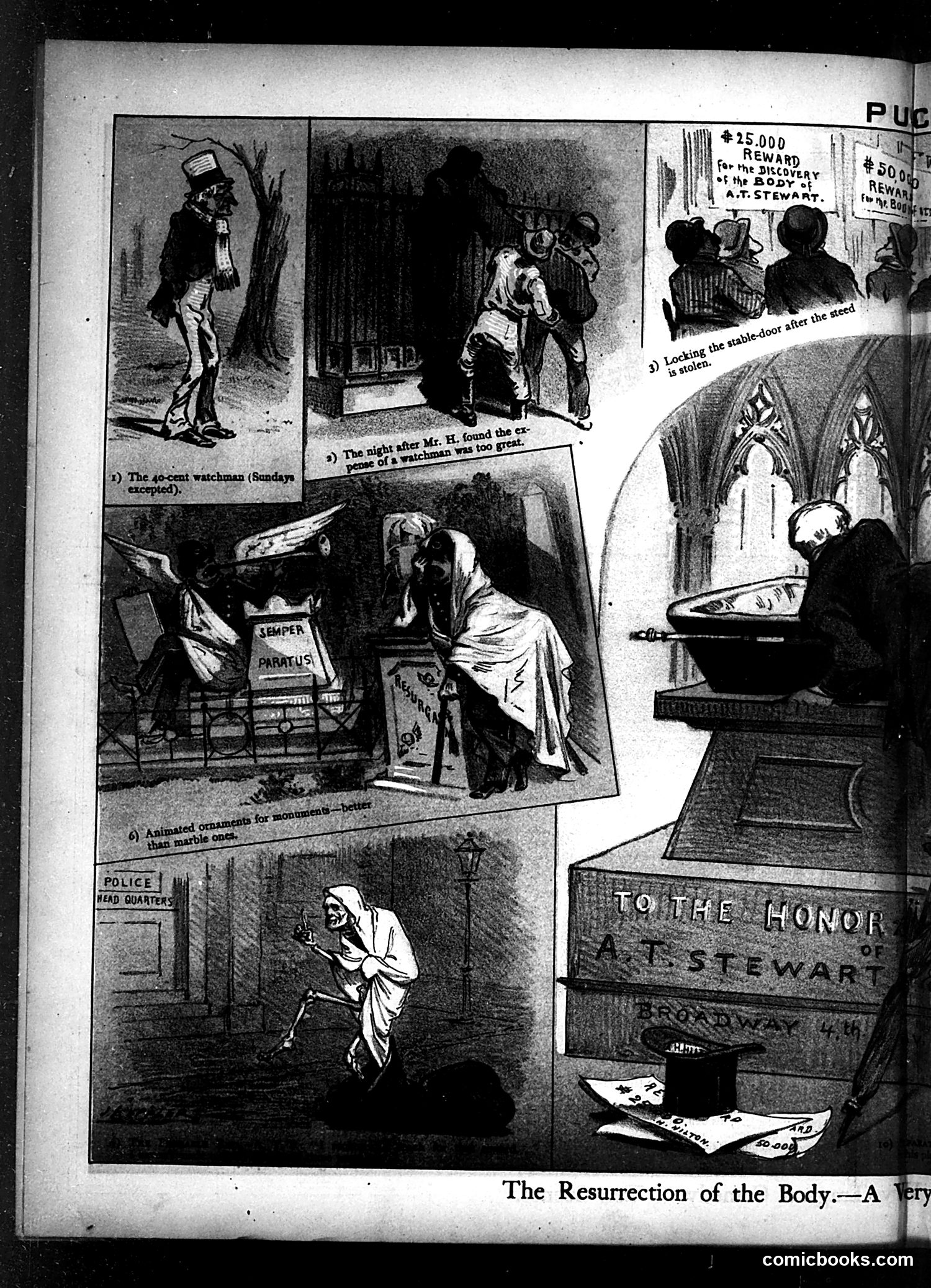
This appears to be a serialized story or comic strip illustrated with dark, Gothic imagery. The narrative follows what seems to be a body-snatching plot—a common 19th-century crime and literary theme. Key elements visible: - A watchman discovers something suspicious - Someone "locking the stable-door after the steed is stolen" (suggesting theft already occurred) - References to "animated ornaments for monuments" and "marble ones"—implying stolen bodies - A figure near police headquarters - A final scene showing a body in what appears to be a church or tomb, with a memorial "TO THE HONOR OF T. STEWART" The narrative appears to satirize grave robbing or body theft, possibly referencing a real historical incident. The specific reference to "A.T. Stewart" likely connects to an actual grave robbery case, though the exact historical event requires external verification.
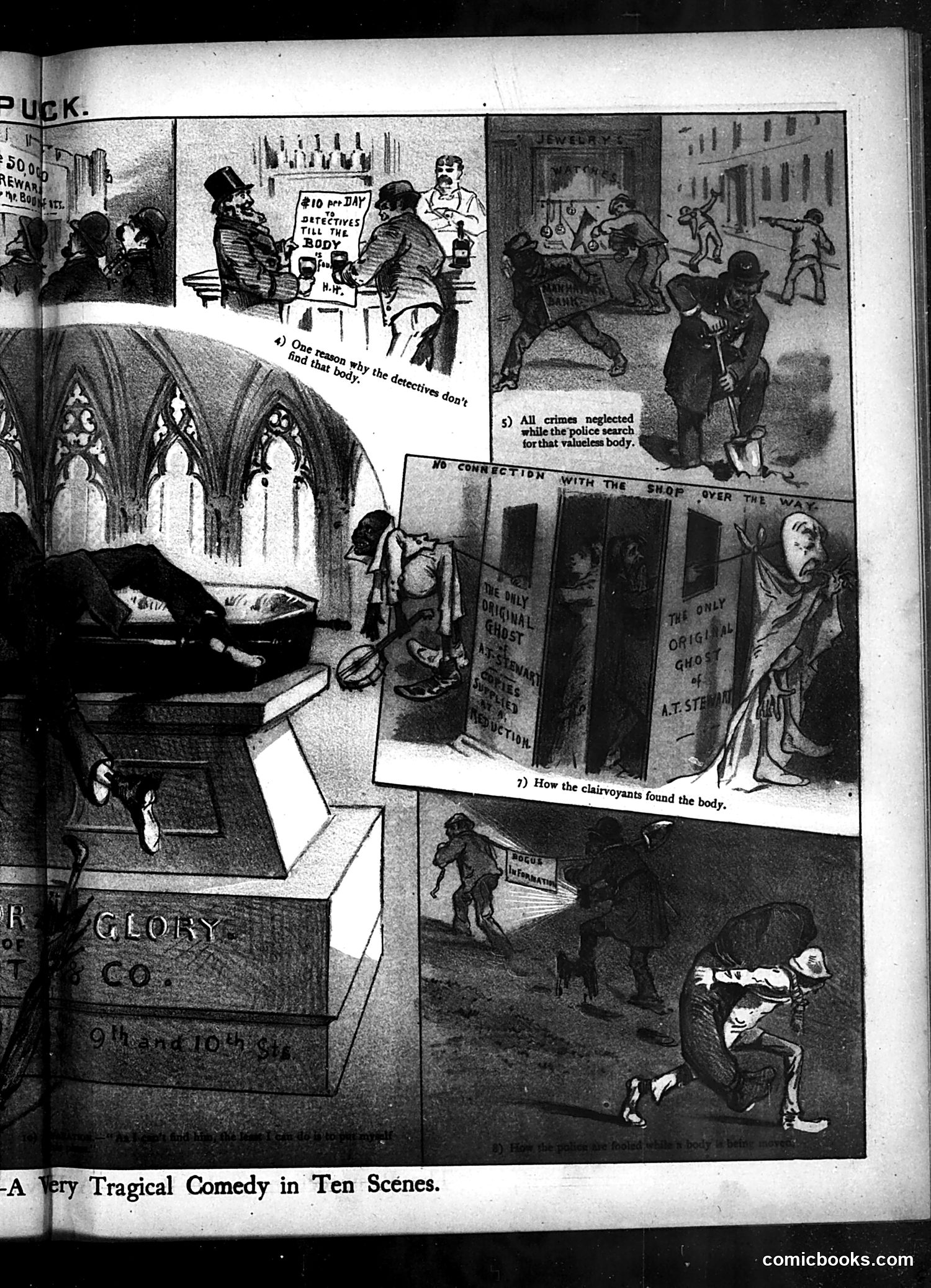
This appears to be a satirical narrative comic strip depicting a murder mystery or crime investigation. The numbered scenes show: 1. A body in a coffin at a church 2. Detectives discussing evidence ("$10 per day" visible on a sign) 3. A police search of suspicious premises 4. Clairvoyants claiming to locate the body The satire mocks multiple targets: incompetent detectives unable to solve obvious crimes, the commercialization of detective work (charging by the day), and the popular contemporary phenomenon of spiritualist "clairvoyants" exploiting public fascination with the supernatural to solve mysteries. The title "Tragical Comedy" signals that the serious crime drama becomes absurd through bungling law enforcement and fraudulent spiritualism—typical Puck-style mockery of contemporary follies and superstitions.
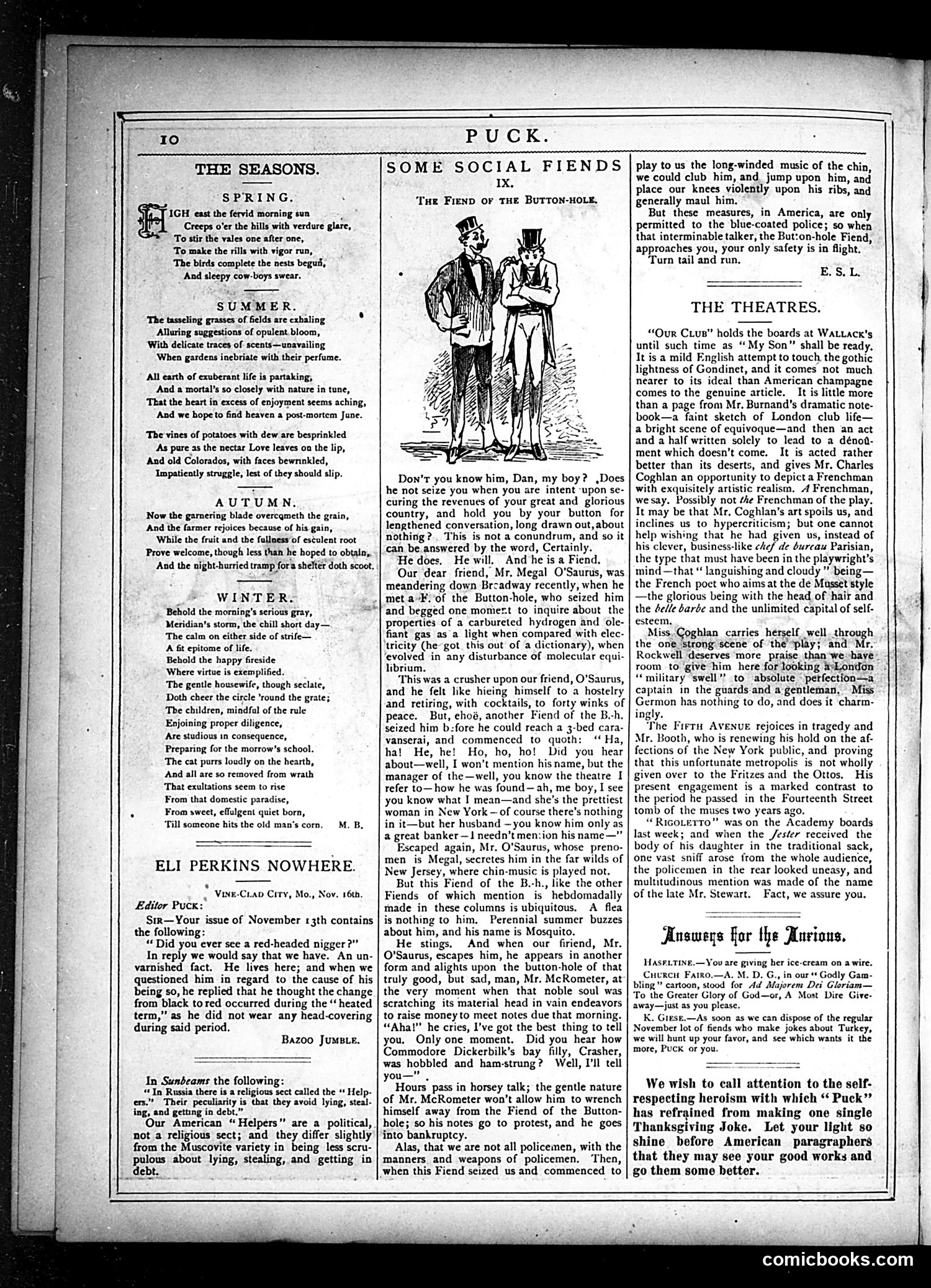
This cartoon satirizes a specific social type: the intrusive, garrulous bore who attaches himself to acquaintances. The illustration shows two men—one trying to escape while the other, dressed formally with a top hat, grabs his companion insistently. The accompanying text explains the joke: this "Friend of the Button-Hole" is someone who seizes you by your coat button during conversation and won't let go, trapping you in tedious discussion. The piece notes this behavior is permitted to American police but considered rude elsewhere. The satire targets social parasites who monopolize attention through physical persistence rather than charm—a recognizable character type mocked for his lack of social awareness and ability to read disinterest in his victims.
This page from *Puck* contains two literary pieces rather than political cartoons: **"A Portrait"** is a poem celebrating a woman named Anne, praising her beauty, accomplishments, and refined tastes. The verses emphasize her artistic abilities, graceful manners, and cultural sophistication. **"Bianca"** is a longer prose piece by W.E. Norris (credited as "in 'Belgravia'"), describing the author's encounter with an acquaintance in Venice. It's a gossipy anecdote about social interactions and romantic intrigue among European society figures abroad. Neither piece contains obvious political satire. This appears to be a literary rather than satirical page—*Puck* regularly mixed humor, commentary, and literary content. The social observations are lighthearted rather than biting.
This page appears to be primarily text—a serialized story or article rather than a political cartoon. The page is numbered 12 and titled "PUCK" at the top. The narrative discusses romantic entanglements involving characters including "Von Rosenau," "Bianca," and references to Venice and the Palazzo Marinelli. The text mentions social class tensions, courtship customs, and romantic complications among what appears to be European aristocracy or wealthy characters. At the bottom, there's a note "(To be continued)" indicating this is part of an ongoing serialized narrative. Without visible illustrations or clear political references on this particular page, this appears to be literary content rather than satirical cartooning typical of Puck magazine's known format.
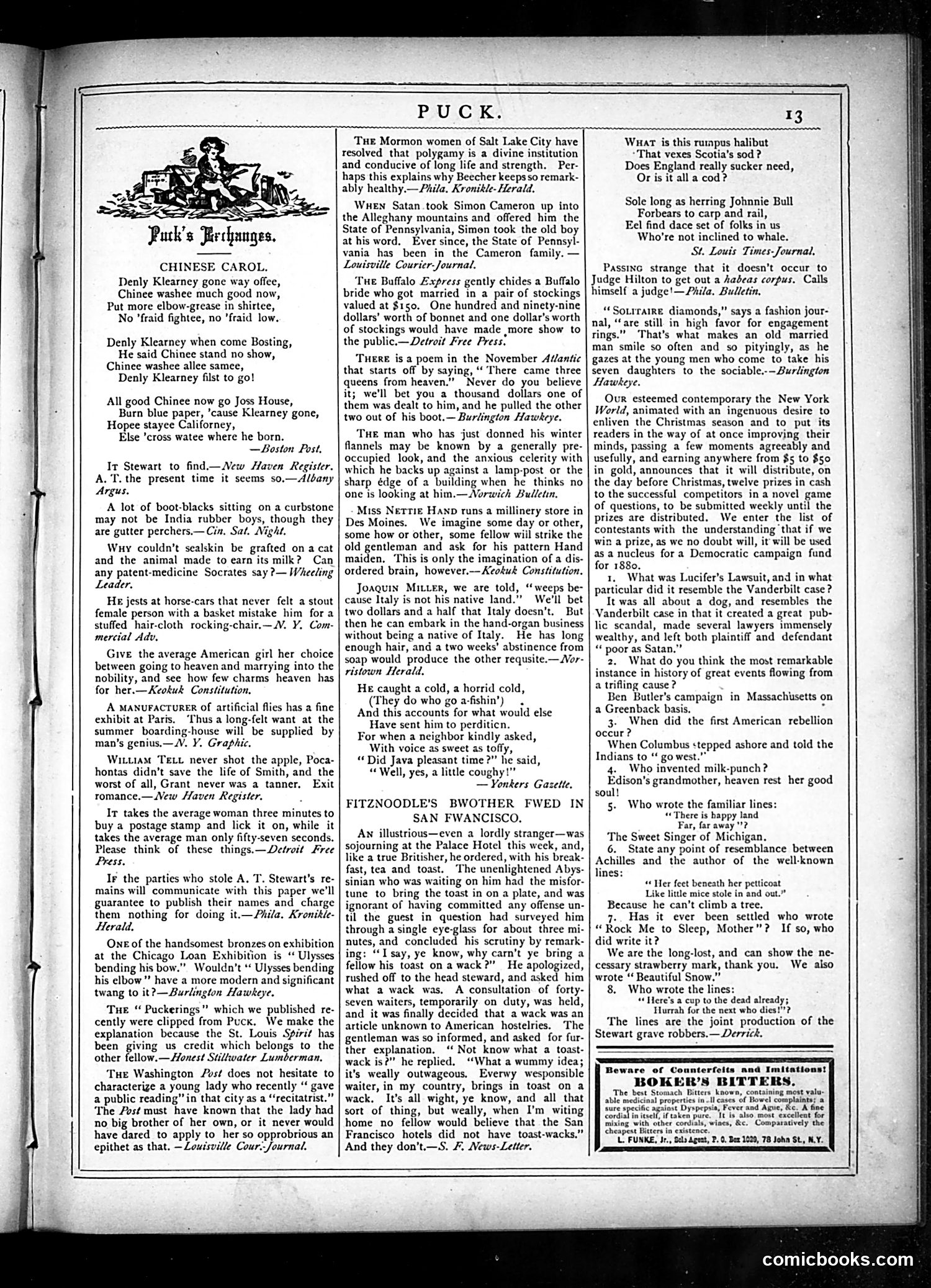
This page contains "Puck's Briarpatch," a satirical humor section featuring jokes and short commentary pieces rather than illustrated political cartoons. The content includes humorous quips about Chinese immigrants ("Chinese Carol"), social commentary on wealthy industrialists, and satirical observations on contemporary events. One piece mocks a "manufacturer of artificial flies" and their marketing to boarding houses. Another section titled "Fitznoodle's Brother Fwed in San Francisco" recounts an anecdote about a guest at a hotel being confused about whether "toast-wacks" (toast racks) existed in San Francisco. The humor relies on wordplay, misunderstandings, and satirical observations typical of late 19th/early 20th-century American periodicals. Without illustrations accompanying these pieces, the page functions primarily as written satire of social customs and contemporary figures.
This is primarily an **advertising page** from Puck magazine, not a political cartoon. The page contains numerous commercial advertisements for late 19th-century products and services, including: - Compressed yeast and clothing (trouserings, suitings, overcoatings) - Furniture by Thonet Brothers - Apollinaris mineral water - Vichy Springs water - Patent and trademark services - Dental offices - A pamphlet binding service The only notable image is a portrait of **Hunyadi János**, described as "The Great European Novelty," promoting natural mineral water's health benefits—typical marketing language for patent medicines of the era. The page demonstrates how Puck supported itself: advertising revenue was essential to the magazine's business model.
This page is primarily **advertising content** rather than editorial satire. It contains numerous commercial advertisements typical of Puck magazine's revenue model, including: - Champagne and wine merchants - A tailor (Nicoll) - Photography studios (Kurtz) - Furniture dealers - Umbrellas (Isaac Smith's) - Various other New York City businesses The only clear cartoon element is a **decorative heraldic-style illustration** for D.A. Meltzer's Hungarian wines, featuring a mounted figure in ornate baroque framing—typical Victorian commercial artwork rather than political satire. The page demonstrates how 19th-century magazines funded operations through extensive paid advertisements, often occupying entire pages with minimal editorial content.
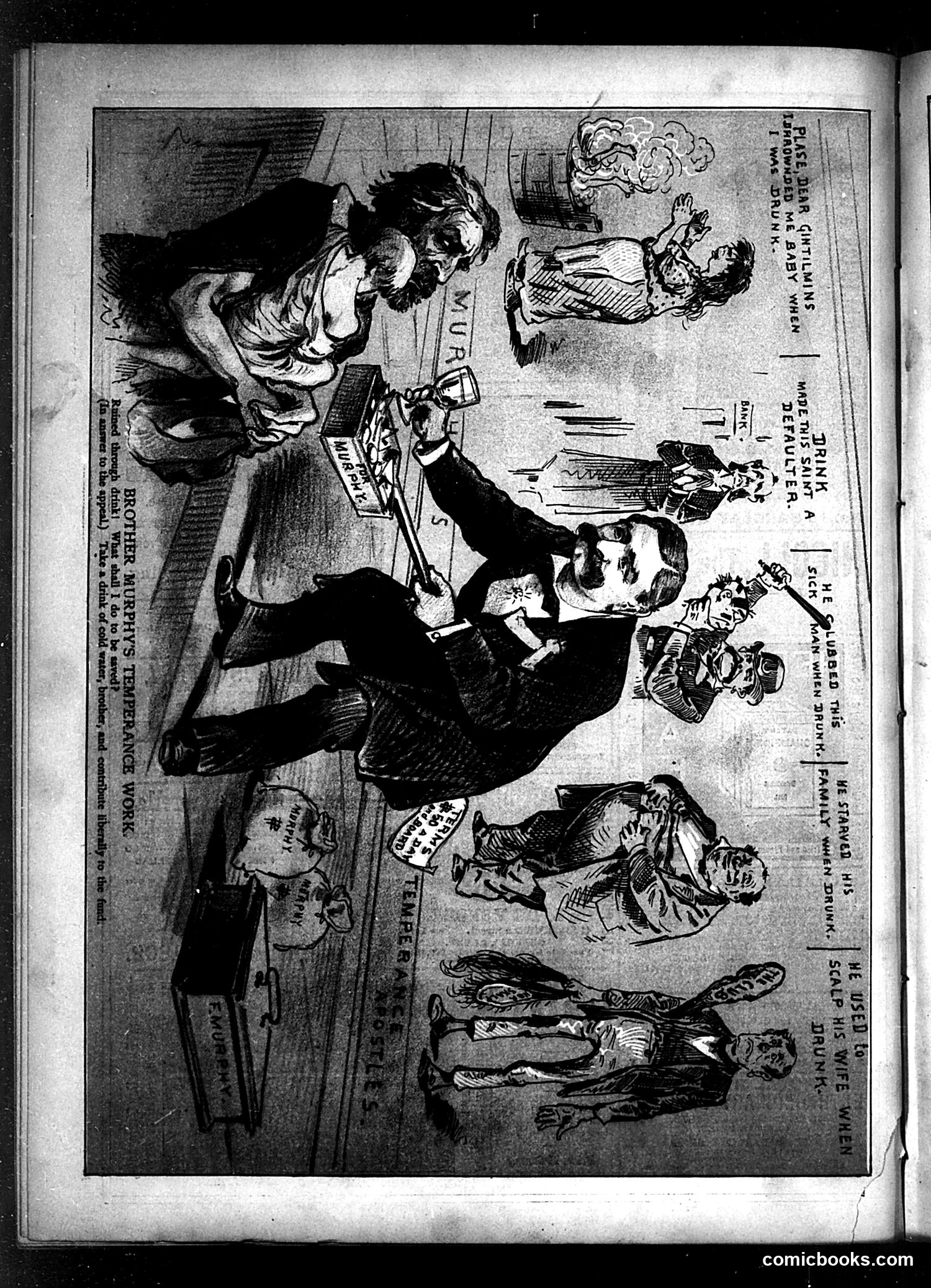
This Puck magazine page depicts a satirical scene showing what appears to be a political or business figure in formal attire as the central focus. The cartoon criticizes this person's relationship with various subordinate figures and questionable dealings. While the OCR text is largely illegible in this reproduction, the visual composition suggests commentary on corruption, favoritism, or abuse of power—common Puck themes. The figures surrounding the main character appear to represent different constituencies or victims being exploited or manipulated. Without clearer text or additional context identifying the specific historical moment, I cannot definitively name the central figure or pinpoint the exact political event being satirized. The artistic style and printing quality suggest this is from Puck's peak era (late 1800s-early 1900s).