
Puck, 1878-11-27 · page 4 of 16
Puck — November 27, 1878 — page 4: what you’re looking at
What you’re looking at
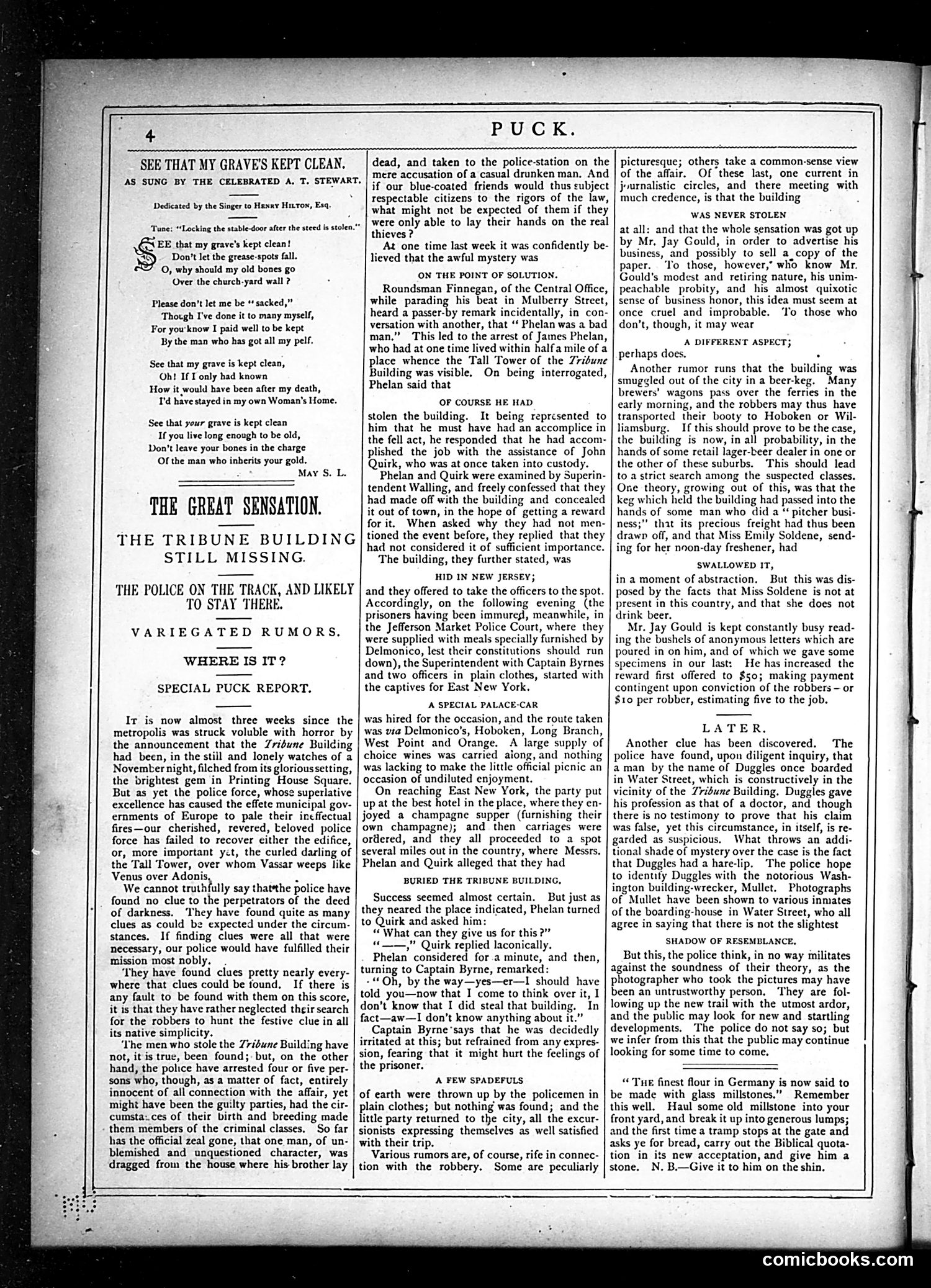
This Puck page satirizes the **mysterious disappearance of the Tribune Building** in New York City—apparently a real incident causing public sensation around the time of publication. The article mocks the **incompetence of police and city officials** who cannot locate an entire building, despite various theories: that it was stolen and smuggled out by river, hidden in New Jersey, or involved in insurance fraud schemes. The satire targets how **sensational the press coverage became**, with wild rumors spreading while authorities bungled the investigation. The police claimed they'd arrest the perpetrators but produced no real evidence or progress. This reflects Puck's typical role: **mocking official incompetence and public gullibility** regarding urban mysteries, while critiquing how newspapers amplified absurd speculation into major scandals.
📄 Transcribed text from this page (OCR, searchable)
Machine-transcribed from the original scan — historical spelling and the odd misread are preserved.
PUCK. SEE THAT MY GRAVE'S KEPT CLEAN. AS SUNG BY THE CELEBRATED A. T. STEWART. Dedicated by the Singer to Hann Hittox, Esq. ‘Tune: ‘Locking the stable-door after the steed is stolen.’ EE that my grave’s kept clean! <0) Don't let the grease-spots fall. O, why should my old bones go ‘Over the church-yard wall ? Please don’t let me be “sacked,” ‘Though I've done it to many myself, For you'know I paid well to be kept By the man who has got all my pelf. See that my grave is kept clean, Oh! If I only had known How it would have been after my death, T'd have stayed in my own Woman's Home. See that your grave is kept clean If you live long enough to be old, Don’t leave your bones in the charge Of the man who inherits your gold. May S. L. THE GREAT SENSATION. THE TRIBUNE BUILDING STILL MISSING. THE POLICE ON THE TRACK, AND LIKELY TO STAY THERE. VARIEGATED RUMORS, WHERE IS IT? SPECIAL PUCK REPORT. Ir is now almost three weeks since the metropolis was struck voluble with horror by the announcement that the Zridune Building had been, in the still and lonely watches of a November night, filched from its glorioussetting, the brightest gem in Printing House Square. But as yet the police force, whose superlative excellence has caused the effete municipal gov- ernments of Europe to pale their ineffectual fires—our cherished, revered, Leloved police force has failed to recover either the edifice, or, more important yet, the curled darling of the Tall Tower, over whom Vassar weeps like Venus over Adonis, We cannot truthfully say thatthe police have found no clue to the perpetrators of the deed of darkness. ‘They have found quite as many clues as could be expected under the circum- stances. If finding clues were all that were necessary, our police would have fulfilled their mission most nobly. ‘They have found clues pretty nearly every- where that clues could be tound. If there is any fault to be found with them on this score, it is that they have rather neglected their search for the robbers to hunt the festive clue in all its native simplicity. ‘The men who stole the Zribune Building have not, it is true, been found;:but, on the other hand, the police have arrested four or five per- sons who, though, as a matter of fact, entirely innocent of all connection with the affair, yet might have been the guilty parties, had the cir- cumsta:ces of their birth and breeding made them members of the criminal classes. So far has the official zeal gone, that one man, of un- blemished and unquestioned character, was dead, and taken to the police-station on the mere accusation of a casual drunken man, And if our blue-coated friends would thus subject respectable citizens to the rigors of the law, what might not be expected of them if they were only able to lay their hands on the real thieves ? At one time last week it was confidently be- lieved that the awful mystery was ON THE POINT OF SOLUTION. Roundsman Finnegan, of the Central Office, while parading his beat in Mulberry Street, heard a passer-by remark incidentally, in con- versation with another, that “ Phelan was a bad man.” This led to the arrest of James Phelan, who had at one time lived within halfa mile of a place whence the Tall Tower of the Zribune Building was visible. On being interrogated, Phelan said that OF COURSE HE HAD stolen the building. It being represented to him that he must have had an accomplice in the fell act, he responded that he had accom- plished the job with the assistance of John Quirk, who was at once taken into custody. Phelan and Quirk were examined by Superin- tendent Walling, and freely confessed that they had made off with the building and concealed it out of town, in the hope of getting a reward for it. When asked why they had not men- tioned the event before, they replied that they had not considered it of sufficient importance. The building, they further stated, was HID IN NEW JERSEY; and they offered to take the officers to the spot. Accordingly, on the following evening (the prisoners having been immureg, meanwhile, in the Jefferson Market Police Court, where they were supplied with meals specially furnished by Delmonico, lest their constitutions should run down), the ‘Superintendent with Captain Byrnes and two officers in plain clothes, started with the captives for East New York. A SPECIAL PALACE-CAR was hired for the occasion, and the route taken was va Delmonico’s, Hoboken, Long Branch, West Point and Orange. A large supply of choice wines was carried along, and nothing was lacking to make the little official picnic an occasion of undiluted enjoyment. On reaching East New York, the party put up at the best hotel in the place, where they en- joyed a champagne supper (furnishing their own champagne); and then carriages were ordered, and they all proceeded to a spot several miles out in the country, where Messrs. Phelan and Quirk alleged that they had BURIED THE TRIBUNE BUILDING, Success seemed almost certain. But just as they neared the place indicated, Phelan turned to Quirk and asked him: «What can they give us for this ?” "Quirk replied laconically. Phelan considered for.a minute, and then, turning to Captain Byrne, remarked: -“Oh, by the way—yes—er—I should have told you—now that I come to think over it, I don’t know that I did steal that building. In fact—aw—I don’t know anything about Captain Byrne‘says that he was decidedly irritated at this; but refrained from any expres- sion, fearing that it might hurt the feelings of the prisoner. A FEW SPADEFULS of earth were thrown up by the policemen in plain clothes; but nothing’ was found; and the little party returned to the city, all the excur- sionists expressing themselves as well satisfied with their trip. Various rumors are, of course, rife in connec- tion with the robbery. Some are peculiarly dragged from the house where his brother lay picturesque; others take a common-sense view of the affair. Of these last, one current in journalistic circles, and there meeting with much credence, is that the building WAS NEVER STOLEN at all: and that the whole sensation was got up by Mr. Jay Gould, in order to advertise his business, and possibly to sell a_copy of the paper. ‘To those, however,” who know Mr. Gould's modest and retiring nature, his unim- peachable probity, and his almost quixotic sense of business honor, this idea must seem at once cruel and improbable. ‘To those who don’t, though, it may wear A DIFFERENT ASPECT; perhaps does. Another rumor runs that the building was smuggled out of the city in a beer-keg. Many brewers’ wagons pass over the ferries in the early morning, and the robbers may thus have transported their booty to Hoboken or Wil- liamsburg. If this should prove to be the case, the building is now, in all probability, in the hands of some retail lager-beer dealer in one or the other of these suburbs. This should lead toa strict search among the suspected classes. One theory, growing out of this, was that the keg which held the building had passed into the hands of some man who did a “ pitcher busi- ness;"’ that its precious freight had thus been drawn off, and that Miss Emily Soldene, send- ing for her noon-day freshener, had SWALLOWED IT, in a moment of abstraction. But this was dis- posed by the facts that Miss Soldene is not at present in this country, and that she does not drink beer. Mr. Jay Gould is kept constantly busy read- ing the bushels of anonymous letters which are poured in on him, and of which we gave some specimens in our last: He has increased the reward first offered to $50; making payment contingent upon conviction of the robbers — or $10 per robber, estimating five to the job. LATER. Another clue has been discovered. The police have found, upon diligent inquiry, that a man by the name of Duggles once boarded in Water Street, which is constructively in the vicinity of the 7ribune Building. Duggles gave his profession as that of a doctor, and though there is no testimony to prove that his claim was false, yet this circumstance, in itself, is re- garded as suspicious. What throws an addi- tional shade of mystery over the case is the fact that Duggles hada hare-lip. ‘The police hope to identity Duggles with the notorious Wash- ington building-wrecker, Mullet. Photographs of Mullet have been shown to various inmates of the boarding-house in Water Street, who all agree in saying that there is not the slightest SHADOW OF RESEMBLANCE, But this, the police think, in no way militates against the soundness of their theory, as the photographer who took the pictures may have been an untrustworthy person. They are fol- lowing up the new trail with the utmost ardor, and the public may look for new and startling developments. The police do not say so; but we infer from this that the public may continue looking for some time to come. “Tue finest flour in Germany is now said to be made with glass millstones.” Remember this well. Haul some old millstone into your front yard, and break it up into generous lumps; and the first time a tramp stops at the gate and asks ye for bread, carry out the Biblical quota- tion in its new acceptation, and give him a stone. N. B,—Give it to him on the shin. comicbooks.com