
Puck, 1878-11-27 · page 3 of 16
Puck — November 27, 1878 — page 3: what you’re looking at
What you’re looking at
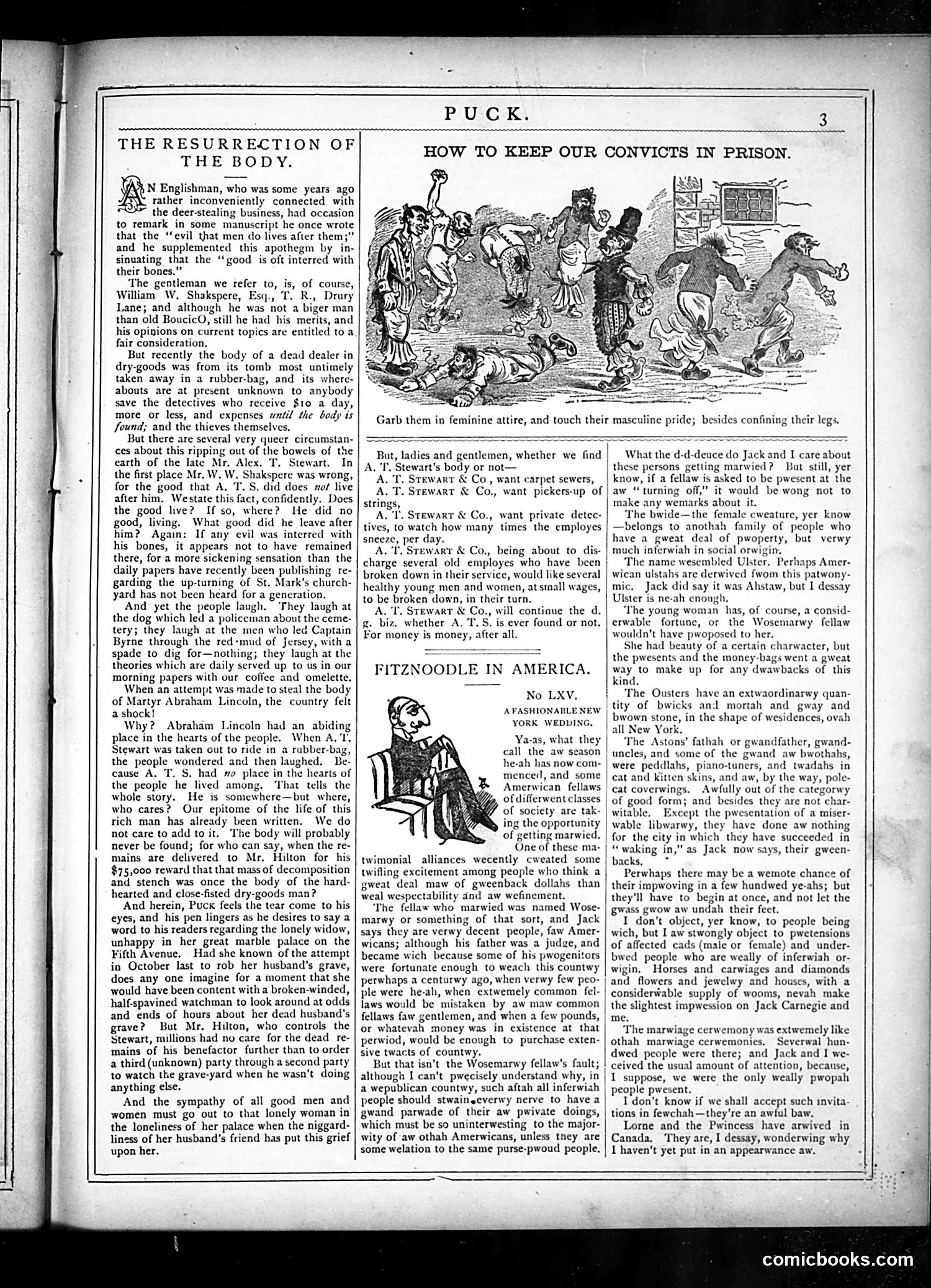
**"How to Keep Our Convicts in Prison"** presents a satirical cartoon showing guards restraining prisoners. The accompanying text mocks the apparent ease with which convicts escape, suggesting institutional incompetence. References to carpet sewers and private detectives imply that wealthy businesses (A. T. Stewart & Co.) hire their own security rather than trusting public systems—a critique of privatized law enforcement. **"Fitznoodle in America"** satirizes a fashionable Englishman navigating American social aspirations. The text ridicules newly wealthy Americans aping European aristocracy through marriages, acquisitions of old European art, and ostentatious consumption. The satire targets the nouveau riche's insecurity and their attempts to purchase social legitimacy through material goods and foreign connections. Both pieces mock institutional failure and social pretension characteristic of Gilded Age America.
📄 Transcribed text from this page (OCR, searchable)
Machine-transcribed from the original scan — historical spelling and the odd misread are preserved.
PUCK. THE RESURRECTION OF THE BODY. N Englishman, who was some years ago rather inconveniently connected with the deer-stealing business, had occasion to remark in some manuscript he once wrote that the ‘evil that men do lives after them;”” and he supplemented this apothegm by in- sinuating that the “good is oft interred with their bones.” The gentleman we refer to, is, of course, William’ W. Shakspere, Esq., T. R., Drury Lane; and although he was not a biger man than old BoucicO, still he had his merits, and his opinions on current topics are entitled to a fair consideration. But recently the body of a dead dealer in dry-goods was from its tomb most untimely taken away in a rubber-bag, and its where- abouts are at present unknown to anybody save the detectives who receive $10 a day, more or less, and expenses until the body is found; and the thieves themselves. But there are several very queer circumstan- ces about this ripping out of the bowels of the earth of the late Mr. Alex. T. Stewart. In the first place Mr. W. WW. Shakspere was wrong, for the good that A. TS. did does nof live after him. Westate this fact, confidently. Does the good live? If so, where? He did no good, living. What good did he leave after him? Again: If any evil was interred with his bones, it appears not to have remained there, for a more sickening sensation than the daily papers have recently been publishing re- garding the up-turning of St. Mark’s church- yard has not been heard for a generation. And yet the people laugh. ‘They laugh at the dog which led a policeman about the ceme- tery; they laugh at the men who led Captain Byrne through the red-mud of Jersey, with a spade to dig for—nothing; they laugh at the theories which are daily served up to us in our morning papers with our coffee and omelette. When an attempt was made to steal the body of Martyr Abraham Lincoln, the country felt a shock! Why? Abraham Lincoln had an abiding place in the hearts of the people. When A.‘T. Stewart was taken out to ride in a rubber-bag, the people wondered and then laughed. Be- cause A, S. had xo place in the hearts of the people he lived among. ‘That tells the whole story. He is somewhere—but where, who cares? Our epitome of the life of this rich man has already been written, We do not care to add to it. The body will probably never be found; for who can say, when the re- mains are delivered to Mr. Hilton for his $75,000 reward that that mass of decomposition and stench was once the body of the hard- hearted and close-fisted dry-goods man? And herein, Puck feels the tear come to his eyes, and his pen lingers as he desires to say a word to his readers regarding the lonely widow, unhappy in her great marble palace on the Fifth Avenue. Had she known of the attempt in October last to rob her husband's grave, does any one imagine for a moment that she would have been content with a broken-winded, half-spavined watchman to look around at odds and ends of hours about her dead husband's grave? But Mr. Hilton, who controls the Stewart, millions had no care for the dead re- mains of his benefactor further than to order a third (unknown) party through a second party to watch the grave-yard when he wasn’t doing anything else, ‘And the sympathy of all good men and women must go out to that lonely woman in the loneliness of her palace when the niggard- liness of her husband’s friend has put this grief upon her. HOW TO KEEP OUR CONVICTS IN PRISON. But, ladies and gentlemen, whether we find | A. 'T. Stewart’s body or not— | A. T. Stewart & Co, want carpet sewers, | A. T. Stewart & Co., want pickers-up of | strings, A. ‘IT. Stewart & Co., want private detec- tives, to watch how many times the employes sneeze, per day. A. T. Srewart & Co., being about to dis- charge several old employes who have been } broken down in their service, would like several | healthy young men and women, at sinall wages, to be broken down, in their turn. A. 'T. Stewart & Co., will continue the d. g. biz. whether A. T. s ever found or not. For money is money, after all. FITZNOODLE IN AMERICA. No LXV. AFASHIONABLE NEW YORK WEDDING Ya-as, what they call the aw season he-ah has now com- menced, and some Amerwican fellaws of differwent classes of society are tak- ing the opportunity | of getting marwied. One of these ma- twimonial alliances wecently cweated some twifling excitement among people who think a gweat deal maw of gweenback dollahs than weal wespectability dnd aw wefinement. The fellaw who marwied was named Wose- marwy or something of that sort, and Jack says they are verwy decent people, faw Amer- wicans; although his father was a judge, and became wich because some of his pwogenitors were fortunate enough to weach this countwy perwhaps a centurwy ago, when verwy few peo- | ple were he-ah, when extwemely common fel- | laws would be mistaken by aw maw common fellaws faw gentlemen, and when a few pounds, or whatevah money was in existence at that perwiod, would be enough to purchase exten- sive twacts of countwy. But that isn’t the Wosemarwy fellaw’s fault; although I can’t pwecisely understand why, in a wepublican countwy, such aftah all inferwiah people should stwaingeverwy nerve to have a gwand parwade of their aw pwivate doings, | which must be so uninterwesting to the major- wity of aw othah Amerwicans, unless they are some welation to the same purse-pwoud people, What the d-d-deuce do Jack and I care about these persons getting marwied? But still, yer know, if a fellaw is asked to be pwesent at the aw “turning off,” it would be wong not to make any wemarks about it. The bwide—the female cweature, yer know —belongs to anothah family of people who have a gweat deal of pwoperty, but verwy much inferwiah in social orwigin, ‘The name wesembled Ulster. Perhaps Amer- wican ulstahs are derwived fwom this patwony- mic. Jack did say it was Ahstaw, but I dessay Ulster is ne-ah enough. ‘The young woman has, of course, a consid- erwable fortune, or the Wosemarwy fellaw wouldn't have pwoposed to her. She had beauty of a certain charwacter, but the pwesents and the money-bags went a gweat way to make up for any dwawbacks of this kind. The Ousters have an extwaordinarwy quan- s and mortah and gway and bwown stone, in the shape of wesidences, ovah all New York, The Astons’ fathah or gwandfather, gwand- uncles, and some of the gwand aw bwothabs, were peddlahs, piano-tuners, and twadahs in cat and kitten skins, and aw, by the way, pole- cat coverwings. Awfully out of the categorwy of good form; and besides they are not char- witable. Except the pwesentation of a miser- wable libwarwy, they have done aw nothing for the city in which they have succeeded in “waking in,” as Jack now says, their gween- backs, =~ Perwhaps there may be a wemote chance of their impwoving in a few hundwed ye-ahs; but they'll have to begin at once, and not let the gwass gwow aw undah their feet. 1 don’t object, yer know, to people being wich, but I aw stwongly object to pwetensions of affected cads (male or female) and under- bwed people who are weally of inferwiah or- wigin, Horses and carwiages and diamonds and flowers and jewelwy and houses, with a considerwable supply of wooms, nevah make the slightest impwession on Jack Carnegie and me. ‘The marwiage cerwemony was extwemely like othah marwiage cerwemonies. Severwal hun- dwed people were there; and Jack and I we- ceived the usual amount of attention, because, I suppose, we were the only weally pwopah people pwesent. I don’t know if we shall accept such invita- tions in fewchah—they’re an awful baw, Lorne and the Pwincess have arwived in Canada, They are, I dessay, wonderwing why [haven't yet put in an appearwance aw. comicbooks.com