
Puck, 1878-11-27 · page 11 of 16
Puck — November 27, 1878 — page 11: what you’re looking at
What you’re looking at
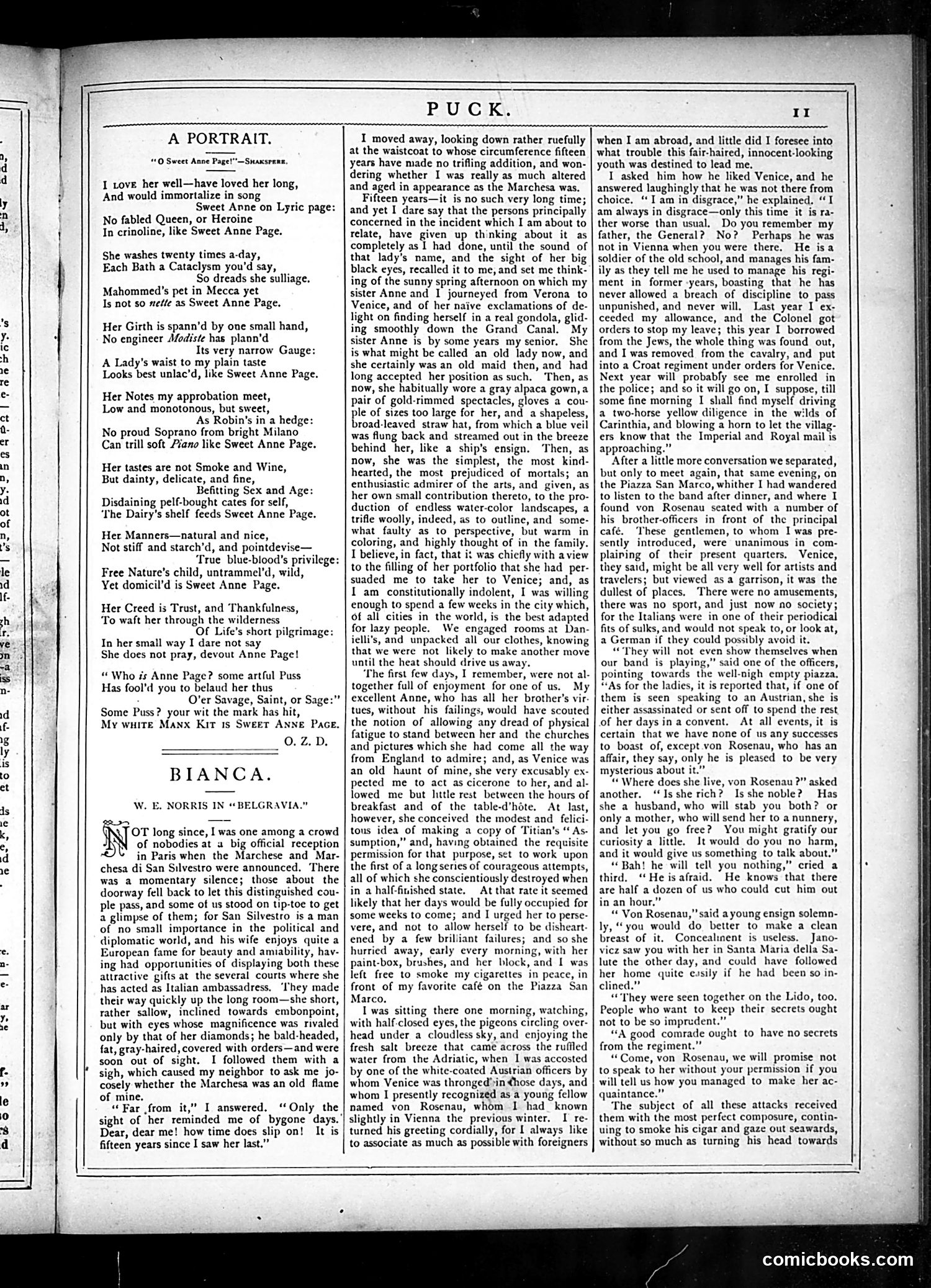
This page from *Puck* contains two literary pieces rather than political cartoons: **"A Portrait"** is a poem celebrating a woman named Anne, praising her beauty, accomplishments, and refined tastes. The verses emphasize her artistic abilities, graceful manners, and cultural sophistication. **"Bianca"** is a longer prose piece by W.E. Norris (credited as "in 'Belgravia'"), describing the author's encounter with an acquaintance in Venice. It's a gossipy anecdote about social interactions and romantic intrigue among European society figures abroad. Neither piece contains obvious political satire. This appears to be a literary rather than satirical page—*Puck* regularly mixed humor, commentary, and literary content. The social observations are lighthearted rather than biting.
📄 Transcribed text from this page (OCR, searchable)
Machine-transcribed from the original scan — historical spelling and the odd misread are preserved.
If- f- | A PORTRAIT. +0 Sweet Anne Page!"—Snaxsranz. I cove her well—have loved her long, ‘And would immortalize in song Sweet Anne on Lyric page: No fabled Queen, or Heroine In crinoline, like Sweet Anne Page. She washes twenty times a-day, Each Bath a Cataclysm you'd say, So dreads she sulliage. Mahommed’s pet in Mecca yet Is not so neffe as Sweet Anne Page, Her Girth is spann’d by one small hand, No engineer Modiste has plann'd Its very narrow Gauge: A Lady's waist to my plain taste Looks best unlac’d, like Sweet Anne Page. Her Notes my approbation meet, Low and monotonous, but sweet, As Robin's in a hedge: No proud Soprano from bright Milano Can trill soft Piano like Sweet Anne Page. Her tastes are not Smoke and Wine, But dainty, delicate, and fine, Befitting Sex and Age: Disdaining pelf-bought cates for self, ‘The Dairy’s shelf feeds Sweet Anne Page. Her Manners—natural and nice, Not stiff and starch’d, and pointdevise— True blue-blood’s privilege: Free Nature's child, untrammel’d, wild, Yet domicil’d is Sweet Anne Page. Her Creed is Trust, and Thankfulness, ‘To waft her through the wilderness Of Life's short pilgrimage: In her small way I dare not say She does not pray, devout Anne Page! “ Who is Anne Page? some artful Puss Has fool'd you to belaud her thus O'er Savage, Saint, or Sage:” Some Puss? your wit the mark has hit, My wuite Manx Kirt ts Sweet ANNE Pace. __O.Z.D. BIANCA. W. E, NORRIS IN “BELGRAVIA.” OT long since, I was one among a crowd of nobodies at a big official reception in Paris when the Marchese and Mar- chesa di San Silvestro were announced. There was a momentary silence; those about the doorway fell back to let this distinguished cou- ple pass, and some of us stood on tip-toe to get a glimpse of them; for San Silvestro is a man of no small importance in the political and diplomatic world, and his wife enjoys quite a European fame for beauty and amiability, hav- ing had opportunities of displaying both these attractive gifts at the several courts where she has acted as Italian ambassadress. ‘hey made their way quickly up the long room—she short, rather sallow, inclined towards embonpoint, but with eyes whose magnificence was rivaled only by that of her diamonds; he bald-headed, fat, gray-haired, covered with orders—and were soon out of sight. I followed them with a sigh, which caused my neighbor to ask me jo- cosely whether the Marchesa was an old flame of mine. “Far from it,” I answered. ‘Only the sight of “her reminded me of bygone days.’ Dear, dear me! how time does slip on! It is fifteen years since I saw her last.” I moved away, looking down rather ruefully at the waistcoat to whose circumference fifteen years have made no trifling addition, and won- dering whether I was really as much altered and aged in appearance as the Marchesa was. Fifteen years—it is no such very long time; and yet I dare say that the persons principally concerned in the incident which I am about to relate, have given up thinking about it as completely as I had done, until the sound of that lady’s name, and the sight of her big black eyes, recalled it to me, and set me think- ing of the sunny spring afternoon on which my sister Anne and I journeyed from Verona to Venice, and of her naive exclamations of de- light on finding herself in a real gondola, glid- ing smoothly down the Grand Canal. My sister Anne is by some years my senior. She is what might be called an old lady now, and she certainly was an old maid then, and had long accepted her position as such. ‘Then, as now, she habitually wore a gray alpaca gown, a pair of gold-rimmed spectacles, gloves a cou- ple of sizes too large for her, and a shapeless, road-leaved straw hat, from which a blue veil was flung back and streamed out in the breeze behind her, like a ship's ensign. Then, as now, she was the simplest, the most kind- hearted, the most prejudiced of mortals; an enthusiastic admirer of the arts, and given, as her own small contribution thereto, to the pro- duction of endless water-color landscapes, a trifle woolly, indeed, as to outline, and some- what faulty as to perspective, but warm in coloring, and highly thought of in the family. I believe, in fact, that it was chiefly with aview to the filling of her portfolio that she had_per- suaded me to take her to Venice; and, as 1 am _ constitutionally indolent, I was willing enough to spend a few weeks in the city which, of all cities in the world, is the best adapted for lazy people. We engaged rooms at Dan- ielli's, and unpacked all our clothes, knowing that we were not likely to make another move until the heat should drive us away. ‘The first few days, I remember, were not al- together full of enjoyment for one of us. My excellent Anne, who has all her brother's vir- tues, without his failings, would have scouted the notion of allowing any dread of physical fatigue to stand between her and the churches and pictures which she had come all the way from England to admire; and, as Venice was an old haunt of mine, she very excusably ex- pected me to act as cicerone to her, and al- lowed me but litle rest between the hours of breakfast and of the table-d’hote. At last, however, she conceived the modest and _felici- tous idea of making a copy of Titian’s “ As- sumption,” and, having obtained the requisite permission for that purpose, set to work upon the first of a long series of courageous attempts, all of which she conscientiously destroyed when in a half-finished state, At that rate it seemed likely that her days would be fully occupied for some weeks to come; and I urged her to perse- vere, and not to allow herself to be disheart- ened by a few brilliant failures; and so she hurried away, early every morning, with her paint-box, brushes, and her block, and I was left free to smoke my cigarettes in peace, in front of my favorite café on the Piazza San Marco. I was sitting there one morning, watching, with half-closed eyes, the pigeons circling over- head under a cloudless sky, and enjoying the fresh salt breeze that came across the ruffled water from the Adriatic, when 1 was accosted by one of the white-coated Austrian officers by whom Venice was thronged’vin ¢hose days, and whom I presently recognized as a young fellow named von Rosenau, whom I had_ known slightly in Vienna the previous winter. I re- turned his greeting cordially, for I always like to associate as much as possible with foreigners when I am abroad, and little did I foresee into what trouble this fair-haired, innocent-looking youth was destined to lead me. I asked him how he liked Venice, and he answered laughingly that he was not there from choice. “I am in disgrace,” he explained, “I am always in disgrace—only this time it is ra- ther worse than usual, Do you remember my father, the General? No? Perhaps he was not in Vienna when you were there, He isa soldier of the old school, and manages his fam- ily as they tell me he used to manage his regi- ment in former -years, boasting that he has never allowed a breach of discipline to pass unpunished, and never will, Last year I ex- ceeded my allowance, and the Colonel got orders to stop my leave; this year I borrowed from the Jews, the whole thing was found out, and I was removed from the cavalry, and put into a Croat regiment under orders for Venice. Next year will probably see me enrolled in the police; and so it will go on, I suppose, till some fine morning I shall find myself driving a two-horse yellow diligence in the wilds of Carinthia, and blowing a horn to let the villag- ers know that the Imperial and Royal mail is approaching.” After a little more conversation we separated, but only to meet again, that same evening, on the Piazza San Marco, whither I had wandered to listen to the band after dinner, and where I found von Rosenau seated with a number of his brother-officers in front of the principal café. These gentlemen, to whom I was pre- sently introduced, were unanimous in com- plaining of their present quarters. Venice, they said, might be all very well for artists and travelers; but viewed as a garrison, it was the dullest of places. There were no amusements, there was no sport, and just now no society; for the Italians were in one of their periodical fits of sulks, and would not speak to, or look at, a German if they could possibly avoid it. “They will not even show themselves when our band is playing,” said one of the officers, pointing towards the well-nigh empty piazza, “As for the ladies, it is reported that, if one of them is seen speaking to an Austrian, she is either assassinated or sent off to spend the rest of her days ina convent. At all events, it is certain that we have none of us any successes to boast of, except. von Rosenau, who has an affair, they say, only he is pleased to be very mysterious about it.” “Where does she live, von Rosenau ?” asked another. ‘‘Isshe rich? Isshe noble? Has she a husband, who will stab you both? or only a mother, who will send her to a nunnery, and let you go free? You might gratify our curiosity a little. It would do you no harm, and it would give us something to talk about.” “Bah! he will tell you nothing,” cried a third. ‘He is afraid. He knows that there are half a dozen of us who could cut him out in an hour.” “ Von Rosenau,” said ayoung ensign solemn- ly, “you would do better to make a clean breast of it. Concealinent is useless. Jano- vicz saw you with her in Santa Maria della Sa- lute the other day, and could have followed her home quite easily if he had been so in- clined.” “They were seen together on the Lido, too, People who want to keep their secrets ought not to be so imprudent.” “A good comrade ought to have no secrets from the regiment.” “Come, von Rosenau, we will promise not to speak to her without your permission if you will tell us how you managed to make her ac- quaintance.”” The subject of all these attacks received them with the most perfect composure, contin- uing to smoke his cigar and gaze out seawards, without so much as turning his head towards comicbooks.com