
Puck, 1878-11-27 · page 7 of 16
Puck — November 27, 1878 — page 7: what you’re looking at
What you’re looking at
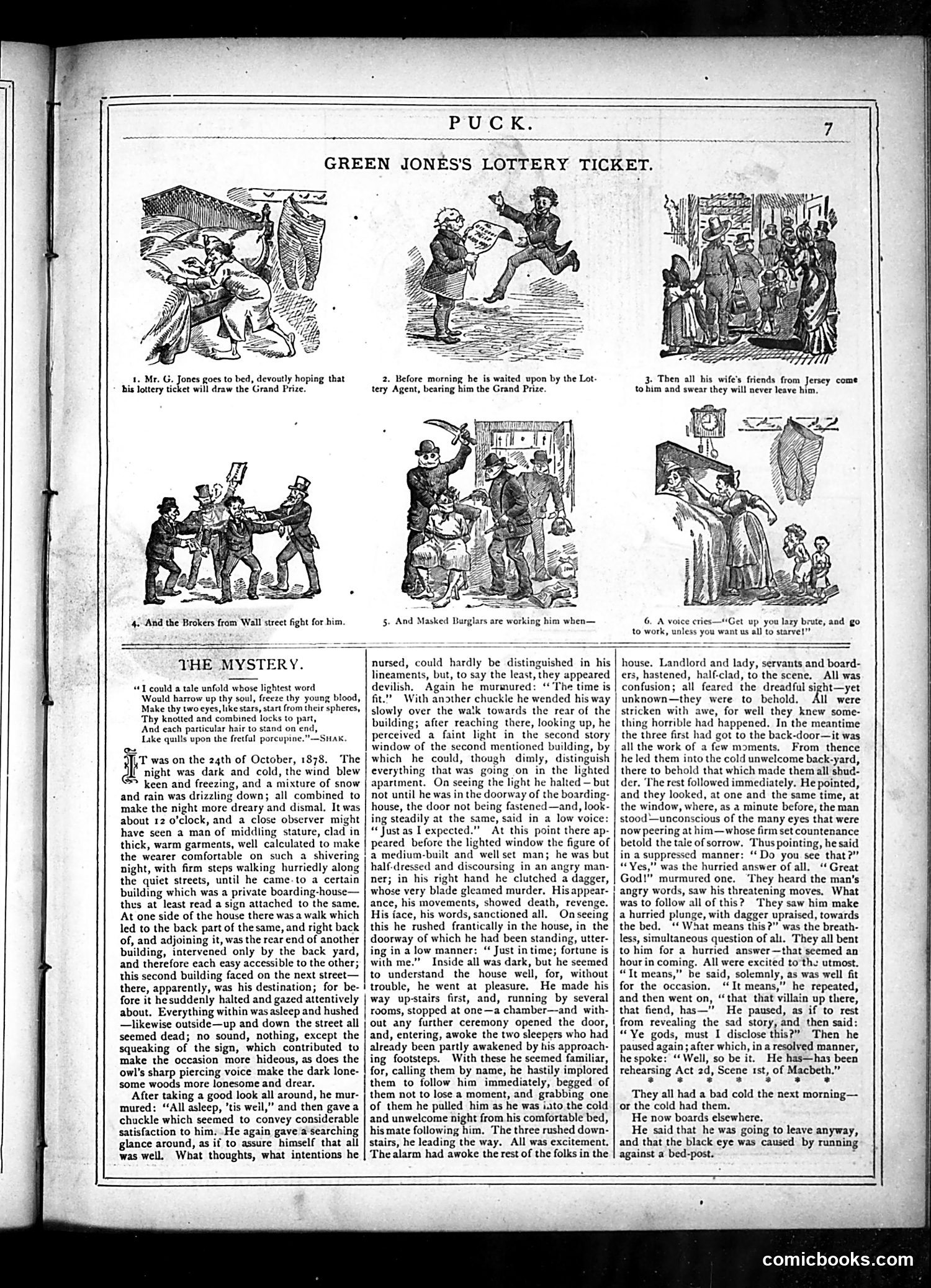
This six-panel comic strip satirizes lottery gambling and its consequences. Mr. G. Jones foolishly hopes his lottery ticket will win the "Grand Prize" (panel 1). A lottery agent visits him with news (panel 2), leading Jones to celebrate with his wife's Jersey friends (panel 3). The story then darkens: brokers from Wall Street fight over him (panel 4), masked burglars rob him (panel 5), and a voice warns him to "get on yer hay bode, and go to work" (panel 6). The satire targets lottery schemes as snares for the gullible poor. Winning supposedly brings not fortune but exploitation—by financial schemers and criminals who recognize an easy mark. The moral: honest labor ("hay bode"/hay bale) beats gambling's false promises.
📄 Transcribed text from this page (OCR, searchable)
Machine-transcribed from the original scan — historical spelling and the odd misread are preserved.
PUCK. GREEN JONES'S LOTTERY TICKET. 1. Mr. G. Jones goes to bed, devoutly hoping that his lottery ticket will draw the Grand Prize. 4. And the Brokers from Wall street fight for him. 2. Before morning he is waited upon by the Lot- tery Agent, bearing him the Grand Prize. 3. Then all his wife's friends from Jersey come tohim and swear they will never leave him. 6. A voice cries—'Get up you lazy brute, and go to work, unless you want us all to starve!” YVHE MYSTERY. “T could a tale unfold whose lightest word Would harrow up thy soul, freeze thy young blood, Make thy two cyes, like stars, start from their spheres, Thy knotted and combined locks to part, And each particular hair to stand on en Lake quills upon the fretful porcupine.” oe a was on the 24th of October, 1878. ‘The SuaK. night was dark and cold, the wind blew keen and freezing, and a mixture of snow and rain was drizzling down; all combined to make the night more dreary and dismal. It was about 12 o'clock, and a close observer might have seen a man of middling stature, clad in thick, warm garments, well calculated to make the wearer comfortable on such a shivering night, with firm steps walking hurriedly along the quiet streets, until he came-to a certain building which was a private boarding-house— thus at least read a sign attached to the same. At one side of the house there was a walk which led to the back part of thesame, and right back of, and adjoining it, was the rear end of another building, intervened only by the back yard, and therefore each easy accessible to the other; this second building faced on the next street-— there, apparently, was his destination; for be- fore it hesuddenly halted and gazed attentively about. Everything within was asleep and hushed —likewise outside—up and down the street all seemed dead; no sound, nothing, except the squeaking of the sign, which contributed to make the occasion more hideous, as does the owl’s sharp piercing voice make the dark lone- some woods more lonesome and drear. After taking a good look all around, he mur- mured: “All asleep, 'tis weil,” and then gave a chuckle which seemed to convey considerable satisfaction to him. _He again gave a searching glance around, as if to assure himself that all was well, What thoughts, what intentions he nursed, could hardly be distinguished in his lineaments, but, to say the least, they appeared devilish, Again he murmured: ‘ The time is fit.” With another chuckle he wended his way slowly over the wa!k towards the rear of the building; after reaching there, looking up, he perceived a faint light in the second story window of the second mentioned building, by which he could, though dimly, distinguish everything that was going on in the lighted apartment. On seeing the light he halted — but not until he was in the doorway of the boarding- house, the door not being fastened—and, look- ing steadily at the same, said in a low voice: “Just as I expected.” At this point there ap- peared before the lighted window the figure of a medium-built and well set man; he was but half-dressed and discoursing in an angry man- ner; in his right hand he clutched a dagger, whose very blade gleamed murder. His appear- ance, his movements, showed death, revenge. His face, his words, sanctioned all. On seeing this he rushed frantically in the house, in the doorway of which he had been standing, utter- ing in a low manner: “ Just in time; fortune is with me.” Inside all was dark, but he seemed to understand the house well, for, without I trouble, he went at pleasure. He made his way upstairs first, and, running by several rooms, stopped at one—a chamber—and with- out any further ceremony opened the door, and, entering, awoke the two sleepers who had already been partly awakened by his approach- ing footsteps. With these he seemed familiar, for, calling them by name, he hastily implored them to follow him immediately, begged of them not to lose a moment, and grabbing one of them he pulled him as he was iato the cold and unwelcome night from his comfortable bed, his mate following him. The three rushed down- stairs, he leading the way. All was excitement, The alarm had awoke the rest of the folks in the house. Landlord and lady, servants and board- ers, hastened, half-clad, to the scene. All was confusion; all feared the dreadful sight—yet unknown—they were to behold, Il were stricken with awe, for well they knew some- thing horrible had happened. In the meantime the three first had got to the back-door—it was all the work of a few moments. From thence he led them into the cold unwelcome back-yard, there to behold that which made them all shud- der, The rest followed immediately. He pointed, and they looked, at one and the same time, at the window, where, as a minute before, the man stood—unconscious of the many eyes that were now peering at him—whose firm set countenance betold the tale of sorrow. Thus pointing, he said in a suppressed manner: ‘Do you see that?” “Yes,” was the hurried answer of all. ‘Great God!" murmured one. They heard the man's angry words, saw his threatening moves. What was to follow all of this? They saw him make a hurried plunge, with dagger upraised, towards the bed. ‘ What means this?” was the breath- less, simultaneous question of ali. They all bent to him for a hurried answer—that seemed an hour in coming. All were excited to the utmost. “Tt means,” be said, solemnly, as was well fit for the occasion. ‘It means,” he repeated, and then went on, “that that villain up there, that fiend, has—"” He paused, as if to rest from revealing the sad story, and then said: “Ye gods, must I disclose this?” Then he paused again; after which, in a resolved manner, he spoke: ‘Well, so be it. He has—has been rehearsing Act 2d, Scene 1st, of Macbeth.” SH hl is ene rhie.e rene They all had a bad cold the next morning— or the cold had them. He now boards elsewhere. He said that he was going to leave anyway, and that the black eye was caused by running against a bed-post. = comicbooks.com