
Puck, 1878-11-27 · page 6 of 16
Puck — November 27, 1878 — page 6: what you’re looking at
What you’re looking at
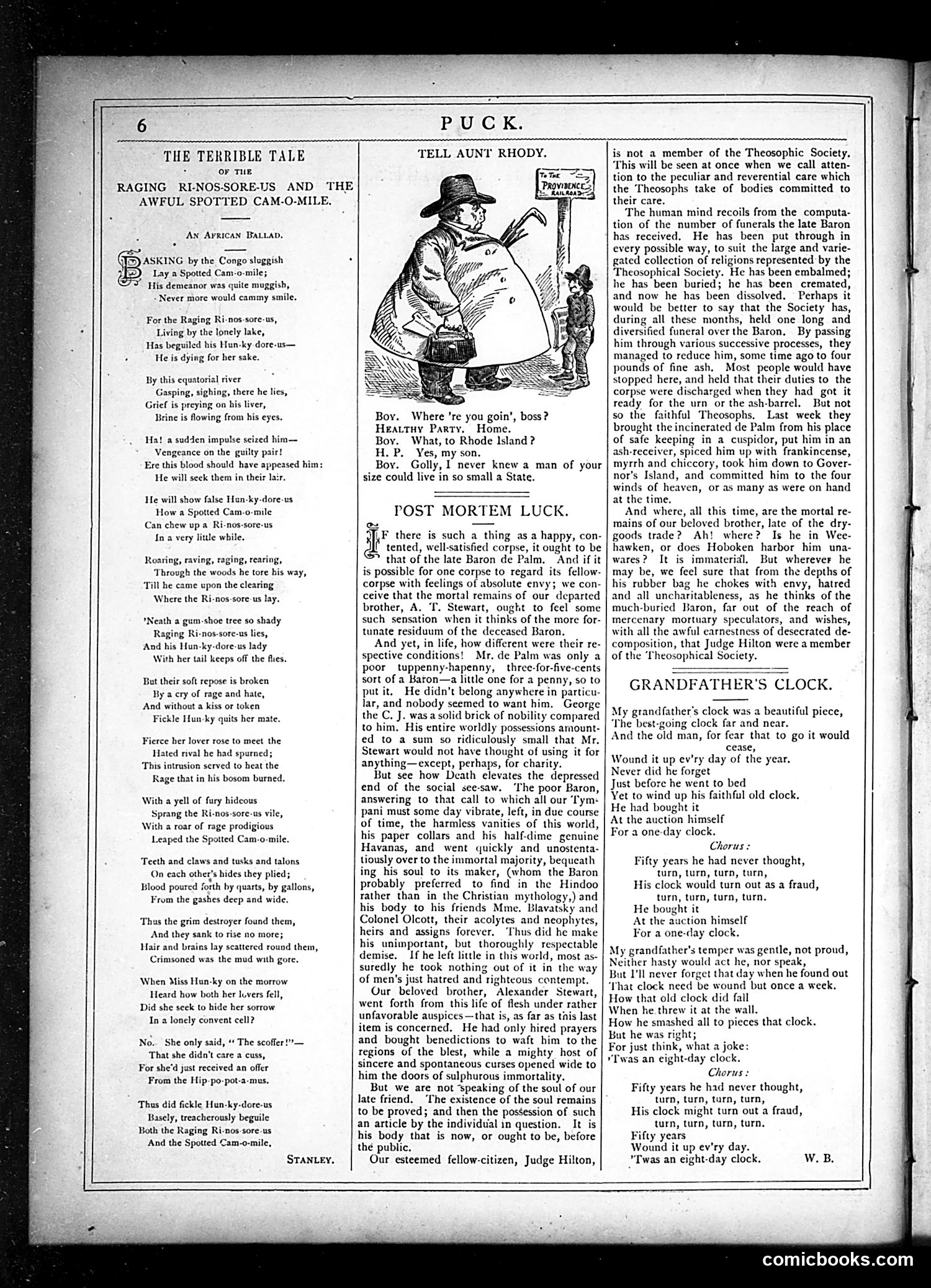
This cartoon depicts a man reading a newspaper to a small boy, illustrating the folk song "Tell Aunt Rhody" (visible on the sign). The humor appears to be visual rather than politically pointed—it simply captures a domestic scene of an adult sharing news with a child. The page also contains poetry and prose pieces including "Post Mortem Luck" (discussing the Theosophic Society and Baron de Palm's remains) and "Grandfather's Clock" (verses about an heirloom timepiece). These are satirical pieces on contemporary social topics, though without identifying the specific publication date, the precise political references remain unclear. The content emphasizes Puck's mix of humor, social commentary, and literary content typical of 19th-century American satirical magazines.
📄 Transcribed text from this page (OCR, searchable)
Machine-transcribed from the original scan — historical spelling and the odd misread are preserved.
PUCK. RAGING RI-NOS-SORE-US AND THE TERRIBLE TAL OF THE E THE AWFUL SPOTTED CAM-O-MILE, Ay Avrican BALLab. ASKING by the Congo sluggish Lay a Spotted Cam-o-mile; His demeanor was quite muggish, Never more would cammy smile. For the Raging Ri-nos-sore-us, Living by the lonely lake, Has beguiled bis Hun-ky-dore-us— He is dying for her sake. By this equatorial river Gasping, sighing, there he lies, Grief is preying on his liver, Brine is flowing from his eyes. Ha! a sudden impulse seized him— Vengeance on the guilty pair! Ere this blood should have appeased him: He will seek them in thei He will show false Han-ky-dore-us How a Spotted Cam-o-mile Can chew up a Ri-nos-sore-us In a very little while. Roaring, raving, raging, rearing, ‘Through the woods he tore his way, Till he came upon the clearing Where the Ri-nos-sore-us lay. *Neath a gum-shoe tree so shady Raging Ri-nos-sore-us lies, And his Hun-ky-dore-us lady With her tail keeps off the fies. But their soft repose is broken By a cry of rage and hate, And without a kiss or token Fickle Hun-ky quits her mate. Fierce her lover rose to meet the Hated rival he had spurned; This intrusion served to heat the Rage that in his bosom burned, With a yell of fury hideous Sprang the Ri-nos-sore-us vile, With a roar of rage prodigious Leaped the Spotted Cam-o-mile, ‘Teeth and claws and tusks and talons On each other's hides they plied; Blood poured forth by quarts, by gallons, From the gashes deep and wide, ‘Thus the grim destroyer found them, And they sank to rise no more; Mair and brains lay scattered round them, Crimsoned was the mud with gore. When Miss Hun-ky on the morrow Heard how both her lovers fell, Did she seek to hide her sorrow Ina lonely convent cell? No. She only said, « The scoffer! That she didn't care a cuss, For she'd just received an offer From the Hip-po-pot-a-mus. ‘Thus did fickle Hun-ky-dore-us Basely, treacherously beguile Both the Raging Ri-nos-sore-us ‘And the Spotted Cam-o-mile, STANLEY. ‘TELL AUNT RHODY. Rae Boy. Where 're you goin’, boss? Heattuy Party. Home. Boy. What, to Rhode Island ? H.P. Yes, my son. Boy. Golly, I never knew a man of your size could live in so small a State. POST MOR 1 LUCK. las — I there is such a thing as a happy, con- at tented, well-satisfied corpse, it ought to be > that of the late Baron de Palm. And if it is possible for one corpse to regard its fellow- corpse with feelings of absolute envy; we con- ceive that the mortal remains of our ‘departed brother, A. T. Stewart, ought to feel some such sensation when it thinks of the more for- tunate residuum of the deceased Baron. And yet, in life, how different were their re- spective conditions! Mr. de Palm was only a poor tuppenny-hapenny, three-for-five-cents sort of a Baton—a little one for a penny, so to put it, He didn’t belong anywhere in particu- lar, and nobody seemed to want him. George the C. J. was a Solid brick of nobility compared to him. His entire worldly possessions amount- ed to a sum so ridiculously small that Mr. Stewart would not have thought of using it for anything—except, perhaps, for charity. But see how Death elevates the depressed end of the social see-saw. ‘The poor Baron, answering to that call to which all our ‘ym: pani must some day vibrate, left, in due course of time, the harmless vanities of this world, his paper collars and his half-dime genuine Havanas, and went quickly and unostenta- tiously over to the immortal majority, bequeath ing his soul to its maker, (whom the Baron probably preferred to find in the Hindoo rather than in the Christian mythology,) and his body to his friends Mme. Blavatsky and Colonel Olcott, their acolytes and neopiyi heirs and assigns forever. ‘Thus did he mal his unimportant, but thoroughly respectable demise. If he left little in this world, most as- suredly he took nothing out of it in the way of men’s just hatred and righteous contempt. Our beloved brother, Alexander Stewart, went forth from this life of flesh under rather unfavorable auspices —that is, as far as this last item is concerned. He had only hired prayers and bought benedictions to waft him to the regions of the blest, while a mighty host of sincere and spontaneous curses opened wide to him the doors of sulphurous immortality. But we are not speaking of the soul of our late friend. ‘The existence of the soul remains to be proved; and then the possession of such an article by the individual in question. It is his body that is now, or ought to be, before the public. Our esteemed fellow-citizen, Judge Hilton, is not a member of the Theosophic Society, ‘This will be seen at once when we call atten- tion to the peculiar and reverential care which the Theosophs take of bodies committed to their care. The human mind recoils from the computa- tion of the number of funerals the late Baron has received. He has been put through in every possible way, to suit the large and varie- gated collection of religions represented by the Theosophical Society. He has been embalmed; he has been buried; he has been cremated, and now he has been dissolved. Perhaps it would be better to say that the Society has, during all these months, held one long and diversified funeral over the Baron. By passing him through various successive processes, they managed to reduce him, some time ago to four pounds of fine ash. Most people would have stopped here, and held that their duties to the corpse were discharged when they had got it ready for the urn or the ash-barrel. But not so the faithful Theosophs. Last week they brought the incinerated de Palm from his place of safe keeping in a cuspidor, put him in an ash-receiver, spiced him up with frankincense, myrrh and chicory, took him down to Gover- nor’s Island, and committed him to the four winds of heaven, or as many as were on hand at the time, And where, all this time, are the mortal re- mains of our beloved brother, late of the dry- goods trade? Ah! where? Is he in Wee- hawken, or does Hoboken harbor him una wares? It is immaterial, But wherever he may be, we feel sure that from the depths of his rubber bag he chokes with envy, hatred and all uncharitableness, as he thinks of the much-buried Baron, far out of the reach of mercenary mortuary speculators, and wishes, with all the awful earnestness of desecrated de- composition, that Judge Hilton were a member of the Theosophical Society. GRANDFATHER'S My grandfather's clock was a beautiful piece, The best-going clock far and near. And the old man, for fear that to go it would cease, Wound it up ev'ry day of the year. Never did he forget Just before he went to bed Yet to wind up his faithful old clock. He had bought it At the auction himself For a one-day clock. Chorus Fifty years he had never thought, turn, turn, turn, turn, His clock would turn out as a fraud, turn, turn, turn, turn. He bought it t the auction himself For a one-day clock. My grandfather's temper was gentle, not proud, Neither hasty would act he, nor speak, But I'll never forget that day when he found out ‘hat clock need be wound but once a week. How that old clock did fall When he. threw it at the wall. How he smashed all to pieces that clock. But he was righ For just think, what a jok +Twas an eight-day clock. Chorus: Fifty years he had never thought, turn, turn, turn, turn, His clock might turn out a fraud, turn, turn, turn, turn, Fifty years Wound it up ev'ry day. "Twas an eight-day clock. CLOCK. comicbooks.com