
A complete issue · 16 pages · 1878
Puck — October 30, 1878
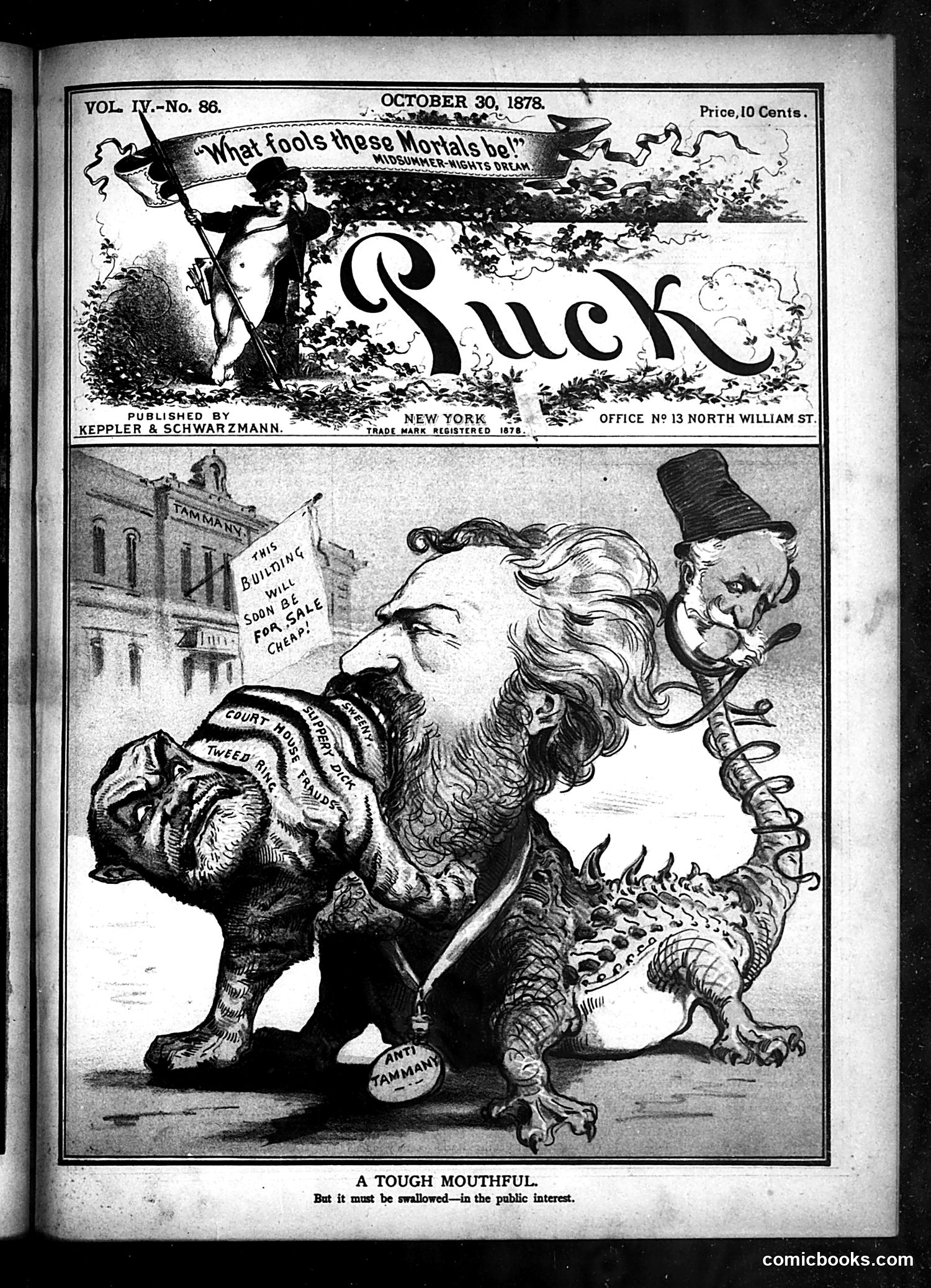
This cartoon titled "A Tough Mouthful" depicts a bearded man in formal dress (whose identity is unclear from the image alone) attempting to swallow an uncomfortably large pill or object labeled "TAMMANY." The figure appears distressed, while a skeletal or demonic character in a top hat holds the object, suggesting coercion. In the background, a "Tammany Building" sign advertises property for sale "by check." The satire targets Tammany Hall, New York's notoriously corrupt Democratic political machine. The cartoon suggests someone is being forced to accept or "swallow" Tammany's political influence or corruption despite finding it repugnant—depicting the organization as an indigestible, unpleasant burden imposed on the city.
This page is primarily **text content** rather than satirical cartoons. The visible sections include: **"Light and Shadow"** — A satirical piece criticizing poverty and inequality in France, contrasting the wealthy with the impoverished masses. It argues socialist ideals haven't solved class problems. **"Her Majesty's Opera"** — A critical commentary on Manager Mapelson's opera company. The piece questions whether importing foreign opera talent represents good value, suggesting American singers deserve opportunity and that the venture may be financially questionable. **"Potter the Scrupulous"** — A brief satirical note about someone (Potter) objecting to working on Sunday, highlighting religious observance conflicting with professional obligations. **"North British Financial Rectitude"** and **"Puckerings"** sections contain additional social commentary typical of Puck's editorial voice. The page functions primarily as **opinion/satire journalism** rather than visual cartooning.
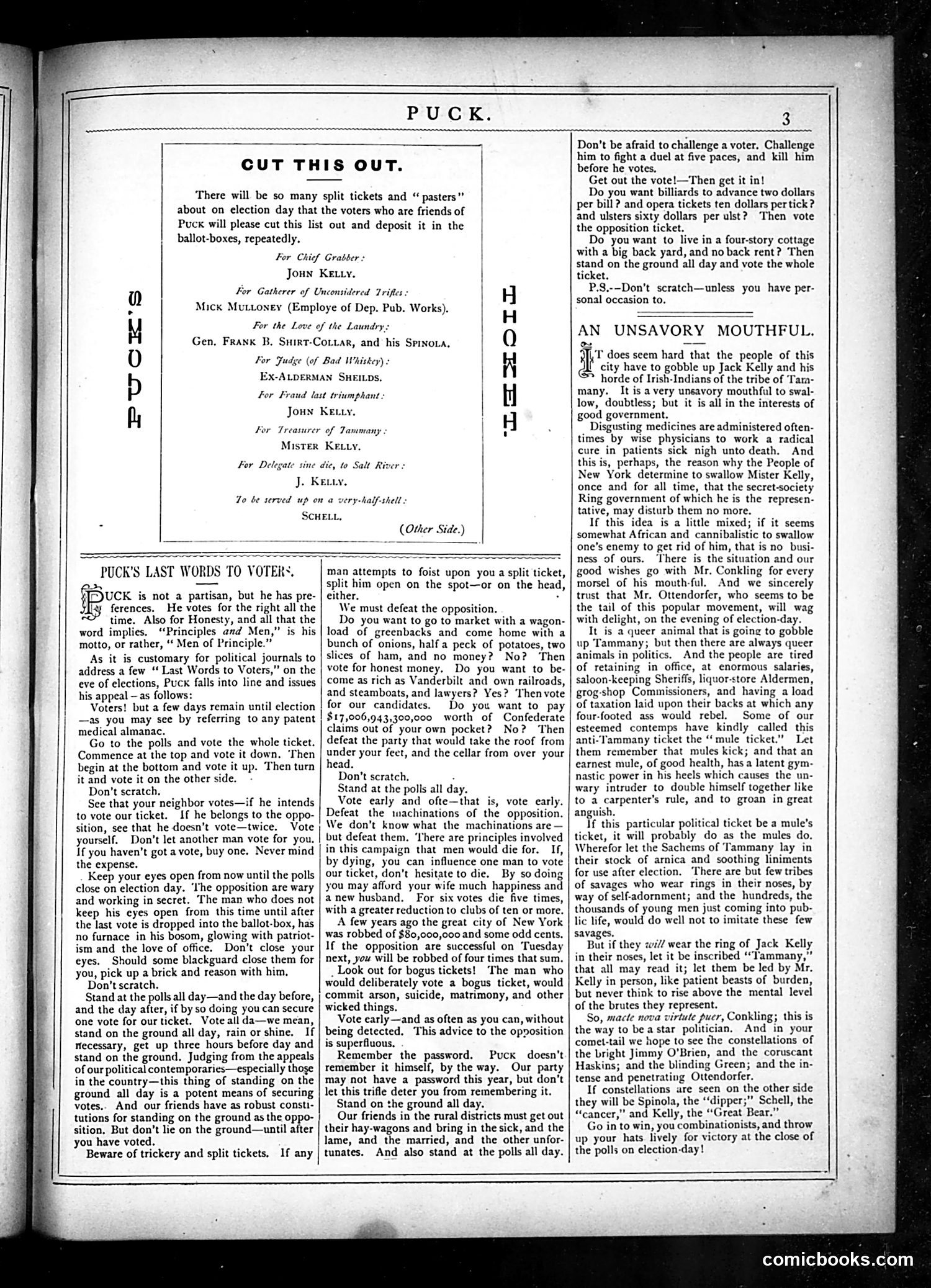
This page contains political guidance rather than cartoons. "Cut This Out" provides voting instructions for the Democratic ticket, listing candidates for various offices including Chief Grafter (John Kelly), Gatherer of Uncontested Strikes (Mick Mulloney), and Treasurer of Tammany (Mister Kelly). "Puck's Last Words to Voters" mocks machine politics and electoral corruption. The satire targets widespread practices: split tickets, voter fraud, bribery (Confederate bonds), and ballot-box stuffing. It specifically attacks Tammany Hall's control of New York politics and warns against Jack Kelly's Irish-Indian political machine. The piece advocates early, honest voting while warning voters about opposition machinations. The tone is cynical about electoral integrity, suggesting corruption was so normalized that satirizing it required direct instruction rather than visual metaphor.
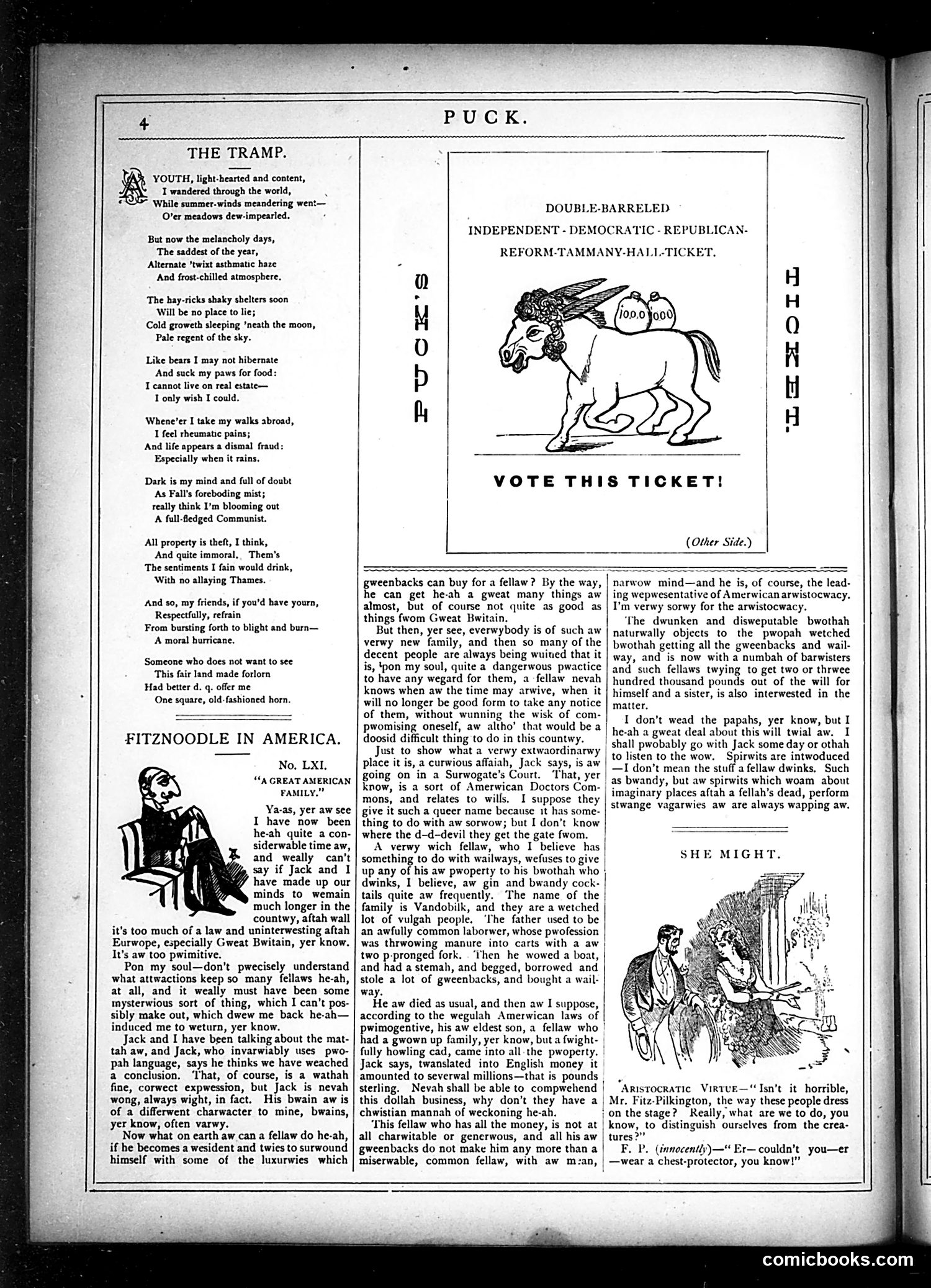
This page contains political satire from the late 19th century. The central image shows a donkey labeled with "100 0 000" carrying multiple figures, representing a "Double-Barreled Independent-Democratic-Republican-Reform-Tammany-Hall Ticket"—mocking fusion political tickets that combined disparate parties. The "Tramp" poem satirizes a wandering vagrant's miserable existence. "Fitznoodle in America" continues a serial feature mocking Irish immigrants and American social pretensions through dialect humor. "She Might" appears to be a short joke about class distinctions and proper behavior. The overall page ridicules 1890s political coalition-building and immigrant stereotypes—reflecting Puck's use of caricature and mockery to comment on contemporary American politics and society.
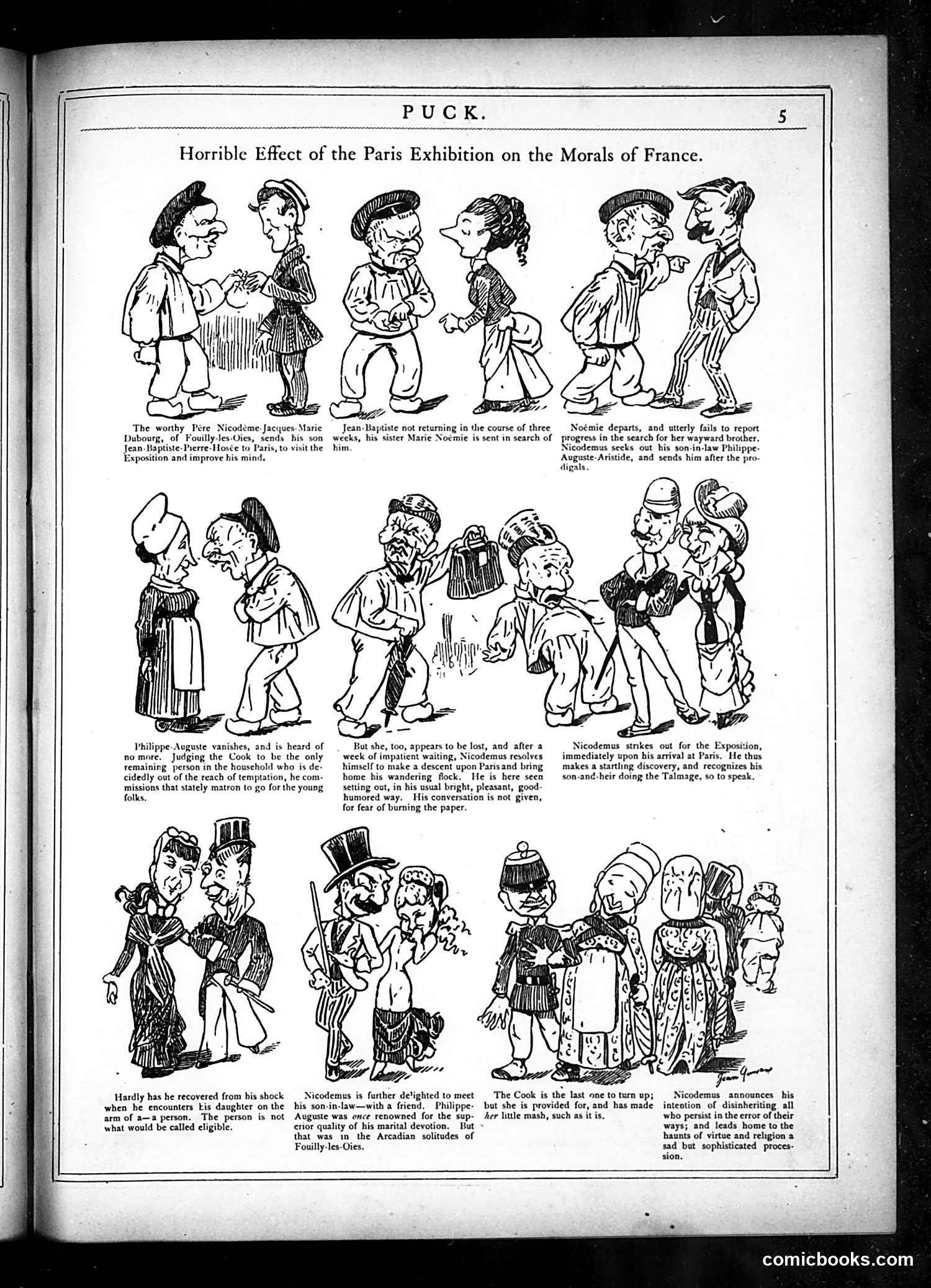
This Puck satirical page mocks French moral decay allegedly caused by the Paris Exposition. Through nine comic vignettes, it depicts various scandals involving named French figures: - **Père Nicodème Jacques-Marie Duhourg** abandons his family to visit the Exposition - **Jean-Baptiste** goes missing; his sister searches for him - **Norémie** fails to report her employer's progress, creating domestic chaos - **Philippe-Auguste** vanishes and is found "lost" - **Nicodème** gets further lost, discovering his son at the Talmage - Other figures experience marital and family disruptions The satire suggests the Exposition corrupts French morality, drawing people away from family duties and causing widespread domestic confusion. It's essentially mocking France's supposed vulnerability to vice through this cultural event.
This is a narrative poem rather than a cartoon. It tells of Admiral Hippolyte (likely referring to a French naval officer), who dies and is given an elaborate funeral procession from a French railway junction to Marseilles. The satire centers on the Admiral's mother-in-law, who accompanies the coffin and makes absurd demands throughout—insisting on military honors, complaining about accommodations, and ultimately negotiating a financial "swap" to accept the Admiral's burial arrangement. The joke appears to mock both pretentious military funeral customs and the stereotypical meddling mother-in-law figure. The poem uses the contrast between solemn military ceremony and her petty, mercenary concerns for comic effect, suggesting that even death cannot escape domestic absurdity.
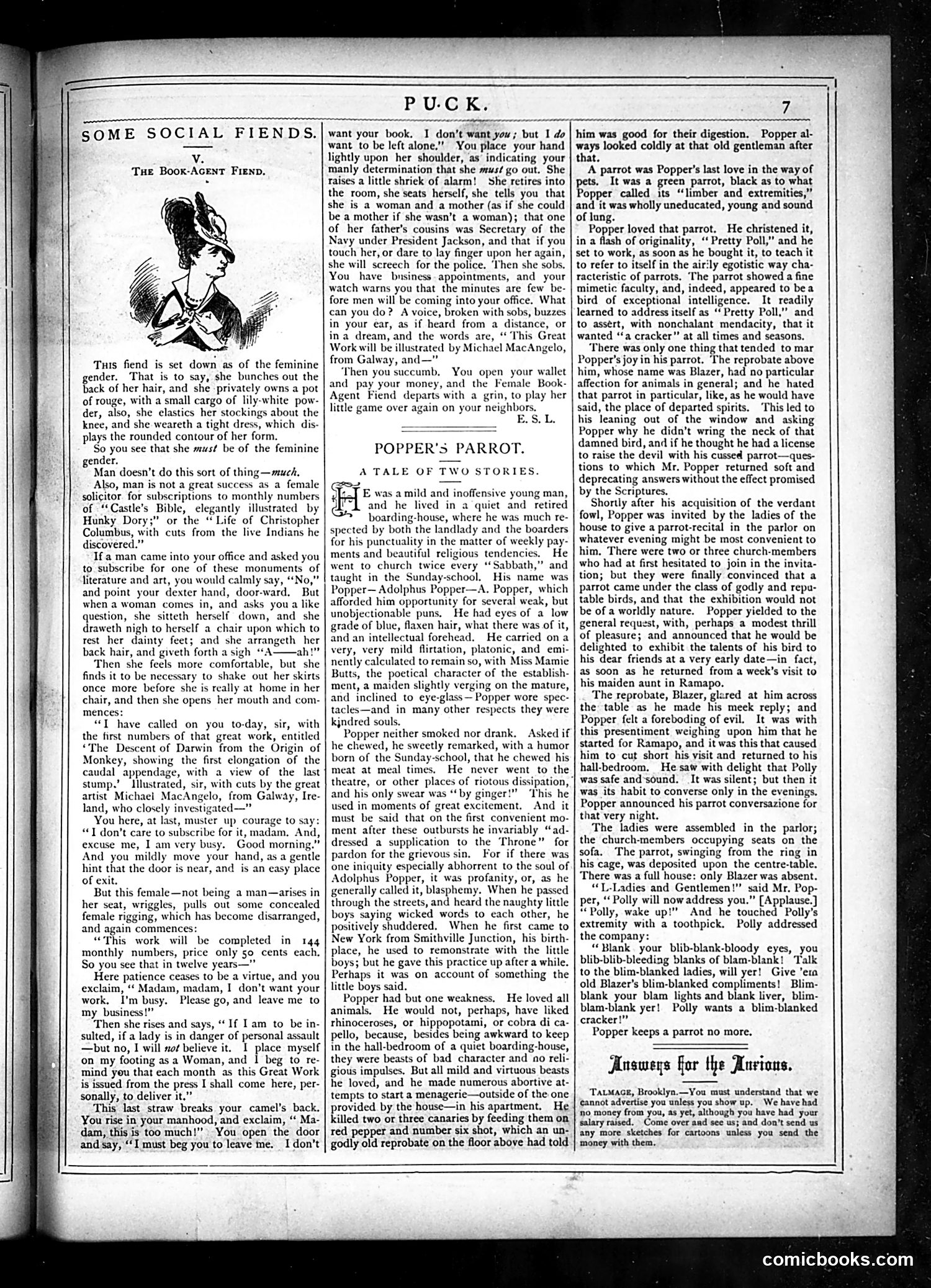
This page contains two distinct pieces: 1. **"Some Social Friends" (left)**: A satirical column by E.S.L. mocking the "Book-Agent Friend"—a social type who aggressively pushes subscriptions to illustrated books and encyclopedias on acquaintances, using manipulative tactics and false friendliness to make sales pitches. 2. **"Popper's Parrot" (right)**: A two-part humorous tale about Adolphus Popper, a mild-mannered man whose pet parrot becomes increasingly crude and embarrassing in public. The parrot's foul language and behavior humiliate Popper at social gatherings, particularly among church ladies, until he eventually surrenders the bird. The satire targets both Victorian prudishness and the awkwardness of uncontrollable social embarrassment.
This page appears to be a satirical illustration depicting a chaotic scene with multiple figures arranged around what seems to be a central table or surface. The word "PUCK" is visible on the left margin, confirming this is from the famous American satirical magazine. The composition suggests a commentary on political or social disorder—possibly depicting elected officials, businessmen, or public figures engaged in undignified behavior or conflict. The black-and-white engraving style is characteristic of Puck's artistic approach from the late 19th or early 20th century. However, without clearer visibility of specific faces, text labels, or dated context clues in the image itself, I cannot definitively identify which historical figures or specific political events this cartoon references. The satirical intent is evident, but the particular targets remain unclear from this reproduction.
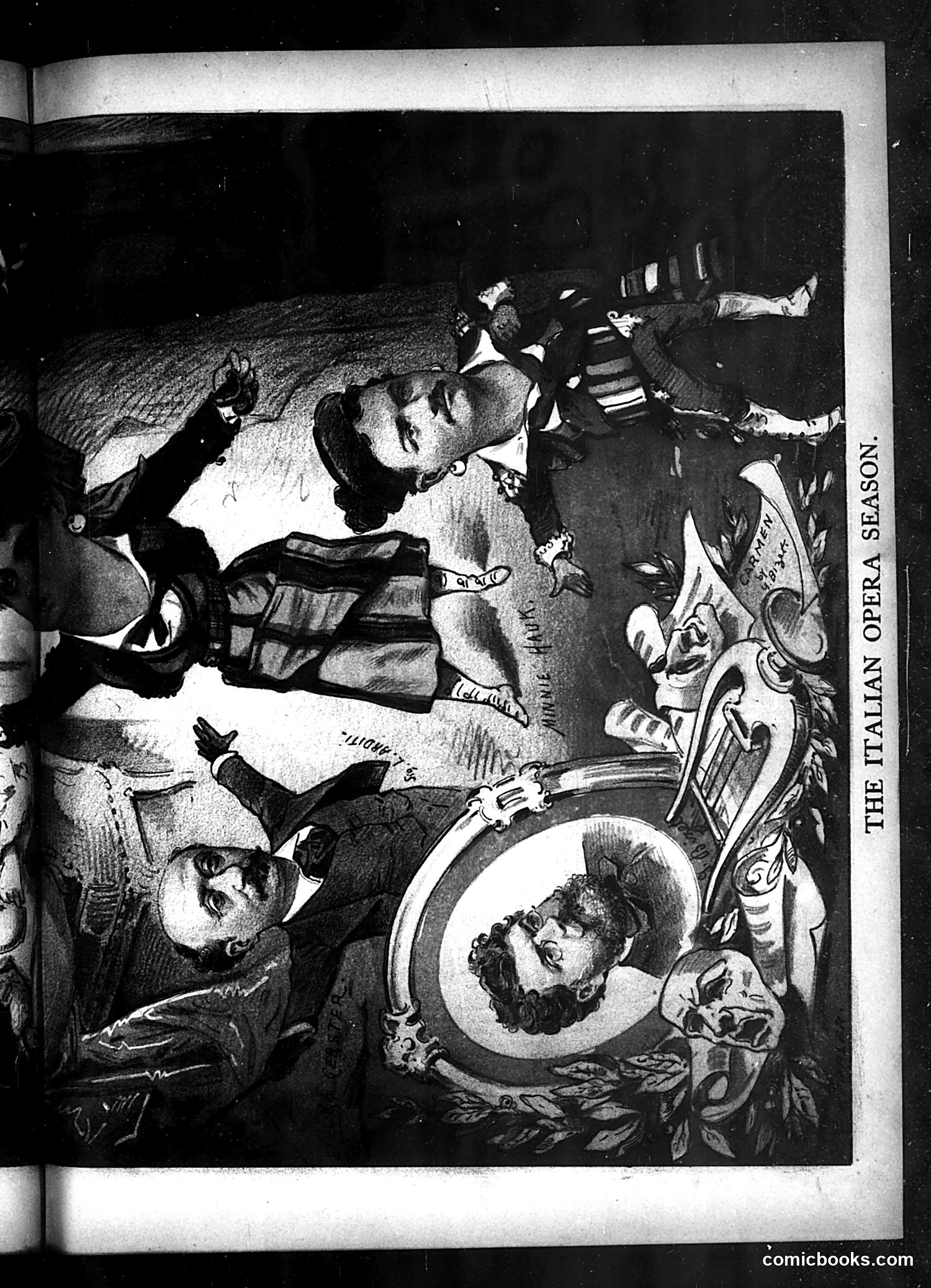
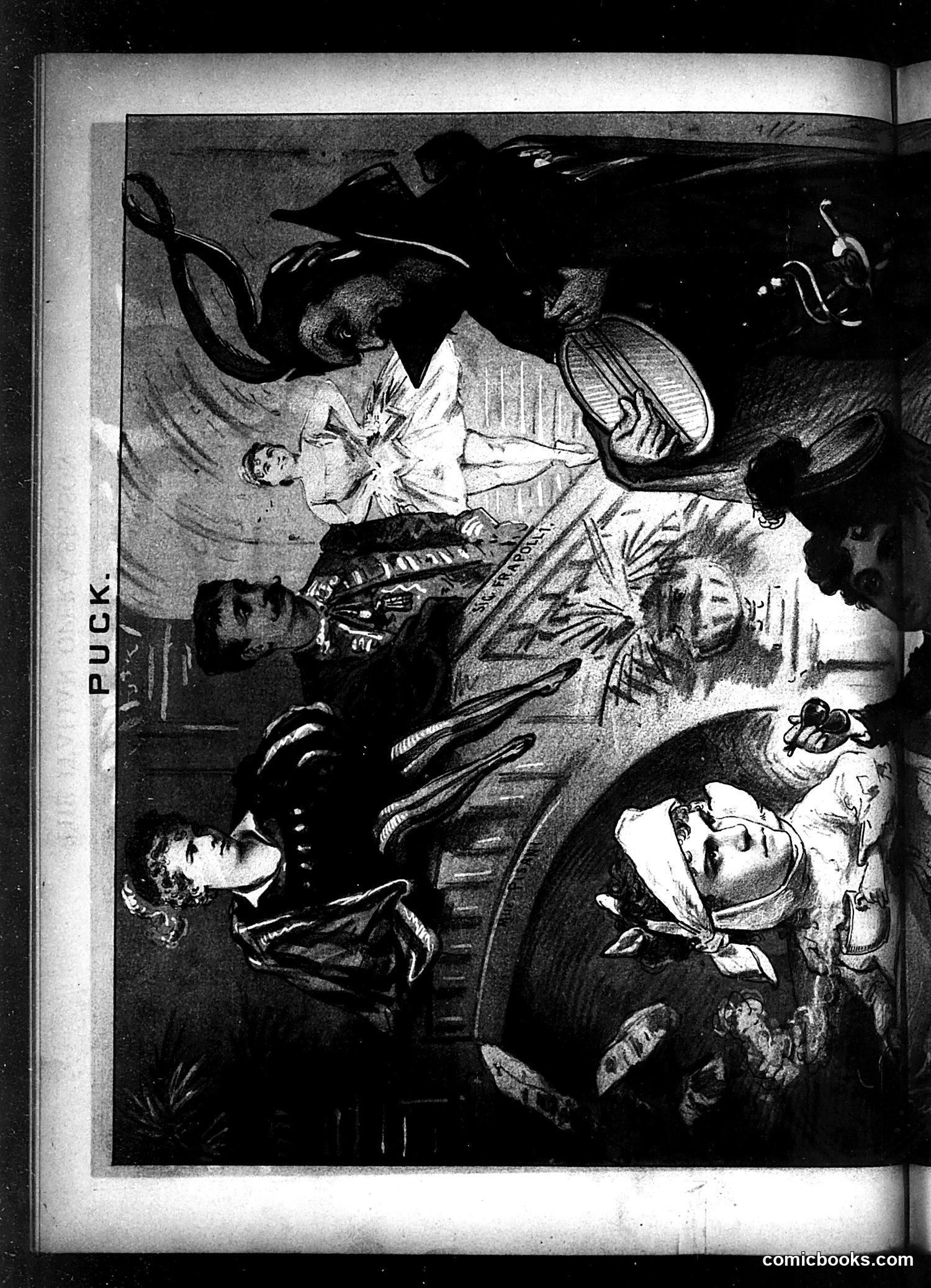
This appears to be a satirical illustration about Italian opera, depicting what seems to be performers or characters in dramatic poses typical of operatic performance. The image shows multiple figures in period costume arranged in an exaggerated theatrical manner—characteristic of Puck's mocking approach to high culture. The satire likely targets the pretentiousness of opera audiences or the melodramatic excess of operatic performance itself. The ornate decorative frame and dramatic positioning mock the grandiosity associated with Italian opera's popularity in America during the Gilded Age. Without clearer identification of specific historical figures or a date visible on this page, the precise targets remain unclear, though the overall point appears to be ridiculing opera's overwrought aesthetic and its elite cultural status.
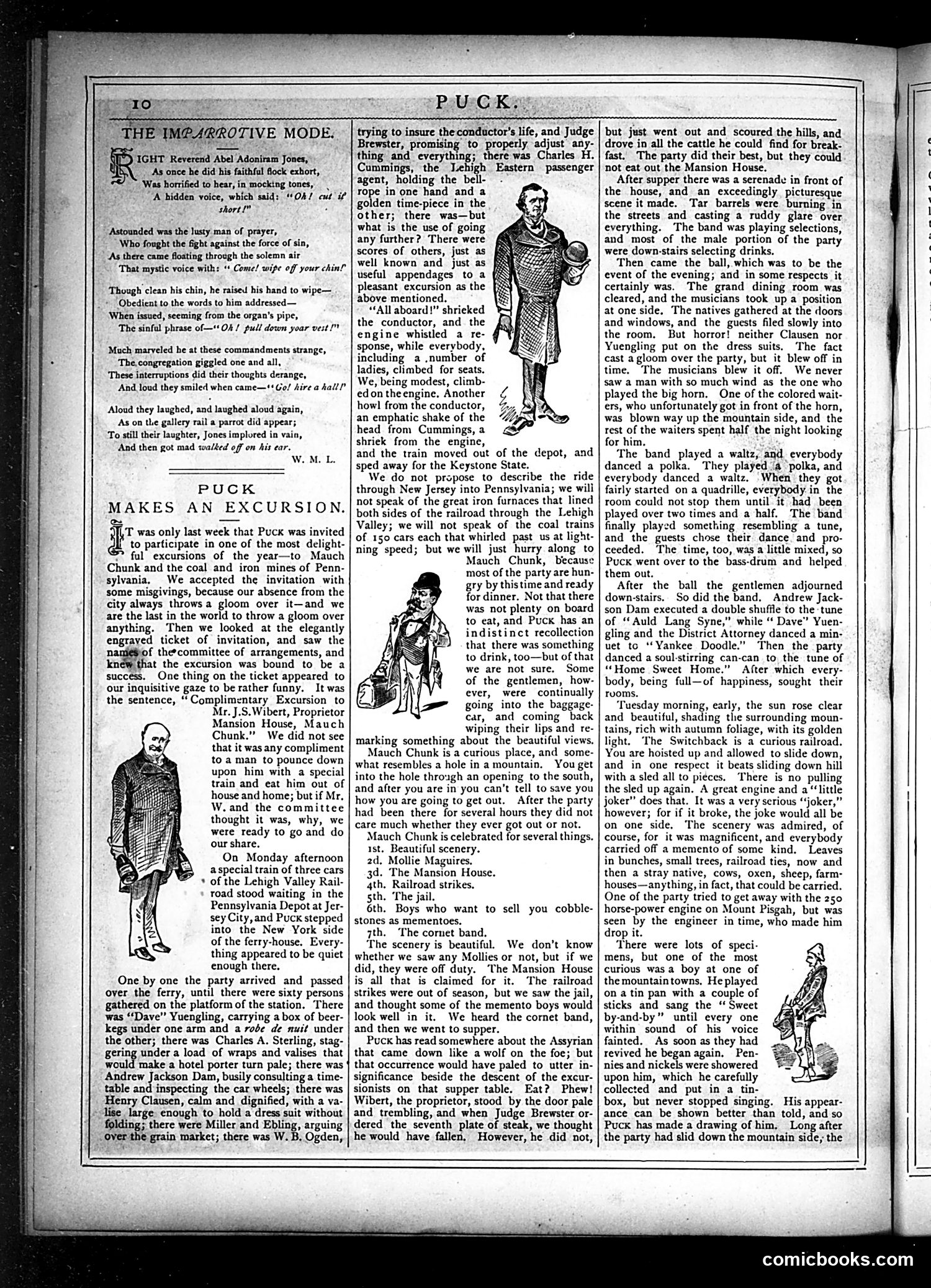
This page contains two satirical articles about a Puck magazine excursion trip. The main text describes an invited railroad journey through Pennsylvania coal mines and into New Jersey, organized by the Pennsylvania Railroad. The satire targets the railroad's attempt at a publicity stunt—offering journalists a chaperoned tour to showcase operations while controlling the narrative. The article mocks the participants' complaints about coal dust, crowded conditions, and inadequate food, despite the elaborate arrangements. The accompanying illustrations show figures in period dress observing the excursion. The humor derives from exposing the gap between the railroad's promotional intent and the actual discomforts experienced, a common Puck approach to critiquing corporate manipulation of press coverage. The specific dates, names, and locations mentioned are historically verifiable elements of this particular excursion.
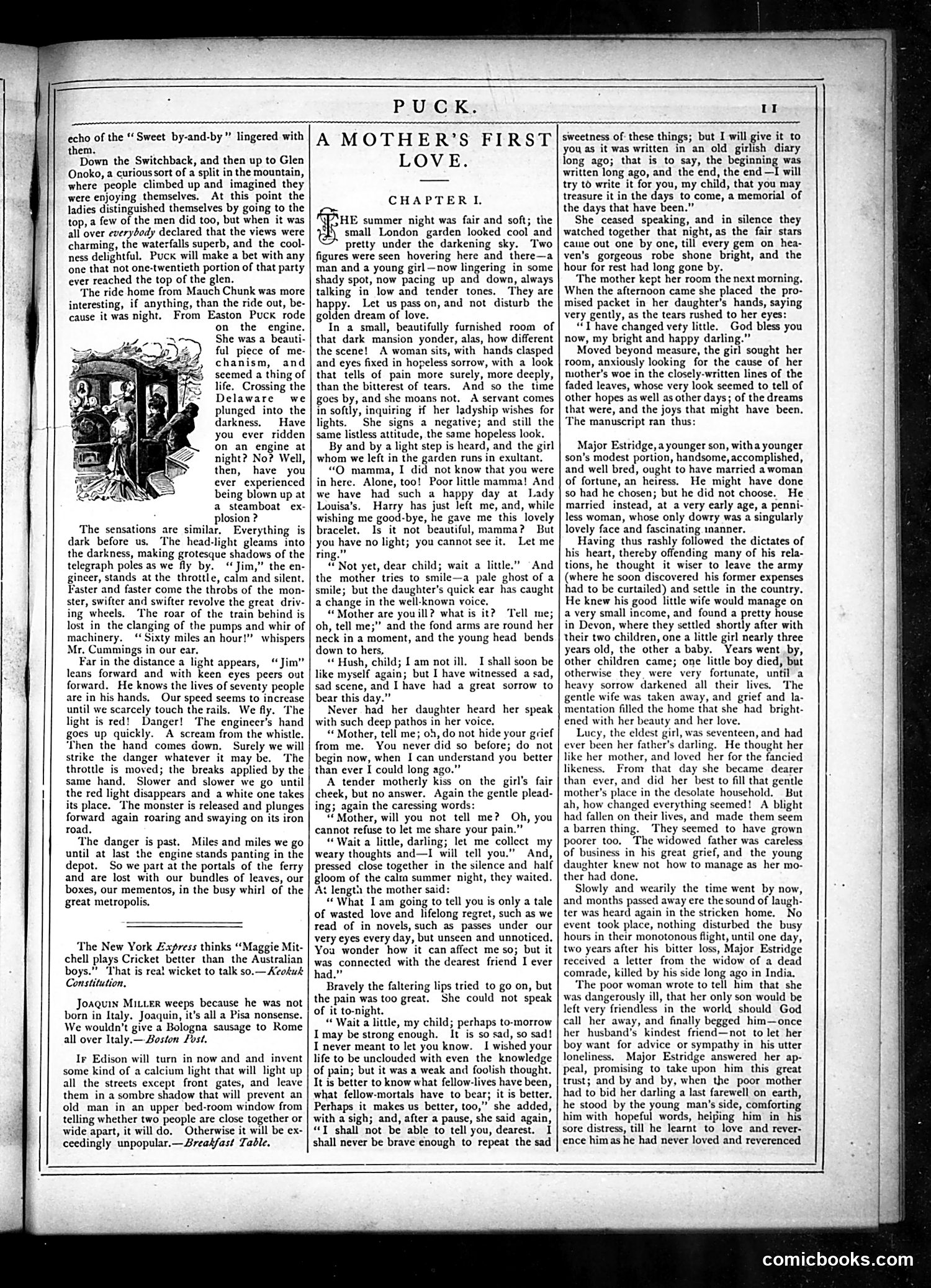
This page contains "A Mother's First Love," Chapter 1 of what appears to be serialized fiction rather than political satire. The illustrated story depicts a sentimental domestic scene set in a London garden, focusing on a mother's emotional conflict between her duties to her children and her lingering grief over a lost love. The small illustration shows Victorian-era figures in period dress. The narrative concerns themes of maternal devotion, sacrifice, and melancholy—typical of sentimental fiction popular in late 19th-century publications. This is **not political satire**. Rather, it's serialized romantic fiction characteristic of Puck's literary content, mixing illustrated stories with its better-known satirical cartoons elsewhere in the magazine.
This page contains serialized fiction rather than political cartoons or satire. The text is Chapter II of a story titled "PUCK" involving characters named Harry, Lucy Estridge, and Lord Lynn at Lynn Castle. The narrative focuses on romantic and domestic themes—Harry's arrival at the estate, Lucy's emotional responses, piano playing, and social interactions. There are poetic passages about nature and sentiment ("A feeling of sadness and longing / Comes o'er me..."). This appears to be entertainment fiction rather than satirical political content. Puck magazine, while known for satire, also published literary serials for readers. Without visible illustrations or explicit political/social commentary on this page, the content reads as straightforward romantic period drama rather than satire requiring historical context to decode.
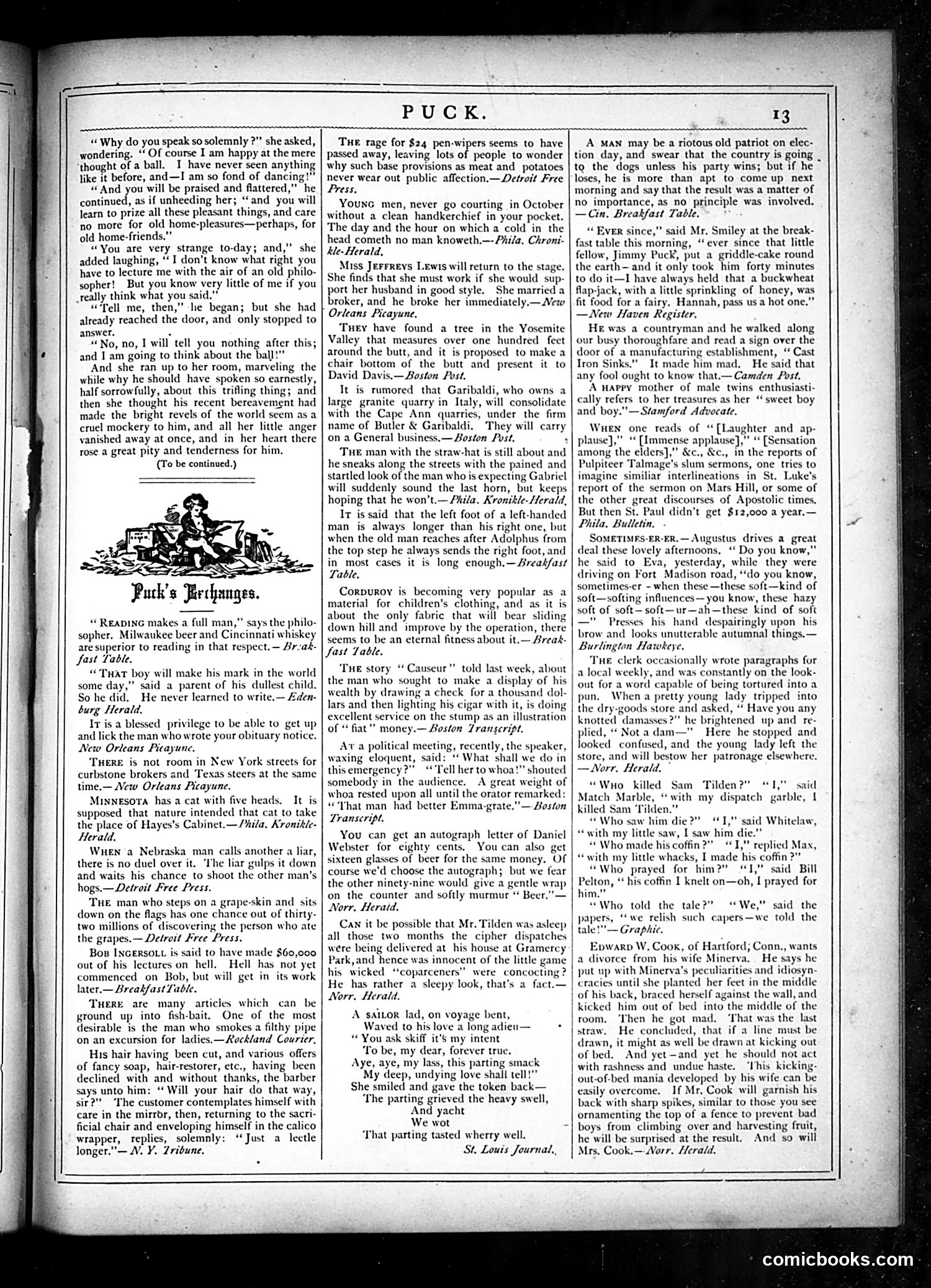
This page contains brief humorous anecdotes and social commentary rather than political cartoons. The content includes: **"Puck's Jestinges"** — A collection of short jokes about contemporary life, including observations about: - Reading and education - A Nebraska man's tall tale about shooting - Corduroy fabric becoming fashionable for children's clothing - Political meetings and oratory - Various urban and domestic situations The one visible illustration shows a simple sketch of what appears to be a domestic or rural scene. The humor targets Victorian-era social pretensions, foolish behavior, and everyday absurdities. Without identifying specific political figures or events, the page exemplifies Puck's general satirical approach: mocking common human follies and social conventions of the period through brief, witty observations rather than elaborate political allegory.
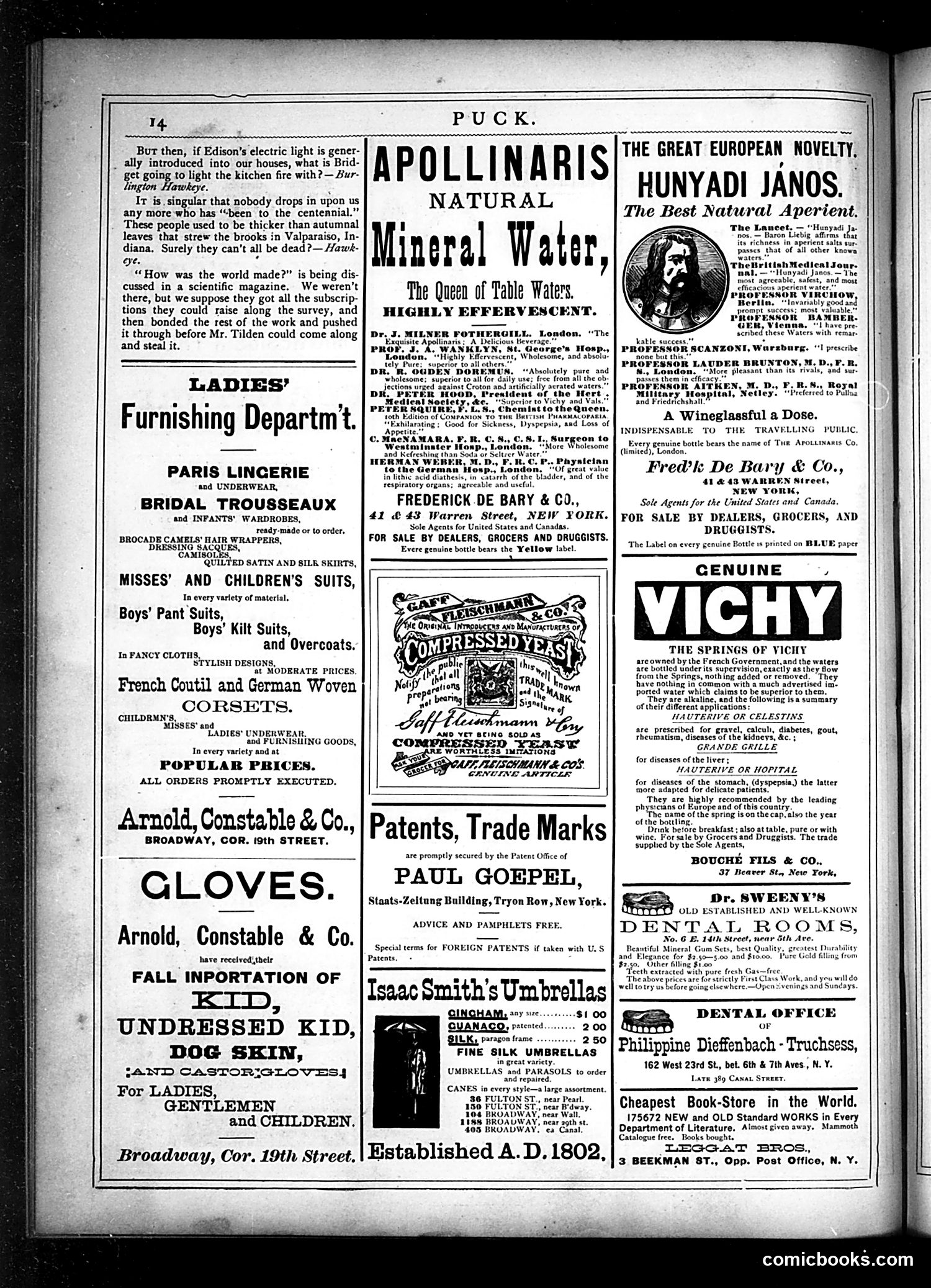
This page is **primarily advertising**, not satirical content. It features commercial advertisements for period products including: - Ladies' furnishings and undergarments (Paris lingerie, corsets) - Children's clothing - Gloves and umbrellas - Patent and trademark services - Mineral water and patent medicines (Apollinaris water, Vichy springs water, compressed yeast) - Dental services - A bookstore The only potentially editorial content is a small box at top-left discussing Edison's electric light technology entering homes, presented as a question to readers rather than satire. The page reflects late 19th-century advertising practices, with medical/health products heavily promoted alongside fashion items—typical of Puck's revenue model during this era.
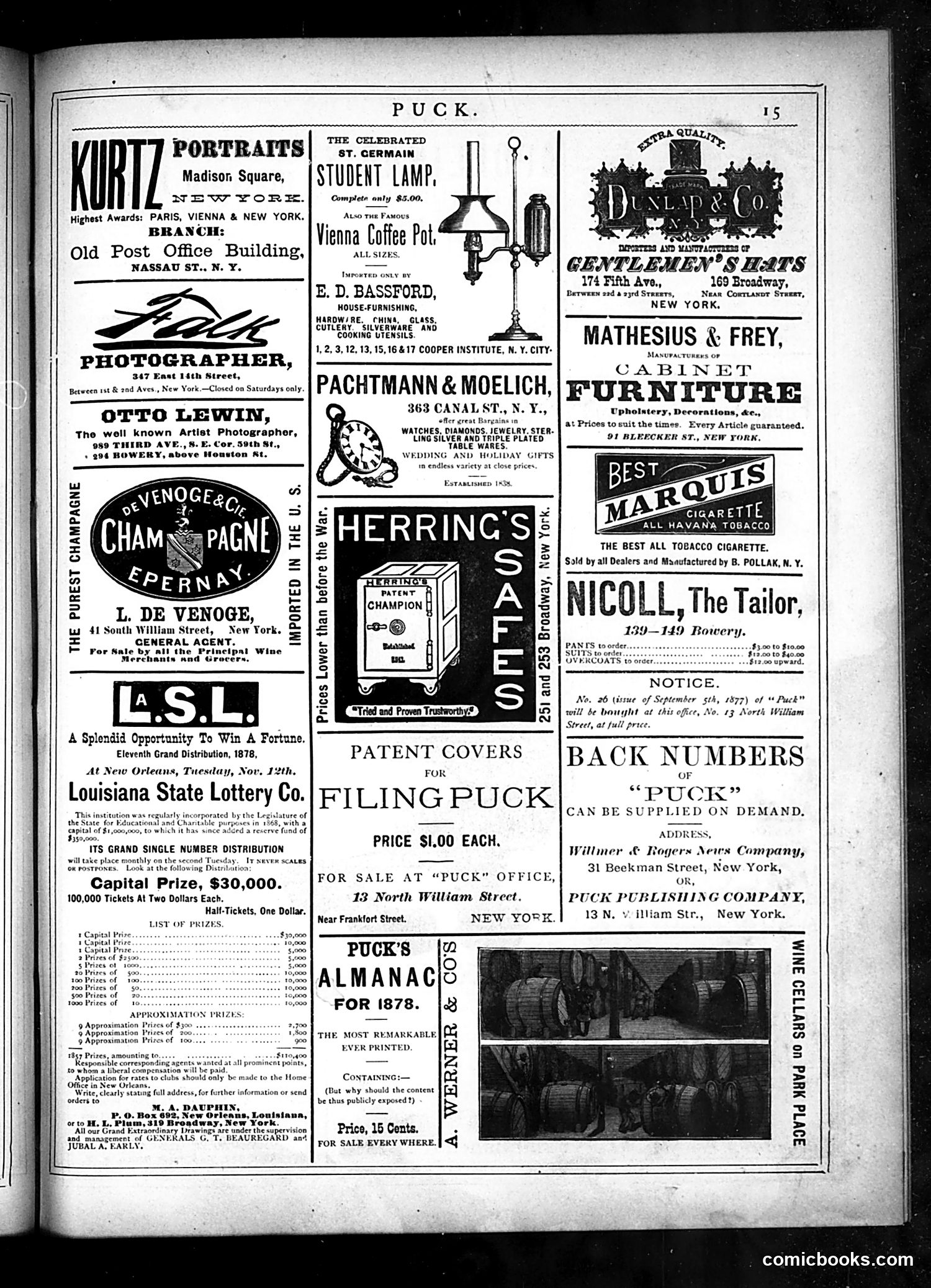
This page is primarily **advertising and back matter** for Puck magazine, not editorial cartoons. The advertisements feature various 1870s-era businesses: portrait photographers (Kurtz), a student lamp manufacturer, jewelry sellers (Pachtmann & Moelich), champagne importers, furniture dealers, and a tailor. The only substantive content is **Puck's Almanac for 1878** promotion, advertised as "the most remarkable ever printed," selling for 15 cents. A notice offers back issues of Puck through Willmer & Rogers News Company. There's also a **Louisiana State Lottery advertisement** promoting their "Grand Single Number Distribution" with a $530,000 capital prize—reflecting the era's popular (and often fraudulent) gambling schemes. The page illustrates how 19th-century magazines sustained themselves through paid advertising rather than subscription revenue alone.
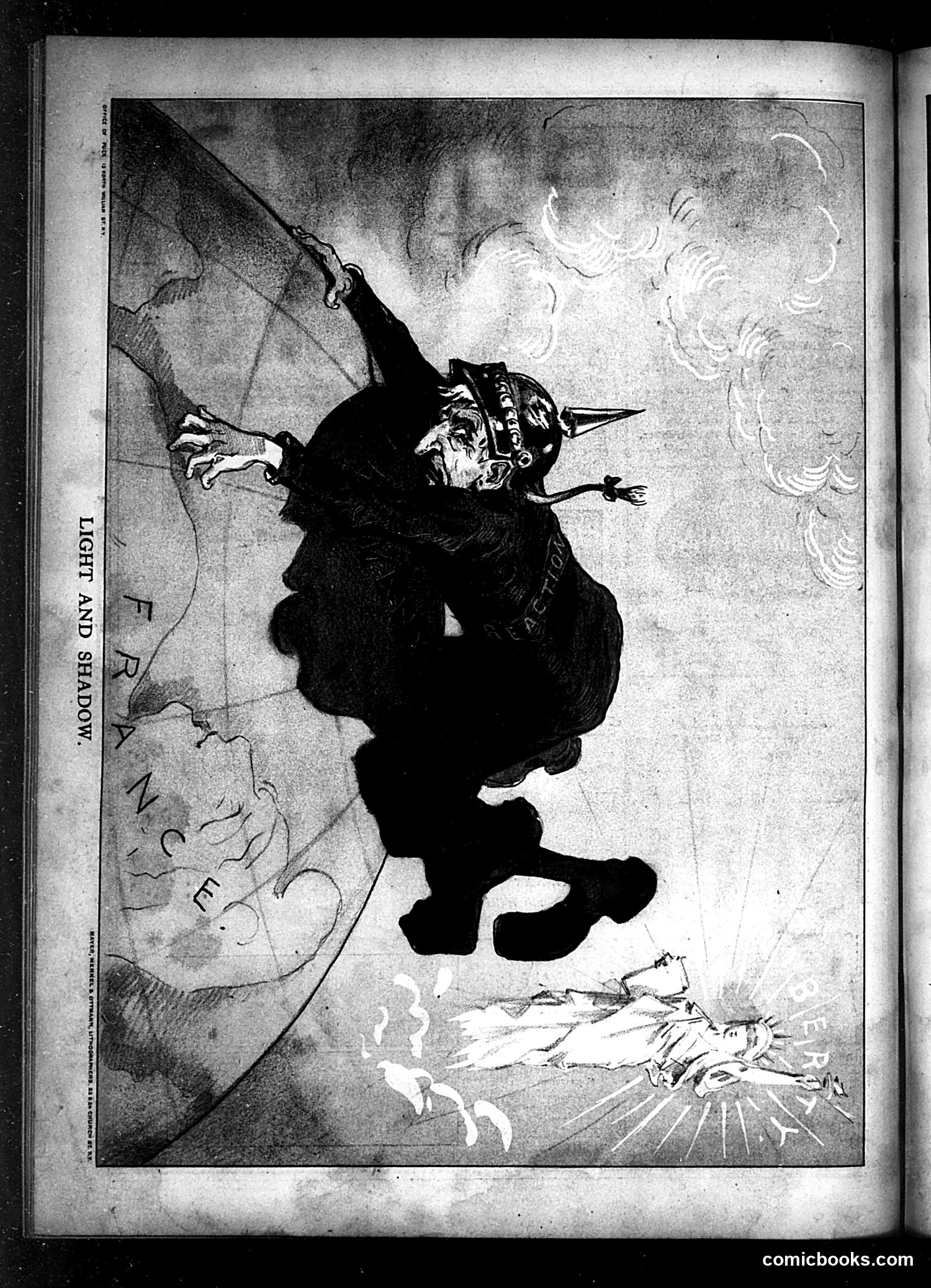
This political cartoon depicts a menacing figure in military dress—likely a German or Prussian soldier based on the spiked helmet (Pickelhaube)—wielding a rifle with bayonet. The silhouette style emphasizes the threatening nature of this militaristic figure. The title "Light and Shadow" suggests a contrast between civilization and darkness/danger. The cartoon appears to critique German militarism, possibly referencing pre-WWI or WWI tensions. The soldier's aggressive posture and the dramatic lighting create an ominous atmosphere suggesting that military authoritarianism represents a "shadow" threatening American values of "light" (liberty, democracy). The style and subject matter are consistent with early 20th-century American satire responding to European military aggression.